The insurance speed to market definition has two halves. For state regulators, speed to market is the program the NAIC began in 2000 to modernize rate and form filing: uniform review checklists, uniform transmittal documents, product coding, SERFF and, for life and annuity products, an interstate compact, all meant to let a compliant product reach the market without needless delay. For an insurer, speed to market is simpler and harder: the number of days between knowing a rate or product change is needed and having it in force for policyholders. Some of those days run on the department's clock; the rest run on the company's own, before the filing is sent and after it is approved. Botminds' Rate & Form Filing Automation works on the company's days: it builds and checks each state's package before submission and drafts answers to objections, so less of the calendar is spent assembling, checking and answering.
Speed to market benefits both companies and consumers. Faster delivery of a new product gives companies more flexibility in reacting to changes in the market, resulting in products that meet consumers' current needs.
NAIC Product Filing Review Handbook (2024), chapter 2
What is the insurance speed to market definition?
In the regulators' own terms, speed to market is a set of initiatives, not a number. The NAIC's handbook traces it to a March 2000 Statement of Intent on the future of insurance regulation, which "Insurance regulators referred to this plan as the 'speed-to-market' initiative," and to four areas of work: integrating multistate procedures with state requirements, greater reliance on competition in commercial lines, full implementation of SERFF, and a central filing point for life and health products (NAIC, 2024).
The tools that came out of it are the ones filers use today. In the handbook's words, "The speed-to-market tools provide a more streamlined approach in the regulatory submission process, while maintaining state-specific statutory requirements." They are the Review Standards Checklists, the Uniform Transmittal Documents, the Uniform Product Coding Matrices, SERFF and the Interstate Insurance Product Regulation Commission, the Compact, which since 2007 has reviewed certain life, annuity, disability income and long-term care products once for many states. There is no compact for property and casualty rates: a homeowners rate change is still filed state by state.
For a carrier, the useful definition is a duration. We define insurance speed to market as the calendar days from a rate indication, or a product decision, to the effective date for policyholders in each state. That definition is ours; it counts every clock, not only the regulator's.
Where the regulators' definition came from, and what it measures now
The regulators' definition came from a complaint both sides shared. "In the mid-1990s, regulators and industry representatives began to discuss compliance challenges with rate and form filing," the handbook records, and "There was consensus among the parties that the existing paper-intensive rate and form filing process lacked efficiency and required modernization" (NAIC, 2024). The answer was uniform tools and electronic filing.
Measurement lagged. The NAIC's Speed to Market Working Group heard in October 2025 that the SERFF metrics report once given to commissioners, with "the number of filings submitted through SERFF, turnaround times for those filings, and the extent to which states were adopting and using market regulation tools," had not been distributed "for approximately five years" (NAIC Speed to Market (D) Working Group, October 2025). The new report was planned annually from year-end data, beginning at the 2026 Spring National Meeting, with "monthly filing and closure counts, five-year trend data, turnaround times, and product-specific details" for lines including personal auto and homeowners, state by state and "not include state-to-state comparisons."
So the public, comparable number a carrier might want, how long each state takes, is not published nationally. Each state's report goes to its own commissioner. A carrier that wants its speed to market has to measure it from its own filings.
Speed to market vs time to market
In general business usage the two terms overlap, and in insurance it helps to separate them. Time to market is the development span of a product: from the idea to the first sale. Speed to market, in the regulators' sense, is how fast the filing and review system moves a compliant product through. A carrier's own measure needs both, because a rate revision spends time in development (data, indication, selection, forms) and then in the system (filing, review, questions, approval).
Speed to market and time to market, as the terms are used for insurance products
| Speed to market | Time to market | |
|---|---|---|
| Whose term | State regulators and the NAIC since 2000 | Product and business teams generally |
| What it covers | The filing and review system: uniform checklists, transmittals, product codes, SERFF, the Compact | The whole development span of a product or change |
| What it is measured in | Turnaround of filings, use of uniform tools, by state | Calendar days from decision to first policy |
| Who controls it | Mostly the departments, with filers' compliance | Mostly the company, except the review clocks |
| For a homeowners rate revision | Each state's review clock and questions | Indication, selection, forms, packages, review, implementation, notices |
New York speed to market insurance filings
New York turned the phrase into a filing procedure. In 2000 its Property Bureau introduced an optional route "As part of an overall Department initiative to improve the 'speed to market' objective for insurance products in the ever-changing financial services markets": a filing accompanied by completed review standards checklists and an officer's compliance certification gets priority in processing (Supplement No. 3 to Circular Letter No. 11 (1998)).
In SERFF today, a New York speed-to-market filing needs an officer-signed compliance certification, a completed Master List of Review Standards Checklists and Compliance Questionnaires, a filing description that states the speed-to-market basis, and code "98" in the state-specific field (NY DFS filing instructions). The route is not available for rate filings in personal automobile, public automobile, workers' compensation or physicians' and surgeons' medical malpractice. It trades the Department's checking for the insurer's certification, which is speed bought with accountability; the NY DFS rate filing checklist shows what that certification covers.
The clocks inside a filing
A rate revision runs on at least six clocks between the indication and the effective date, and only some of them belong to the regulator. The first three are the company's: building the indication and selecting the rate; deciding the form changes; assembling and checking each state's package. The fourth is the department's: the review period the rating law sets, from use on filing in Texas to a 60-day waiting period for a South Carolina homeowners increase above 7%. The fifth is shared: each round of questions and answers. The sixth is the company's again: implementing the rates and sending any notices the law requires before renewals change.
The last clock is easy to forget. Texas, for example, requires an insurer to notify a residential property policyholder of a renewal increase of at least 10% no later than 30 days before it takes effect (Tex. Ins. Code §2251.005(b); each state's notice rule is compared in rate increase notices in California and other states). An approval that arrives 20 days before the effective date can still be too late for the policyholders who need 30 days' notice.
Rate & Form Filing Automation's deadline watcher keeps those clocks on one timeline for each state, with response windows, expected approvals and the margin before the effective date. In the fictional sample, Kestrel Ridge Mutual's HO-3 Southeast 2027 revision for 1 February 2027, the margins at the time of the check ranged from 122 days in Tennessee, approved after 31 days with no objection, to 48 days in Virginia, still being drafted. South Carolina's filing, due for submission that week, was expected to be approved 73 days before 1 February.
An insurance speed to market model for one filing
A speed to market model adds the clocks for one state filing and shows which ones a team can shorten. The model below uses cited inputs: Botminds' estimate of the company's own assembly and checking time, South Carolina's statutory waiting period for a homeowners increase above its 7% band, the 30-day response window the sample team works to, and Texas's 30-day notice lead for large residential increases. It is an illustration of the method, not any one state's actual timeline.
One filing's clocks, by hand and with the package checked before submission
- Assemble and check9 d
- Department review60 d
- One objection round30 d
- Notice lead before renewals30 d
- Assemble and check2 d
- Department review60 d
- Notice lead before renewals30 d
The model makes two points. The department's clock is the largest single block, and a carrier cannot shorten it; it can only avoid extending it. And the days a carrier can remove are its own assembly time and the objection rounds its own inconsistencies cause. Who controls each day changes as those days fall.
Who controls the days in the model: the company's share falls, the department's rises
By hand · 129 days
- Company: assemble, check, notify · 30%
- Shared: objection round · 23%
- Department: review · 47%
Checked before submission · 92 days
- Company: assemble, check, notify · 35%
- Department: review · 65%
Insurance speed to market examples, measured honestly
Honest examples of speed to market report the clock they measure. California reports two kinds. Its statute sets a 60-day deemer after public notice and a 180-day outer limit (Cal. Ins. Code §1861.05(c)). Its Bulletin 2024-7 path allows 60 days of review, two 30-day extensions and a 10-day decision on the Department's calculated rate (CDI Bulletin 2024-7). And its 2025 annual report says "All but one approved Sustainable Insurance Strategy filing has been completed in less than 120 days from Public Notice," with the first two approvals averaging "less than 95 days" (CDI 2025 Annual Report).
California's rate review clocks, as written and as the Department reports them
None of those numbers is a carrier's speed to market. A filing reaches public notice only once the Department has a complete application, and the company's days before that, and after approval, are outside every published figure. The sample shows the spread inside one program: on the same day, one state approved after 31 days with no objection, another on day 14 with no letter, another answering its first objection letter.
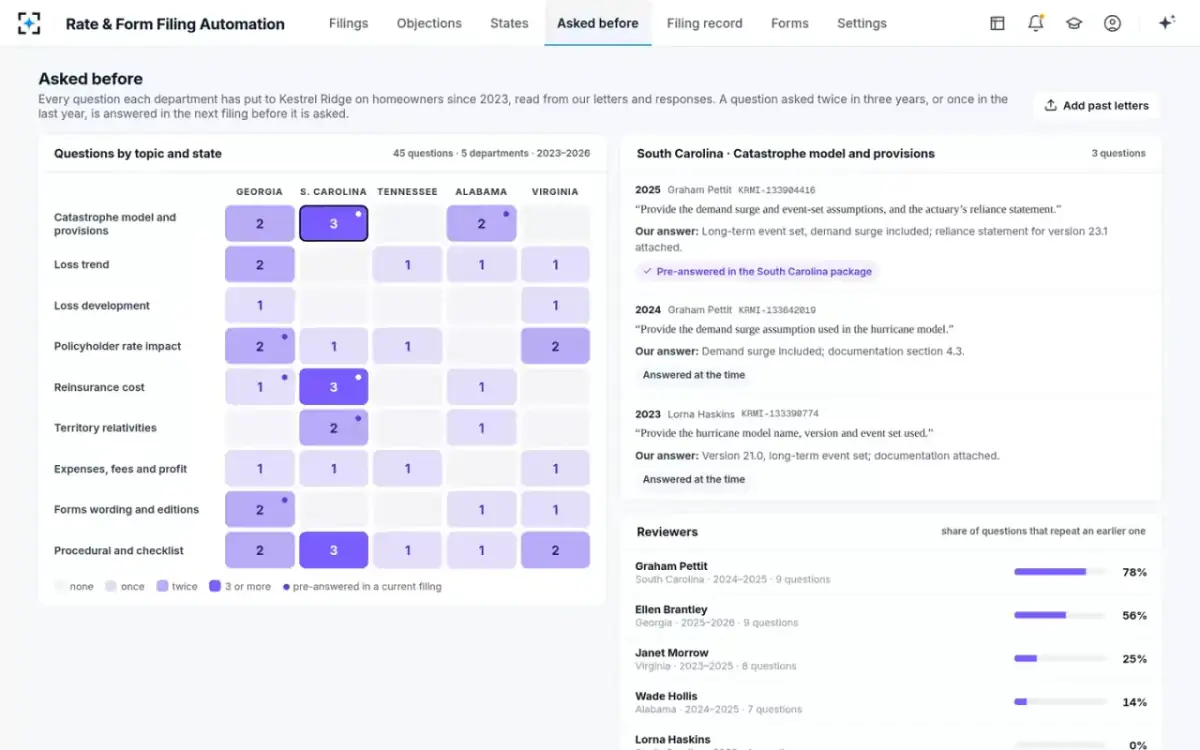
The questions each department asked before, by topic and state
What the NAIC product filing review handbook 2024 says about speed
The NAIC Product Filing Review Handbook, 2024 edition, puts the burden of speed on both sides and is specific about the filer's half. "Adhering to filing and product requirements shortens the review time and helps get products to market sooner," it says, and it asks filers to look up each state's standards and requirements while the product is still being developed (NAIC, 2024). On predictive models it asks reviewers to "Review predictive models in a timely manner to enable reasonable speed to market."
The handbook is maintained by the Speed to Market Working Group and reviewed on a two-year cycle; the October 2025 minutes record that the updated edition, carrying the 2024 date on its cover, was published to the NAIC website on 29 July after a technical review (NAIC, October 2025). Its chapters on the filing process and on property and casualty rate regulation are the closest thing to a shared manual for filers and reviewers.
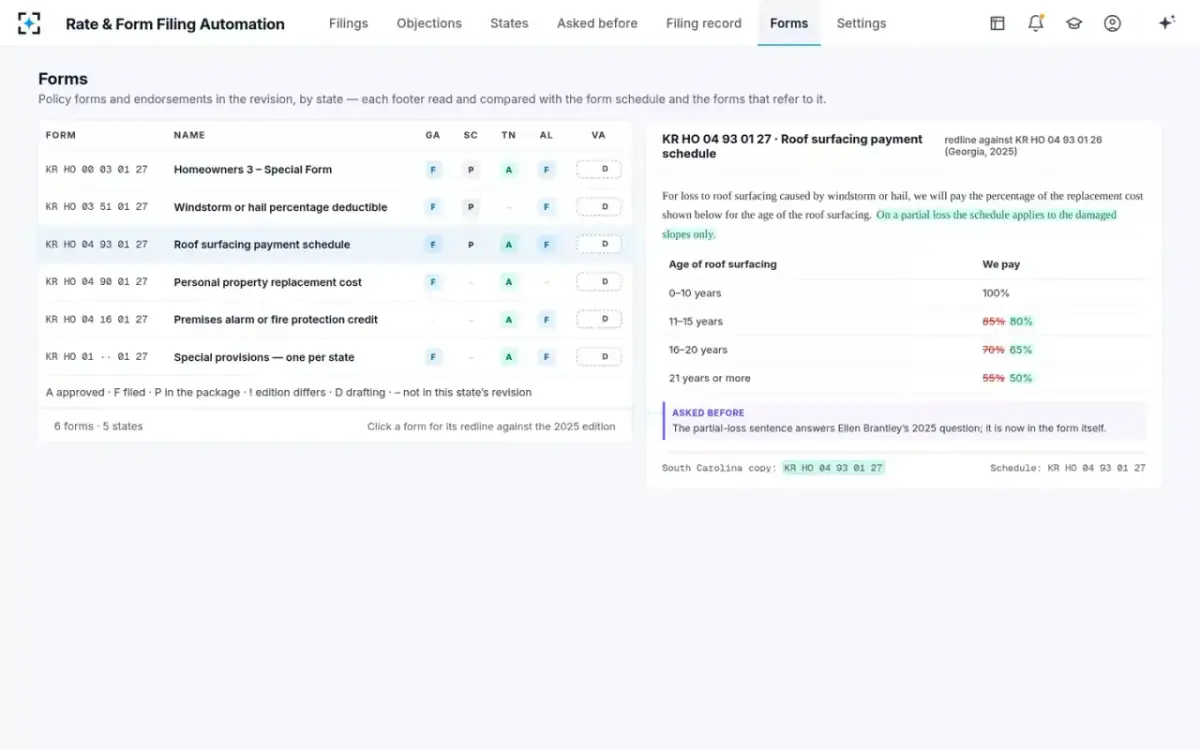
Forms are a clock too: each footer read against the schedule
Read together, the regulators' definition and the carrier's meet at one point: a complete, consistent filing is the fastest thing either side can produce. That is the part of speed to market a filing team owns, and the part Rate & Form Filing Automation is built for. The rate filing approval timeline prices each day of the department's clock; to see the sample program's clocks in one place, start from Rate & Form Filing Automation.
Questions people ask
What does speed to market mean in insurance?
For regulators it means the NAIC's program, begun in 2000, of uniform filing tools and electronic filing that lets compliant products reach the market faster. For an insurer it means the days from deciding on a rate or product change to having it in force, state by state.
What is an example of speed to market in insurance?
California reports that all but one of its approved Sustainable Insurance Strategy filings were completed in less than 120 days from public notice. New York's optional speed-to-market procedure gives priority processing to filings that come with completed checklists and an officer's compliance certification.
Is there an interstate compact for property and casualty filings?
No. The Interstate Insurance Product Regulation Commission covers certain life, annuity, disability income and long-term care products; property and casualty rates and forms are filed with each state.
Who publishes rate filing turnaround times?
States do, to their own commissioners. The NAIC's Speed to Market Working Group planned a state-specific SERFF metrics report with turnaround times from 2026, without state-to-state comparisons, after about five years without one.
How can an insurer improve speed to market for rate filings?
By shortening the days it controls: identifying each state's requirements early, filing packages that are complete and consistent, answering objections quickly with cited support, and pre-answering questions the same department asked before. A carrier cannot shorten the department's review clock; it can only avoid extending it.