A rate increase notice for insurance in California works differently from most states. California does not set a percentage above which a homeowner must be told of a rate increase; instead, at least 45 days before a homeowners policy expires, the insurer must deliver an offer of renewal stating the premium, or a notice of nonrenewal, and before any rate change is used the Insurance Commissioner must notify the public of the application. Other states use a trigger: Texas requires notice of a residential rate increase of 10% or more at least 30 days before it takes effect, Florida requires every residential renewal premium 45 days ahead with the rate and coverage dollars shown separately, Maryland requires 45 days' notice of most private passenger auto increases, and Washington will require automatic notices of 10% increases from 2029. For an insurer, each rule becomes a count of policies by renewal month that must match the rate filing. Botminds' Rate Dislocation Analysis counts those notices from the same re-rate of the book that produces the filing exhibits, so the two cannot disagree.
This page describes rules for insurers' compliance and pricing teams, quoted from the official texts as read in October 2026, and is not advice on a particular policy. The worked counts come from a fictional sample carrier's Texas homeowners program as it runs through the solution.
An insurer may send the notice described by Subsection (a) to any policyholder of a residential property insurance policy issued by the insurer, regardless of whether the policyholder's premium amount will increase as a result of the scheduled rate change.
Tex. Ins. Code §2251.005(c)
Does California require a rate increase notice?
Not as a separate percentage-triggered notice for homeowners. California's rules work at two other points. Before a rate change is used, the insurer files an application and the Commissioner "shall notify the public of any application by an insurer for a rate change"; a consumer may request a hearing within 45 days of that public notice, and one must be held on a timely request if a personal lines change exceeds 7% (Cal. Ins. Code §1861.05).
At renewal, the insurer must, at least 45 days before expiration, deliver or mail either "An offer of renewal of the policy contingent upon payment of premium as stated in the offer", which must also state any reduction of limits or elimination of coverage and the insurer's consumer telephone number, or a notice of nonrenewal (Cal. Ins. Code §678). If it does neither, "the existing policy, with no change in its terms and conditions, shall remain in effect for 45 days" from the date the offer or notice is delivered or mailed. For policies expiring on or after 1 July 2020, a notice of nonrenewal must go out at least 75 days before expiration. These rules apply to residential property and personal liability policies, "other than automobile insurance and workers’ compensation insurance" (Cal. Ins. Code §675); auto renewals follow a different chapter.
For a California pricing team, then, the notice question is a deadline question: the new premium for every renewal in the first months after an approved change must be calculated in time for a 45-day offer. And because approval may come late, as the California Department of Insurance acknowledged in Bulletin 2024-7 on review timelines, the window between approval and the first renewals can be short.
Rate increase notice requirements by state: trigger, lead time and content
States differ on three points: what triggers a notice, how far ahead it must go, and what it must say. The figure shows the lead time each rule requires before a renewal; the table after it sets out triggers and content.
How far ahead of a renewal each notice must go
- Notice of nonrenewal at least 75 days before75 days
- Offer of renewal with the premium45 days
- Renewal premium, rate and coverage dollars shown45 days
- Notice of a premium increase45 days
- Nonrenewal mailed by the 60th day before expiry60 days
- Notice of the rate increase30 days
- Automatic notice with primary factors20 days
Counted back from a 1 March 2027 renewal, those lead times mean a Texas nonrenewal mailed by 31 December 2026, a California or Florida renewal premium out by 15 January, and a Texas rate increase notice by 30 January. A rate change filed in November for March renewals leaves the pricing team weeks, not months, to produce a correct count. Nonrenewal notices are a subject of their own, covered by Botminds' Cancellation and Nonrenewal Compliance.
Five states' rules for telling a policyholder about a higher renewal premium
| State and line | What triggers it | Lead time | What it must contain |
|---|---|---|---|
| California, homeowners | Every renewal: an offer of renewal stating the premium | At least 45 days before expiration | Premium; any reduction of limits or elimination of coverage; the insurer's consumer telephone number |
| Texas, residential property | A rate increase at renewal making the premium at least 10% greater than the lesser of the prior 12 months' or prior term's premium paid | Before renewal and no later than 30 days before the increase takes effect | Notice of the rate increase; may be sent to any policyholder |
| Florida, residential property | Every renewal premium | At least 45 days before | Dollars recouped for named assessments; dollars due to an approved rate increase and dollars due to coverage changes |
| Maryland, private passenger auto | An increase in total premium, including surcharges, reclassification or a lost discount; not a general filed increase without reclassification | At least 45 days before | Current and renewal premium; the reasons; the right to protest, and to a hearing above 15% |
| Washington, home and auto | From 1 January 2029: a renewal increase of 10% or more (on request before then) | At least 20 days before | Reasonable explanation and primary factors, including premium capping and rate changes |
Texas: the 10% notice and the "lesser of" test
Texas's rule turns on a comparison that a spreadsheet can easily get wrong. The insurer must notify a residential property policyholder of "a rate increase scheduled to take effect on the policy's renewal that will result in a premium amount to be paid by the policyholder that is at least 10 percent greater than the lesser of" two amounts: the premium paid "during the 12-month period preceding the policy's renewal date", or the premium paid "during the policy period preceding the policy's renewal date" (Tex. Ins. Code §2251.005(a)). The notice must go "before the renewal date and not later than the 30th day before the date the rate increase is scheduled to take effect."
Two features shape how a carrier counts. The comparison is with premium paid, so a policy whose premium changed during the term, or that is younger than a year, needs both amounts computed, not just this year's annual premium. And subsection (c), quoted at the top of this page, lets the insurer send the notice to any residential policyholder whether or not the premium rises. A count that errs can only safely err by sending too many; a carrier unsure about a borderline policy is permitted to notify it. The rule has been in force since 1 April 2007.
Florida: 45 days, and the rate dollars kept apart from the coverage dollars
Florida requires notice of every residential renewal premium, not only increases. "The insurer shall give the first-named insured at least 45 days’ advance written notice of the renewal premium", and every notice of renewal premium for residential property must specify "The dollar amount of any premium increase that is due to an approved rate increase and the total dollar amount that is due to coverage changes", as well as the dollars recouped for assessments by the Florida Hurricane Catastrophe Fund, Citizens and the Florida Insurance Guaranty Association, each named (Fla. Stat. §627.4133).
The rate-versus-coverage split is a calculation, not a form field. For each renewal, the insurer must know what the policy would have cost at the new rates with last year's coverage, and what the coverage changes added. A re-rate that applies the proposed rates to the policy's current characteristics, and attributes the change factor by factor, produces both numbers; a workbook that compares this year's premium with next year's cannot.
Notice of premium increase in Maryland, and Washington's notices from 2029
Maryland's rule is for private passenger auto. At least 45 days before the effective date of an increase in total premium, the insurer must send written notice by a first-class mail tracking method, on a form approved by the Commissioner, stating the current and renewal premium and the reasons; an increase includes a surcharge, retiering or reclassification, or removal or reduction of a discount. The notice "need not be given if the premium increase is part of a general increase in premiums that is filed in accordance with Title 11 of this article and does not result from a reclassification of the insured." The insured may protest within 30 days, and for an increase "of more than 15% for the entire policy" may request a hearing (Md. Code Ins. §27-614).
Washington's rule for private passenger auto and homeowners coverage was amended in 2026. Until 1 March 2027 insurers explain an increase on written request; from then, on request, with "no more than the top three primary factors"; and from 1 January 2029, "Insurers shall provide premium change notices automatically when a renewal will result in a 10 percent premium increase or more", at least 20 calendar days before the renewal. The listed primary factors include "premium capping, and rate changes (including those subject to rate stability rules, transition rules, or premium-capping rules" (WAC 284-30A). A carrier with a cap in force in Washington will have to explain it, policy by policy.
A rate increase notice insurance example: what the letter should say
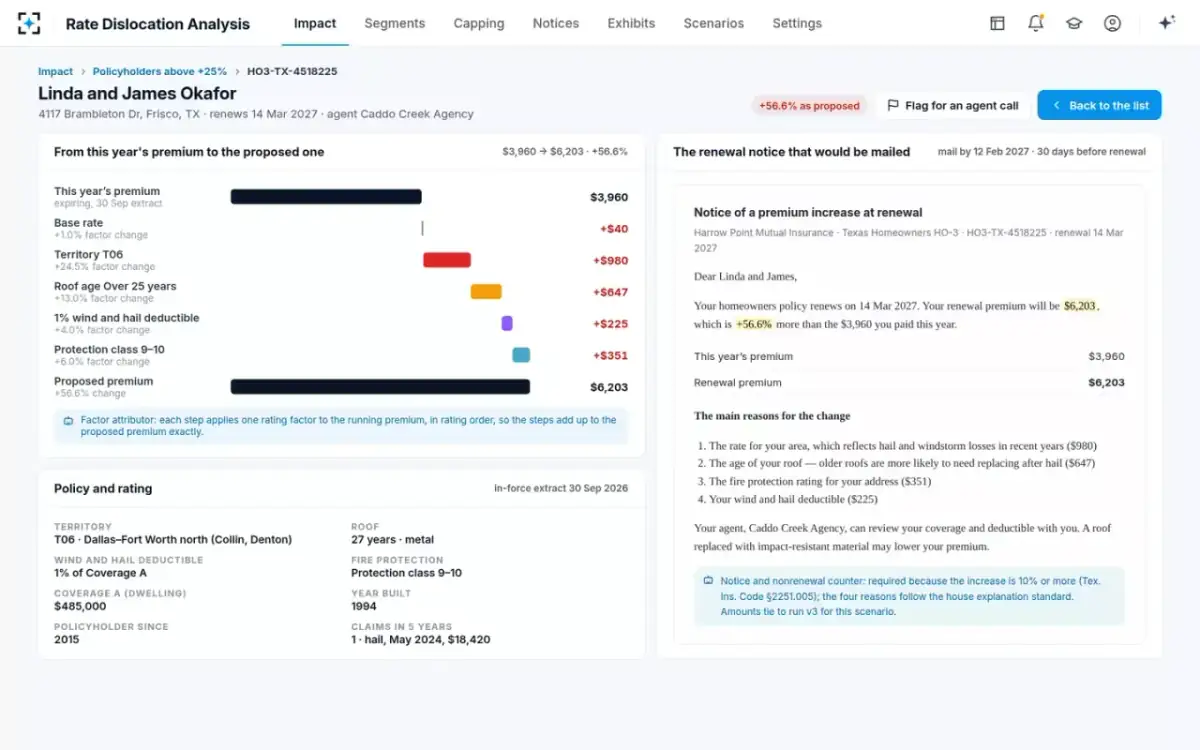
A good notice says what the premium was, what it will be, and why, in dollars a policyholder can check. On the sample Texas program, the draft notice for one Frisco policy states this year's premium of $3,960 and the renewal premium of $6,203, +56.6%, and lists the main reasons in dollars: the rate for the area, which reflects hail and windstorm losses, $980; the age of the roof, $647; the fire protection rating for the address, $351; and the wind and hail deductible, $225. It names the agent who can review coverage and deductible, and notes that a roof replaced with impact-resistant material may lower the premium. It must be mailed by 12 February 2027, 30 days before the 14 March renewal.
A draft renewal notice, with the reasons in dollars
What a renewal premium increase notice should contain
- Current and renewal premium
Both in dollars; Maryland requires both for auto.
- The size of the change
In dollars and percent, against the comparison the state uses.
- The reasons, in dollars
The rating factors that drove the change; Washington will require primary factors from 2029.
- Rate separated from coverage
Florida requires the dollars from an approved rate increase and from coverage changes to be shown apart.
- Any cap or transition rule
What the premium will be once the cap no longer applies; the NAIC asks whether insureds should be told.
- Who to contact
The insurer and the agent; California requires the insurer's consumer telephone number on the renewal offer.
- The policyholder's rights
Protest or hearing rights where the state gives them, as Maryland does for auto.
- The mailing date
Set from the renewal date and the state's lead time, and recorded.
Why notice counts and the rate filing disagree
Notice counts and filing exhibits disagree because they are usually made from different data at different times. On the sample review, the product manager circulated a workbook for the scenario "territory at 60%" that counted 71,233 Texas 10% notices. The re-rate of the same scenario counted 72,907. The workbook was built from an extract taken on 31 August; 1,674 policies had a mid-term endorsement after that date, and the workbook rated them on their old premium, which left them below the 10% line. Nobody's arithmetic was wrong.
Three other sources of disagreement are common. The comparison base: a count that uses annual premium where the statute uses premium paid will misclassify policies near the line. The scenario: a notice file built from the scenario discussed in September and an exhibit built from the scenario filed in November. And the cap: a cap does not change who crosses a 10% line if it sits above 10%, which on the sample is why both the capped and uncapped scenarios need 72,907 notices. Washington's rule adds a fourth from 2029: the cap itself becomes a reason the notice must explain.
Counting every notice from one run
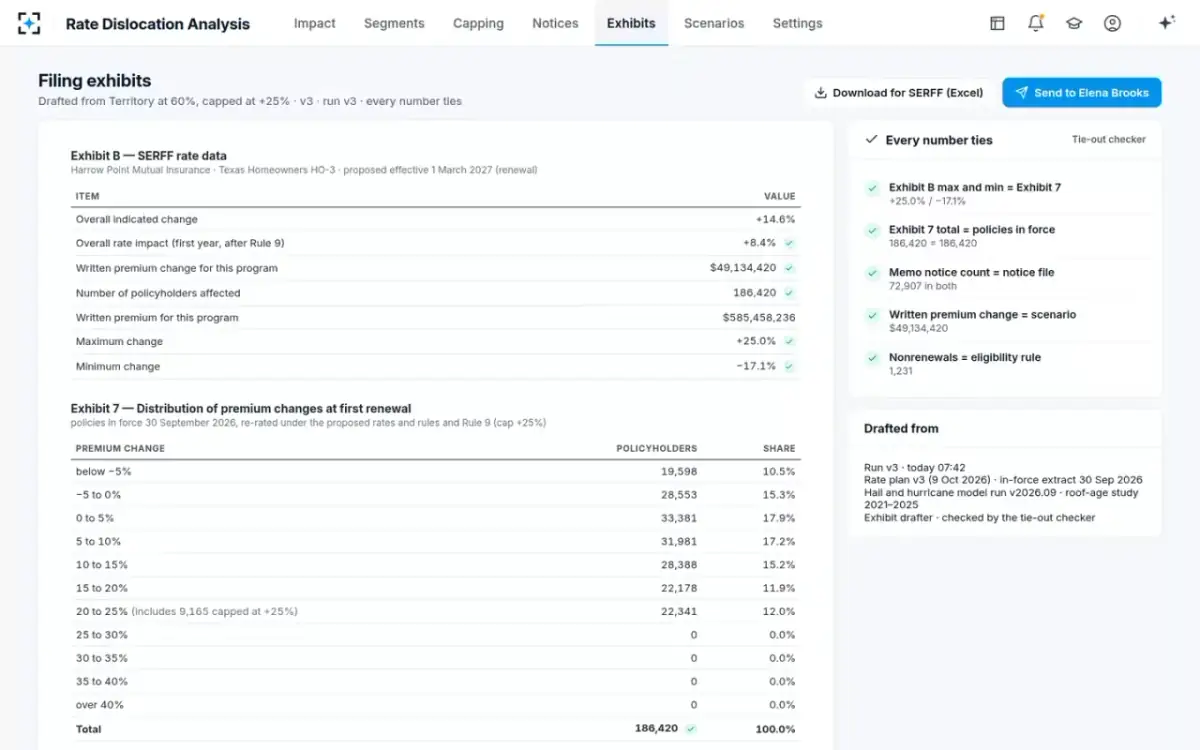
The control is simple to state: the notice count, the distribution exhibit and the actuarial memorandum come from the same saved run, and nothing is sent until they agree. On the sample review, the run schedules 72,907 Texas notices across twelve renewal months, first mailing 30 January 2027, alongside 1,231 nonrenewals under a new eligibility rule for wood-shake roofs over 25 years.
Texas 10% notices by renewal month on the sample program
The same run feeds the exhibits, and the tie-out checker compares them before anything is sent: the memorandum's notice count against the notice file, the exhibit's maximum and minimum against the distribution, the distribution's total against policies in force. The agents never send a notice and never file; the rate filing analyst files, and the mail file goes through the carrier's own process. How the distribution itself is built is set out in dislocation analysis in insurance, and what an increase threshold does and does not limit in is there a limit on how much insurance can increase per year.
The memo's notice count tied to the notice file before filing
To count notices for your own states from your own book, start from Rate Dislocation Analysis.
Questions people ask
Is there a renewal premium increase notice sample from a regulator?
Washington's rule includes model wording for its premium change notices, and Maryland's auto notice must be on a form the Commissioner approves. Texas and California prescribe what must happen and when rather than a letter. The example on this page follows the common elements: current and renewal premium, the change, the reasons in dollars and who to contact.
How far in advance must an insurer give notice of a rate increase?
It depends on the state and line: 30 days before a Texas residential rate increase of 10% or more takes effect, 45 days for a Florida residential renewal premium, a California homeowners renewal offer or a Maryland auto increase, and from 2029 at least 20 days for a Washington 10% increase. Nonrenewal notices usually need longer, such as 60 days in Texas and 75 days for California homeowners.
Do I get a notice if my insurance company raises rates in California?
For homeowners, the insurer must deliver an offer of renewal stating the premium at least 45 days before the policy expires. Separately, the Commissioner must notify the public of each rate change application, and a consumer may request a hearing within 45 days of that notice.
What does a notice of premium increase in Maryland include?
For private passenger auto, the current and renewal premium, the reasons stated clearly and specifically, a statement that the insured may contact the producer or insurer for a review, and the right to protest within 30 days, with a hearing available for increases of more than 15% for the whole policy. No notice is needed for a general filed rate increase that does not reclassify the insured.
Can an insurer send rate increase notices to everyone?
In Texas, yes: §2251.005(c) allows the notice to go to any residential policyholder whether or not the premium rises. None of the other rules cited on this page forbids an extra notice; they set minimums. The count still matters for the filing, which must match the policies the change actually affects.