Revenue neutral rate changes in insurance are changes to a rating plan that leave the insurer's total premium unchanged, an overall rate change of 0%. They are common when a carrier refits territory, roof age, credit or vehicle relativities without seeking more money: the base rate is adjusted so that the increases for some classes are exactly offset by decreases for others. Neutral describes the total, not the person. Because each policy carries its own combination of rating factors, and the changes multiply, a revenue neutral filing can raise some premiums by 20% or more while cutting others as much, and it still triggers notices, caps and questions from agents and regulators. Botminds' Rate Dislocation Analysis re-rates every in-force policy under a proposed plan and draws the distribution of changes, so a "revenue neutral" label never travels without the histogram that shows what it means for policyholders.
The worked example on this page is illustrative arithmetic, labelled as such. The book-wide figures come from a fictional sample carrier's Texas homeowners program as it runs through the solution, and the method from the Casualty Actuarial Society's ratemaking text.
When a simple base rate change is implemented, the amount of dislocation is nearly uniform across all insureds. If rate relativities are also changed, the amount of dislocation can vary significantly for different insureds or classes of insureds.
Werner and Modlin, Basic Ratemaking, Casualty Actuarial Society (2016)
What does revenue neutral mean in insurance rates?
In insurance pricing, revenue neutral means the proposed rates would collect the same total premium as current rates from the current book of business. It is a statement about the overall rate level only, the 0% at the top of the actuarial memorandum. Elsewhere the phrase has other uses, a revenue neutral tax rate for example, but the logic is the same: the total is held constant while its distribution changes.
The NAIC's handbook for rate reviewers separates the two decisions that a revenue neutral change keeps apart. The indicated overall change is the company's best estimate of its premium needs; once the overall rate level is determined, "the rate change gets allocated to the classifications and other rating factors" (NAIC Product Filing Review Handbook). A revenue neutral filing sets the first at zero and does all its work in the second.
Why a revenue neutral rate change still moves premiums
A revenue neutral rate change moves premiums because it changes relativities, and relativities differ by policy. If territory A's relativity rises and territory B's falls, the base rate can be set so the totals balance, but nobody lives in an average territory. Add a second variable that moves at the same time, and its changes multiply with the first, so the policies that get both increases get the product.
What a revenue neutral claim says, and what it measures
The claim: 0%: the book pays the same total.
What it actually measures: Total proposed premium on today's book ÷ total current premium − 1.
The claim: Unchanged on average.
What it actually measures: Spread from large decreases to large increases, by each policy's combination of factors.
The claim: No one, overall.
What it actually measures: Everyone whose relativities moved; the tail can be a tenth of the book or more.
The claim: None needed for a 0% change.
What it actually measures: Required for each policy whose own increase crosses a state threshold, such as 10% in Texas.
The claim: Unnecessary.
What it actually measures: Often needed for the tail; a cap funded through the base rate makes uncapped policies pay more.
The claim: Neutral.
What it actually measures: Neutral only if the book stays the same; large changes alter who renews.
A revenue neutral change worked: four cells, 0% overall
Take an illustrative book with two territories and one roof-age split. Territory A holds 60% of premium and its relativity rises 10%; territory B holds 40% and falls 15%. That nets to zero: 0.6 × 10% − 0.4 × 15% = 0. At the same time, older roofs, a quarter of premium in each territory, get a 12% higher relativity and newer roofs a 4% lower one, again netting to zero: 0.25 × 12% − 0.75 × 4% = 0. Each change alone is revenue neutral, and so are both together. The policies are not.
Two revenue neutral changes, multiplied cell by cell
| Cell | Share of premium | Territory change | Roof change | Policy change |
|---|---|---|---|---|
| Territory A, older roof | 15% | +10% | +12% | +23.2% |
| Territory A, newer roof | 45% | +10% | −4% | +5.6% |
| Territory B, older roof | 10% | −15% | +12% | −4.8% |
| Territory B, newer roof | 30% | −15% | −4% | −18.4% |
| Whole book | 100% | 0% | 0% | 0.0% |
A filing described as "0% overall" gives 15% of the book's premium a 23.2% increase and 30% an 18.4% decrease. In a state with a 10% notice threshold, every policy in the first cell gets a notice. A carrier with a +20% cap on renewal increases has to cap the first cell, which breaks the neutrality the filing claims, unless the base rate rises to pay for it.
The same 0% change, as the policyholders see it
Territory relativities: where many revenue neutral changes start
Territory relativities are the factors that make one rating territory's premium higher or lower than the base territory's, and they are a natural candidate for a revenue neutral filing: refitting territories to new loss experience or a new catastrophe model moves premium from areas that were over-charged to areas that were under-charged, without by itself requiring more premium in total. Florida's motor vehicle rating law shows why regulators care about the granularity: using a single ZIP Code as a rating territory is deemed unfairly discriminatory unless the filing's experience makes it actuarially sound (Fla. Stat. §627.0651(8)).
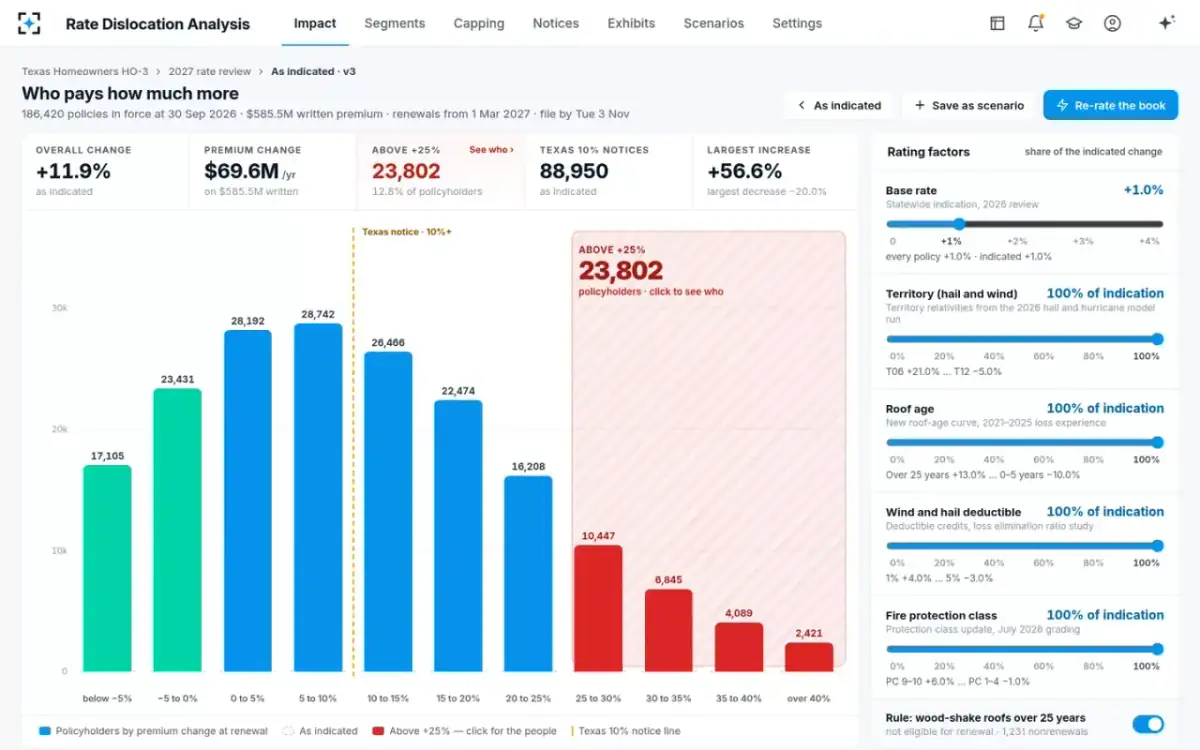
Territory is also where the sample book's tail comes from. On the sample Texas homeowners review, which is not revenue neutral (the plan with every factor at its full indication moves the book +11.9%), territory is the largest factor for 61% of the 23,802 policyholders above +25%. Even at +11.9% overall, 40,536 policyholders, more than one in five, get a decrease. The spread around the average is the same phenomenon as in the worked example: what a filing calls its overall change is a weighted average of very different policy changes.
An +11.9% average with one policyholder in five getting a decrease
The off-balance factor keeps a change neutral; a cap pulls against it
The off-balance factor is the base rate adjustment that holds the overall change when relativities move. The CAS text defines it as the reciprocal of one plus the change in average rate differential, the amount the base rate must move to balance the changes in the differentials (the rate change calculator quotes the definition and works it). In the worked example, the relativity changes already balance, so the off-balance is 1.000; in most real filings they do not, and the base rate moves to make the filing neutral.
A cap pulls the other way. In the CAS example of capping one rating level, holding that level to 20% creates a shortfall that is recovered by raising the base rate 0.87%, which raises every uncapped level a little: the capped policyholders' protection is paid for by everyone else. A revenue neutral filing with a cap therefore has two possible meanings, neutral after the base rate is raised to fund the cap, or neutral before the cap with the cap's cost absorbed by the insurer, and the filing should say which. The arithmetic is worked line by line in a rate change calculator for insurance.
Rate capping: why insurance companies cap a neutral change, and who pays
Insurance companies cap revenue neutral changes for the same reason they cap increases: the policies in the tail are the ones most likely to leave. The CAS text notes that even when every rating variable's change is small, "the cumulative effect of the changes to all of the rating variables may be significant", and that companies cap so that fewer of those insureds shop for a better deal. A refit that is neutral in total but sends the best-protected homes in one territory up 23% is a retention problem in that territory.
Regulators then ask how the cap itself is funded. Missouri's guidance on rate stability rules sets a condition directly relevant to neutral filings: the rules must be, "in the aggregate, rate neutral or result in an overall rate decrease" (Missouri Bulletin 20-01). Washington requires the next filing to take into account "the effect of the rate stability rule on the indicated rate level" (WAC 284-24-130(11)), so a cap's deferred premium does not quietly reappear later. On the sample program, a +25% cap on the selected scenario forgoes $1.51 million, 0.26% of written premium, in the first year, and the pricing team chose to absorb it rather than raise the base rate.
Neutral on today's book is not neutral on next year's
A revenue neutral calculation assumes the book does not change. The CAS text is explicit: "Normally, actuaries use the latest in-force distribution as the best estimate of the expected future distribution", and in doing so "the actuary assumes the rate change will not alter the existing portfolio." It then gives the case where that fails: a non-standard auto insurer whose large, uneven change means "insureds receiving large rate changes may non-renew their policies."
For a revenue neutral filing the bias runs one way. Policyholders who get large increases are the likeliest to leave, and those who get decreases the likeliest to stay, so a change neutral on today's book collects less than neutral premium from next year's. The size of that effect depends on how much of the book sits in the tails, which is one more reason the histogram, not the 0%, is the number to examine.
How regulators read a revenue neutral claim
Regulators read the overall change from the memorandum and the impact from the distribution, and they ask for both. The NAIC's white paper on predictive models asks reviewers to obtain a dislocation analysis showing the distribution of percentage and dollar impacts on renewal business and, in element C.7.a, the five rating variables behind the largest swings up and down (NAIC, Regulatory Review of Predictive Models). A neutral filing that is mostly a model refit falls squarely within those elements.
Public research shows how unusual neutral or downward filings are in the first place. A Federal Reserve staff working paper on homeowners rate filings found that only about 6.7% of filings in its data requested decreases, and that the average requested decrease was about 2% against an average increase of about 6% (Oh, Sen and Tenekedjieva, FEDS 2022-064). In a market where most filings ask for more, the question a neutral filing invites is where its increases fall.
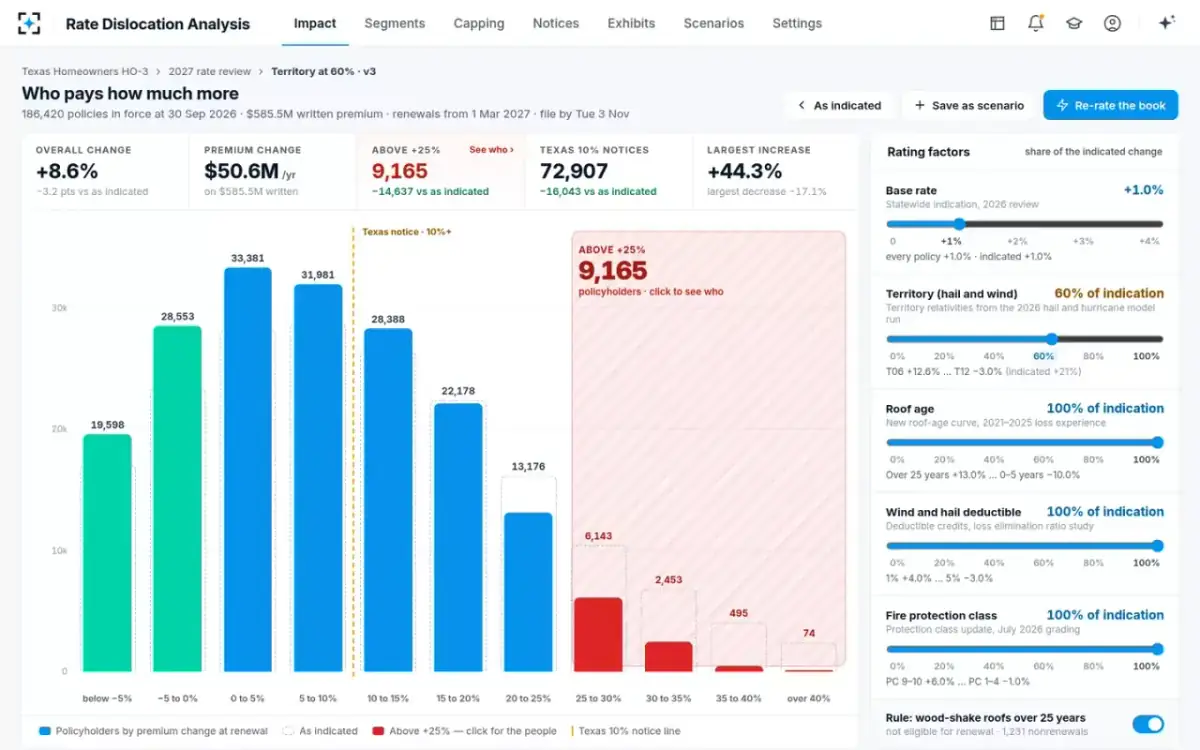
One factor changed, the whole distribution re-drawn
What should come with a revenue neutral claim
A revenue neutral claim is a true statement about one number. The checklist below is what should travel with it, in the memorandum, in the board paper and in the briefing for agents. Every item comes from the same re-rate of the book.
Seven things a revenue neutral filing should show beside its 0%
- The distribution of policy changes
Bands from the largest decrease to the largest increase, by count and by premium.
- The largest increases, explained
Each split by rating factor, so the reason is visible.
- The variables behind the swings
Ranked across the book, up and down.
- Notices the change triggers
Policy by policy against each state's threshold, such as 10% in Texas.
- Any cap, and who pays for it
Funded by the base rate, which breaks pure neutrality for the uncapped, or absorbed.
- The off-balance
Measured by re-rating the book, not approximated from averages.
- The retention assumption
Neutral on today's book; what happens if the tail leaves.
Each item on that list is a view of the same re-rated book. That is the design of Rate Dislocation Analysis, and how the histogram is read is set out in dislocation analysis in insurance.
Questions people ask
What is the meaning of a revenue neutral rate?
A revenue neutral rate change collects the same total revenue as before while changing who pays what. In insurance it means a filing with a 0% overall rate change; in tax policy it means a rate set so the government's total collections stay level. In both, individuals can pay more or less.
Can a revenue neutral rate change still require renewal notices?
Yes. Notice rules apply to each policy, not to the overall change. In Texas, any residential renewal whose rate increase raises the premium by at least 10% over the lesser of the prior 12 months' or prior term's premium needs notice at least 30 days before it takes effect, whatever the filing's overall figure.
What are territory relativities?
Factors that scale the base rate up or down by the rating territory where the risk is located, so that each territory's premium reflects its expected losses. A base territory has a relativity of 1.00; a territory at 1.25 pays 25% more, other things equal. Because a refit moves premium between areas, a territory change can be filed as revenue neutral and still produce large individual increases.
How is an off-balance factor calculated?
As one divided by one plus the change in the average rate differential across the book. In the CAS example, relativity changes average +2.57%, so the off-balance is 0.9749 and the base rate falls about 2.5% to compensate. An exact figure comes from re-rating every policy rather than averaging.
Why do insurance companies cap rate changes that are revenue neutral?
To keep the policies in the tail, whose increases make them likeliest to leave. A cap limits how much of the change any one renewal carries, phasing the rest in. Missouri's guidance expects such rules to be rate neutral or reduce premium in the aggregate, and Washington limits them to three years.