Is there a limit on how much insurance can increase per year? For most homeowners and drivers in the United States, no single law caps the percentage a premium can rise at renewal. States control increases in other ways: some must approve rates before use, and California holds a hearing on request when a personal lines rate application exceeds 7%; some require a notice when a renewal increase reaches a threshold, such as 10% for residential property in Texas; and a few cap increases for particular insurers or costs, such as 15% a year per policy for Florida's state-created insurer, Citizens. Inside those rules, insurers often cap their own renewal increases with a filed rate stability rule. Botminds' Rate Dislocation Analysis is used by insurers' pricing teams to see, before a rate change is filed, which policyholders would face large increases, to design such a cap and to count the notices the law requires.
This page describes rules, not advice for a particular policy; the state insurance department is the place to ask about one. Statutes are quoted from the states' official texts, read in October 2026; check the current text before relying on one. The examples of how a carrier applies them come from a fictional sample insurer's Texas homeowners program as it runs through the solution.
Premiums have risen far faster than inflation, and the limits are narrow
18–43%
rise in average homeowners premium since 2018, after inflation, depending on the region
15%
yearly cap per policy for Florida's Citizens Property Insurance Corporation from 2026
7%
personal lines rate application in California above which a requested hearing must be held
Is there a limit on how much insurance can increase per year? The short answer
There is no nationwide cap, and in most states no statutory cap on an individual renewal increase for a voluntary-market home or auto policy. State law regulates rates instead of premiums: rates must not be "excessive, inadequate, unfairly discriminatory", in California's wording, and the review process differs by state. The NAIC's handbook for rate reviewers groups the systems as prior approval, file and use, use and file, no file, and flex rating, where prior approval is needed only when a change goes beyond a set percentage; the handbook's example is 7% (NAIC Product Filing Review Handbook).
Three kinds of percentage therefore matter, and they are easy to confuse. A cap limits the increase. A notice threshold requires the insurer to tell the policyholder in advance. A review trigger sends the rate filing, or a protest, to a hearing. The figure below ranks the ones in force in the states this page covers.
The percentages in state law, ranked, and what each one does
Is there a limit on how much insurance can increase in California?
California has no statutory percentage cap on a renewal increase; it relies on review before a rate is used. Under Proposition 103, a rate change needs an application to the Commissioner, who must give public notice of it. The application is deemed approved 60 days after public notice unless a hearing is held, and a hearing must be held on a timely request if the proposed adjustment exceeds 7% of the current rate for personal lines (15% for commercial lines); in any event an application is deemed approved 180 days after it is received, unless disapproved after a hearing or extraordinary circumstances apply (Cal. Ins. Code §1861.05).
The 7% applies to the insurer's rate application, not to each policy. An approved overall change of 6.9% can still raise some policies far more if relativities change, because the overall figure is an average. At renewal, a California homeowners insurer must deliver, at least 45 days before expiration, an offer of renewal that states the premium (Cal. Ins. Code §678(a)), so the new premium is known six weeks ahead. How much can insurance increase at renewal in California, then? As much as the approved rates produce for that policy; the controls are the approval, the hearing and the notice, which are described in rate increase notices in California and other states.
How much can homeowners insurance increase per year in Texas?
Texas sets no percentage limit for the voluntary homeowners market. It is a file-and-use state: an insurer may use a rate from the day it is filed, and the Commissioner must disapprove a non-compliant rate no later than the earlier of its effective date or the 30th day after filing (Tex. Ins. Code §2251.101, §2251.103). An insured "who is aggrieved with respect to any filing under this chapter that is in effect" may apply to the Commissioner in writing for a hearing on it (§2251.105).
What Texas does require is notice. An insurer must notify a residential property policyholder of a rate increase at renewal that will make the premium at least 10% greater than the lesser of the premium paid in the prior 12 months or in the prior policy period, and send the notice at least 30 days before the increase takes effect (§2251.005). The Texas Windstorm Insurance Association, the state's wind insurer for the coast, is different: its filed rates may not reflect an average change of more than 10% or a change for a rating class of 15%, under §2210.359, with exceptions written into that section (Tex. Ins. Code ch. 2210).
How much can homeowners insurance increase per year in Florida?
Florida caps increases in two places. Citizens Property Insurance Corporation, the state-created insurer, "shall annually implement a rate increase which, except for sinkhole coverage, does not exceed" a set percentage "for any single policy issued by the corporation, excluding coverage changes and surcharges": 12% for 2023, rising a point a year to "Fifteen percent for 2026 and all subsequent years", until its rates are actuarially sound. Policies that do not cover a primary residence may be charged up to 50% above the prior year's rate (Fla. Stat. §627.351(6)(n)).
The second is a filing that passes reinsurance costs through: there, financing products "may not result in a premium increase exceeding 3 percent for any individual policyholder", and "All costs contained in the filing may not result in an overall premium increase of more than 15 percent for any individual policyholder" (Fla. Stat. §627.062(2)(k)). For other private-market filings there is no per-policy cap. Every residential renewal must give the policyholder at least 45 days' written notice of the renewal premium, and the notice must show the dollars due to an approved rate increase apart from the dollars due to coverage changes (Fla. Stat. §627.4133).
Limits and thresholds for a home or auto renewal, by state
| State | Cap on an individual increase | Notice before renewal | Hearing or review |
|---|---|---|---|
| California | None in statute for the voluntary market | Homeowners: offer of renewal with the premium at least 45 days before expiration (§678) | Hearing on timely request if a personal lines application exceeds 7% (§1861.05) |
| Texas | None for the voluntary market; windstorm association limited to 10% average, 15% by class (§2210.359) | Residential property: increase of 10% or more, at least 30 days before (§2251.005) | Aggrieved insured may apply for a hearing on a filing in effect (§2251.105) |
| Florida | Citizens: 15% a year per policy from 2026, excluding coverage changes; reinsurance-cost filings: 15% per policyholder | Residential: renewal premium at least 45 days before, rate and coverage dollars shown (§627.4133) | Review by the Office of Insurance Regulation under §627.062 |
| Maryland (auto) | None | Private passenger auto: at least 45 days before an increase, unless part of a general filed increase without reclassification (§27-614) | Protest within 30 days; hearing available for an increase of more than 15% for the policy |
| Washington | A filed rate stability rule may limit increases for up to three years (WAC 284-24-130) | Home and auto: explanation on request now; automatic notice of a 10% increase from 1 January 2029, at least 20 days before (WAC 284-30A) | Rate review by the Insurance Commissioner |
What is rate capping in auto insurance?
In auto insurance, rate capping is usually the insurer's own rule, filed with its rates, that limits how much one driver's premium can move at a renewal because of a rate change, with the rest phased in. The CAS ratemaking text calls it a premium transition rule and gives the example of a 15% cap on a 20% change: 15% at the first renewal and "the remaining 4.3% ( = 1.20 / 1.15 - 1.0 ) at the second renewal" (CAS, Basic Ratemaking). Washington and Missouri set standards for such rules: in Washington they may run no more than three years and apply only to drivers who would otherwise see more than 10% on an annual policy (WAC 284-24-130); Missouri's guidance allows five years and changes of 5% or more (Missouri Bulletin 20-01).
Maryland adds a procedure rather than a cap for private passenger auto. An insurer must send written notice at least 45 days before the effective date of an increase in total premium, which includes a surcharge, a reclassification or the removal of a discount; no notice is needed for a general filed increase that does not reclassify the insured. A driver who believes the increase is wrong may protest within 30 days, and for an increase of more than 15% for the entire policy may request a hearing (Md. Code Ins. §27-614).
Why insurers cap renewal increases on their own
Insurers cap increases mostly to keep customers. The CAS text notes that the size of a rate change weighs heavily on whether an existing insured renews, and that a company "may wish to mitigate the premium impact for any single insured to reduce the probability that the insured shops for a better deal." It adds that "a regulation or law may limit the increase an insurance company may offer a renewing insured."
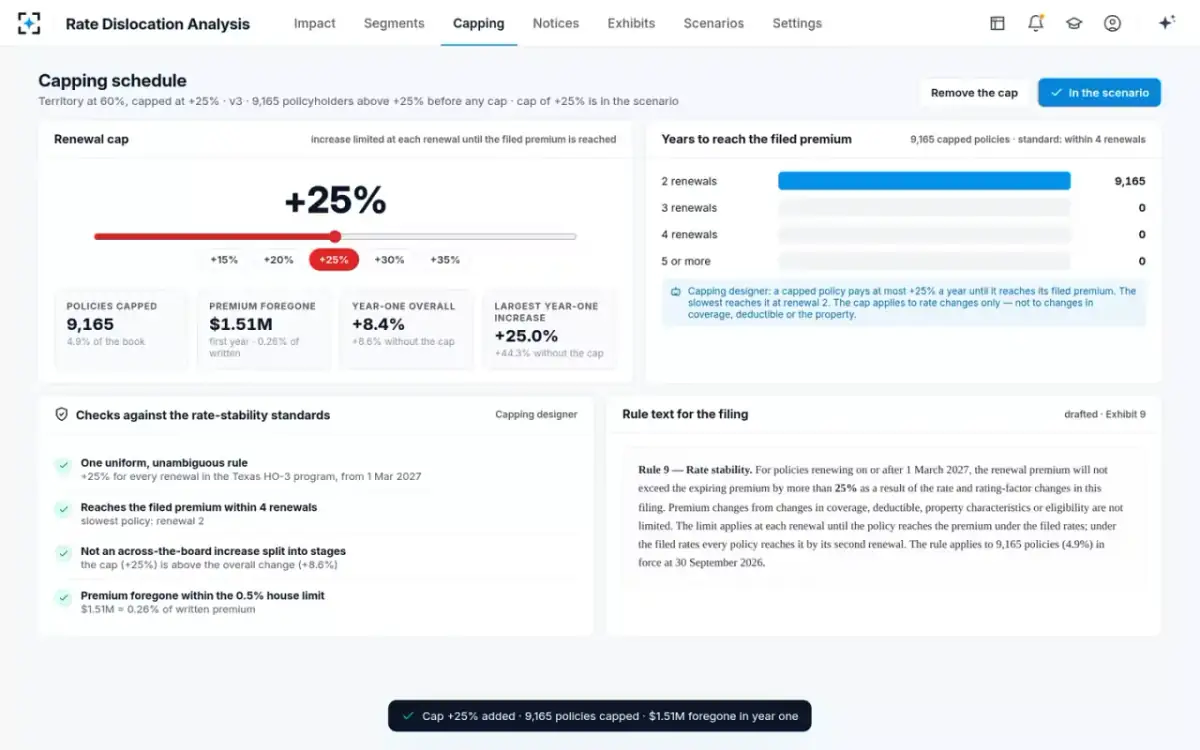
On the sample Texas program, the pricing team's choice shows the trade. With every factor at its full indication, 23,802 policyholders, 12.8% of the book, would see more than +25%. Taking territory at 60% of its indication cuts that to 9,165; a +25% renewal cap then limits all 9,165 for $1.51 million of premium foregone in the first year, and each reaches the filed premium by its second renewal. Nothing in Texas law required the cap. How the cap is worked out, and who pays for it, is shown in a rate change calculator for insurance.
A carrier's own cap on the sample book: who it reaches
What the limits do not cover: coverage, the property and the risk
Every cap and threshold described here applies to the effect of a rate change, not to every reason a premium moves. Citizens' Florida cap excludes "coverage changes and surcharges". Washington's rate stability rules "must not apply to premium changes resulting from changes in coverage, exposure, or policyholder characteristics". Missouri lists examples of risk changes a stability rule should not moderate: "changes in the age of drivers, changes in credit scores, homes or roofs and/or coverage limits." Texas's notice rule turns on a rate increase taking effect at the policy's renewal.
So a renewal can rise by more than a cap or a threshold for reasons the rule does not reach: a higher dwelling limit, a new driver, a claim surcharge, an older roof crossing into a new band. Florida's rule that the renewal notice show the rate and coverage dollars separately exists because policyholders cannot otherwise tell the two apart. For insurers, it means a dislocation analysis has to separate rate effects from risk effects policy by policy. Why a particular premium went up is the subject of Botminds' Premium Increase Explanation.
Questions that decide whether a limit applies to a renewal
- Which insurer?
A state-created insurer, such as Florida Citizens or the Texas windstorm association, may have a cap the private market does not.
- Which line?
Maryland's notice and hearing rules in §27-614 are for private passenger auto; Texas's 10% notice is for residential property.
- Is it a rate change?
Caps and notices apply to rate changes, not to coverage, exposure or risk changes.
- Is it a cap, a notice or a review?
A 10% notice threshold does not stop a 30% increase; it requires the policyholder to be told.
- Was a stability rule filed?
The insurer's own cap, if any, is in its filed manual; filings are public in states such as Texas.
- What is the date?
Florida's Citizens cap rose a point a year to 15%; Washington's automatic notices start in 2029.
What a pricing team sees before the renewal letter is mailed
From the insurer's side, every rule above becomes a line on a histogram. The sample team's screen shows each policyholder by premium change at renewal, a dashed line at Texas's 10% notice threshold, and the tail above the carrier's own +25% line; a cap is one more scenario, priced and checked against the carrier's standards and, where they apply, a state's rules such as Washington's three-year limit.
A carrier's +25% renewal cap, priced before filing
To see how a cap and the notice count come out of one re-rate of the book, start from Rate Dislocation Analysis.
Questions people ask
Is there an insurance rate increase limit by state?
Not as a general rule. A few states cap increases for specific insurers or filings, such as Florida's 15% yearly cap per policy for Citizens from 2026 and Texas's limits on windstorm association rates. Most states regulate through rate review, with thresholds such as California's 7% hearing trigger, and through notice rules such as Texas's 10% notice for residential property.
Does an insurance policy itself cap rate increases?
A standard homeowners or auto policy does not promise a future premium; the price is set at each renewal from the filed rates. An insurer may file a rate stability rule that caps renewal increases from a rate change, and that rule is part of its filed manual. Filings, including such rules, are public in states such as Texas.
Can a 10% notice threshold stop a larger increase?
No. A notice threshold requires the insurer to tell the policyholder in advance; it does not limit the increase. In Texas the notice must go out no later than 30 days before a residential rate increase of 10% or more takes effect, and the insurer may send it to any policyholder whether or not their premium rises.
Who decides whether a rate increase is allowed?
The state insurance department, under that state's rating law. In prior approval states such as California the department approves rates before use; in file-and-use states such as Texas the insurer may use a rate once filed and the department may disapprove it; in flex rating states, approval is needed only above a set percentage. All require rates not to be excessive, inadequate or unfairly discriminatory.
How much can insurance increase at renewal in California?
No statute sets a percentage for an individual renewal in the voluntary market. The insurer's rates must be approved first, a consumer may request a hearing, and one must be held on a timely request if a personal lines application exceeds 7%. The renewal offer with the premium must arrive at least 45 days before a homeowners policy expires.