A rate change calculator for insurance multiplies rather than adds. A policy's new premium is its current premium times one plus the change in each rating factor that applies to it, base rate included, so five moderate changes can stack into a large one. Across a book, the overall change is the premium-weighted average of those policy changes. Two mechanics catch people out: the off-balance, the base-rate adjustment needed when relativities change so that the overall change lands where it was selected, and capping, where limiting the change for one group or one policy leaves a shortfall someone else pays. Botminds' Rate Dislocation Analysis runs that arithmetic on every in-force policy at once, proposes a cap, prices it, and checks it against the carrier's rate-stability standards before the filing goes in. The calculator and worked examples below show the same arithmetic on one policy and one rating variable.
The variable-capping example is the Casualty Actuarial Society's, from Werner and Modlin's Basic Ratemaking; the policy example and the book-wide figures come from a fictional sample carrier's Texas homeowners program as it runs through the solution.
If the actuary caps the proposed relativity for any one territory, this will reduce the proposed average rate differential across all territories, which will necessitate an offsetting increase in the proposed base rate in order to achieve the target average premium.
Werner and Modlin, Basic Ratemaking, Casualty Actuarial Society (2016)
How a rate change calculator for insurance works
For one policy, the rate change is the product of each factor's change, applied in the manual's order. The formula is: new premium = current premium × (1 + base rate change) × (1 + change in factor 1) × … × (1 + change in factor n), with any additive fees handled where the manual applies them. The percentage change is the new premium divided by the current, minus one.
On the sample book, one Frisco homeowner's renewal works out as 1.010 × 1.245 × 1.130 × 1.040 × 1.060 = 1.566: a base rate change of +1.0%, territory +24.5%, roof age +13.0%, wind and hail deductible +4.0% and protection class +6.0%, which together take $3,960 to $6,203, +56.6%. Added instead of multiplied, the same five changes would give +48.5%, eight points short. The calculator below starts from that policy; change any input.
Try it: a policy-level rate change calculator with a renewal cap
How is an insurance rate change calculated across a book? The off-balance, worked
Across a book, the overall change is total proposed premium divided by total current premium, minus one, and the base rate is the lever that sets it. When relativities change, the average relativity of the book changes too, and the base rate must move the other way to keep the overall change at the selected level. The CAS text names the adjustment: the reciprocal of one plus the change in average rate differential "is commonly referred to as the off-balance factor. It is called that as it represents the amount the base rate needs to be adjusted to balance the changes in the rate differentials."
The CAS example has three levels of one rating variable, with $138,000, $659,000 and $203,000 of premium, current relativities 0.80, 1.00 and 1.20, and selected relativities 0.90, 1.00 and 1.25. The relativity changes are +12.50%, 0% and +4.17%, a premium-weighted average of +2.57%, so the off-balance factor is 0.9749 (= 1 / 1.0257). The selected overall change is +15.0%. Each level's total change is its relativity change × the off-balance × 1.15.
A 20% cap on one level, paid for by the other two through the base rate
Level 1 would rise 26.13%, above management's 20% limit. Capping it is a four-step calculation, set out below. The result is the point of the Pull quote at the top of this page: the cap is paid for by the uncapped levels, whose increases rise by just under a point each.
Capping one level at 20%: the four steps
| Step | Calculation | Result |
|---|---|---|
| 1. Relativity that gives Level 1 exactly +20% | (1.20 ÷ (0.9749 × 1.15)) × 0.80 | 0.8563 |
| 2. Premium shortfall from the cap | $174,059 proposed − $165,600 capped ($138,000 × 1.20) | $8,459 |
| 3. Base rate rise to recover it from Levels 2 and 3 | $8,459 ÷ $975,889 (their proposed premium) | +0.87% |
| 4. Level 1 relativity, undoing the base rate rise | 0.8563 ÷ 1.0087 | 0.8489 |
| Final base rate offset | Off-balance 0.9749 × capping adjustment 1.0087 | about 0.983 |
Step 4 is the one most spreadsheets miss. Raising the base rate raises Level 1 too, so its relativity must be cut again, or the capped level ends above its cap. On a real book with several variables changing at once, the same logic applies to every capped cell, and an exact off-balance comes from re-rating the book: the CAS text notes that the change in average rate differential can be calculated exactly "using the extension of exposures method", compared with the approximation in extension of exposures vs parallelogram.
Overall rate change calculator: from policy changes to the filed number
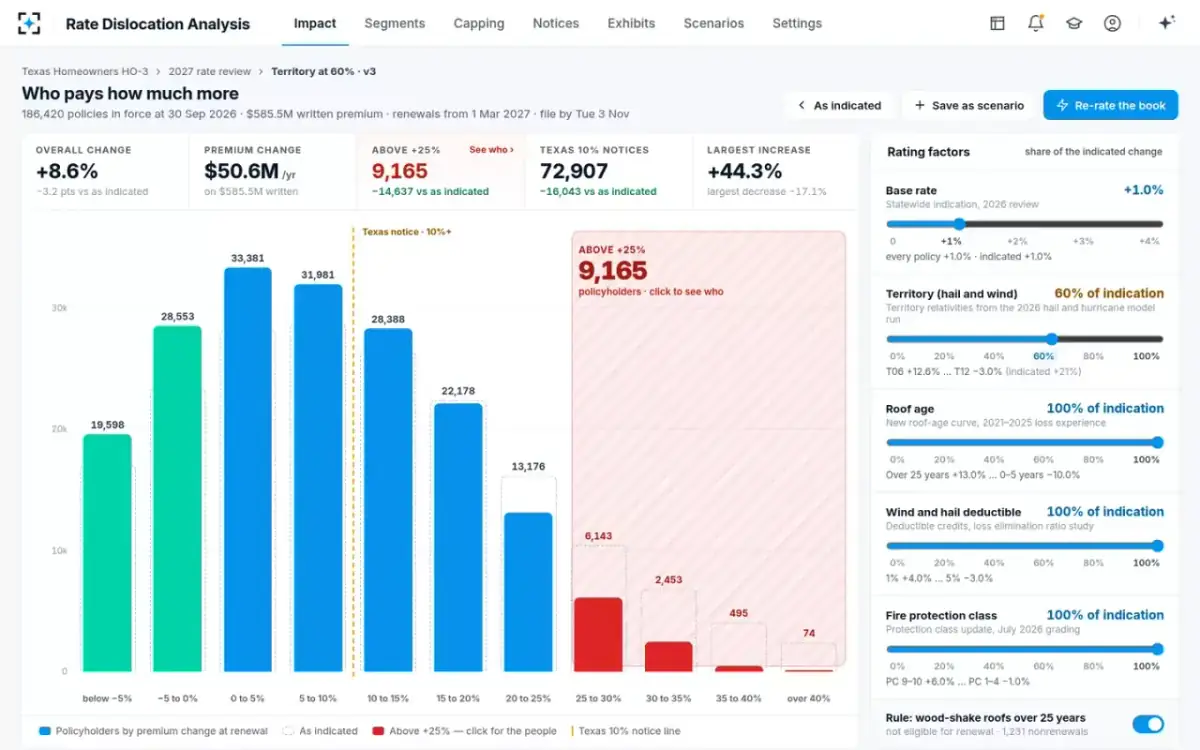
The overall rate change in a filing is the premium-weighted average of every policy's change, so it moves with the mix of the book as much as with the rates. On the sample Texas book of $585.5 million, the plan with every factor at its full indication adds $69.6 million, +11.9%. With territory at 60% of its indication it adds $50.6 million, +8.6%. With a +25% renewal cap the first-year addition is $49,134,420, +8.4%, the $1.51 million difference being the premium the cap defers.
Two choices change the number without changing any rate. The first is the denominator: written premium on the in-force book, as here, or earned premium on an experience period, as in an indication, which must first be put on-level. The second is the base: the overall change in an indication compares proposed premium with premium at current rates, which is why the CAS text insists on restating history at today's rates before anything else. Its simplest example makes the point: with rates already raised from $200 to $210 and a true need of $220, the right change is 4.8%, not 10% (CAS, Basic Ratemaking).
A calculator that reports only the overall figure also hides its distribution. The sample's +8.6% is made of 48,151 decreases, 65,362 increases under 10%, 63,742 between 10% and 25%, and 9,165 above 25%. Those are the numbers a pricing team caps, and the numbers a state's notice rules count.
What is rate capping in insurance?
Rate capping is a rating rule that limits how much an individual policyholder's premium can change at one renewal because of the insurer's rate change, phasing the rest in over later renewals. Regulators use three names for the same thing. Washington's rule says a rate stability rule is "also sometimes called" a transition rule or a premium-capping rule, and defines it as a rating rule "to limit premium changes experienced by policyholders due to the insurer's" revision of its own rating plan, an acquisition, or business moved between affiliates (WAC 284-24-130). Missouri's guidance uses the same three names (Missouri Bulletin 20-01).
Capping a variable, as in the CAS example, and capping a policy are different tools. A variable cap changes the relativities themselves, permanently. A policy cap, or premium transition rule, leaves the filed rates alone and limits what each renewal can move; in the CAS text's words, "A premium transition rule dictates the maximum and/or minimum amount of change in premium that an insured can receive at a single renewal." The variable cap can keep the overall change at the target by moving the base rate. The policy cap usually cannot, because it applies after the rates are set.
Premium capping at renewal: how many renewals to reach the filed premium
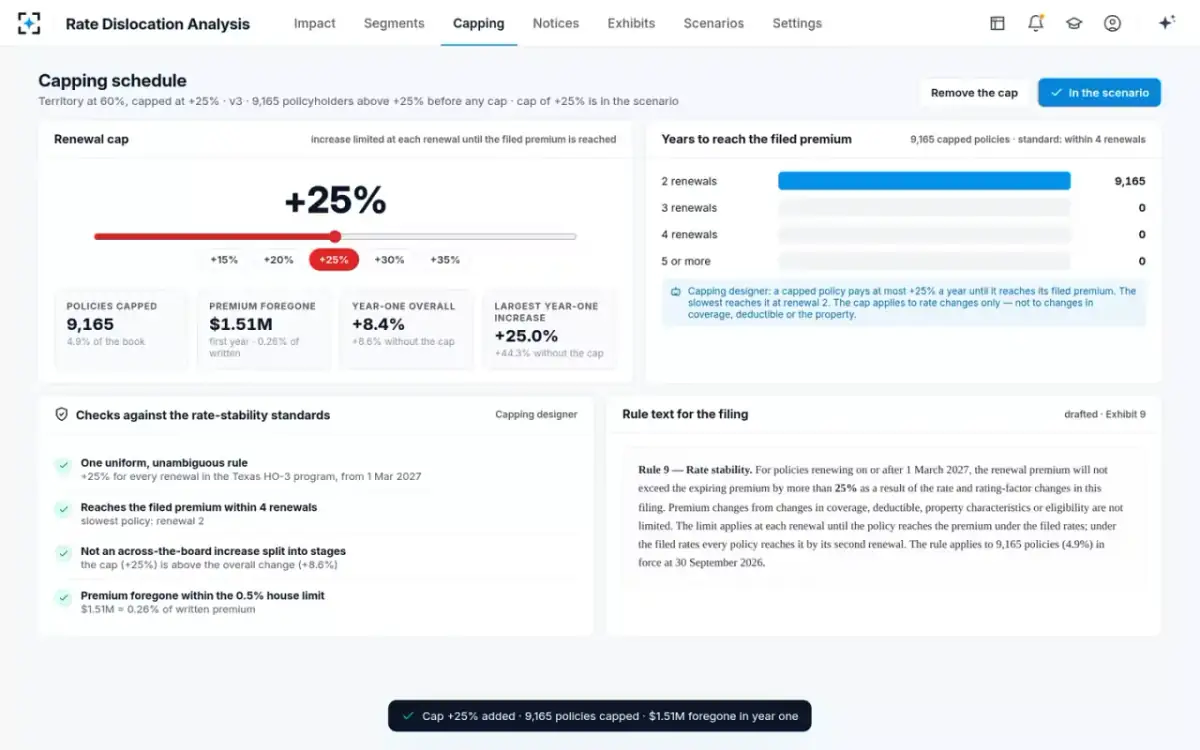
Under a premium transition rule, the policy pays at most the cap at each renewal until it reaches the premium under the filed rates. The CAS text's example: a 15% cap on a policy whose rate change is 20% gives +15% at the first renewal and "the remaining 4.3% ( = 1.20 / 1.15 - 1.0 ) at the second renewal." With a +25% cap, the sample Frisco policy at +56.6% would pay $4,950 at its first renewal and $6,188 at its second (4,950 × 1.25), leaving the last $15 of its $6,203 for a third. That is why the calculator above shows three renewals. On the scenario actually recommended, territory at 60%, the largest increase is +44.3%, and every capped policy reaches its filed premium by the second renewal.
Two rules in the CAS text decide whether a transition rule is fair. It should apply "only to premium changes directly resulting from company initiated rate changes", so a renewal whose insured adds coverage or buys a newer car is measured on the new characteristics at both old and new rates. And the company "should try to avoid long transition periods in order to minimize the chances of multiple overlapping transition periods created by multiple rate changes." The NAIC handbook for rate reviewers asks the same questions from the regulator's side, including "How would exposure change be addressed?" and "How many rate capping rules can be implemented at any given time?" (NAIC Product Filing Review Handbook).
What a cap costs, and who pays for it
A policy cap costs the premium it defers, and the insurer chooses who pays: the company, by accepting a lower year-one change, or the other policyholders, by raising the base rate to hold the overall change. On the sample Texas program, with territory at 60% of its indication, a +25% renewal cap limits 9,165 policies, 4.9% of the book, and forgoes $1.51 million of premium in the first year, 0.26% of the $585.5 million written. The year-one overall change falls from +8.6% to +8.4%. Every capped policy reaches its filed premium by its second renewal.
The CAS text describes the choice for the base rate: whether equilibrium is reached "over the whole time the proposed rates are in effect, or by the expected end of the transition period", adding that if the cap "applies equally to premium increases and decreases, and the rate changes are uniformly distributed, this is not an issue. However, that is not normally the case." Missouri's safe harbor takes a side: taken together, rate stability rules should be rate neutral or lower rates overall, so a cap may not be used to collect more premium than the rates would.
The cap, its cost and its checks, for the sample scenario
Rules for rate capping: what Washington, Missouri and Florida say
Capping is a filed rating rule, and some states set its limits. Washington's is a rule with force; Missouri's is guidance that describes a safe harbor. They agree on more than they differ.
Two states' standards for rate stability rules in personal lines
Washington, WAC 284-24-130 (effective 2013): A rule: a stability rule that fails it "will be considered to be unfairly discriminatory".
Missouri, Bulletin 20-01 (2020): Guidance: it "does not have the force and effect of law"; meeting it avoids enforcement.
Washington, WAC 284-24-130 (effective 2013): Revision of the insurer's own rating plan, an acquisition, or business moved between affiliates.
Missouri, Bulletin 20-01 (2020): Significant revisions to rating methodology, such as a new model; an acquisition; affiliate transfers.
Washington, WAC 284-24-130 (effective 2013): Policyholders who would otherwise see more than 10% on an annual policy (5% six-month).
Missouri, Bulletin 20-01 (2020): Policyholders who would otherwise see a change of 5% or more.
Washington, WAC 284-24-130 (effective 2013): Changes in coverage, exposure or policyholder characteristics; staging an across-the-board increase.
Missouri, Bulletin 20-01 (2020): Changes in the risk profile, such as driver ages, credit scores, homes or roofs, or limits.
Washington, WAC 284-24-130 (effective 2013): No effect on policies more than three years after the rule's effective date.
Missouri, Bulletin 20-01 (2020): Not longer than five years from the rule's original effective date.
Washington, WAC 284-24-130 (effective 2013): The next filing must reflect the rule's effect on the indicated rate level.
Missouri, Bulletin 20-01 (2020): Rate neutral or an overall rate decrease, in the aggregate.
Washington's staging ban deserves its own example, because it is the one a cap most easily breaks. A stability rule may not be "a substitute for multiple filings of base rate changes", and "if an insurer desires a twenty-one percent rate increase across the board, it cannot file a rate stability rule that has the effect of implementing two ten percent changes one year apart." A cap set below the overall change would do exactly that, which is why the sample's capping check compares the +25% cap with the +8.6% overall change.
Other states cap by statute for specific insurers or costs. Florida's Citizens Property Insurance Corporation must keep its annual rate increase for any single policy, excluding coverage changes and surcharges and except for sinkhole coverage, to 15% for 2026 and later years until its rates are actuarially sound (Fla. Stat. §627.351(6)(n)). Texas limits the windstorm association's filed rates to an average change of 10% and a class change of 15%, with exceptions written into the section (Tex. Ins. Code §2210.359). Whether any of this means a limit on what a household's premium can do in a year is a separate question, answered in is there a limit on how much insurance can increase per year.
From one policy to the whole book: the calculator before filing
A calculator for one policy answers a policyholder's question; a pricing team needs the same arithmetic for every policy and every scenario. Re-rated in full, the sample book with every factor at its full indication moves +11.9%, with 23,802 policyholders above +25%. With territory at 60% of its indication, +8.6% and 9,165. With the +25% cap added, +8.4% in the first year and nobody above the cap. Each of those is the calculator above, run 186,420 times and summed.
One slider, the whole book re-rated
For the full re-rate, the capping designer and the checks, start from Rate Dislocation Analysis.
Questions people ask
What is the formula for an insurance rate change?
For one policy, new premium = current premium × (1 + base rate change) × (1 + change in each relativity that applies), with fees added where the manual adds them. For a book, the overall change is total proposed premium ÷ total current premium − 1. The indicated overall change itself comes from the loss ratio method: the projected loss and expense ratio divided by the target, minus one.
What is an off-balance factor in actuarial pricing?
It is the adjustment to the base rate that offsets a change in the book's average relativity, so the overall change stays at the selected level. In the CAS example, relativity changes average +2.57%, so the off-balance is 1 ÷ 1.0257 = 0.9749. An exact off-balance comes from re-rating every policy.
What does premium capping mean in home insurance?
It limits how much a homeowner's renewal premium can rise at one renewal because of the insurer's rate change, phasing the rest in. Washington and Missouri both say a cap should not apply to changes in coverage, exposure or the property itself, such as a roof getting older. Florida's renewal notice for residential property must separate the dollars due to an approved rate increase from those due to coverage changes.
How do you calculate an overall rate change with a cap?
Re-rate each policy at full proposed rates, apply the cap to each renewal's rate change, and divide the capped total by current premium. On the sample book the uncapped scenario is +8.6% and the capped +8.4%, with $1.51 million foregone in the first year. If the overall change must hold, the base rate rises to recover the shortfall, and the capped policies' relativities are adjusted back down.
Can an insurer cap increases but not decreases?
It can propose an asymmetric rule, but regulators look at its total effect. Missouri's safe harbor requires stability rules to be rate neutral or produce an overall decrease in the aggregate, and the NAIC handbook asks whether decreases should be capped and what happens if a capped policyholder asks to be quoted as new business.