Regulatory filing automation for insurance companies is software that prepares, checks and tracks the rate, rule and form filings an insurer makes with state insurance departments, and the version worth trusting is the one that proves the filing agrees with itself. A single overall rate change appears in at least five places: the actuarial memorandum, the rate level exhibit, the manual rate pages, the SERFF rate/rule schedule and the notice to policyholders. Regulators read them side by side, insurers sign affidavits and certifications that they are true, and market conduct examiners later check that the rates charged match the rates filed. Botminds' Rate & Form Filing Automation is built around that test: its consistency checker ties every number, model version and edition date across the package and reports both values with their pages, and it never changes a figure itself.
One sample state package, checked before submission
18
items in the package: memorandum, exhibits, rate pages, forms and SERFF schedules
sample
412
numbers tied across those items by the consistency checker
sample
3
that differed, each routed to the person who owns it
sample
$1
the premium tolerance allowed between exhibits and SERFF fields
sample setting
What should regulatory filing automation do for insurance companies?
It should do three jobs and refuse two. Assemble each state's package from one program decision. Check it against the state's current requirements and against itself. Draft the words people will sign, such as objection answers, with every figure cited. And refuse to change an actuarial number or to submit anything on its own. The regulators' own documents describe the problem the first three solve: the NAIC's Product Filing Review Handbook says a fully compliant filing needs no correspondence beyond the approval, while a noncompliant one costs the reviewer a great deal of time to document (NAIC, 2024).
Most of what is sold as filing automation stops at the first job, faster forms. That helps with volume, but volume is not what draws letters. A department that receives a package where the memorandum, the exhibit and the SERFF field disagree has to ask which is right, and the question costs the insurer a round of correspondence whether the error was a typo or a judgement.
One number in five places
The overall rate change is the clearest example because every document states it. Trace the sample's South Carolina figure, a selected change of +11.2% on $58.7 million of written premium, and it appears five times before the filing leaves, each written by a different person at a different moment.
One overall rate change, traced through five documents
A person decides
1 · Actuarial memorandumSection 1 states the indicated +14.1% and the selected +11.2%, effective 1 February 2027. Written by the pricing actuary.
A person decides
2 · Rate level exhibitExhibit 1, line 9: the selected change and the premium it produces. Signed by the actuary, in version 3 of the exhibits.
Agent
3 · Manual rate pagesFourteen South Carolina rate pages whose base rates and factors must produce +11.2% overall on the in-force book.
Never: edits a rate on a manual page
Agent
4 · SERFF rate/rule scheduleOverall % rate impact, written premium change, policyholders affected, maximum and minimum change. In the sample, typed as 11.0% from version 2.
Never: submits the filing
A person decides
5 · Policyholder noticeWhere state law requires one, each renewal notice must reflect the filed change. The product manager owns the wording and timing.
Every one of those documents was correct when it was written. The SERFF field was typed on 2 October, when the second version of the exhibits selected 11.0%. The actuary's third version, uploaded the morning of the check, selected 11.2%. Nothing in the process was careless; the process simply had five copies of one decision and no step that compared them.
The overall change is not the only traveller. The same package carries the written premium change ($6,574,400 in the sample), the number of policyholders affected (22,640), the largest and smallest individual changes (+24.9% and −7.5%), the catastrophe model version, and the edition date of every form. Each of those also lives in more than one document. In the sample, the check tied 412 numbers across 18 items and found three that differed: the overall change, a model version in an exhibit footnote, and a form footer edition.
Insurance regulatory filing requirements that make consistency a legal matter
Consistency is not a matter of neatness, because insurers sign for their filings. California's affidavit, signed under penalty of perjury, declares "that the information filed in the above referenced submission is true, complete, and accurate" and that "the Excel templates submitted in the filing have not been altered in any way not expressly authorized by Department filing instructions" (CDI Affidavit, September 15, 2026 edition). In March 2026 the Commissioner warned that undisclosed changes to the Department's template formulas undermine the affidavit itself (CDI Bulletin 2026-2).
New York's speed-to-market certification puts an officer's name on the same promise, that the rate filing sequence checklist is true to the officer's knowledge, with disciplinary action against the insurer and the officer if it proves materially false (DFS form CERT-R). Florida keeps a door open after approval: within a year of a rate's effective date, the Office can still disapprove it as excessive if it finds a material misrepresentation or material error in the filing (Fla. Stat. §627.062(2)(g)).
And the check does not end at approval. The NAIC's market conduct examination standards for underwriting and rating begin with the requirement that the rates charged for a policy follow the filed rates, where rates are filed, or the insurer's rating plan (NAIC Market Regulation Handbook, examination standards). A filing whose rate pages do not produce the change its memorandum states is a filing an examiner can later compare with what policyholders paid. That is a sixth place the number lives: the rating system.
How to submit a rate filing in the SERFF filing system, and where errors enter
A SERFF rate filing is built in a fixed sequence: the filing wizard (state, line and type of insurance, filing type), the General Information tab with the filing description, the Rate/Rule Schedule with the rate information fields and the manual pages, the Form Schedule with each form and its edition, the Supporting Documentation tab with the memorandum, exhibits and state checklists, then fees and submission. New York's instructions say the information in the wizard and on the General Information tab "is in lieu of a separate transmittal document and/or a cover letter" (NY DFS filing instructions).
Errors enter at the schedules, because that is where facts are re-typed. The NAIC's uniform transmittal fields are built into every SERFF filing (NAIC, 2024), so the overall change, premium and policyholder counts are typed again by the analyst from the exhibits. Form editions are typed again into the Form Schedule from the forms. The memorandum and exhibits are attached as files, so they cannot drift from themselves, but the fields around them can.
States add their own cross-references. California asks that "The company tracking number stated on the Affidavit should be the same as the company tracking number used in SERFF" (CDI instructions, section II.B). New York asks that a filing based on one the Department did not approve name the earlier file or SERFF tracking number in the filing description. Each is a small consistency rule, and each one missed is a question.
The check that compares the five documents before SERFF
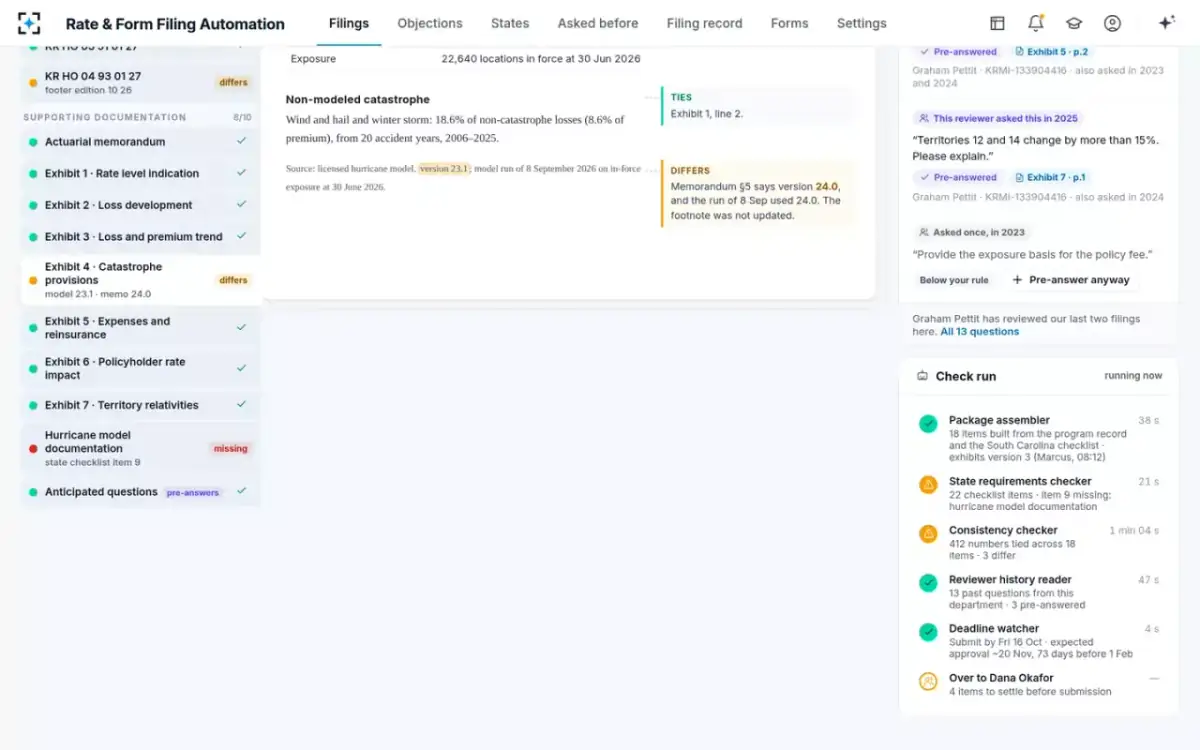
What a consistency check reads, and what it reports
A useful consistency check reads every document in the package, finds every value that appears in more than one, and reports any pair that differs with both values and both pages. That last part is what makes it trustworthy: a report that says "inconsistent" without showing where is a second search for the analyst. The tolerances belong to the insurer, not the tool.
What 'the same' means: the matching rules a filing team sets
Must match exactly
Rates, versions, editions, counts
Rate changes, model versions, form editions and policy counts must be identical everywhere they appear. Alternatives: rates and versions only, or everything including premium to the dollar.
Premium tolerance
$1
Rounding allowed between exhibits and SERFF fields, so a premium carried to the cent in an exhibit and to the dollar in SERFF is not flagged.
Before a filing leaves
Block while anything differs
Submission blocks while an item is inconsistent or missing. The analyst can still submit with a reason and a second signature from the chief actuary.
Who fixes what
The owner of the document
An exhibit or signature changes only with the actuary; a form only with the product manager; a SERFF field with the analyst, on the record.
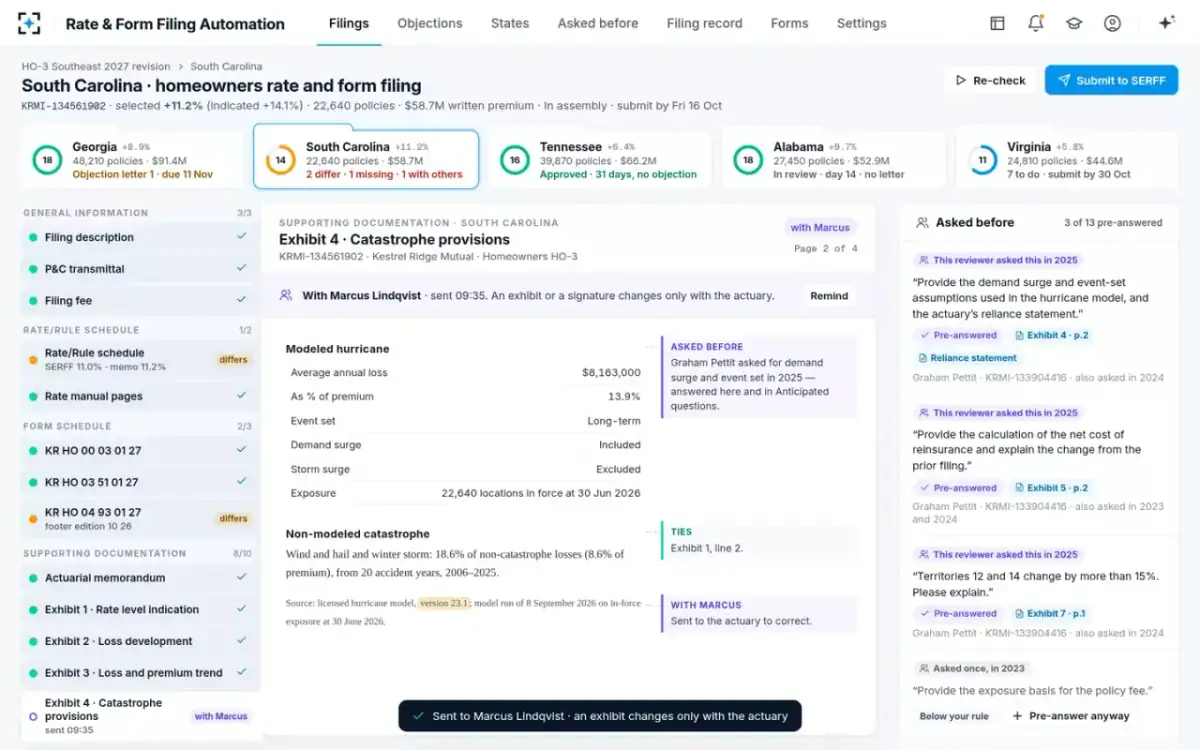
Routing is the other half. In the sample, the SERFF field was the analyst's to fix and took one click. The exhibit footnote naming hurricane model 23.1 was not: the analyst cannot edit an exhibit, so it went to the actuary, and the tab stayed marked until he corrected it. The form footer went to the product manager, who held the right copy.
A difference the analyst cannot fix, routed to the actuary
SERFF filing tips and tricks that are really consistency rules
Most SERFF filing tips and tricks passed between analysts are consistency rules in disguise. Decide the precision of the overall change once, and use it in the memorandum, the exhibit, the schedule and the notice. Type SERFF fields last, from the exhibits that will be attached, never from a draft. Read form editions from the footers, not from last year's schedule. Name every prior filing by its tracking number. Re-run the comparison after every new version of the exhibits.
The states' own instructions encode the same rules. New York's Exhibit RT-2 requires the overall rate effect to fall between the largest and smallest cumulative changes to individual policyholders (NY DFS instructions). Texas requires a notice to residential property policyholders of any renewal increase of at least 10%, sent no later than the 30th day before it takes effect (Tex. Ins. Code §2251.005), so the change in the filing and the change in the notice must agree. The NY DFS rate filing checklist collects New York's rules of this kind in one place.
Insurance regulatory filings by state: why the copies multiply
The copies multiply because filing is state by state and repeats every year. A Federal Reserve staff study of homeowners rate filings from 2009 to 2019 found that the average insurer in its sample operated in about 15 states and filed for a rate change in about 70% of its states each year (FEDS 2022-064). On those averages, one homeowners program means roughly ten state filings a year, and with five documents each, about fifty copies of the overall change alone to keep in line. That is our arithmetic on the study's averages, not a figure the study reports.
Other kinds of filing add their own repeated numbers. The NAIC handbook notes that filings can be made "for a single insurance company or multiple insurance companies within a group," and that an insurer responding to an advisory organization's loss cost filing may adopt it, decline it, or "implement with modifications" (NAIC, 2024). A group filing repeats each company's figures; a loss cost adoption carries a multiplier that must agree with the expense provision. New York writes that second rule into its instructions: the change in the loss cost multiplier must equal the product of the changes in loss cost modification and expense.
The handbook also says why the work never stops: "Most filings are modifications to existing programs in response to enacted legislation, regulations, court decisions, or to enhance an existing program." Every modification is a new version of documents that already agreed with each other, and a new chance for one of them to fall behind.
How to judge a regulatory filing automation claim
Judge a tool by what it finds on a filing you already know. Every vendor can demonstrate on its own sample; the test that matters is a replay on one of your past filings that drew an objection letter. Count how many of the department's questions a pre-submission check would have prevented, how many it would not, and how many of its findings your filing team agrees with.
Questions to ask before trusting a regulatory filing automation tool
- Show me a difference you found, with both values and both pages
A finding without its pages is a new search for the analyst.
- Run it on one of our past filings that drew a letter
Compare its findings with the department's actual questions.
- Which values do you compare, and with what tolerance?
Rates, model versions, form editions, counts and premium; the tolerances should be ours to set.
- Can the tool change a number in an exhibit?
The answer must be no; exhibits belong to the actuary.
- Does it check the version of the exhibits that will be filed?
Most mismatches come from a field typed from an earlier version.
- Who can override a block, and is the override on the record?
A reason and a second signature are the minimum.
- How does it learn a state changed its checklist?
Ask for the interval and the evidence from the last change.
Where filing automation fits beside SERFF and the portals, and where it stops
Rate & Form Filing Automation fits teams filing one program in several states, where one decision is copied into many packages and most of the effort goes into keeping them aligned. Where it does not: it will not tell you whether a selection is defensible, build an indication, or choose a model. It checks that the numbers the actuary produced appear the same way everywhere, and it drafts answers that cite them.
It also does not replace the regulators' own checks. California's portal generates a reconciliation report inside the Department's own templates, and each department's reviewer still reads the filing. The solution's job is the comparison none of those can make: your memorandum against your exhibits, your rate pages, your SERFF fields, your forms and your notices, before any of them leaves. In the fictional sample, that comparison is what found a SERFF field typed from an earlier version, a model version left in a footnote and a form footer carrying the wrong edition date, all before submission. Product filing automation software sets out the go-live plan, and responding to an objection in SERFF shows the drafting side. To see the five-document check on the sample, start from Rate & Form Filing Automation.
Questions people ask
What is SERFF filing?
SERFF, the System for Electronic Rates and Forms Filing, is the NAIC's web-based system through which insurers, third-party filers and advisory organizations submit rate, rule and form filings to state insurance departments, and through which departments review, correspond and decide. Nearly every jurisdiction accepts filings through it, and some, such as New York, require it for most filers.
What are insurance regulatory filings by state?
They are the rate, rule and form filings an insurer makes in each state where it writes a line, under that state's rating law and filing instructions. One program revision is usually one filing per state, each with its own checklist, reviewer and clock.
What is the regulatory filing automation insurance industry trend?
Regulators are automating their side: SERFF is moving to a modernized platform in waves of states, and California's portal now generates a reconciliation report filers must clear for its faster review timeline. Insurers' side is moving from filling forms to checking packages before submission.
Why do rate filings get objections for inconsistent numbers?
Because each document in a filing is written by a different person at a different time, and a reviewer reads them together. A SERFF field typed from an earlier version of the exhibits, or a footnote left from last year, is enough to prompt a question.
Can automation sign or certify a filing?
No. Affidavits and certifications are signed by people: in California an authorized representative, under penalty of perjury; in New York's speed-to-market procedure an authorized officer. Automation can make what they sign accurate; it cannot sign it.