An actuarial memorandum example for a property and casualty rate filing reads as a short argument with exhibits: a summary of the proposed change, a description of the data, the adjustments made to it, the indicated rate change, the selected change and why it differs, the catastrophe and expense provisions, and the effect on policyholders, with each statement pointing to the exhibit and line that proves it. It is the document a department's actuary reads first and returns to most. It is hard to write well because every number in it also appears in an exhibit, a rate page or a SERFF field, and a reviewer compares them. Botminds' Rate & Form Filing Automation does not write the actuary's memorandum; it takes the same actuarial memorandum and exhibits, cut for that state, and checks that every figure the memo states agrees with the page it cites.
In the actuarial report, the actuary should state the actuarial findings, and identify the methods, procedures, assumptions, and data used by the actuary with sufficient clarity that another actuary qualified in the same practice area could make an objective appraisal of the reasonableness of the actuary's work as presented in the actuarial report.
Actuarial Standards Board, ASOP No. 41, Actuarial Communications, §3.2
What is an actuarial memorandum?
An actuarial memorandum is the actuary's written explanation of how proposed rates were developed, filed with the exhibits that carry the calculations. Under the Actuarial Standards Board's terms it is part of an actuarial report, and ASOP No. 41 notes that a report "may comprise one or several documents," in which case "the actuary should communicate which documents comprise the report" (ASOP No. 41, §3.2). A memorandum that names its exhibits does exactly that.
The term is used in several practice areas. Life and health filings have actuarial memoranda too, and the NAIC's Product Filing Review Handbook mentions them for nonforfeiture and disability products. This guide is about the property and casualty rate filing memorandum, the one a homeowners or auto rate change carries, where the standard for estimating future costs is ASOP No. 53.
The NAIC handbook sets the reviewer's frame in one sentence, borrowed from the Casualty Actuarial Society's ratemaking principles: a rate is reasonable and not excessive, inadequate or unfairly discriminatory "if it is an actuarially sound estimate of the expected value of all future costs associated with an individual risk transfer" (NAIC, 2024). Every section of a memorandum is evidence for that sentence.
Actuarial memorandum rate filing requirements
The requirements come from two places: the professional standards every credentialed actuary follows, and each state's filing instructions. ASOP No. 53 asks the actuary to disclose "the methods or models used in developing or reviewing the future cost estimates" and "the material assumptions made by the actuary," and, when historical data are used, "any adjustments made to the historical data" (ASOP No. 53, §§4.1–4.2).
States then say what the memorandum must contain. California's prior approval instructions list a minimum: "a clear statement of the purpose of the filing," a summary of all proposed changes, "the underlying assumptions relied on for the changes," support for each selection of trend, development and catastrophe factors, "any adjustments/modifications to the data," "any credibility standard used together with justification for its use," and comment on "any model that has been used in any form, manner, or capacity" (CDI instructions, section V). California adds a sentence every drafter should read twice: "Unless the final approval letter explicitly states otherwise, any proposed changes not addressed within the Filing Memorandum are not approved."
New York asks for the same narrative in Exhibit RF-2 of its Rate Filing Sequence Checklist, covering every actuarial process, method and assumption applied to the company's data and any methodology change since the last filing, with expenses in RF-3 built from three years of the company's Insurance Expense Exhibit (NY DFS instructions, 06/2026). The NY DFS rate filing checklist walks those exhibits one by one.
Sections of an actuarial memo, in the order reviewers read them
The sections of an actuarial memo follow the ratemaking chain, and reviewers read them in that order because each step depends on the one before. The table maps each section to the exhibit it should cite and the question a reviewer brings to it.
Sections of a rate filing memorandum, the exhibit each cites, and the reviewer's question
| Section | Cites | The reviewer asks |
|---|---|---|
| 1. Purpose and summary | Rate level indication exhibit; SERFF rate/rule schedule | What changes, by how much overall, from what date, for how many policyholders? |
| 2. Data | Experience exhibits; reconciliation to the annual statement | Which years, which basis (accident, policy, report year), and does it tie to statutory data? |
| 3. Premium adjustments | On-level and premium trend exhibits | Are past rate changes and premium drift reflected correctly? |
| 4. Loss adjustments | Loss development and loss trend exhibits | How were development and trend selected, and from what fits? |
| 5. Catastrophe and large loss | Catastrophe provisions exhibit; model documentation | Which model and version, which years for non-modeled perils, what reliance? |
| 6. Expenses, reinsurance, profit | Expense and reinsurance exhibits | Why these loads, and is a net cost of reinsurance allowed here? |
| 7. Credibility and indication | Rate level indication exhibit | What standard, what complement, what indicated change? |
| 8. Selection and capping | Rate level indication exhibit; rating factor exhibits | Why does the selected change differ from the indication? |
| 9. Rating factors and territories | Territory and rating factor exhibits | How was the overall change allocated, and who moves most? |
| 10. Policyholder impact | Policyholder rate impact exhibit | What are the largest and smallest changes, and how many policyholders get each? |
An actuarial memorandum example, annotated
The example below is drawn from the fictional sample in Rate & Form Filing Automation: Kestrel Ridge Mutual's South Carolina homeowners HO-3 filing in its HO-3 Southeast 2027 revision, 22,640 policies and $58.7 million of written premium. Each excerpt is how a memo section states the figure; each note is what makes it hold up when a reviewer checks it.
Excerpts from a sample rate filing memorandum, with the exhibit each one must match
§1 Summary
"The indicated overall rate level change is +14.1%. The company selects +11.2%, effective 1 February 2027 for new business, affecting 22,640 policyholders and $6,574,400 of annual written premium."
Must match
Exhibit 1 line 9, the rate/rule schedule in SERFF and the policyholder impact exhibit. In the sample, SERFF said 11.0%.
§5 Catastrophe, modeled
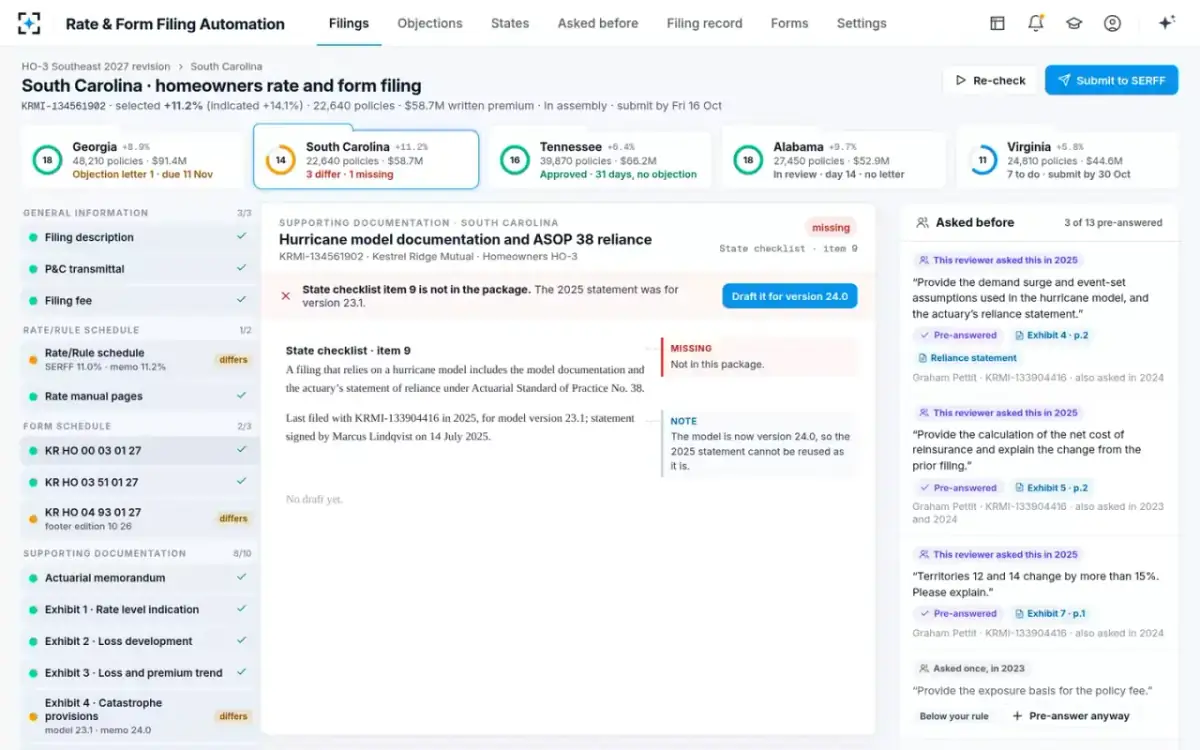
"Hurricane losses are provided by a licensed model, version 24.0, long-term event set, demand surge included, storm surge excluded, run on 8 September 2026 against in-force exposure at 30 June 2026. Average annual loss: $8,163,000, 13.9% of premium."
Must match
The catastrophe exhibit's footnote and the model documentation. In the sample, the footnote still said 23.1, and the reliance statement on file was for 23.1.
§5 Catastrophe, non-modeled
"Wind and hail and winter storm: 18.6% of non-catastrophe losses, 8.6% of premium, from 20 accident years, 2006–2025."
Must match
The catastrophe exhibit and Exhibit 1 line 2. State the years, the threshold and the weighting, or expect the question.
§10 Policyholder impact
"Individual changes range from −7.5% to +24.9%."
Must match
The policyholder impact exhibit and the SERFF schedule's maximum and minimum fields. The overall change must lie between them.
Three things make an excerpt reviewable. It states the number exactly as the exhibit does, with the same precision. It names where the number comes from: the exhibit and line, or the model run and date. And it gives the reviewer what they need to ask the next question without writing a letter: the years, the basis, the version.
The South Carolina example shows how a memo goes wrong without any section being badly written. The memorandum was right about the model version; the exhibit footnote was left from the previous year. The overall change was right in the memorandum; the SERFF field was typed from an earlier draft of the exhibits. A reviewer reading the memo against the exhibits finds both in minutes.
Indicated and selected: writing the gap
The selection section is where reviewers spend their judgement, because the indicated change is the actuary's estimate and the selected change is a business decision. The NAIC handbook accepts that insurers have reasons to depart from the indication, naming competition, marketing, legal concerns and retention, but expects the departure to be justified "within the constraints of the law" (NAIC, 2024). New York goes further: a selection not in line with the indication triggers its judgement exhibits, JDG-1 and JDG-2.
Write the gap as arithmetic and a reason. In the sample's South Carolina memo, the indication is +14.1% and the selection +11.2%, a gap of 2.9 points. The section should state what the selection does to the expected loss ratio, why the company accepts it (for example, to limit the largest individual changes, which reach +24.9%), and whether the remaining need will be filed later. In the sample's Georgia filing, the selection of +8.9% sits below an indication of +12.6%; the Georgia reviewer asked about the trend behind the indication, and the drafted answer states the indication both with the new trend and with the old one.
Capping belongs here too. Where a state permits premium capping or transition rules, the NAIC handbook lists the questions a regulator may raise, including whether all increases are capped or only those above a percentage, and how many renewal cycles pass before the new rates are fully in place. A memo that answers them in advance saves a letter.
Catastrophe and model sections: name the model, the version and the reliance
The catastrophe section carries the most disclosure because it rests on models most reviewers cannot run. The NAIC handbook says catastrophe models "are typically based on the potential loss under various simulations and are, thus, difficult for most regulators to evaluate" and that regulators "sometimes report inability to conduct detailed reviews of the models" (NAIC, 2024). What the reviewer can check is what the memo discloses.
The current professional standard is ASOP No. 38, revised in 2021 as "Catastrophe Modeling (for All Practice Areas)." It asks the actuary to disclose, among other things, the methodology used to validate the model, "a description of the user input that was incorporated into the catastrophe model," and "a description of adjustments made to the catastrophe model output" (ASOP No. 38, §4.1). A memo that names the model's version, event set, demand and storm surge settings and exposure date has written most of that disclosure.
A checklist item tied to the model version, flagged before submission
Predictive models get their own disclosure. Where a rating plan rests on a generalized linear model, the NAIC's white paper on the regulatory review of predictive models lists the information elements a reviewer may request, and California's instructions, quoted above, require the filing memorandum to comment on any model used in any way (NAIC, Regulatory Review of Predictive Models). Describing a model once in the memo, with its version, is cheaper than describing it in a response.
Rate filing exhibits: what each section must cite
Rate filing exhibits are the calculations; the memorandum is the explanation. California publishes a standard exhibit set, numbered up to Exhibit 21, and a reconciliation checklist listing which exhibit figures must agree with which template inputs, from on-level factors to catastrophe loads. Most states let the filer number its own exhibits, which makes it more important that the memo cites them by number, page and line.
From data to SERFF: where a memorandum's numbers travel
A person decides
Actuary builds the exhibitsExperience, on-level factors, development, trend, catastrophe provisions, expenses, indication, selection, impact.
A person decides
Actuary writes the memorandumExplains each exhibit, states each figure and names the exhibit, page and line it comes from.
Agent
Package assemblerCuts the program memorandum and exhibits for each state and fills the SERFF schedule fields.
Never: invents or edits an actuarial number
Agent
Consistency checkerTies every figure, model version and date in the memo to its exhibit, the rate pages and the SERFF fields.
Never: changes a figure; it reports both values and their pages
A person decides
Actuary corrects, analyst submitsThe actuary fixes any exhibit or memo text; the analyst submits once the package agrees with itself.
Revisions are where citations break. The sample's analyst typed the SERFF overall change on 2 October from version 2 of the exhibits; the actuary uploaded version 3 on the morning of the check. A memo that says "Exhibit 1, line 9" is only as good as the version of Exhibit 1 that ships with it, which is why the check runs on the exhibits as they will be filed.
Where reviewers stop reading
Reviewers stop reading at the first number they cannot trace, and write a letter. In our reading of the NAIC handbook's review topics and the states' instructions, the usual stopping points are a trend selection with no fits shown, a catastrophe load with no years or no model version, a net cost of reinsurance in a state that requires direct data, a credibility standard named but not justified, and an overall change that differs between the memo and the schedule.
The handbook gives the actuary room on judgement, and says in terms that a trend selection need not match a formula, but room is not silence. A judgement stated with its range, here the fits on either side and the indication with and without the change, is a paragraph. A judgement left unstated is a letter, and responding to an objection in SERFF shows what that letter costs.
Before the memorandum goes: a ten-minute self-check
- The overall indicated and selected changes are stated once, and match the indication exhibit and the SERFF schedule
Same precision everywhere: decide whether it is 11.2% or 11.19%.
- Every figure names its exhibit, page and line
Cite the version that will be filed.
- Data basis, years and the tie to statutory data are stated
Accident, policy or report year; the reconciliation to the annual statement.
- Trend and development show the fits and the reason for the selection
Give the range; the handbook does not require a formula match.
- Catastrophe models are named with version, event set, settings and run date
And a reliance statement that matches the version.
- Non-modeled catastrophe provisions state years, threshold and weighting
The handbook describes 20 or more years as the traditional base.
- The gap between indicated and selected is explained
As arithmetic and as a business reason.
- Credibility standard and complement are stated and justified
California and New York both ask for it.
- Policyholder impact gives the largest, smallest and overall change
The overall must lie between the other two.
- Every proposed change appears in the memo
In California, a change not addressed in the memorandum is not approved.
Rate & Form Filing Automation runs the mechanical half of that list on every state package: the figure-by-figure tie between memo, exhibits, rate pages and SERFF fields, the model version in each footnote, and the presence of each checklist item. The other half, whether a selection is defensible, stays with the actuary. To see the check run on the sample memorandum, start from Rate & Form Filing Automation; for the clock that a clean memo protects, see the rate filing approval timeline.
Questions people ask
What is the definition of an actuarial memorandum?
It is the actuary's written explanation of how a filed rate, reserve or product was developed, filed alongside the exhibits that contain the calculations. In property and casualty rate filings it sets out the data, adjustments, indication, selection and impact, and it forms part of the actuarial report under ASOP No. 41.
Who signs an actuarial memorandum?
The actuary responsible for the work, usually the pricing actuary, who must meet the qualification standards that apply. Some states also want an officer's certification of the filing as a whole, such as New York's speed-to-market rate certification.
How long should a rate filing actuarial memorandum be?
As long as it takes to explain every proposed change and every material assumption, and no longer. California's rule sets the floor: any proposed change not addressed in the memorandum is not approved unless the approval letter says otherwise.
Where can I find actuarial memorandum examples from real rate filings?
Many states make filed rate filings public, often through SERFF Filing Access or a department's own viewing room; the NAIC describes SERFF as one way states meet their public access laws. Read several from the same state and line, since each state's instructions shape the memo.
What are rate filing exhibits?
They are the numbered calculation tables a memorandum explains: experience, on-level and trend factors, loss development, catastrophe provisions, expenses, the rate level indication, territory and rating factors, and policyholder impact. California prescribes a standard exhibit template; most states let the filer design and number its own.