The NY DFS rate filing checklist is the Department of Financial Services' Rate Filing Sequence Checklist, a mandatory form for every property and casualty filing of rates, rating rules, classifications, territories or rating plans, on which the insurer marks each of 36 numbered exhibits yes or no and files the exhibits in that order. It makes a filing complete. It does not make the filing consistent: the overall rate change in the actuarial memorandum, the side-by-side rate pages, the policyholder impact exhibit and the SERFF schedule can each be present and still disagree. Reviewers read the numbers, not the ticks. Botminds' Rate & Form Filing Automation checks both tests before submission: its state requirements checker marks every checklist item present or missing, and its consistency checker ties each number across every document in the package.
New York's checklist in four numbers
2002
the year the Rate Filing Sequence Checklist became mandatory, for filings from 16 September
Circular Letter 11, Supp. 4
36
numbered exhibits on the current form, each marked yes or no
Ed. 6/2026
5
years of raw loss experience Exhibit JDG-2 asks for when rates rest on judgement
RFSC instructions
0
paper filings accepted from most insurers: Regulation 195 requires SERFF
NY DFS
What is the NY DFS rate filing checklist?
It is the form that sets the minimum contents and the order of a New York property and casualty rate filing. The Department introduced it in 2002 for a stated reason: "We have found that delays in the review process are often the result of insurers' submissions that are either incomplete or are not drafted in accordance with statutory and regulatory requirements applicable to the subject of the filing" (Supplement No. 4 to Circular Letter No. 11). The checklist, it said, "incorporates the minimum information required by the Department for the approval/acknowledgement of rates, rules and rating plans filings."
Two other documents sit beside it. The review standards checklists, by line of insurance, list the legal requirements a filing's forms and rules must meet, and DFS says their attachment "is mandatory for all filings submitted through SERFF." The compliance questionnaires cover specific rules, such as a consent-to-rate filing. DFS is explicit about their limits: "compliance with the review standards checklists or compliance questionnaires alone does not guarantee approval of any filing" (DFS Property Insurer Rate Filing Instructions).
The NAIC describes the national version of the same idea. Its Review Standards Checklists "were designed to help insurance companies verify the filing requirements of a state before making a rate or policy form filing," and "Some states post Review Standards Checklists to their state websites, while others incorporate the contents of the checklists into the SERFF filing submission requirements" (NAIC Product Filing Review Handbook, 2024). New York does both.
The NY rate filing sequence checklist, exhibit by exhibit
The NY rate filing sequence checklist groups its 36 exhibits into families, and a typical homeowners rate revision touches most of them. The form says every line must be checked yes or no; a "no" carries a printed reason, such as "Filing contains no actuarial data" for the actuarial memorandum. DFS asks for the checklist and exhibits "in one component and bookmarked in order of appropriate exhibits."
The 36 exhibits of New York's Rate Filing Sequence Checklist, by family
| Family | Exhibits | What a homeowners rate revision usually supplies |
|---|---|---|
| Rate filing basics (RF) | RF-1 to RF-4 | Supplemental explanatory memorandum, actuarial memorandum, expenses, investment income |
| Rate impact (RT) | RT-1 to RT-5 | Side-by-side current and proposed rates; policyholder rate level changes; policy counts; insurer and program information; flex-rating if it applies |
| Experience (EXP) | EXP-1 to EXP-6 | Overall indication, premium and loss adjustments, credibility, class and territory indications, rating factor indications |
| Supplements (SUPP) | SUPP-1 to SUPP-3 | Multi-tier programs, personal lines catastrophe reinsurance loads, homeowners hurricane deductibles |
| Judgement (JDG) | JDG-1, JDG-2 | Explanation of key areas of judgement and raw loss experience, when rates depart from the indication |
| Competition (CMP) | CMP-1 to CMP-4 | Competitor analysis, only where rates rest on a competitor's |
| Advisory organizations (RSO) | RSO-1, RSO-2 | Adoptions of rate service organization filings and loss cost modification support |
| Other | TR-1, FHV-1 to 3, STM-1, STM-2, RP-1 to 3, MRP-1 | Motor tort reform, for-hire vehicles, speed-to-market certifications, rating plans, manual rate pages |
Three exhibits do most of the work on a personal lines property filing. Exhibit RF-2, the actuarial memorandum, must contain "A detailed narrative of all actuarial processes, procedures, methodologies and assumptions that were applied to the company's data" and a description of any methodology change since the last filing. Exhibit RT-2 shows the effect on existing policyholders, including a histogram in 10% bands and the largest single dollar increase for any renewal. And Exhibit RT-4, required "for all personal lines property rate filings," asks for the business plan, approximate market share and "the company's most recent four rate level changes" (RFSC instructions).
New York rate filing requirements: JDG-2 and the judgement exhibits
JDG-2 is the exhibit that holds an insurer to its own data when it chooses not to rely on it. If any part of the proposed rates rests on judgement, or the proposed rates are "not in line with the company's experience indications," Exhibit JDG-1 must explain the judgement, and the company "must satisfy its burden under Article 23 of the NYIL" that the rate is adequate, not excessive and not unfairly discriminatory (RFSC instructions).
JDG-2 then asks for "The latest 5 individual years (or as many individual years as are available) of raw experience (i.e., unadjusted earned premiums and incurred losses by year)" and "A detailed explanation of why the company has chosen not to rely on its experience as the primary basis of support." An insurer that calls its data not credible must show it: "it must substantiate this belief by using a credibility formula to determine the actual credibility of the data."
That is a consistency rule hiding in a completeness form. The raw premiums and losses in JDG-2 must be the same data that produced the indication in EXP-1 and the credibility in EXP-4. A reviewer who sees five years of raw experience that cannot be reconciled to the indication has a question for the actuary, whatever the checklist says.
Speed-to-market filings: an officer certifies the checklist
New York offers an optional speed-to-market procedure in which an officer certifies the filing and the Department relies on that certification. Since 2000, filings "accompanied by properly completed checklists and appropriate Compliance Certification(s) will be given priority in processing" (Supplement No. 3 to Circular Letter No. 11). On the rate filing sequence checklist these are Exhibits STM-1, the master list of compliance checklists, and STM-2, the rate and rating plan compliance certification.
The certification is a signed statement about the checklist itself. The officer certifies that "the information contained in the rate filing sequence checklist indicated in the Master List of Compliance Checklists, as submitted with, and made part of this filing, is true to the best of my knowledge and belief," and acknowledges that if it "is materially false or incorrect, appropriate corrective and disciplinary action" may follow against the insurer and the officer (DFS form CERT-R). DFS adds that it will hold the officer responsible for an electronic signature "to the same extent that the person would be held responsible" for a wet one.
Two limits apply. The speed-to-market procedure is not available for rate filings for personal automobile, public automobile, workers' compensation, or physicians' and surgeons' medical malpractice. And priority in processing rests on the Department's reliance that "all statutes and regulations applicable to the filing have been duly considered and incorporated therein." A certified filing that disagrees with itself is the worst of both: faster to the reviewer, and signed. The insurance speed to market definition looks at what that kind of speed does and does not count.
Complete is not consistent: the four cases
A filing passes two separate tests, and the checklist measures only one. Complete means every required exhibit is present. Consistent means every number, version and edition that appears in more than one place has the same value everywhere. The four combinations behave very differently once a reviewer opens the filing.
Complete and consistent are two tests, and only one of them is on the checklist
Consistent with itself
Disagrees with itself
Complete
Complete · consistent
Ready. In the sample, 18 of 18 items complete and consistent after the fixes, submitted with three past questions pre-answered.
Complete · inconsistent
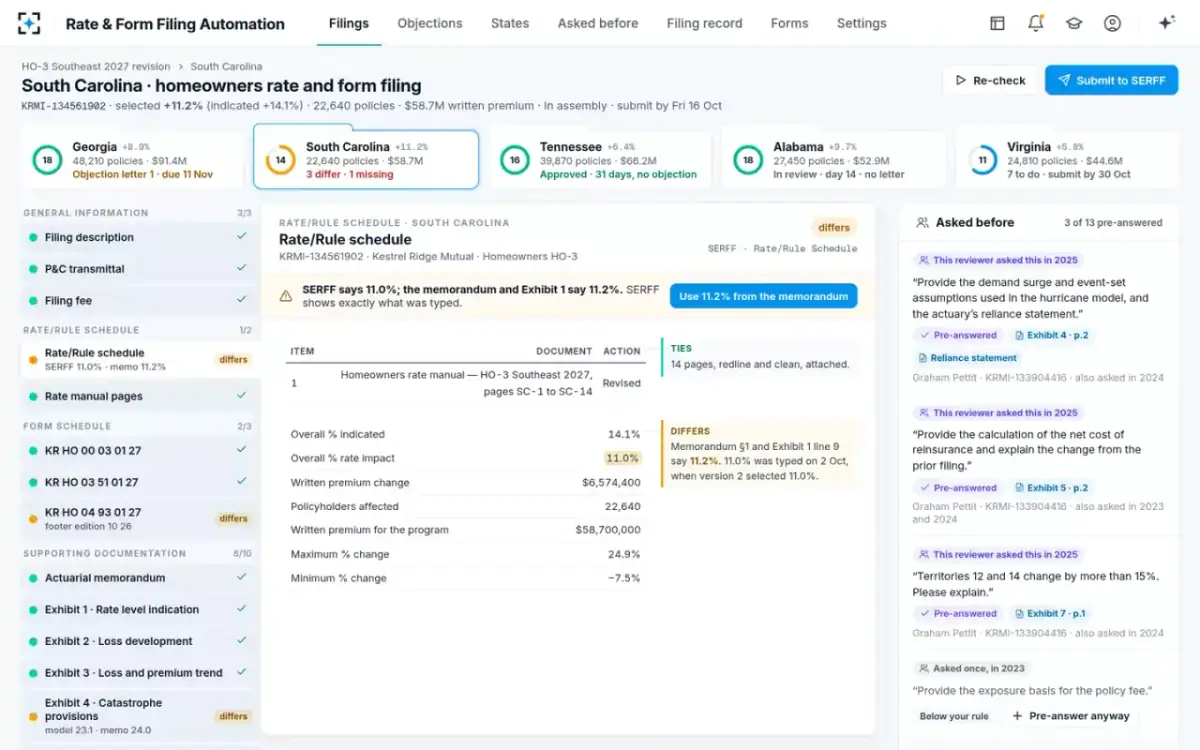
Every box ticked, and a letter anyway. In the sample, SERFF's overall change typed as 11.0% against 11.2% in memorandum §1 and Exhibit 1. No checklist line catches it.
Incomplete
Incomplete · consistent
Rates rest partly on judgement and JDG-1 explains it, but JDG-2's five years of raw experience are missing. The numbers agree; the filing still is not acceptable as filed.
Incomplete · inconsistent
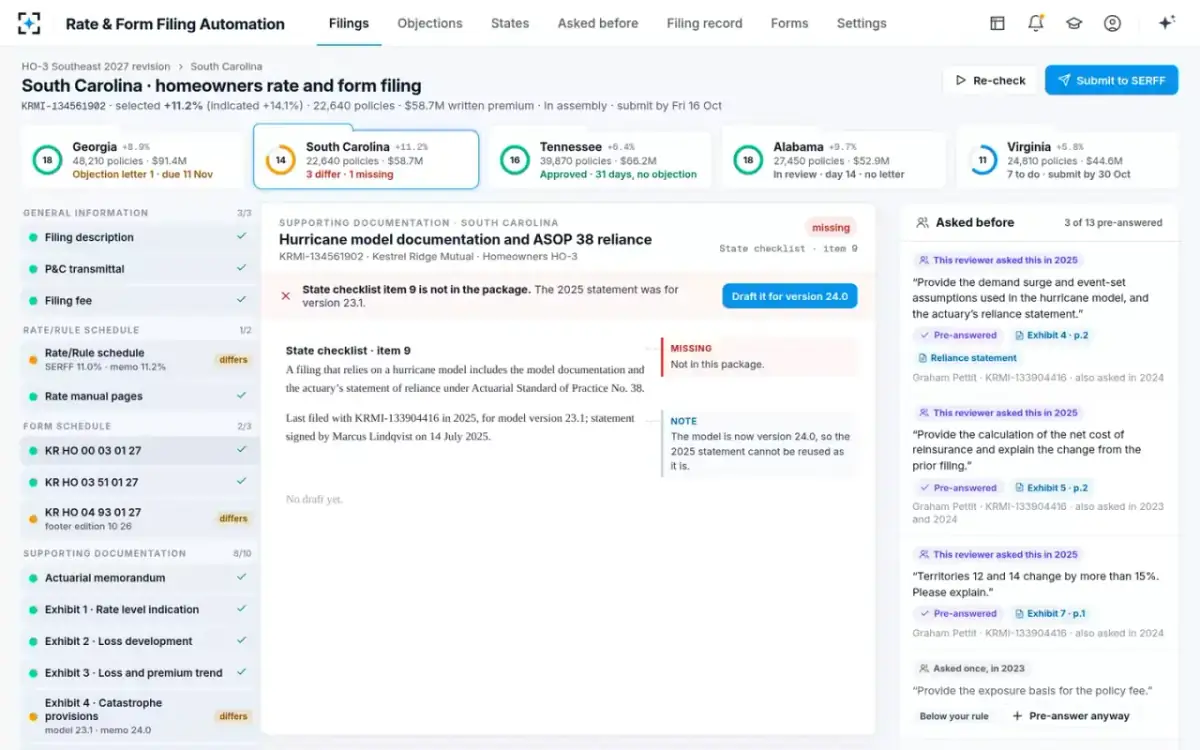
The hardest cell to recover from, because two kinds of fix are needed. In the sample, checklist item 9 was missing while an exhibit footnote named the old hurricane model version.
The top-right cell is the one that costs the most, because nobody inside the company sees it. Every owner ticked their exhibit. The analyst typed the rate/rule schedule from version 2 of the exhibits on 2 October; the actuary selected 11.2% in version 3. Each document is correct for the moment it was written.
Complete, and still inconsistent: the SERFF field and the memorandum disagree
Which numbers must agree across a New York filing?
The New York instructions themselves contain several arithmetic rules, and they are the best evidence that DFS reads across exhibits. Exhibit RT-2 states one outright: "The overall rate effect must always fall between the largest and smallest cumulative rate effects." Exhibit RSO-1 states another: "The percentage change in loss cost multiplier must equal the product of the percentage change in loss cost modification and the percentage change in expense" (RFSC instructions).
California went further and published the cross-checks it most often has to make. Its Data Quality and Reconciliation Checklist names "the common data reconciliation errors the Department encounters when reviewing an insurer's filing" and lists, for example, comparing written and earned premiums across the annual statement, the rate template, the application and two exhibits, and checking "that the trend period for premium in Exhibit 5 is the same as that for loss in Exhibit 8" (CDI reconciliation checklist). New York has no equivalent form, but the same disagreements draw the same questions.
What the checklist asks, and what the reviewer then reads
The checklist asks: Is it included? (yes or no)
The reviewer reads: Whether the overall change, trend and catastrophe load it states match EXP-1, EXP-3 and the rate pages
The checklist asks: Three years of Insurance Expense Exhibit data and the selected loads
The reviewer reads: Whether a selection that differs from the three-year average is explained, as the instructions require
The checklist asks: Current and proposed rates with the percentage change
The reviewer reads: Whether the proposed column matches the manual rate pages filed in the rate/rule schedule
The checklist asks: Largest, smallest and overall effect, histogram in 10% bands
The reviewer reads: Whether the overall effect lies between the largest and smallest, and matches the SERFF schedule
The checklist asks: The agreement and the allocation to New York
The reviewer reads: Whether the reinsurance premiums reconcile to the amounts allocated, step by step
Rate filing checklist 2024 to 2026: why the version matters
Checklists change, and a rate filing checklist from 2024 is not the 2026 form. New York's rate filing sequence checklist carries its edition on every page, Ed. 6/2026 at the time of writing, and its instructions are dated 06/2026. The current Exhibit TR-1 asks motor vehicle filings for the decrease in claims expected from reforms "enacted by Part F of Chapter 55 of the laws of 2026, and by Part EE of Chapter 58 of the Laws of 2026," a requirement no earlier edition could carry.
DFS's own advice on its review standards checklists applies to all of them: "As these are subject to ongoing updates, please always check to make sure you are using the current version in SERFF." California's change log for its prior approval package records seven updates in 2026 alone. A filing built from last year's checklist can be complete against the wrong list.
That is the case for reading the checklist from the department's current instructions each time rather than from a saved copy. In Rate & Form Filing Automation, each department's checklist is read from its current filing instructions and checked monthly for changes; that interval is a setting, and the first filing after a change is where a team should look hardest.
SERFF filing requirements by state: what a checking tool should do
A tool that helps with a New York filing should do three things a person does slowly and two things it must never do. It should read the state's current checklist and mark each item present or missing with the reason. It should tie every number, model version and edition date across the memorandum, exhibits, manual pages, SERFF fields and forms, and report both values with their pages. And it should tell you who owns each fix.
Before a New York rate filing goes: consistency checks the checklist does not ask for
- The overall rate change is the same in RF-2, EXP-1 or JDG-1, RT-2 and the SERFF rate/rule schedule
Rounding is the usual culprit; decide the precision once and use it everywhere.
- RT-2's overall effect lies between its largest and smallest cumulative changes
DFS states this rule in the instructions; a failure here is arithmetic, not judgement.
- RT-1's proposed column matches the manual rate pages attached to the rate/rule schedule
The side-by-side is often built from a draft manual.
- Expense loads in RF-3 match the expected loss ratio used in the indication
A changed commission load must flow through to the loss cost multiplier in RSO-1 if loss costs are adopted.
- JDG-2's raw premiums and losses reconcile to the data behind EXP-1
Five years, unadjusted, by year.
- Model names and versions agree in the memorandum, catastrophe exhibits and SUPP-2
A footnote is the place an old version survives.
- The checklist and certification forms are the current editions
Check the edition line on each page against the DFS site.
And the two things it must never do: change a figure, and certify the filing. The numbers belong to the actuary, and in a speed-to-market filing the certification belongs to an officer whose signature DFS treats as a wet one. The solution's consistency checker "never changes a figure" and reports both values and their pages; the state requirements checker "never waives a requirement." Submission is blocked while an item differs or is missing, unless the analyst records a reason and the chief actuary adds a second signature.
A missing checklist item, with the reason it cannot be reused
Where the solution fits, honestly: its sample filing runs in Georgia, South Carolina, Tennessee, Alabama and Virginia, and it reads each department's checklist the same way, so New York's 36 exhibits are a configuration, not a different product. Where it does not fit: it will not decide whether a judgement in JDG-1 is defensible, and it will not tell you whether DFS will accept a competitor-based rate. Those are the actuary's and the product manager's calls. For the same two tests applied to California's templates, see the California prior approval rate filing instructions; to see the checks run on the sample package, start from Rate & Form Filing Automation.
Questions people ask
Is the NY rate filing sequence checklist mandatory?
Yes, for every New York property and casualty filing containing rates, rating rules, classifications, territories or rating plans, since 16 September 2002. DFS's filing page says it "must be completed for any filing containing rates, rating rules, classifications, territories, or rating plans," whether filed on a speed-to-market basis or not.
What is Exhibit JDG-2 in a New York rate filing?
JDG-2 is the raw loss experience exhibit: the latest five individual years of unadjusted earned premiums and incurred losses, and an explanation of why the company did not rely on that experience. It is required when JDG-1 is completed because rates rest on judgement, and the company has New York or countrywide experience for the classes affected.
Does New York require SERFF for rate filings?
Yes. Insurance Regulation 195 (11 NYCRR 6) §6.2(a)(2) requires rate, rating plan, rule, manual, classification, territory and form submissions through SERFF, with limited exceptions and exemptions in §6.3. DFS stopped requiring a separate cover letter in SERFF filings and asks for that content in the filing description.
What is a filing checklist for an insurance company?
It is a regulator's list of what a rate or form filing must contain, often with the statute or rule behind each item and a place to show where in the filing it is met. The NAIC calls them Review Standards Checklists; some states post them on their websites and others build them into SERFF's state requirements.
Is homeowners insurance prior approval in New York?
New York's Insurance Law §2305(a) says prior approval of rates "shall not be required" except for the lines listed in §2305(b), and that list includes private passenger automobile insurance, subject to §2350's flex rating, but not homeowners. The exemption carries a sunset date, which Chapter 150 of the Laws of 2026 moved from 30 June 2026 to 30 June 2029 (S10582/A11367). Homeowners rates are still filed and reviewed, and the rate filing sequence checklist applies to them.