A rate filing approval timeline runs from the day a filing reaches the department to the day the rate can be used, and its floor is set by each state's rating law: a Texas residential property rate can be used on and after the day it is filed, and the Commissioner has at most 30 days to disapprove it before it takes effect; a Florida "file and use" filing waits for a review of up to 90 days; a California prior approval application is deemed approved 60 days after public notice if no hearing is required, with a 180-day backstop. Everything above the floor is time a department spends asking and an insurer spends answering. Each of those days has a price: premium the approved rate would have earned. Botminds' Rate & Form Filing Automation works on the cheapest days to save, the ones before submission, by checking each state's package against its checklist and against itself so that fewer questions come back.
The statutory floors under a rate filing approval timeline
30days
at most for Texas to disapprove a filed rate before it takes effect; once in effect, only after a hearing
Tex. Ins. Code §§2251.103–.104
90days
for Florida to finish a "file and use" review, or the rate is deemed approved
Fla. Stat. §627.062
60days
after public notice before a California application is deemed approved, if no hearing applies
Cal. Ins. Code §1861.05(c)
<95days
average for California's first two Sustainable Insurance Strategy approvals in 2025
CDI 2025 Annual Report
How long does a rate filing take to process?
A rate filing takes as long as the state's rating law allows at minimum and as long as the questions take at most. The NAIC's Product Filing Review Handbook describes the best case from the reviewer's chair: "It is easy to process a filing that is fully compliant. No communication with the filer is needed, other than to send a notice that the filing is approved or acceptable for use" (NAIC, 2024). Every exchange of letters adds a round trip.
There is no national published average. The NAIC's Speed to Market Working Group noted in October 2025 that the SERFF metrics report once given to commissioners, including "turnaround times for those filings," had not been distributed "for approximately five years," with a new state-by-state report planned from 2026. A Federal Reserve staff study of homeowners filings from 2009 to 2019 found that "execution times are on average larger in high friction states," its term for states where rate regulation binds hardest (FEDS 2022-064). What a filing team can measure is its own calendar, state by state.
In the fictional sample used in this guide, Kestrel Ridge Mutual's HO-3 Southeast 2027 revision, Tennessee approved after 31 days with no objection, Alabama was on day 14 with no letter, and Georgia was answering its first objection letter. The same program, filed the same autumn, ran on five different clocks.
Rate filing approval times by rating law
Rate filing approval times follow the rating law. Under file and use, the rate is usable on filing and the department has a window to disapprove. Under prior approval with a deemer, the rate waits, but approval arrives by operation of law if the department does not act. Under flex rating, the size of the change decides which of the two applies. File and use vs use and file sets out the families in detail; the timeline below draws the clocks to scale.
Five rating-law clocks for a homeowners rate change, drawn to scale in days
- Disapproval window, if not yet in effect30 d
- Extension for good cause+30 d
- Filed before use30 d
- Waiting period60 d
- Extension on notice+60 d
- Review to notice of intent90 d
- Review60 d
- Extension+30
- Extension+30
- Accept or reject10
The Florida lane shows why names mislead. Florida calls it file and use, but only a filing made at least 90 days before its effective date, and not put into use while the Office reviews it, earns the label (Fla. Stat. §627.062(2)(a)1.). In practice a Florida homeowners insurer waits for the Office's notice or the 90th day. Texas's file and use, by contrast, lets an insurer use a rate from the day it is filed (Tex. Ins. Code §2251.101(a); both statutes are quoted in file and use vs use and file).
Deemer period insurance law: what the clock does when a reviewer asks a question
A deemer period is the number of days after which a filing is treated as approved if the regulator has not acted. California's is written into Proposition 103: an application "shall be deemed approved sixty days after public notice" unless a consumer requests a hearing within 45 days, the Commissioner orders one, or the change exceeds 7% for personal lines and a hearing is timely requested, and "In any event, a rate change application shall be deemed approved 180 days after the rate application is received" (Cal. Ins. Code §1861.05(c)).
The deemer is only as strong as the state's rule on questions. Texas excludes the days an insurer takes to answer a request for information from its 30-day count, so a slow answer delays the decision day for day. Florida does the reverse for its 90 days, so a slow answer risks a notice of intent to disapprove. California asks insurers to waive the deemed-approved dates: "Frequently, the Department requests rate applicants to waive the 'deemed approved' dates set forth in Insurance Code section 1861.05(c)," and its instructions warn that refusing may require the Department "to issue a notice of hearing" (CDI instructions, October 2026 edition).
California's admission of the gap is on the record. In 2024 the Commissioner wrote that "the Department's rate application review and approval process has extended beyond Prop. 103's existing statutory approval timelines," citing among other causes "insurance companies filing incomplete applications" and intervenors not ready to engage "until weeks or even months after the timeline" (CDI Bulletin 2024-7). The Bulletin's answer was a 60-day review from public notice with at most two 30-day extensions, each with a written status of the issues still open.
What a day of delay costs: the arithmetic
A day of delay past the planned effective date costs one day's worth of renewals written at the old rate for a full policy term. If renewals are spread evenly through the year, that is the annual premium change divided by 365. On the sample's South Carolina filing, an 11.2% change on $58.7 million of written premium, the annual change is $6,574,400, or about $18,000 for each day the effective date slips.
The price of one waiting day on one state filing
Annual premium change
$6,574,400
11.2% × $58.7 million of written premium
One day
$18,012
÷ 365
One week
$126,084
× 7
One 30-day objection round
$540,362
× 30, if it pushes approval past the effective date
Across the five-state program
$73,041 a day
$26.66 million of annual premium change ÷ 365, if every state slipped together
Two caveats keep the arithmetic honest. First, the cost is zero while approval still lands before the effective date: a filing approved 73 days early, as the sample's South Carolina filing is expected to be, has room for an objection round. Second, the loss is not recovered later. A renewal written at the old rate on a day of slippage stays at the old rate for its term; the next filing does not refund the difference to the insurer.
There are costs the arithmetic leaves out: the filing team's own time on each letter, and the risk that a late approval collides with each state's notice rules for renewals. Botminds' estimate for drafting answers to one objection letter is about four working days by hand and half a day with the solution, with the actuary's day of review unchanged; that is an estimate from the sample's steps, not a measured result.
Time is not the only thing that waits
A longer review also tends to end in a smaller rate. The same Federal Reserve staff study found that, conditional on filing, the average homeowners filing sought a 15.6% change and received 5.85%, and that the average insurer filed in 70% of the states and years in which it wrote business (FEDS 2022-064). The study's authors present the gap as a measure of regulatory friction, and their views are their own; for a pricing team, it is a reminder that a question answered badly can cost points as well as days.
Requested and received: the average homeowners rate change, 2009–2019
California publishes its own version of the same fact. Its Rate Regulation Branch processed 3,282 property and casualty rate, rule and form filings in 2025 and says its review cut requested increases by more than $736 million (CDI 2025 Annual Report). Not every reduction follows a question, but most questions are where reductions are argued.
Where the days go inside the company
Most of a filing's calendar is spent before the department sees it. Botminds' estimate for one state's homeowners rate and form filing, by hand, is four working days assembling the package, three checking numbers, editions and the checklist, and a day finding what the department asked before; with the solution, those fall to one, half and half a day. The actuary's day of review and sign-off does not change.
Those internal days do not show on any department's timeline, but they decide where the filing starts it. The sample's South Carolina filing had to be submitted by Friday 16 October to be approved by around 20 November with 73 days to spare before 1 February. Every day of assembly past that date comes out of the margin, and the margin is what absorbs an objection round.
The deadline watcher works back from the effective date
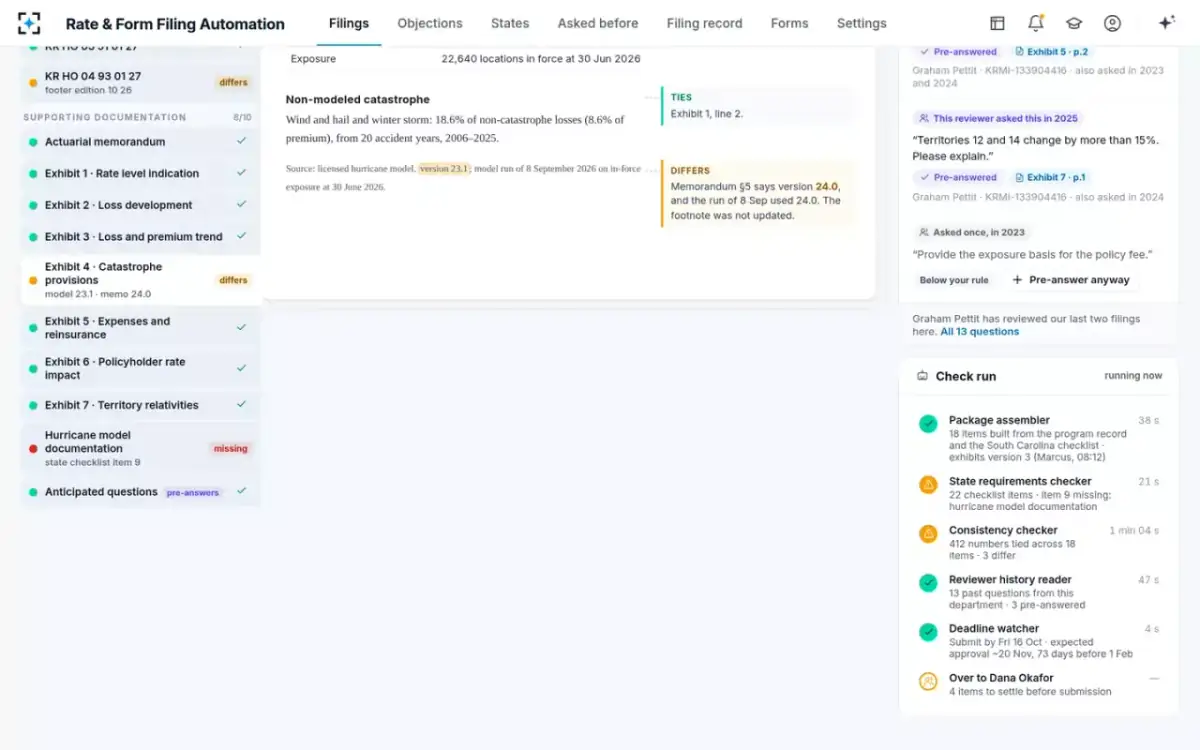
The cheapest days to save are before submission
A day saved before submission costs nothing at the department and nothing in goodwill. The NAIC handbook puts it from the reviewer's side: "A filing can be handled more expeditiously if the initial submission is complete because less time is spent sending and receiving communications" (NAIC, 2024). A question that is never asked has no response window.
Three kinds of question can be prevented before filing. Missing items, by checking the state's current checklist. Inconsistencies, by tying every number, model version and form edition across the memorandum, exhibits, manual pages, SERFF fields and forms. And repeats, by pre-answering questions the same reviewer asked before. In the sample, the South Carolina check found three differences and one missing item before submission, and three of the Georgia reviewer's 2025 questions were pre-answered and not asked in 2026.
What cannot be prevented is a genuine disagreement about a selection. A reviewer who doubts a trend or a catastrophe load will ask, and the right response is a fast, cited answer, which is the subject of responding to an objection in SERFF.
Your response window and checks, as settings
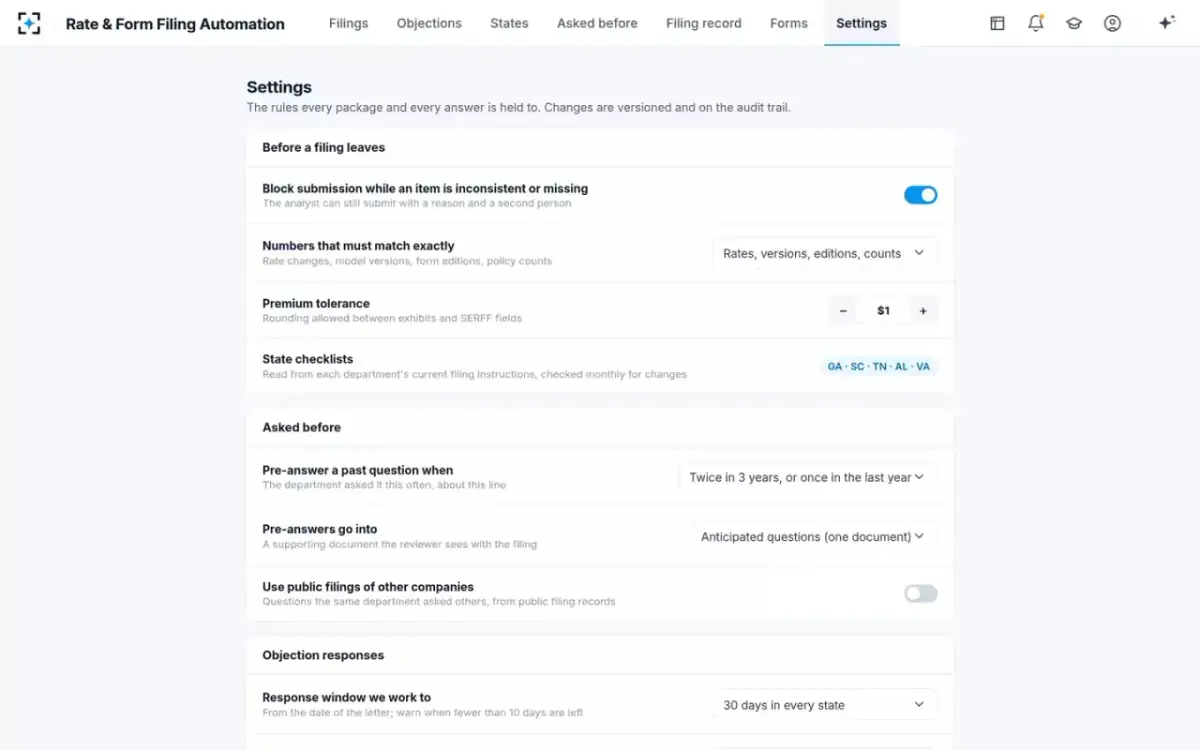
Rate filing deadline planning: working back from the effective date
A rate filing deadline is the latest submission date that still leaves room for the state's clock and one round of questions before the effective date. Work it backwards: effective date, minus any renewal notice period the state requires, minus the statutory review clock, minus one objection round of about 30 days, gives the latest safe submission date. Add the internal days of assembly and checking in front of that.
For the sample's 1 February new business date, Florida's rule would put the filing at least 90 days ahead, by early November, before any question; a South Carolina filing above the 7% band faces a 60-day waiting period that the director may extend by up to 60 more. The deadline watcher holds each state's dates on one timeline and shows the margin ahead of the effective date for each.
Planning this way turns delay from a surprise into a number. A state with 90 days of margin can absorb a letter; a state with 48, like the sample's Virginia filing, cannot absorb two. To see the five sample states on one calendar, start from Rate & Form Filing Automation.
Questions people ask
What is a deemer clause in insurance rate filing?
It is a provision that treats a filing as approved if the regulator does not act within a set number of days. The NAIC handbook gives "30 days" as an example; California's Proposition 103 uses 60 days after public notice, with a 180-day outer limit from receipt.
How long does a rate filing take in California?
By statute, 60 days after public notice if no hearing applies, and no more than 180 days from receipt. Under Bulletin 2024-7, a complete application is reviewed within 60 days of public notice with up to two 30-day extensions; the Department reported that its first two Sustainable Insurance Strategy approvals in 2025 took less than 95 days on average.
Does a request for more information stop the review clock?
It depends on the state. In Texas the days spent waiting for the insurer's answer are excluded from the 30-day disapproval period; in Florida, requests for supporting information do not toll the 90-day file and use review.
Is prior approval slower than file and use?
Usually, because the rate cannot be used until approval or the deemer date, while a file and use rate can be used on filing or after a short wait. The Federal Reserve staff study of homeowners filings found longer execution times in the states it classed as high friction.
What does a day of rate filing delay cost?
Roughly the annual premium change divided by 365, for each day approval slips past the planned effective date, if renewals are spread evenly. On a filing raising $6.57 million a year, that is about $18,000 a day.