Yes: in most states insurance rate filings are public record, open to anyone once the state releases them, usually through SERFF Filing Access or a state's own search. But "public" has three different starting points in different statutes, on filing, on public notice, or after the rate takes effect, and most states let companies keep some material confidential, from trade secrets to filed predictive models. The NAIC's handbook for rate reviewers puts it plainly: each state decides what is confidential and "when filing information might become public". For a pricing team the rules decide two things: how soon a competitor's move can be seen, and which of its parts will never be. Competitor Rate Filing Analysis is Botminds' solution for reading rivals' public filings; it collects only what each state publishes, keeps every document's source address and date, and so works inside each state's rules.
The statutes and regulator pages below were read in October 2026. Where a sample carrier appears, it is fictional: Kestrel Point Mutual, watching six invented rivals in six Southeastern states.
Public record, on three different clocks
Day 0
Texas: each filing and its supporting information is public information
Tex. Ins. Code §2251.107
Weekly
California: new rate filings are listed in a public notice posted every Friday
California Department of Insurance
30+ days
Iowa: personal lines filings open to inspection after the filing becomes effective
Iowa Code §515F.5; 30-day waiting period
Are insurance rate filings public record, or public information?
Both terms are used, and the difference is mostly the statute's wording. Some states call filings "public information" under their open records law, some say they are "open to public inspection", and others leave it to the regulator's practice. The NAIC's Product Filing Review Handbook, written by state regulators for state regulators, says: "Each state determines the confidentiality of a rate filing and the supplemental material to the filing. It also determines when filing information might become public, the procedure to request that filing information be held confidentially, and the procedure by which a public records request is made" (NAIC Product Filing Review Handbook, 2024).
It then warns filers that "a rate filing might become part of the public record." That is the starting presumption a competitor can rely on: a rival's rates, rating rules and the actuarial support for them are meant to be seen, because a rate regulated in public is easier to challenge. The CAS ratemaking text lists competitors' rate filings among the standard external data sources actuaries use, adding the qualifier that matters here: "Depending on the jurisdiction, competitor rate filings may be available to the public" (Werner and Modlin, Basic Ratemaking, CAS).
Three moments a rate filing can become public
On filing, on public notice, or after the rate takes effect. Which one a state uses decides how early a competitor can read a rival's move, and in a file-and-use state it decides whether the move can be read before customers feel it. The chart sets the three moments side by side for the states on this page.
The earliest a homeowners rate filing is open to the public, by state
Even one state can use two moments. Iowa's casualty chapter, which covers homeowners, opens a filing "after the filing becomes effective", while its workers' compensation chapter opens a filing to inspection "When a filing is deemed complete" (Iowa Code §515A.4). A watch that reads one line well can therefore be early in one line and late in another in the same state.
Are insurance rate filings public record in Texas?
Yes, by statute, from the day they are filed. Texas Insurance Code §2251.107(a) says: "Each filing made, and any supporting information filed, under this chapter is public information subject to Chapter 552, Government Code, including any applicable exception from required disclosure under that chapter" (Tex. Ins. Code §2251.107). Chapter 552 is the Texas Public Information Act, so the exceptions it allows, such as trade secrets, can still apply to parts of a filing.
In practice the Texas Department of Insurance publishes through SERFF Filing Access, for filings received after 13 April 2014, and shows a filing's details only if the company or the department marked it available for public access. Filings a company marked confidential do not appear in results, and confidential documents are left out of filings that do. For anything you cannot find, the department points to an open records request (Texas Department of Insurance, SERFF). The statute makes the filing public; the search shows what has been released.
Are insurance rate filings public record in California?
Yes, and more completely than in most states. Proposition 103 added Insurance Code §1861.07, which the Department of Insurance's General Counsel quoted in a 2018 legal opinion: "[a]ll information provided to the commissioner pursuant to [Article 10] shall be available for public inspection" (California Department of Insurance, General Counsel opinion, 10 August 2018). The department also announces each filing it receives. Its public notice cover letter says notices "are posted every Friday" and that the law "allows any member of the public to request a hearing within 45 days from the date of this notice on any of the rate changes proposed" (California Department of Insurance, public notice).
The filings themselves are in the department's virtual viewing room and its Web Access to Rate and Form Filings, with one notable exception on the department's own page: "Filings made by Advisory Organizations are available to the public, but can only be viewed at one of our Public Viewing Rooms in San Francisco or Los Angeles" (California Department of Insurance, rate filings). A competitor reading California therefore gets early warning from the notice and the full filing from the viewing room, except for the rating organizations' loss cost filings, which need a visit.
California also reaches the part most states leave out. The same opinion concluded that underwriting rules filed with a rate application are open to public inspection under §1861.07 even when the insurer marks them confidential, proprietary or a trade secret, and it noted that when insurers had marked filed rules confidential, the department released them on a member of the public's request. It relied on the California Supreme Court's 2004 decision in State Farm v. Garamendi, which held that trade secret information is not exempt from disclosure under that section. Where other states may never show a rival's tier rules, California's filings should.
How to look up insurance rate filings in Florida
Through the Office of Insurance Regulation's IRFS Forms and Rates Filing Search, not SERFF Filing Access. The OIR says the system lets users "search, view and/or download publicly available information" for property and casualty and life and health filings from 5 January 2001 to the present, by company name, file log number, NAIC company or group code, line, type of insurance, filing type and dates (Florida OIR, IRFS).
The same page carries a caution every reader of a Florida filing should keep in mind: "Displayed rate changes may not fully reflect increases and decreases due to claims of trade secret." A Florida rate change shown in the search is what the company did not claim as confidential. Read the filing's own exhibits before relying on a summary figure, and note where pages are withheld.
How to look up insurance rate filings in Texas, step by step
Start from the Texas Department of Insurance's SERFF page, which links to SERFF Filing Access for Texas. Search by company and narrow by type of insurance and filing type, or search directly on a SERFF tracking number. Open the filing and read four places in order: the summary at the top for status and dates, the rate/rule schedule for the overall change, the supporting documentation for the actuarial memorandum, and the correspondence for objection letters and the disposition.
Then check what is missing. TDI tells readers to look in the supporting documentation for the company's answer to whether the filing contains confidential information, because a confidential document is simply absent from public results. A filing that answers yes is incomplete by design, and an analysis of it should say so rather than treat the gap as nothing.
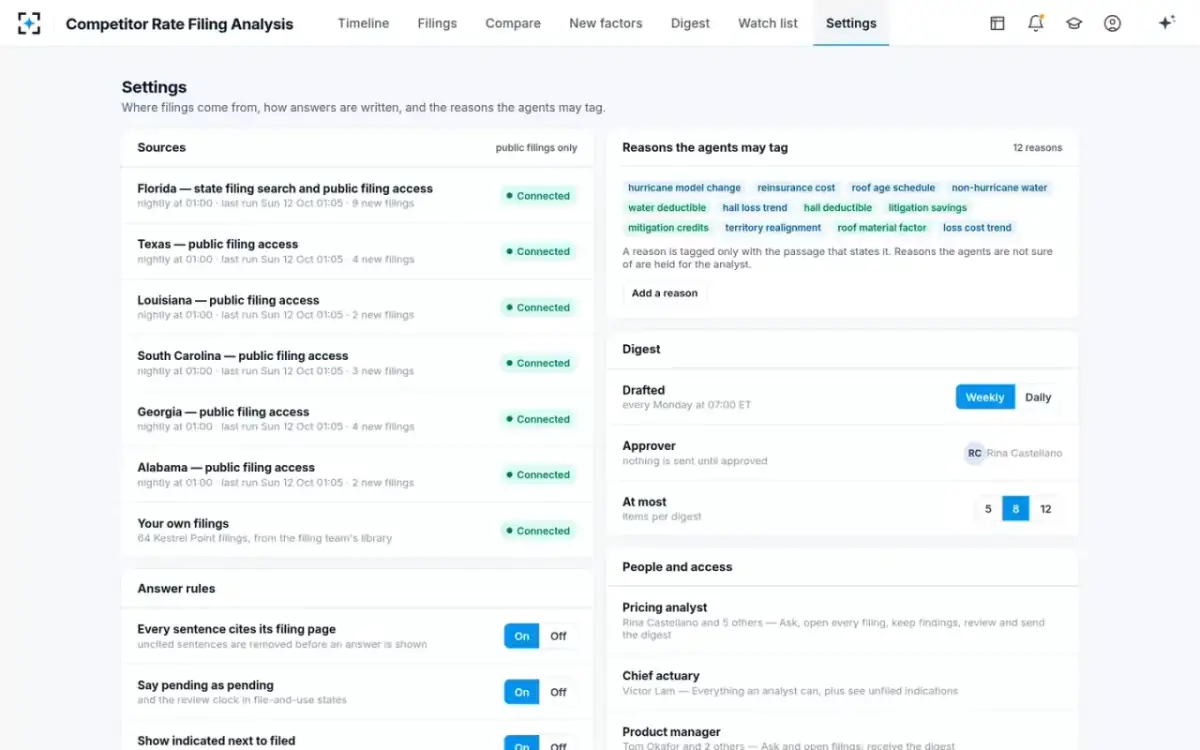
Public filings only: each state's source, read nightly
Insurance rate filings as public record: four states compared
| State | When a filing is public | What may be withheld | Where to read it |
|---|---|---|---|
| Texas | When filed: each filing and its supporting information is public information | Material excepted under the Public Information Act; documents a company marked confidential are not shown in search | SERFF Filing Access (filings received after 13 April 2014); open records request for the rest |
| California | Listed in the weekly public notice; all application information available for public inspection | Little: filed underwriting rules are public even if marked confidential; advisory organization filings viewable only in the public viewing rooms | Virtual viewing room and WARFF; weekly public notices |
| Florida | Once publicly available in IRFS; the statute sets no single moment | Rate changes displayed may not reflect amounts claimed as trade secret | IRFS Forms and Rates Filing Search (filings from 5 January 2001) |
| Iowa | Homeowners and other personal risks: after the filing becomes effective | Not addressed in §515F.5; check the regulator’s practice | SERFF Filing Access |
What stays confidential in a public rate filing
Three kinds of material tend to be missing. The first is anything a state's law lets a company protect as a trade secret, which in Florida's case can affect even the rate change displayed. The second is model detail: the NAIC handbook's guidance on predictive models commits regulators to "Protect the confidentiality of filed predictive models and supporting information in accordance with state laws and/or regulations" (NAIC Product Filing Review Handbook), so a rival's generalized linear model may be described in its memorandum but not published in full.
The third was never filed at all. Many states do not require the underwriting rules that place a risk in a tier to be filed with the rates, and those rules move the final premium. California is the clearest exception: rules filed with a Proposition 103 application are public there, marked confidential or not. That is why a competitor's filed rates are a reliable guide to what changed and why, and an unreliable guide to what any one customer pays. Botminds' rate filing monitoring agents are built around that limit: they state what a rival filed and its status, never a customer's premium.
Insurance rate filings and public notice: which states announce them
Some states announce filings as well as publishing them, and the announcement is the earliest public signal. California's weekly notice is the best known: one list a week of every company that filed, with the line, the filing type, the overall rate change requested where there is one and the SERFF number, and a 45-day window for the public to request a hearing. In the 52 notices posted from 31 October 2025 to 23 October 2026 there were 2,448 entries, one per company named on a filing.
A public notice is not the filing. It tells you that a rival filed and roughly what; the memorandum, the rating pages and the regulator's questions are in the filing itself, which you then read in the viewing room or the state's search. For competitive work the notice is a trigger and the filing is the evidence. Homeowners rate filings by state shows what a year of California's notices reveals when it is counted.
What the public record rules mean for a rival-filing watch
They set its timing and its blind spots. A watch on Texas can see a rival's filing the day it is released, which in a file-and-use state may be the day the rate is first used. A watch on Iowa homeowners sees the filing only once it has taken effect, so it can confirm a move but never anticipate it there. A watch on Florida must read IRFS separately and treat displayed rate changes with care. A watch everywhere must respect what is marked confidential and never reach past public access.
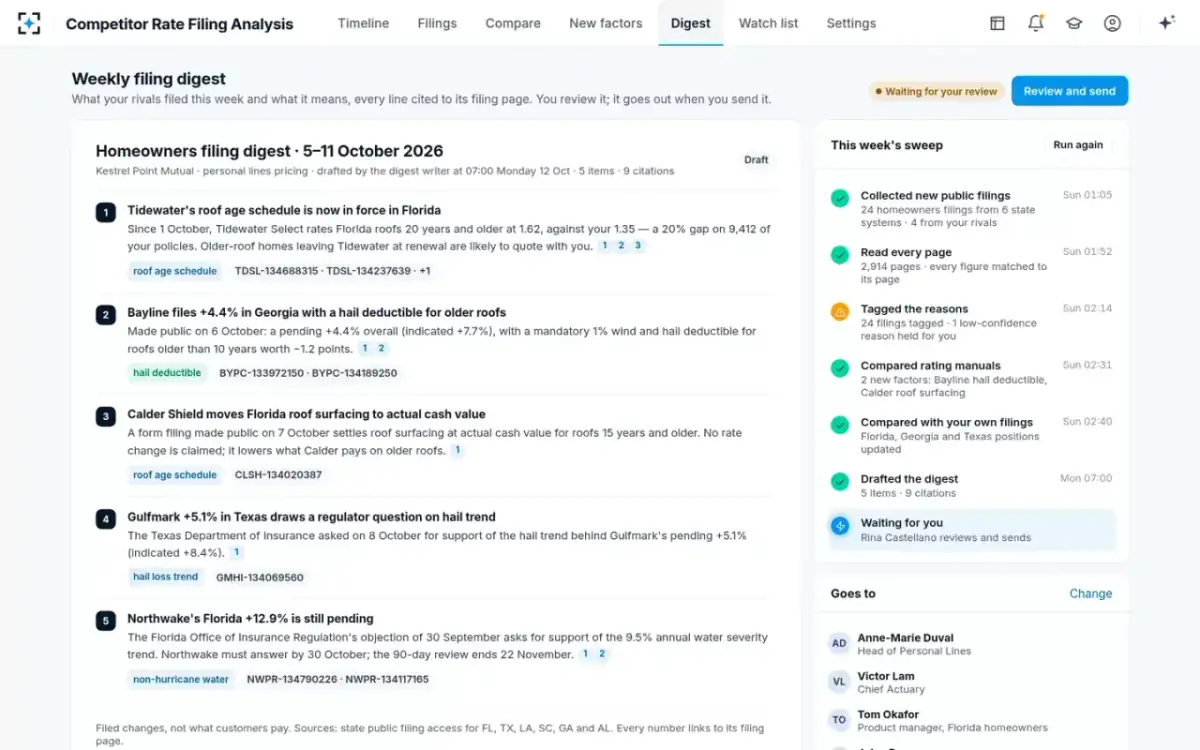
That is how the sample watch is built: the filing collector reads each state's public filing access only, never signs in to a filer account, never collects a document the state has not marked public, and keeps each document's source address and the date it was read. When the weekly digest says a rival's Georgia filing was "made public on 6 October", that date is the state's, not a guess. What to set up before you watch rivals lists the states, systems and history to settle first, and the Competitor Rate Filing Analysis page shows the whole flow.
Competitor Rate Filing Analysis reports when each filing was made public
Before you rely on a rival's public filing, check these
- Which moment made it public in this state?
On filing, on notice or after effect decides whether you are early or late.
- Is any part marked confidential?
In Texas, look for the company’s answer in the supporting documentation.
- Is the displayed rate change complete?
In Florida, trade-secret claims can affect it; read the exhibits.
- Are the tier rules in the filing?
Often not; a filed rate is not a customer’s premium.
- When did you read it?
Keep the source address and the date, because statuses and documents change.
Questions people ask
Are insurance rate filings public information?
In most states, yes, once the state releases them. Texas says so in its statute: each filing and its supporting information is public information under the state's Public Information Act. Other states use phrases like open to public inspection, with timing and confidentiality rules of their own.
Are insurance rate filings public record in Texas?
Yes, from the day they are filed, subject to the Public Information Act's exceptions. The Texas Department of Insurance publishes them on SERFF Filing Access for filings received after 13 April 2014, and documents a company marked confidential do not appear in search results.
Are insurance rate filings public record in California?
Yes. Under Insurance Code §1861.07, all information provided with a Proposition 103 rate application is available for public inspection, and the Department of Insurance posts a public notice of filings every Friday. Members of the public may request a hearing within 45 days of the notice.
Can an insurer keep its rate filing secret?
Not the whole filing, in states that make filings public, but often parts of it. Many states let companies protect trade secrets, and Florida warns that rate changes shown in its search may not reflect amounts claimed as trade secret. California is stricter: its Department of Insurance has concluded that filed underwriting rules must be public even when marked confidential or trade secret.
How do I look up a specific insurance company's rate filings?
Search the state's public system by the company's legal name, not its brand: SERFF Filing Access in 49 states, the District of Columbia and Guam, and IRFS in Florida. Narrow by type of insurance and filing type, then open the filing's rate schedule, memorandum and correspondence.
Are insurance rate filings public notice?
In some states they are announced as well as published. California lists every filing it receives in a weekly public notice, with the line, filing type, any overall rate change and the SERFF number; its 52 notices to 23 October 2026 carried 2,448 entries.