A rate indication is the overall rate change an insurer's actuarial analysis says it needs to cover projected losses, expenses and its profit provision; the selected rate is the change the company actually files, after weighing retention, competition, the regulator and the effect on its customers. In a rate filing the two usually appear side by side, the indication in the actuarial memorandum and exhibits and the selection as the overall rate impact, and they are often different. The gap is the part competitors should read most closely: a rival that files well below its own indication has told the market, in its own exhibits, that more increases may follow. Competitor Rate Filing Analysis is Botminds' solution for reading rivals' filings; it reports indicated and filed changes together for every filing, so the gap is never lost in a summary.
Examples below use a fictional sample carrier, Kestrel Point Mutual, and six invented Florida rivals. Formulas follow the NAIC's Product Filing Review Handbook; the research figures come from the NAIC, the Federal Reserve and the Casualty Actuarial Society.
From indication to selection to the change a policy sees
1Indication
Indicated change = projected loss and LAE ratio ÷ target loss and LAE ratio − 1
Target = (1 − variable expense % − profit and contingencies %) ÷ (1 + fixed expenses to losses)
Illustration: projected 72%; variable expense 25%, profit 5%, fixed expenses 8% of losses. Target = 0.70 ÷ 1.08 = 64.8%. Indicated = 0.72 ÷ 0.648 − 1 = +11.1%
2Selection
Selected change = indication adjusted for retention, competition, regulation and judgment, justified in the filing
Illustration: filed at +8.0%, 3.1 points held back
3Decision
Approved or in-use change = selection as accepted, modified or disapproved under the state’s rating law
Illustration: approved as filed, or less after objections
4Per policy
Each policy’s change = its rating variables’ changes, then any cap or transition rule
Illustration: average +8.0%, individual changes capped at ±15%
What is a rate indication in insurance?
A rate indication is the actuary's estimate of the overall rate change needed for future policies to cover their expected losses, loss adjustment expenses, other expenses and profit. It starts from historical premiums and losses, brings premiums to current rate level, develops losses to ultimate and trends them to the future policy period, replaces actual catastrophe losses with an expected catastrophe load, and adds expense and profit provisions. In homeowners, the catastrophe load is often modelled; Florida's rating law, for instance, requires projected hurricane losses to be estimated with a model the state's hurricane commission has found acceptable.
The meaning in insurance is narrower than the word suggests. An indication is not a price for any customer and not a forecast of what the company will charge. It is a statement about the whole book: if nothing else mattered, this is the change the data supports.
The indicated rate change formula, step by step
Two methods are standard, and they agree when fed the same data. The NAIC handbook sets out the pure premium method, which builds an indicated rate from projected pure premium and fixed expenses divided by one minus the variable expense and profit percentages, and the loss ratio method, which produces an indicated change: the projected loss and LAE ratio divided by the target loss and LAE ratio, minus one (NAIC Product Filing Review Handbook, 2024). The target ratio is what is left of each premium dollar after variable expenses and profit, adjusted for fixed expenses.
Work it through with the illustration in the figure. A projected loss and LAE ratio of 72% against a target of 64.8% indicates an 11.1% increase. Push the projected ratio to 75%, through a heavier catastrophe load or a steeper trend, and the indication rises to about 15.7%; cut the profit provision from 5% to 3% and the target rises to about 66.7%, taking the original indication down to 8.0%. That is why two companies with similar losses can file very different indications, and why the memorandum's assumptions matter as much as its answer.
An indicated rate change calculator is only this arithmetic with the inputs exposed. What a calculator cannot supply is the judgment in each input: which years, which trend, which catastrophe model, which profit provision. Those are the pages of a rival's memorandum worth reading.
What is a selected rate change?
The selected rate change is the overall change a company chooses to file. It may equal the indication, but it often does not: the company weighs how many customers it would lose, where its competitors are, what the regulator will accept and how the change lands on individual policies. The NAIC's 2015 white paper on price optimization describes the practice plainly: "Making adjustments to actuarially indicated rates is not a new concept; it has often been described as “judgment.”" (NAIC Casualty Actuarial and Statistical Task Force, 2015).
In a SERFF filing the selected change is the overall % rate impact, and the indication, where the filing includes one, sits in its own field and in the exhibits. Regulators read both, and so should competitors; how to read insurance rate filings shows where each sits in a filing. The same white paper notes that "Regulators accept some deviations from indicated rates and rating factors," while asking that the deviation be explained.
Rate indication vs selected rate: why the gap is the honest signal
Because the selection is what a rival wants the market to see, and the indication is what its own data says. A rival that files +9.2% on an indication of +14.6% has said, in a public exhibit, that it is charging less than it believes it needs. It may be protecting retention, managing a regulator, or waiting for a reinsurance renewal; the memorandum may say which. Whatever the reason, the gap is pressure that tends to come out in a later filing.
The CAS ratemaking text makes the same point from the other side, warning actuaries who borrow competitors' rates that those rates "are not only based on the competitors’ loss costs but also reflect marketing considerations, judgment, and the effects of the regulatory process" (Werner and Modlin, Basic Ratemaking, CAS). The filed rate is a blend of cost and choice. The indication is the cost alone, as the company sees it.
A filed rate tells you what a rival chose. Its indication tells you what it believes, and the gap tells you how much it is still holding back.
How big is the gap between target and approved rates?
Large, on the evidence of a decade of homeowners filings. A Federal Reserve staff study of homeowners rate filings from 2009 to 2019 found that "Conditional on filing for a rate change, the average (Rate∆Target) is 15.6% and the average (Rate∆Received) is 5.85%," and that "the median Rate Wedge is 0.5": half the filings received at most half of the change the insurer targeted (Oh, Sen and Tenekedjieva, FEDS 2022-064). The authors use the gap state by state as their measure of how restrictive rate regulation is.
Insurers ask for less than they target, and receive less than they ask
15.6%
average target rate change on homeowners filings, 2009–2019
Federal Reserve staff study
5.85%
average rate change received after regulatory review
Same filings
0.5
median ratio of received to target change
Half of filings got half or less
Read the study's wedge as two gaps stacked: the company's own selection below its indication, and the regulator's decision below the selection. A filing shows you the first directly. The second appears in the correspondence and disposition, and in states with a hearing threshold it can shape the first: in California, where a personal lines change above 7% must go to a hearing on a timely request, a year of the state's public notices shows filed changes bunched at 6.9%. Homeowners rate filings by state counts them.
What regulators accept between the current rate and the indication
Generally, anything in between, if it is explained. The NAIC task force's 2015 recommendations put it in two steps: "the selection of a proposed rate between the currently approved rate and the actuarially indicated rate be allowed if based on reasonable considerations", and "a selected rate outside the range defined by the current and indicated rate may be acceptable provided it is disclosed, complies with state law and is shown to be consistent with actuarial ratemaking principles" (NAIC Price Optimization White Paper, 2015). The same paper lists practices it considers inconsistent with the bar on unfair discrimination, among them adjustments based on price elasticity of demand and a policyholder's propensity to shop.
For a competitor this has a practical meaning. A selection between current and indicated is normal and tells you about the rival's priorities. A selection outside that range is unusual, must be disclosed, and is worth reading in full: a rival filing above its own indication, or cutting rates against an indicated increase, is making a deliberate market move.
Capping: the third number between the filing and the customer
The overall change is an average, and capping decides how it is spread. A filing may limit each policy's change to a band, so policies that the new rating structure would move sharply are moved over several renewals instead. In the sample Florida filing the company capped individual changes at +15% and −15% around an overall +8.6%, and the NAIC's handbook lists the questions regulators ask about such rules, from which rates are capped to how many renewal cycles the transition takes.
For competitive reading, a cap means the full effect of a rival's new rating structure arrives later than the headline suggests. A roof age factor of 1.62 may reach the oldest roofs over two or three renewals, not one. The dislocation itself, how many of a book's policies get which change, is analysed in dislocation analysis, from Botminds' Rate Dislocation Analysis; for a rival, the memorandum's statement of the cap is usually all that is public.
Reading the indicated vs selected gap across rivals in Competitor Rate Filing Analysis
One rival's gap is a clue; the gaps of every rival in a state are a map. In the sample, the solution shows each Florida rival's latest filing with its indicated and filed change and the difference between them, held-back points sorted from largest to smallest. Gulfmark Home filed +11.4% on an indication of +17.9%; Tidewater Select filed +8.6% on +10.2%. The first has the most room to come back with another increase.
Indicated minus filed, rival by rival: the gap in each latest Florida filing
Two readings need care. A gap on a pending filing can still change after objections, so the solution marks it pending; what pending means on a rate filing explains why that matters state by state. And the sign matters. Three of the seven bars are not held-back increases at all but cuts deeper than the indication: Calder Shield filed −3.8% against −1.5% indicated, Ostrander Home −4.2% against −2.0%, and the carrier itself −2.1% against an indicated +0.6%. Each of those selections sits outside the range between the current rate and the indication, the range regulators treat as routine, and each is a deliberate bid for business that the memorandum should explain.
Every rival, every state, filed and indicated together
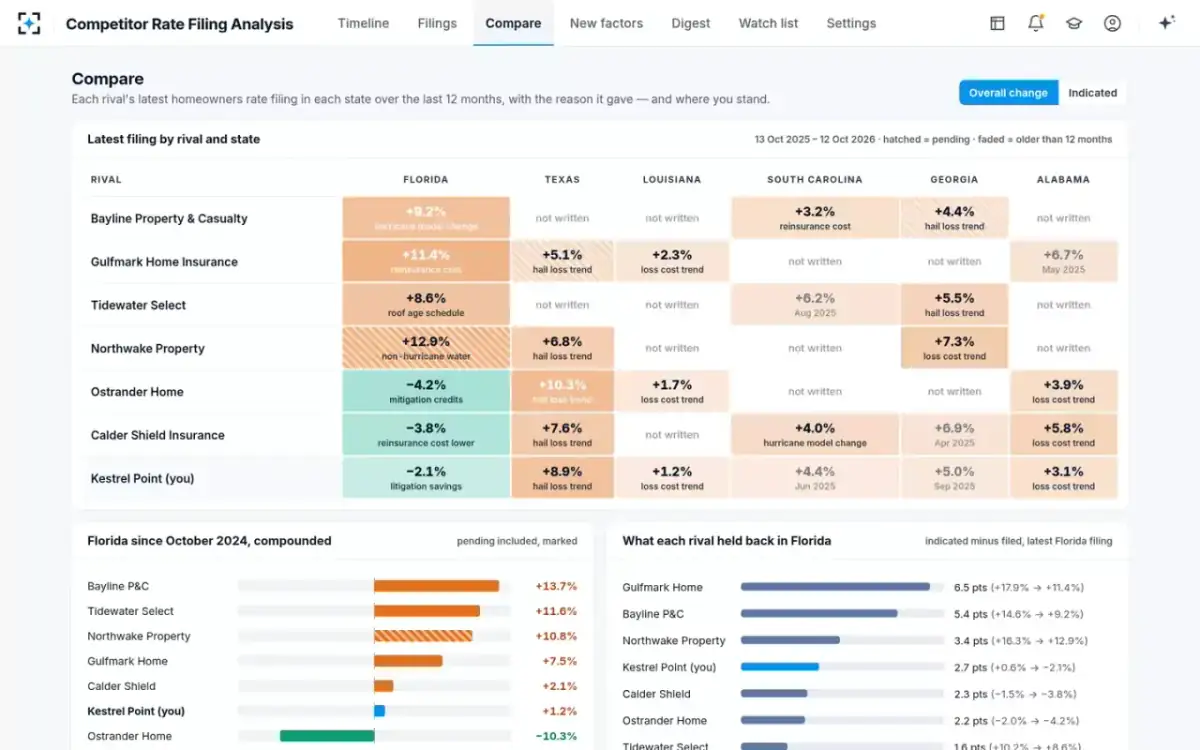
Five questions to ask of any indicated vs selected gap in a rival's filing
- Is the indication complete?
Does it include the catastrophe and reinsurance provisions, or are those filed separately?
- Which way is the gap?
Held back on an increase, cut deeper than indicated, or filed above the indication.
- What does the memorandum say about it?
Retention, competition, a regulatory constraint, a planned second step. Quote it; do not infer it.
- Is the filing still pending?
The selection can be cut after objections; the approved change is the one that counts.
- Is the change capped per policy?
A cap spreads the change over renewals, so the full effect arrives later.
Questions people ask
What does rate indication mean in insurance?
It is the overall rate change an insurer's actuarial analysis says is needed for future premiums to cover expected losses, expenses and profit. It applies to the book as a whole, not to any customer, and it is shown in a rate filing alongside the change the company actually selected.
What is the indicated rate change formula?
Under the loss ratio method in the NAIC's handbook, the indicated change equals the projected loss and LAE ratio divided by the target loss and LAE ratio, minus one. The target is one minus the variable expense and profit percentages, divided by one plus the ratio of fixed expenses to losses.
Why do insurers file less than the indicated rate?
To protect retention, stay close to competitors, avoid a regulatory hearing or a long review, and spread large changes over time. The NAIC task force recommended in 2015 that a selection between the current rate and the indication be allowed when based on reasonable considerations, and that one outside that range be disclosed.
Is the selected rate change what customers pay?
No. It is the statewide average change the company filed; each customer's change depends on rating variables, discounts, tier placement and any cap. In the sample Florida filing, individual changes were capped at plus or minus 15% around an overall +8.6%.
Can a selected rate be higher than the indication?
It can, but it is unusual. The NAIC task force's 2015 white paper recommended that a selected rate outside the range between the current and indicated rate may be acceptable only if it is disclosed, complies with state law and is consistent with actuarial ratemaking principles.
Where is the indication in a SERFF filing?
In the rate/rule schedule's overall % indicated change field, when the filer includes an indication, and in more detail in the actuarial memorandum and its exhibits. The filed change is the overall % rate impact; read both from the pages that print them.