To read an insurance rate filing, start from the filing's own summary fields, then confirm each one against the page that supports it: the status in the regulator's disposition, the overall and indicated change in the actuarial memorandum and exhibits, the effective dates in the rate schedule, the companies and program in the general information, and the reasons in the memorandum's own words. The common misreadings of insurance rate filings, a pending filing reported as approved or an indication quoted as the change filed, each come from skipping one of those five checks, and each check can be scored, so you can measure how often a reader, a colleague or software gets it right. Competitor Rate Filing Analysis is Botminds' solution for reading rivals' filings at scale: agents run the same five checks on every rate, rule and form filing your watched competitors make, and every figure in an answer cites its page.
The worked example below is a fictional sample filing as it runs through the solution: Tidewater Select's Florida homeowners rate filing, read end to end. The company, its figures and its tracking number are invented. Field names and status definitions come from the NAIC's SERFF training material for state reviewers.
What a rate filing hands you, and where it hides the rest
2
percentages on a SERFF rate schedule: the overall % indicated change and the overall % rate impact
NAIC SERFF, rate/rule schedule
4+9
characters in a SERFF tracking number: the filer’s four-letter code, then a unique number
NAIC SERFF glossary
472
pages in one sample Florida rate filing; its main reason sat on page 11
Fictional sample filing
What is an insurance rate filing?
An insurance rate filing is the package a company submits to a state insurance regulator to introduce or change its rates, rating rules or rating plan for a line of business. The NAIC's SERFF glossary defines a filing as "a package of information sent from an insurance company to a state rate and form filing review department", and distinguishes rate, rule, form and advertisement filings, plus multi-type filings that combine them (NAIC SERFF Glossary). The CAS ratemaking text adds what makes them useful to a competitor: "Rate filings normally include actuarial justification for requested rate changes and the manual pages needed to rate a policy" (Werner and Modlin, Basic Ratemaking).
That justification is the actuarial memorandum and its exhibits, and the manual pages are the rating rules and factor tables that changed. The rest of the filing is correspondence: the regulator's objection letters, the company's responses, any amendments and, at the end, the disposition. Read together, the parts say what a rival changed, how much its own data said it needed, why, and what the regulator made of it.
Five checks that decide whether a rate filing was read right, and how to score each
1Status
Is it approved, pending, withdrawn or disapproved, as the state uses the word?
filings whose reported status matches the state’s latest disposition ÷ filings checked
2Indicated and filed
Which number is the indication, which is the change filed, and are both reported?
filings with both figures right and not swapped ÷ filings that print an indication
3Dates
Filed when, decided when, and effective when, for new and renewal business?
filings whose filed, decision and effective dates match the disposition and rate pages ÷ filings checked
4Scope
Which companies, program and sub-type of insurance, and how many policies?
filings with the right companies, program, sub-type and policy count ÷ filings checked
5Reason
What does the memorandum say drove the change, and by how many points?
precision: reasons with a quoted passage ÷ reasons reported; recall: reasons found ÷ reasons the memorandum states
How to read an insurance rate filing report: the SERFF layout, in reading order
Read the summary first and the evidence second, but read both. Most states receive filings through the NAIC's System for Electronic Rate and Form Filing, so most public filings share one layout. The top of every filing, the "Filing at a Glance", gives the company, the SERFF tracking number, the SERFF status, the type and sub-type of insurance, the filing type, the state status and the dates submitted and disposed (NAIC SERFF Lesson 4). Below it sit tabs for general information, the rate and rule schedule, supporting documentation and filing correspondence.
The parts of a SERFF rate filing, and what each one is good for
| Part | What it holds | Read it for |
|---|---|---|
| Filing at a Glance | Company, tracking number, SERFF and state status, type and sub-type of insurance, filing type, dates submitted and disposed | Where the filing stands, and which product it touches |
| General information | Requested effective dates, status in the domicile state, filing description | What the company says it is doing, in one paragraph |
| Rate/rule schedule | Overall % indicated change, overall % rate impact, written premium change, policyholders affected, written premium, maximum and minimum change; the rate and rule pages | The headline numbers and the manual pages that changed |
| Supporting documentation | Actuarial memorandum, exhibits, checklists, the answer to whether the filing contains confidential information | Why the company changed rates, and what is withheld |
| Filing correspondence | Objection letters, responses, amendments, notes and the disposition | What the regulator questioned, and what it decided |
Two fields deserve a second look. The overall % indicated change, SERFF's guidance says, "is only to be completed when an actuarial indication is included in the filing submission", so a blank usually means no indication was submitted; filers do leave fields empty, though, so check the memorandum before concluding there was none. And Texas tells readers to look in the supporting documentation for the company's answer on confidentiality, because confidential documents are left out of public results (Texas Department of Insurance; the search itself is walked through in SERFF filing search).
How to read insurance rate filing codes
Three codes tell you what a filing is before you open a page: the type of insurance, the filing type and the tracking number. Types of insurance follow the NAIC's Uniform Property and Casualty Product Coding Matrix, which the regulators' handbook describes as providing "uniform product naming conventions, consistent terminology, a numerical coding system and descriptions for use in product filings" (NAIC Product Filing Review Handbook). In the matrix, 04.0 is Homeowners; its sub-types include 04.0001 Condominium Homeowners, 04.0003 Owner Occupied Homeowners and 04.0004 Tenant Homeowners, and 19.0001 is Private Passenger Auto (NAIC matrix, edition effective 2020, as posted by Alaska's Division of Insurance).
The filing type says whether a filing carries rates, rules, forms or a mix. The SERFF tracking number, in the glossary's description, combines a four-character identifier for the filer's instance with a unique nine-character string, which is why one company's filings share a prefix across states. A multi-state filing creates one filing per state, each with its own status. The state may also assign its own tracking number; California's weekly public notices, for example, list both the department's file number and the SERFF number.
Check 1: the status, read as the state uses the word
A status is a legal finding in one state and a workflow label in another, so read it against the state's rating law. SERFF's own status moves from submitted and assigned to "Pending Industry Response", when objection letters await the company, then "Pending State Action", when the company has answered and the state has not decided, and finally "Closed", with the state's disposition appended (NAIC SERFF Lesson 4). A closed filing can be approved, filed, acknowledged, withdrawn or disapproved, and the state status field may use its own vocabulary.
The misreading to avoid is the obvious one: treating a pending filing as approved. Under a prior approval law, a pending +9% may never take effect; under a file-and-use law, the rate may already be in use while the review runs. What pending means on a rate filing works through each status state by state.
Check 2: indicated and filed, never one without the other
Every rate filing with an actuarial indication carries two numbers, and they answer different questions. The indicated change is what the company's data says it needs; the filed change, SERFF's overall % rate impact, is what it chose to ask for, after weighing retention, competition and the regulator. In the sample Florida filing the indication is +10.2% and the filed change +8.6%: the company held back 1.6 points.
Report either number alone and you mislead someone. The filed change says what the rival will charge on average once approved; the indication says what it believes it needs, and so how much more may follow. Rate indication vs selected rate explains the formula and how to read the gap across rivals.
Check 3: the dates, requested and actual
A filing carries at least four dates: submitted, requested effective, decided and actually effective, often separately for new and renewal business. They are not interchangeable. SERFF's guidance on the requested effective date is explicit: "It is not necessarily the date the filing officially becomes effective. The State Insurance Department will determine the definitive effective date" (NAIC SERFF Lesson 4).
For competitive reading, the renewal effective date matters most, because that is when a rival's existing customers first see the change and when a price-sensitive one may come shopping. In the sample, the Florida filing was submitted on 9 June 2026, approved on 21 August and in force from 1 October for new and renewal business: almost four months from filing to the first renewal it touched, and six weeks from approval.
Check 4: which companies, program and policies the change applies to
Read the scope before you compare. A filing may cover several companies in a group, one program among several the company writes in the state, or one sub-type of insurance such as owner-occupied homeowners but not condominium. The rate schedule gives the written premium and the number of policyholders affected for the program; in the sample filing, 44,902 Florida HO-3 policies and $158.6 million of written premium, with $13.6 million of premium change.
Scope errors are the quiet ones. A +8.6% on one company's HO-3 program in a group that writes most of its Florida homes through another company says less about the group than it seems. The CAS text warns of the same trap at the level of the whole company: competitor information may not be relevant when insureds, goals, expenses and operations differ, as between a preferred and a non-standard writer (CAS, Basic Ratemaking).
Check 5: the reason, in the company's own words
The reason is the most valuable thing in a filing and the easiest to make up. It lives in the actuarial memorandum, often a few pages in, and it is often stated in points: so much for loss trend, so much for a catastrophe model update, so much for a new rating rule. A reason that cannot be quoted from the memorandum is an inference, and it should be labelled as one or left out.
A rival's Florida filing in Competitor Rate Filing Analysis: five figures, three reasons, one objection
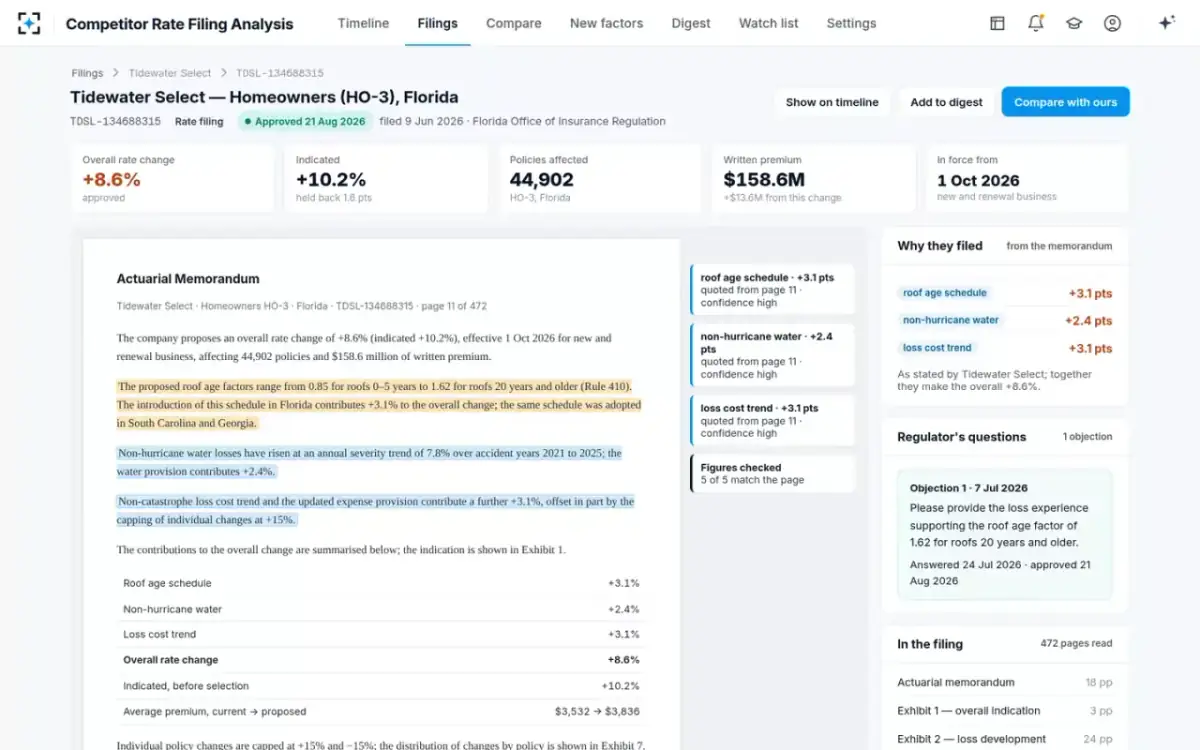
The margin note on the memorandum counts five of five figures matching the page. That count is the second and fourth checks, made visible.
In the sample the three reasons sum to the filed +8.6%, which is itself a check: when a memorandum attributes points to each reason, the parts should add up to the whole, or the memorandum should say why not. Here the company also notes that individual policy changes were capped at +15% and −15%, a detail that matters for how the change lands on its customers and that a reader of the headline alone would miss.
How to know you read a rate filing right: measure the five checks
Treat a reading like any other measurement: compare it with a reference and count the misses. Pick twenty filings your most experienced analyst has read by hand across your states, with a mix of rate, rule and form filings and at least a few pending and withdrawn ones. Have the second reader, a colleague or a tool, read them blind, and score each of the five checks with the formulas in the figure above.
The reason check needs two scores, because it fails in two directions. Precision catches reasons reported without a supporting passage; recall catches reasons the memorandum states that the reader missed. A reader with high precision and low recall is safe but thin; the opposite is dangerous. Run the test again after any change in your states or lines, and whenever a regulator changes its filing format.
Five ways a rate filing is misread, and the check that catches each
Common misreading: A filing in Pending State Action reported as approved.
What the five checks catch: The disposition is read; until it exists, the filing is pending.
Common misreading: A +16.3% indication quoted as the change filed.
What the five checks catch: Both numbers reported, each from its page, and the gap shown.
Common misreading: The requested effective date treated as the date in force.
What the five checks catch: The effective date taken from the disposition and the rate pages.
Common misreading: One company’s program read as the whole group’s move.
What the five checks catch: Companies, program, sub-type and policy count read first.
Common misreading: A reinsurance story attached to a filing driven by roof factors.
What the five checks catch: Only reasons the memorandum states, each with its passage.
A rate filing analysis example: one rival's filing, read end to end
Here is the sample Florida filing read with all five checks, as the solution reads it. Status: approved on 21 August 2026 by the Florida Office of Insurance Regulation, after one objection. Indicated and filed: +10.2% indicated, +8.6% filed and approved; average premium $3,532 to $3,836. Dates: filed 9 June, objection 7 July, answered 24 July, approved 21 August, in force 1 October 2026 for new and renewal business. Scope: one company's HO-3 program, 44,902 policies, $158.6 million of written premium. Reasons: roof age schedule +3.1 points, non-hurricane water +2.4, loss cost trend +3.1, each quoted from page 11.
The regulator's objection points to the item that matters most. It asked for the loss experience behind a roof age factor of 1.62 for roofs 20 years and older, a new rule the company had already introduced in South Carolina and Georgia. That one line turns a percentage into a pricing question for any competitor with older roofs on its books, which is the subject of spotting a rival's new rating factor.
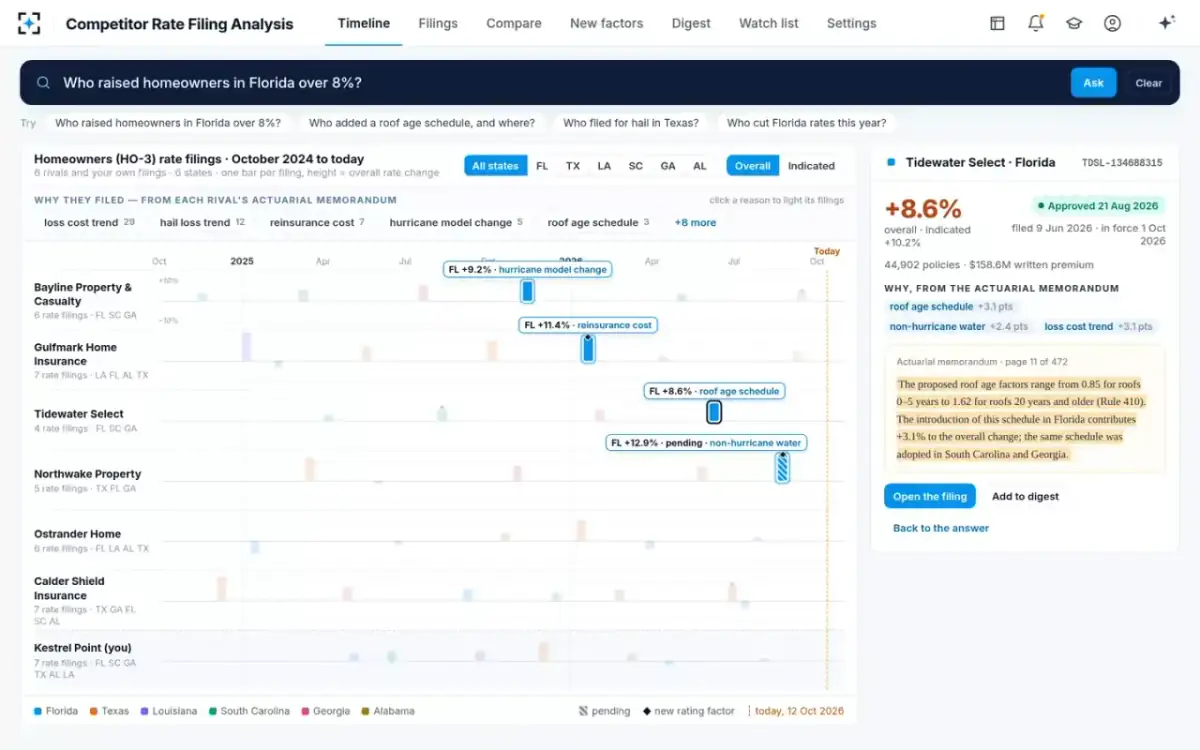
One click from the answer to the passage that supports it
Before you quote a rival's rate filing, check these five things
- Status from the disposition
Not from a summary. No disposition means pending, whatever a headline says.
- Both percentages, side by side
Indicated and filed, each from its page, with the gap in points.
- The date it reaches renewals
The effective date for renewal business, from the disposition or rate pages.
- Companies, program, sub-type, policies
One program in one company is not the group’s market position.
- Reasons you can quote
With the passage and the points; check that the points add up to the change.
Questions people ask
What are rate filings in insurance?
Rate filings are the documents insurers submit to state regulators to set or change rates, rating rules and rating plans. They usually include an actuarial memorandum, exhibits and the rating manual pages that changed, and in most states they become public once the state releases them.
How do I read a rate filing report?
Start with the summary at the top: status, type of insurance, filing type and dates. Then read the rate schedule for the overall % indicated change and overall % rate impact, the actuarial memorandum for the reasons, and the correspondence for the regulator's objections and disposition.
What does the overall % rate impact mean in a SERFF filing?
It is the statewide average percentage change to the company's rates for the coverages in the filing, as the company proposes it. It is the filed change, not the indication, and not any one customer's premium change; individual changes vary around it and may be capped.
How do I search SERFF for rate filings?
Through SERFF Filing Access, which the NAIC lists for 49 states, the District of Columbia and Guam; you search one state at a time by company, type of insurance, filing type, date or SERFF tracking number. Florida publishes through its own IRFS search instead.
Why does a filing show no indicated change?
SERFF's guidance says the indicated change field is completed only when an actuarial indication is included in the submission. Form filings, many rule filings and filings that adopt an advisory organization's loss costs may have none; for a rate filing, check the memorandum before concluding there was no indication.
Are rate filings ever wrong?
They can disagree with themselves: a transmittal field typed by the filer may not match the exhibit it summarizes. That is why each figure should be read from the page it is printed on, and why reasons stated in points should add up to the filed change.