An insurance rate filing monitoring tool watches the public filing systems of the states you write in, collects every rate, rule and form filing your competitors make, and tells you what changed: the overall rate change, the indication behind it, the policies affected, the dates, the status, the reason the company gave and any new rating factor. The hard part is not collecting PDFs. It is reading them without the errors that make competitive intelligence dangerous: an indicated change reported as filed, a pending filing reported as approved, a reason invented where the memorandum states none. Competitor Rate Filing Analysis is Botminds' monitoring solution for personal lines pricing teams. Six agents collect and read every rival filing in your states, a pricing analyst asks questions in plain words, and every sentence of an answer carries the filing page it came from.
The screens on this page come from a fictional sample carrier, Kestrel Point Mutual, watching six invented rivals in Florida, Texas, Louisiana, South Carolina, Georgia and Alabama. The limits described are the solution's own configuration, not claims about any other product.
Companies often create underwriting tiers for which most jurisdictions do not require companies to file the underwriting rules used to assign risks to the tiers.
Casualty Actuarial Society, Basic Ratemaking (Werner and Modlin)
What an insurance rate filing monitoring tool should do
It should answer four questions about any watched rival, in any watched state, from the filing itself: what did they file, how much did their own data say they needed, why did they say they changed it, and where does the filing stand with the regulator. Each answer should point to the page that supports it, so the analyst can check it in one click and the actuary can rely on it.
The CAS line above is the reason the fifth question, what do their customers pay, is not on the list. A rate filing contains the rates, the rating manual pages that changed and the actuarial support, but in many states not the rules that assign a home to a tier, and those rules move the final premium. A tool that reports a rival's "price" from a filing is reporting a guess. A tool that reports what was filed, with its status, is reporting what the market can see.
Volume is the other reason a tool earns its keep. A rival can file in the same state several times a year, and the rule and form filings, where a new surcharge or deductible usually appears, often carry no overall rate change at all. A monitor that reads only rate filings misses them.
Rate filing monitoring system, analysis tool or search tool: what each actually does
Three kinds of product are sold under these names, and they differ in what they read. A filing search tool is an index: it helps you find filings by company, state, line and date, and leaves the reading to you. A rate filing analytics tool adds structured fields extracted from the filing forms, such as the overall change and premium affected, so you can chart them. A monitoring system that reads the documents goes into the memorandum and the rating pages, which is where the reasons and the new factors are.
Two ways to monitor rivals' rate filings, row by row
Search and analytics on filing fields: Yes, by company, state, line and date.
Agents reading every document: Yes, every night, every watched state.
Search and analytics on filing fields: Where the filer completed the transmittal fields.
Agents reading every document: From the page printed in the filing, both kept side by side.
Search and analytics on filing fields: Not read; the reason is in the memorandum text.
Agents reading every document: Quoted from the memorandum, with the points it contributed.
Search and analytics on filing fields: Seen only if someone opens the manual pages.
Agents reading every document: Flagged by comparing manual pages with the last approved ones.
Search and analytics on filing fields: Available in the correspondence, if someone reads it.
Agents reading every document: Each objection letter reported with the question asked.
Search and analytics on filing fields: A filing number.
Agents reading every document: The filing page and passage behind each sentence.
The six agents in Competitor Rate Filing Analysis, one job each
The work splits into six jobs because each has a different way of going wrong. Collection fails by missing a state or reaching into documents that are not public. Extraction fails by taking a number from the wrong table. Reasons fail by inventing a motive. Factor detection fails by calling a renamed rule new. Answers fail by blending indicated and filed. A digest fails by going to the wrong people. Giving each failure to one agent with one written limit makes it testable.
Six agents and the one thing each is never allowed to do
Agent
Filing collectorChecks each watched state’s public filing system nightly and downloads every document of every new filing: memorandum, exhibits, rating pages, correspondence.
Never: signs in to a filer account, or collects a document the state has not marked public.
Agent
Filing readerSplits each filing into its parts and extracts overall and indicated change, policies, premium, dates, status and objection dates, each from its page.
Never: estimates a figure the filing does not print.
Agent
Why taggerReads the actuarial memorandum and notes the reasons the company gave, from a list of 12, each with its passage and points.
Never: infers a motive the memorandum does not state.
Agent
Factor watcherCompares rating manual pages with the rival’s last approved pages, in the same state and others, and flags a factor that appears for the first time.
Never: calls a renamed factor with an unchanged table new.
Agent
Filing analystReads a question for state, line, direction, threshold, reason and rival, answers from the filings only and lights the filings that answer.
Never: states what a customer pays, or mixes indicated and filed.
Agent
Digest writerDrafts the Monday digest from the week’s filings, alerts and saved findings: at most eight items, every sentence cited.
Never: sends without the analyst’s approval.
A person decides
Pricing analystAsks, decides what a finding means, edits the digest and sends it; owns the watch list and the reason list.
Never: decides what the company files; that stays with the chief actuary.
Each agent's output is the next one's input, and each hand-off keeps the page. By the time the analyst asks a question, every figure already carries the page it was printed on and every reason has the passage that states it. That is why an answer can be checked, sentence by sentence, before anyone reads it. How to read insurance rate filings covers the same checks done by hand.
What the monitor must never say, and why each limit exists
Every limit answers a specific error that competitive intelligence makes when it is done in a hurry. The table pairs each one with the misreading it prevents.
The limits that keep a rival filing monitor honest
| Limit | The misreading it prevents | What the answer says instead |
|---|---|---|
| Filed is not charged | Treating a filed rate as the premium a rival’s customer pays, when tier rules and discounts are not in the filing | What the rival filed, and its status |
| Indicated is shown next to filed | Quoting a +16.3% indication as if it were the +12.9% the rival filed | Both figures, side by side, with the gap |
| Pending is said as pending | Reading a filing still under review as approved, and reacting to a change that may never take effect | The status, and the review clock where the state has one |
| No reason without a passage | Attributing a motive, such as reinsurance cost, that the memorandum never states | The reason with its quoted passage, or no reason |
| No figure the filing does not print | Estimating a policy count or premium and presenting it as the filing’s | Only printed figures, each with its page |
| Public filings only | Reaching into confidential documents or a filer’s own account | What the state publishes, with source address and date |
Why "filed is not charged" is the first rule of rate filing analysis
Because the filing is the public part of a pricing system, not all of it. The CAS ratemaking text lists the measures carriers use to study their competitive position, from premium ratios to the share of risks on which they are cheaper, and then names the problem with doing it from filings: in US personal lines, "estimating a competitor’s premium can be difficult if the competitor makes extensive use of risk placement to vary the rate charged" (CAS, Basic Ratemaking).
What a filing does tell you, it tells you exactly. The overall change, the indicated change, the rating factors that moved and the reasons stated are all printed. So the solution answers in those terms. Asked "Who raised homeowners in Florida over 8%?", it names four of twelve Florida rate filings by six rivals since October 2024, three approved and one pending, each with filed and indicated change and its reason, and closes with the line "Filed changes, not what customers pay." The comparison with your own book is made rating factor by rating factor, where it is exact, not premium by premium, where it is not.
How a cited answer is checked before the analyst reads it
Every answer passes two checks before it is shown: every sentence must cite a filing page, and every figure must match the page it cites. A sentence that fails the first is removed; an answer with a figure that fails the second is not shown. The checks run on the answer, not on the model's confidence, so they can be counted.
Competitor Rate Filing Analysis answers, then shows the checks it ran
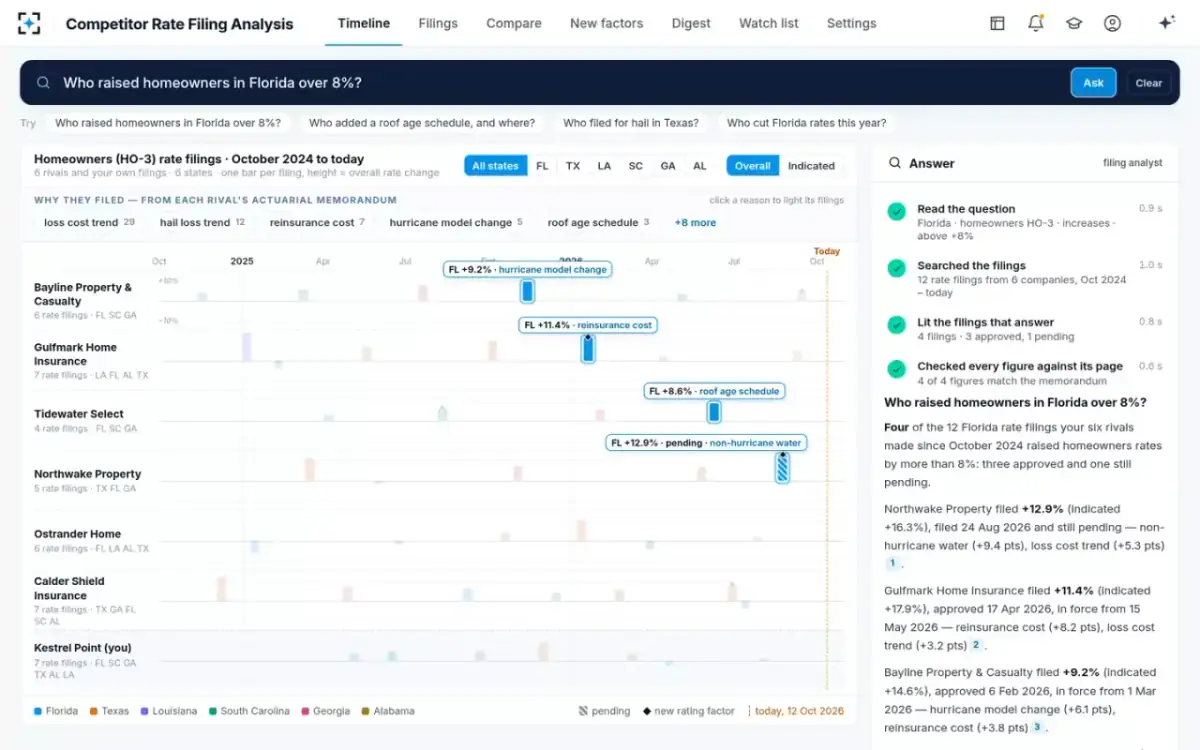
The count of filings searched is not decoration. An answer that says "four" without saying "of twelve" cannot be checked for what it left out. In the sample the analyst can click any lit bar and land on the memorandum passage, highlighted, on page 11 of a 472-page filing. That one click is what replaces the morning of searching.
Alerts: which rival filings are worth a ping
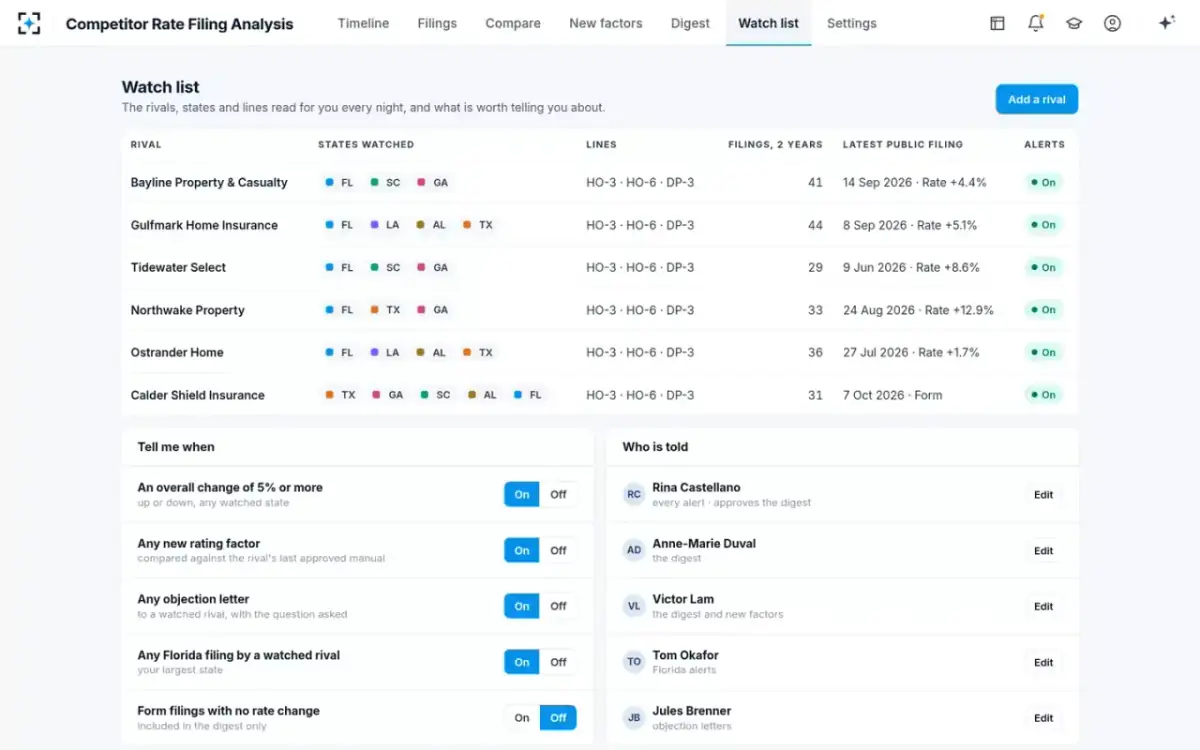
Fewer than you would think, and they should be your choice. A monitor that alerts on every filing becomes a second inbox. In the sample, the watch list sends four kinds of alert: an overall change of 5% or more, any new rating factor, any objection letter to a watched rival, and any Florida filing, Florida being the carrier's largest state. Form filings with no rate change go into the weekly digest only.
A watch list sets what is read, and who is told
Competitor rate filings and SERFF access: what a monitor may collect
Only what the state publishes, and that is less than the whole filing. Most states publish through the NAIC's SERFF Filing Access; Florida publishes through its own search. Texas tells users plainly that "You can see only the details of a filing if the company or TDI marked it available for public access," and that confidential documents are left out of search results even when the rest of a filing shows (Texas Department of Insurance, SERFF). Florida's search warns that the rate changes it displays can understate increases and decreases where a company has claimed trade secret (Florida OIR, IRFS Forms and Rates Filing Search).
Two rules follow for any tool. It should collect from public access only, never through a filer's login, and it should keep each document's source address and date, so an answer can show where a page came from and when. And it should say so when a filing is partly confidential, rather than treat a gap as a zero. Are insurance rate filings public record? sets out the rules state by state.
Insurance rate filing monitoring requirements: what applies to the tool itself
We know of no state that requires a carrier to monitor its competitors' filings; the requirements that apply are about how the company governs the tools it uses. The NAIC's model bulletin on insurers' use of artificial intelligence systems, adopted by 29 jurisdictions as of 8 October 2026 on the NAIC's own adoption map (NAIC), expects governance, documentation and oversight of AI systems that inform decisions about consumers. A monitor that only reads public filings does not decide anything about a consumer, but its output can inform a rate selection, which does.
That is the practical case for the limits above. A reading that is cited, logged and checked can be explained to a regulator; an unsourced summary cannot. In the sample, every question, the filings lit and the pages cited are logged. The NAIC's 2015 white paper on price optimization also listed "competitive analysis" among the activities companies may fold into that term, and recommended that rates stay cost-based whatever the method (NAIC Casualty Actuarial and Statistical Task Force, 2015). Competitive reading informs a selection; it does not replace the indication.
What to ask before buying rate filing monitoring software
Ask to see each of these on filings from your own states, not on the vendor's examples. The answers will tell you within an hour whether the product reads filings or indexes them.
Ten questions to ask any insurance rate filing monitoring tool
- Which state systems does it read, and how often?
SERFF Filing Access covers most states; Florida publishes through its own search. Nightly beats weekly when a rival files in a hurry.
- Does every figure link to the page it came from?
Not to the filing: to the page. Open three at random.
- Does it keep indicated and filed apart, always?
Ask for a filing where the two differ by more than five points and see what the summary says.
- How does it report a pending filing?
Look for the status and, in file-and-use states, the review clock.
- Does it read rule and form filings?
New surcharges and deductibles often arrive with no overall rate change.
- How does it decide a rating factor is new?
By comparing manual pages with the last approved ones, not by keywords; a renamed rule is not new.
- Where does a stated reason come from?
The passage in the memorandum, quoted. No passage, no reason.
- What will it refuse to say?
It should refuse to state a rival customer’s premium.
- Who can see your own unfiled indication?
The pricing team and the chief actuary, never a digest.
- What goes out without a person approving it?
Nothing should.
Where Competitor Rate Filing Analysis fits, and where it does not
It fits a personal lines pricing team that writes in several states, watches a known set of rivals and needs the reasons behind their filings, not only the percentages. It fits homeowners best, where roof, water and catastrophe rules change often and the memorandum says why. It reads your own filings too, so a rival's factor can be set against yours band by band, and it hands the analyst a weekly digest to approve.
It does not quote premiums for sample risks; that is the job of a comparative rater or a quoting study, and the two answer different questions. It cannot read what a state does not publish: a filing marked confidential, an underwriting rule that was never filed, or a line written where rates need not be filed at all. And it does not set your rates. What to set up before you watch rivals lists the states, lines and systems to decide on before any tool is switched on, and the Competitor Rate Filing Analysis page walks through the full morning in the sample.
Questions people ask
Is there software that monitors competitors' insurance rate filings?
Yes. Products range from searchable indexes of filing fields to systems that read every document of every filing. The difference shows in the reasons and new rating factors, which sit in the actuarial memorandum and the manual pages rather than in the filing's form fields.
What is a rate filing analytics tool?
A rate filing analytics tool turns filings into structured data: overall change, indicated change, premium and policies affected, dates and status, so they can be charted by rival and state. Ask whether each field comes from the filer's transmittal entries or from the page in the filing, because the two can disagree.
Can I see competitor rate filings through SERFF access?
Mostly. SERFF Filing Access shows what each participating state has marked public, and Texas says confidential filings and documents do not appear in search results. Florida is not on SERFF Filing Access; its filings are in the Office of Insurance Regulation's own search, which warns that trade-secret claims can affect the rate changes it displays.
How does a monitoring tool know why a competitor raised rates?
Only from the company's own words. The actuarial memorandum usually states what drove the change, sometimes with the points each reason contributed. In Competitor Rate Filing Analysis a reason is kept only with its quoted passage, and a reason the agents are unsure of is held for the analyst.
Does a rate filing monitor tell you what competitors charge?
A careful one does not. Filed rates and manuals are public in most states, but tier placement rules often are not, so a customer's premium can only be estimated. The solution states what a rival filed and its status, never what a customer pays.
How much of a rival's filing does a monitor need to read?
All of it that the state publishes. In the sample, one Florida rate filing ran to 472 pages, and the passage that explained a new roof age schedule was on page 11 of the actuarial memorandum. The rule pages and the regulator's correspondence are separate documents in the same filing.