A rate filing marked pending is one the insurance regulator has received but not yet decided: it may be waiting for a reviewer, for the company's answer to an objection letter, or for the state's final action. Pending does not mean approved, and it does not always mean "not in use". Under a prior approval law the rate cannot be used until approval, or until a deemer period runs out; under a file-and-use law the rate may already be charged while the review continues, and can still be disapproved. So the meaning of pending on a rate filing is always pending, under this state's law, with this much time left on the clock. Competitor Rate Filing Analysis is Botminds' solution for reading rivals' filings; it reports every filing's status as the state gives it, keeps pending, approved and withdrawn apart, and in file-and-use states shows the review clock beside a pending filing.
Status names come from the NAIC's SERFF training material and glossary; rating-law examples from the Florida, Texas and California statutes and regulators. The worked examples use a fictional sample carrier and its invented rivals.
The SERFF status ladder: where pending sits, and what closes it
- 1Not public
Draft
Tracking number assigned; not yet sent to the state.
- 2Public only if the state releases it
Submitted
Sent, and passed the system’s checks; the state can open it.
- 3Pending
Assigned
A reviewer has it; no other action yet.
- 4Pending
Pending Industry Response
An objection letter is open, waiting for the company.
- 5Pending
Pending State Action
The company has answered every objection; the state has not decided.
- 6Decided
Closed – Approved, Filed or Acknowledged
The state’s disposition is final; the outcome is appended to the status.
- 7Decided
Closed – Disapproved, Withdrawn or Rejected
The change will not take effect as filed.
What does pending mean on a rate filing?
It means no final action yet. In SERFF, the system most states use, a filing moves from submitted to assigned once a reviewer has it, then into one of two pending statuses. The NAIC's training lesson for state reviewers defines them: "Pending Industry Response: There are one or more open Objection Letters on the filing that need a response from industry," and "Pending State Action: Industry has responded to all Objection Letters sent by the state. Filing is still open and awaiting further action by the state" (NAIC SERFF Lesson 4).
The two are worth telling apart. Pending industry response means the regulator has asked a question and the company owes an answer; the clock in some states stops while it does. Pending state action means the ball is with the regulator. A rival's filing that has sat in pending industry response for weeks may be one the company is struggling to support.
Rate filing meaning, and why status is part of it
A rate filing is a company's request, or notice, to a state regulator that it will use new rates, rules or a rating plan for a line of business. Its meaning for the market depends on its status as much as its numbers: the same +9.2% is a proposal while pending, a price change once approved and in force, and nothing at all if withdrawn. That is why a filing's status belongs next to its percentage in every report, and why a report without it misleads.
Rate filing approved vs filed vs acknowledged: three ways a filing closes
A filing closes when the state creates a disposition. The NAIC's SERFF glossary defines the closed status as "Closed - *": "The state has created a Disposition indicating the final action on the filing. The asterisk indicates that the state Disposition status (i.e., Approved, Acknowledged, Disapproved) will be appended to the SERFF status" (NAIC SERFF Glossary). Approved means the state affirmatively accepted the change, typical under prior approval. Filed or acknowledged usually means the state received a filing it did not need to approve, typical under file-and-use or use-and-file, without endorsing it.
The difference matters for a competitor in one way. A filed or acknowledged rate can still be disapproved later in many states: under file-and-use laws, the NAIC handbook explains, no specific approval is needed but the department keeps the power to disapprove afterwards, usually for the future only (NAIC Product Filing Review Handbook, 2024). An approved rate in a prior approval state has passed review; a filed one in a competitive state has passed only the filing.
Pending under prior approval: a proposal that may never take effect
Under a prior approval law, a pending rate is not in use. It takes effect only on approval or, where the state has a deemer provision, when the deemer period expires without action. California's Department of Insurance, in a 2018 legal opinion, described its own Proposition 103 rule this way: an application is treated as approved 60 days after public notice unless specified conditions apply, such as a consumer's request for a hearing within 45 days that the commissioner grants (California Department of Insurance, General Counsel opinion, 2018).
SERFF carries the date for such states. Its general information tab includes a "Deemer Date: This is the date that the company may begin using the filed product unless the state has contacted them and notified them otherwise" (NAIC SERFF Lesson 4). For a competitor, a pending prior-approval filing is a statement of intent with an uncertain outcome. It can be cut after objections, withdrawn, or approved months later than the company asked for, and the regulator's correspondence is where to see which way it is going.
Pending in a file-and-use state: Texas and Florida
Under file-and-use, pending can mean "already in use". In Texas, a rate filed under the state's file-and-use chapter may be used from the date it is filed (Tex. Ins. Code §2251.101). The commissioner can disapprove a rate before it takes effect, within 30 days of filing, with the clock paused while the department waits for information it has requested; after that, disapproving a rate in effect takes a hearing. A Texas homeowners filing shown as pending may be a rate customers are already being quoted.
Florida's file-and-use works differently. A filing made at least 90 days before its effective date, and not used during the review, is a file-and-use filing, and the office must issue a notice of intent to approve or disapprove within 90 days. If it does not, the statute says: "The rate shall be deemed approved if the office does not issue a notice of intent to approve or a notice of intent to disapprove within 90 days after receipt of the filing" (Fla. Stat. §627.062(2)(a)). Requests for information do not stop that clock. A company that uses a rate before the review ends files on a use-and-file basis instead, and risks an order to return any portion later found excessive.
What a pending rate filing means under two rating laws
Prior approval: No, not until approved or deemed approved.
File-and-use: It may be: Texas lets a rate be used from the day it is filed.
Prior approval: Approval, disapproval, withdrawal, or a deemer period running out.
File-and-use: Disapproval within the review window, or the window closing; in Florida, deemed approval at 90 days.
Prior approval: Yes: objections often cut the change or add conditions.
File-and-use: Yes, and a rate already used can be ordered back where the law allows.
Prior approval: “Pending: proposed, not in use.”
File-and-use: “Pending: may be in use; review ends on [date].”
Prior approval: California: deemed approved 60 days after public notice unless conditions apply, such as a timely hearing request.
File-and-use: Florida: 90-day review; Texas: 30-day disapproval window before the rate takes effect.
Why pending filings matter most to a competitor
Because they are where the market is going, not where it has been. An approved filing tells you what a rival's customers will pay from a date; a pending one tells you what the rival wants, what the regulator has questioned and how much of the change is at risk. In the sample, three rivals each had a rate filing pending in October 2026, in Florida, Texas and Georgia; counting the pending Florida +12.9% puts that rival's compounded Florida change since October 2024 at +10.8%, which is why the solution marks it rather than leaving it out.
The rating law decides how to weigh it. The NAIC handbook notes that every state legislature has enacted a rating law "except Illinois, which has no rating law" (NAIC Product Filing Review Handbook), and the laws that exist range from prior approval through file-and-use and use-and-file to flex rating, where approval is needed only above a set percentage change. A pending filing in a flex-rating state may be pending only because it crossed that band. Homeowners rate filings by state shows how one prior approval state's threshold shapes the changes companies file.
How long a rate filing stays pending: one filing's life, status by status
In the sample's approved Florida filing, pending took most of the time between filing and decision, and approval was not the end. The filing was submitted on 9 June 2026, drew an objection letter on 7 July, was answered on 24 July, was approved on 21 August and took effect on 1 October. Split by SERFF status, its 114 days look like this.
Where one sample filing's 114 days went, by status
Florida HO-3 rate filing, 9 June to 1 October 2026
- Submitted, under review · 24.6%
- Pending industry response · 14.9%
- Pending state action · 24.6%
- Approved, not yet in force · 35.9%
Two readings follow. The filing was pending for 45 of its 114 days after the objection, so a report that called it approved in July would have been wrong for six weeks. And for more than a third of its life it was approved but not in force: the period when a competitor knows exactly what is coming and the rival's customers do not.
Competitor Rate Filing Analysis: every filing's status, pending kept apart
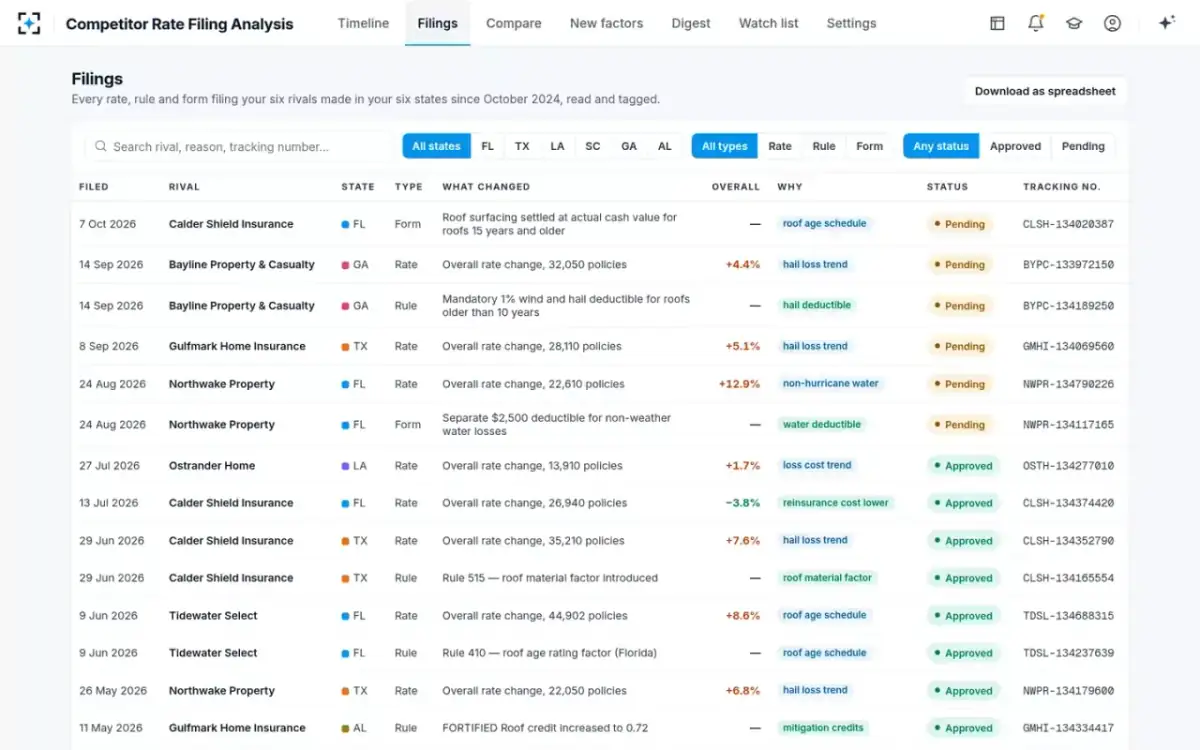
What does a disapproved filing mean? And withdrawn, and rejected?
Disapproved means the state decided the rate does not meet the law's standard, usually that it is excessive, inadequate or unfairly discriminatory, and it may not be used as filed. Withdrawn means the company pulled the filing itself, often after objections, sometimes to refile with changes. Rejected, in SERFF's vocabulary, means the state closed the filing as not acceptable for review, usually because it was incomplete; the NAIC handbook describes intake this way: "If the filing is found to be incomplete, the filing may be rejected, or additional information may be requested" (NAIC Product Filing Review Handbook).
All three are information. A disapproval tells you what the regulator would not accept, which constrains everyone in the state. A withdrawal after objections can precede a smaller refiling. A rejection says the filing was incomplete, not wrong. None of them should be counted as a rate change in a market summary, and a tracker that leaves them as "pending" overstates the market's movement.
How to report a pending rate filing without misleading anyone
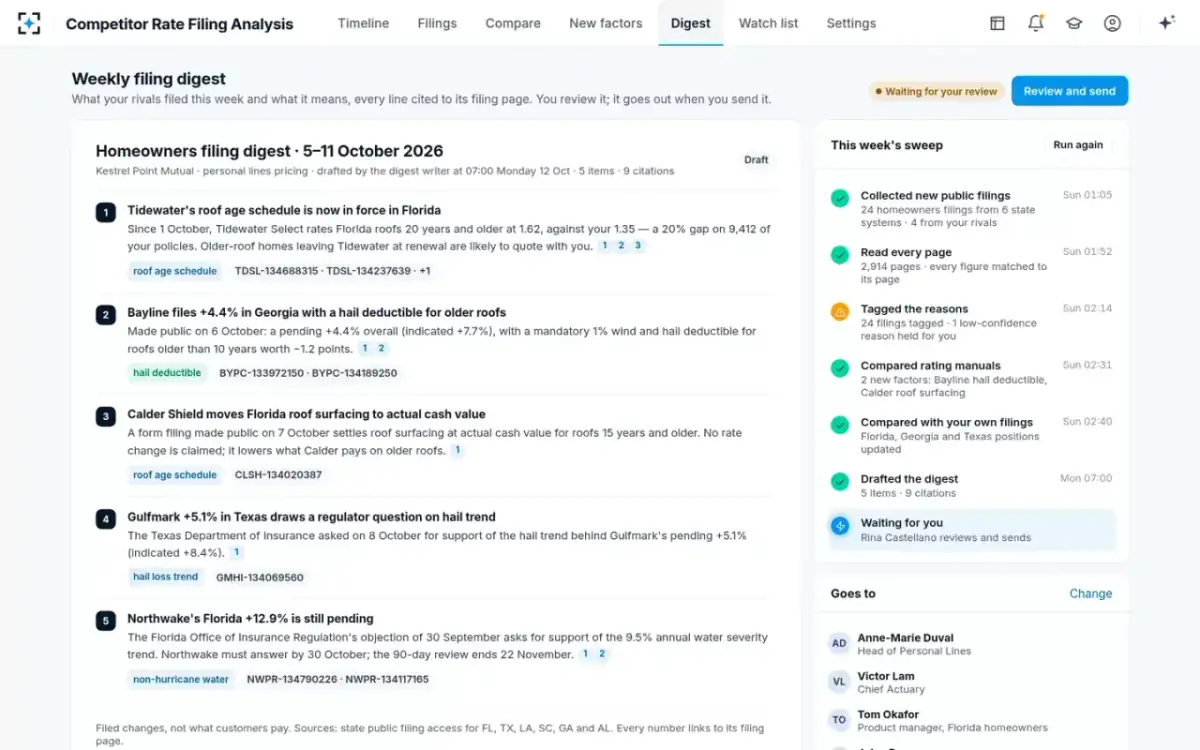
Say pending, say under which law, and give the date the review ends. In the sample, one rival's Florida filing, +12.9% on an indication of +16.3%, was filed on 24 August 2026; the regulator's objection of 30 September asked for support of a 9.5% annual water severity trend, the answer was due on 30 October, and the 90-day review ends on 22 November. That is how the weekly digest reports it, under the headline that it is still pending.
A pending filing in the weekly digest, with its clock
Before you report a rival's pending rate filing, check these five things
- Which pending?
Waiting for the company (an open objection) or for the state.
- Which rating law, for this line, in this state?
Prior approval, file-and-use, use-and-file or flex rating: they give pending different meanings.
- Can the rate already be in use?
Under file-and-use it may be. Say so.
- When does the review end?
The deemer date, the statutory review window, or the objection response date.
- What would change the outcome?
Read the objection letters: the question asked is usually the part at risk.
The status is the first of five checks every reading of a filing should pass; how to read insurance rate filings covers the other four, and rate indication vs selected rate explains why a pending filing's indication is worth reading before its outcome is known.
Questions people ask
What does SERFF filing status mean?
It is the stage a filing has reached in the System for Electronic Rate and Form Filing: draft, submitted, assigned, pending industry response, pending state action, or closed with the state's disposition appended, such as approved, acknowledged or disapproved. States may also keep their own state status, in their own words, alongside it.
Does pending mean the rate increase is coming?
Not necessarily. Under prior approval, a pending increase can be cut, disapproved or withdrawn before it takes effect. Under file-and-use, as in Texas, it may already be in use, though the state can still disapprove it within its review window.
How long can a rate filing stay pending?
It depends on the state and the law. Florida must act on a file-and-use filing within 90 days or the rate is deemed approved; California deems an application approved 60 days after public notice unless conditions such as a timely hearing request apply; open objection letters can extend the time in states where the clock stops.
What is the difference between approved and filed?
Approved means the state affirmatively accepted the change, typical of prior approval states. Filed or acknowledged means the state received a filing it did not have to approve first, typical of file-and-use states, and the NAIC handbook notes that the department can still disapprove the rate afterwards.
What does a disapproved rate filing mean?
The state has decided the rate does not meet the law's standards, typically that it is excessive, inadequate or unfairly discriminatory, so it may not be used as filed. In Texas, disapproving a rate already in effect requires a hearing with at least 20 days' written notice to the filer.
What does withdrawn mean on an insurance rate filing?
The company withdrew the filing itself before the state decided, often after objection letters, and the change will not take effect as filed. A withdrawn filing is frequently followed by a new filing with a smaller change or different support, which is worth watching for.