Homeowners insurance rating factors are the multipliers a company's rating plan applies to a base rate for each characteristic of a home and policy: territory, construction, protection class, amount of insurance, deductible, claims history and, increasingly, roof age, wind and wildfire mitigation and catastrophe model output. Since 2024 the factors themselves have been changing faster than the rates: California opened its rate filings to wildfire catastrophe models, Florida's statutes require mitigation credits in every residential property filing, and roof age schedules have spread from filing to filing. For a competitor, the filing that adds a factor matters more than one that moves the overall rate, because a new factor changes which homes a rival prices up and which it prices down, and the homes it prices up start shopping. Competitor Rate Filing Analysis is Botminds' solution for reading rivals' filings; one of its agents compares every filing's rating manual pages with the rival's last approved pages and flags a factor the first time it appears.
The worked example follows a fictional sample carrier, Kestrel Point Mutual, and a fictional rival, Tidewater Select, whose roof age schedule spread across three states. Law and regulator figures are cited where they appear.
A new rating factor, in one rival's filings
1.62
the rival’s factor for roofs 20 years and older, against the carrier’s own 1.35
Fictional sample
9,412
of the carrier’s 71,350 Florida HO-3 policies sit in that band
Fictional sample
13months
from the flag on the first state’s filing to the factor taking effect in Florida
Fictional sample
What are homeowners insurance rating factors?
A rating factor is a multiplier for one level of one rating variable, applied to a base rate. The NAIC's handbook for rate reviewers explains the convention: "Rating factors less than 1.00 are credits or discounts from the base rate. Rating factors greater than 1.00 are surcharges from the base rate" (NAIC Product Filing Review Handbook, 2024). A homeowners premium is the base rate for the territory multiplied through a chain of such factors, plus or minus fees and credits.
Which variables a company uses, and how many levels each has, is its rating plan, and it changes through filings. Homeowners plans are increasingly built with generalized linear models; the NAIC's white paper on reviewing them asks regulators to "Determine whether individual input characteristics to a predictive model and their resulting rating factors are related to the expected loss or expense differences in risk" (NAIC Casualty Actuarial and Statistical Task Force, Regulatory Review of Predictive Models). That test, related to expected loss, is the one a new factor must pass in most states.
Homeowners insurance rating factors by state: what a state can require or forbid
States set the limits in both directions. Some forbid or restrict variables: the NAIC handbook notes that "Some rating factors, such as education or occupation, might be controversial or perceived to be discriminatory against protected classes and might not be acceptable in a state." Others require them. Florida's statute on residential property filings says a rate filing "must include actuarially reasonable discounts, credits, or other rate differentials, or appropriate reductions in deductibles" for homes with windstorm mitigation features (Fla. Stat. §627.0629), and Florida also requires projected hurricane losses in a rate filing to be estimated with a model or method its hurricane loss commission has found acceptable (Fla. Stat. §627.062).
Some rules govern eligibility rather than price, and the difference matters when reading a rival. Florida bars an insurer from refusing to issue or renew a homeowners policy solely because a roof is less than 15 years old, or because of roof age at all if an authorized inspection shows at least five years of useful life left (Fla. Stat. §627.7011). A roof age rating factor prices older roofs; it does not refuse them. A rival that cannot decline an older roof can still surcharge it; the renewal side of that decision is the subject of Florida's 15-year roof rule, from Botminds' Homeowners Renewal Underwriting.
Homeowners rating factors by state: required, restricted or newly allowed
| State | Rule | What it means for a rival’s rating plan |
|---|---|---|
| Florida | Residential property filings must include mitigation discounts, credits or other differentials (§627.0629) | Every rival files wind mitigation credits; changes to them are worth reading |
| Florida | Projected hurricane losses estimated with a model the state commission accepts (§627.062) | A hurricane model change is a stated reason in many filings |
| Florida | No refusal to issue or renew solely for a roof under 15 years, or with 5 years of life left on inspection (§627.7011) | Roof age moves into pricing rather than eligibility |
| California | Department-reviewed wildfire catastrophe models usable in rate filings (2025), with mandatory wildfire safety discounts since 2022 | Wildfire loads and mitigation credits change in the same filings |
| Any state | Factors such as education or occupation may be unacceptable | A factor allowed in one state may be absent from the same rival’s plan in another |
New rating factors 2024 to 2026: what changed in the public record
Catastrophe models moved into rate filings where they had been kept out. On 1 August 2025 the California Department of Insurance announced it had completed its review of three wildfire catastrophe models, and said that "The Department’s regulation provides a focused, transparent, and efficient way for insurance companies to utilize a model in a rate filing" (California Department of Insurance, 1 August 2025). The same release describes the 2022 Safer from Wildfires regulation as having "introduced the nation’s first mandatory wildfire insurance safety discounts". A California homeowners filing after 2025 can therefore change both the wildfire load and the mitigation credits that offset it.
Elsewhere the change has come through rating rules rather than statutes. The NAIC handbook observes that because rates from catastrophe models "may better reflect an insurers loss potential from catastrophic events, these models are becoming more widely accepted". Roof age schedules, separate deductibles for water or for wind and hail on older roofs, and changes to mitigation credits have been appearing in rule filings, often without any overall rate change. Those are the filings a headline-only reading misses, and the ones the rest of this guide is about.
Why the filing that adds a factor matters more than the one that moves the rate
Because it moves different homes by different amounts. An overall +5% moves every policy about 5%; a new roof age schedule can lower the price of new roofs and raise the price of old ones while the overall change stays small. In the sample, the rival's Florida filing was +8.6% overall, of which the roof schedule contributed 3.1 points, but its factor for roofs 20 years and older is 1.62, against the carrier's 1.35.
The second-order effect is selection. Homes the rival now surcharges harder than you do become cheaper with you at their next renewal, and homes it now prices lower become harder for you to keep. A carrier whose own curve is flatter than a rival's will tend to attract that rival's older roofs, at a price its own data may not support. That is a question for the chief actuary, but only if someone has read the rival's rule pages in time to ask it.
How a new rating factor shows up in a rival's filing
In three places, and rarely in the headline. The rule appears in the rating manual pages filed with the rate/rule schedule, often as a new rule number. The memorandum usually explains it and states its contribution in points, and the CAS ratemaking text notes that a filing changing rating variables "may also include information about the indicated relationships between the different levels for each rating variable undergoing a change" (Werner and Modlin, Basic Ratemaking, CAS). And the regulator's objection letters often ask about it: in the sample, Florida's regulator asked for the loss experience behind the 1.62 factor.
The hard part is that a new rule can arrive in a rule filing with no overall rate change, or in a rate filing whose headline is about something else. In the sample, the rival filed the Florida roof schedule as a separate rule filing alongside the rate filing, and the Georgia filing that carried it was reported under its largest reason, hail loss trend.
Spotting a new rating factor: compare manual pages, not headlines
The reliable method is mechanical: compare each new filing's rating manual pages with the rival's last approved pages in the same state, and with its pages in other states, and flag a rule that has not appeared before. In Competitor Rate Filing Analysis the factor watcher does exactly that on every filing. It does not flag a renamed rule whose table is unchanged, and it compares your own manual without changing it.
Competitor Rate Filing Analysis: new rating factors, where they appeared first and where they spread
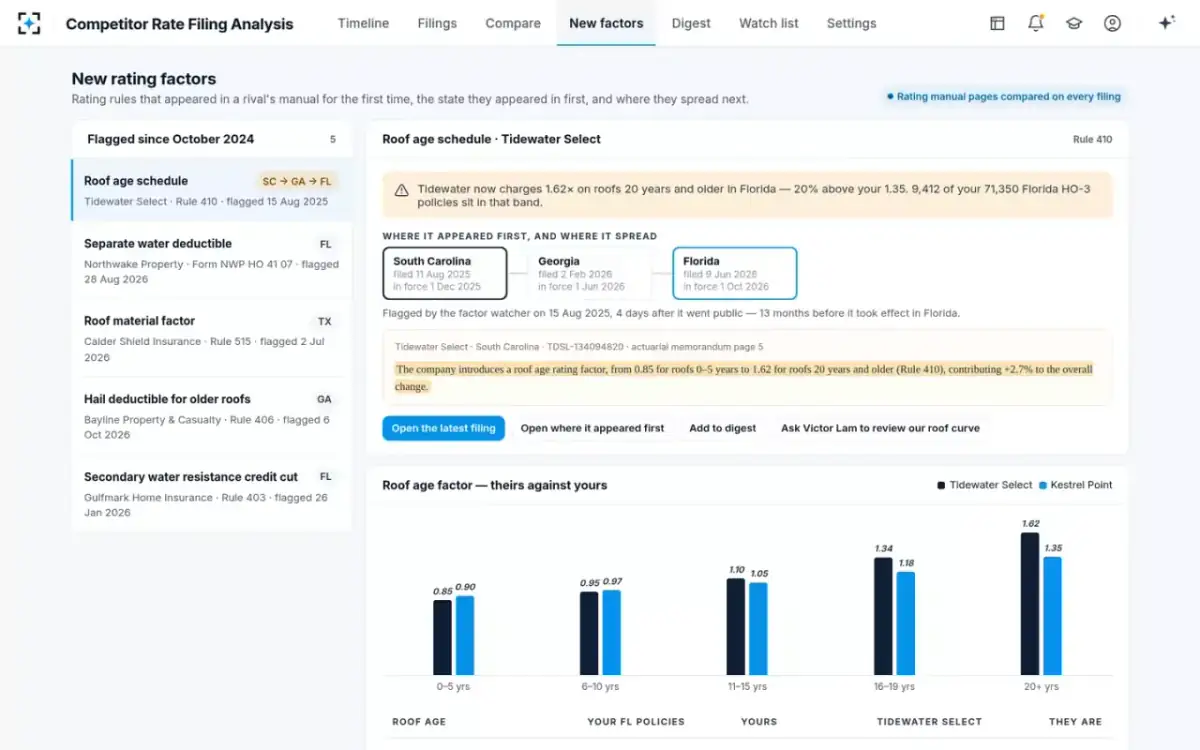
Of the five factors flagged in the sample, four concern roofs, from a roof material factor to a cut in the credit for secondary water resistance under the roof covering, and one concerns water: a separate deductible for non-weather water losses. That pattern is itself a reading of the market: rivals are pricing roof condition and water damage more finely, and a carrier that has not looked at its own roof and water curves recently now has a reason to.
A rival's roof age factors against yours, band by band
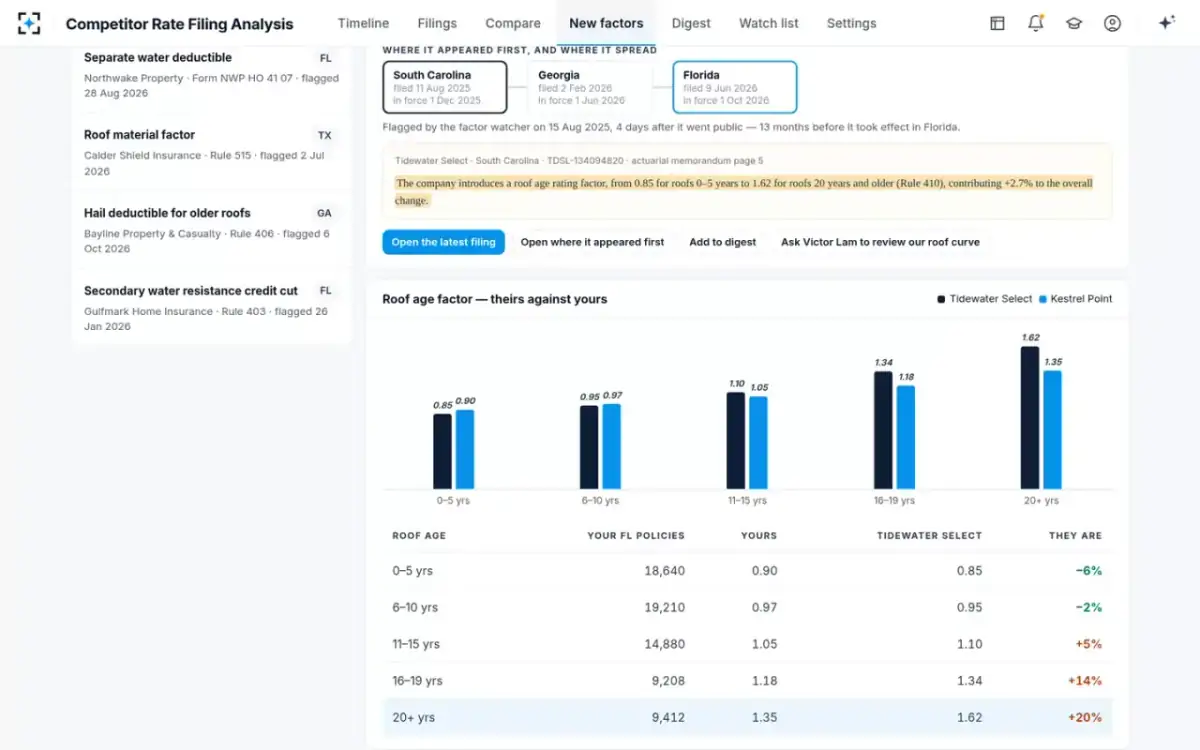
Set the rival's table beside your own and weight both by your policies. The comparison below uses the sample's figures as the solution shows them: the rival's new factors, the carrier's existing ones, and the carrier's Florida HO-3 policies in each band.
A rival's new roof age factors against yours, band by band
Rival’s new factor (Rule 410): 0.85
Your factor: 0.90: the rival is 6% lower
Rival’s new factor (Rule 410): 0.95
Your factor: 0.97: the rival is 2% lower
Rival’s new factor (Rule 410): 1.10
Your factor: 1.05: the rival is 5% higher
Rival’s new factor (Rule 410): 1.34
Your factor: 1.18: the rival is 14% higher
Rival’s new factor (Rule 410): 1.62
Your factor: 1.35: the rival is 20% higher
Raw factors compare two different bases, so normalize them first. The CAS text describes the standard practice: "companies will typically compare current, indicated, and competitors’ relativities all normalized so that the total average exposure-weighted relativity is 1.00 for each." Weighted by the carrier's own Florida policies, the carrier's roof factors average about 1.046 and the rival's about 1.094. Divided through, the rival's oldest band is about 15% above the carrier's rather than 20%, and its newest band about 10% below rather than 6%. That is our arithmetic on the sample, and it says the rival's curve is steeper than the raw table suggests: cheaper for new roofs, dearer for old ones.
Their factor against yours, with your policies in each band
Where the new factor appeared first, and how it spread
A rating rule filed in one state is often filed in the next. In the sample, the rival introduced its roof age schedule in South Carolina, then Georgia, then Florida, each filing approved after roughly ten weeks of review and in force about six weeks later. The flag on the first filing came 13 months before the factor took effect in the carrier's largest state.
One rival's roof age schedule, state by state, from the first filing
- Under review69 d
- Approved43 d
- Not yet filed175 d
- Under review74 d
- Approved45 d
- Not yet filed302 d
- Under review73 d
- Approved41 d
The months in grey are the opportunity. A carrier that sees the first filing has most of a year to review its own roof curve, test its indication by roof age, and decide whether to file before the rival's factor reaches its state. A carrier that learns of it from agents after it takes effect has none. How to read insurance rate filings covers the checks that keep such a flag reliable.
Is a rival's new rating factor price optimization?
Usually not, and the difference is whether the factor is cost-based. The NAIC's 2015 white paper begins its discussion with the admission that "There is no single or widely accepted definition of price optimization", and quotes the CAS definition: "the supplementation of traditional actuarial loss cost models to include quantitative customer demand models for use in determining customer prices" (NAIC Price Optimization White Paper, 2015). A roof age factor justified by roof-related loss experience is a cost-based rating variable; a factor based on how likely a customer is to shop around is not, and the task force recommended that rating practices which cannot be shown to be cost-based should not be allowed.
An insurance price optimization model therefore sits on top of the rating plan, not inside the public factor table, and its effect, where a state permits any, shows up in the selection rather than in the factors. A rival's filing reveals the factors and the indication; the gap between indication and selection is where judgment, and any optimization, shows.
What to do when a rival adds a rating factor
Read it, measure it on your book, and put it in front of the person who decides your rating plan. The checklist below is the sequence the sample follows, from the flag to the chief actuary's review.
Six steps after a rival files a new homeowners rating factor
- Read the rule page and the memorandum passage
The factor table, the rule number and the points the company says it contributes.
- Check the state’s rules
Is the variable required, restricted or newly allowed here? Is it pricing or eligibility?
- Normalize both tables
Weight the rival’s factors and yours by your own policies before comparing levels.
- Count your policies in each band
Where the rival is dearer, you may gain those homes at renewal; ask whether your price is right for them.
- Watch where else it is filed
A rule filed in one state is often filed in the next; track the dates.
- Send it to the person who decides
In the sample, one button asks the chief actuary to review the roof curve.
Questions people ask
What rating factors do insurers use for home insurance?
Common homeowners rating variables include territory, construction and age of the home, protection class, amount of insurance, deductible, claims history and, in more plans each year, roof age, wind and wildfire mitigation and catastrophe model output. Each level gets a factor; above 1.00 is a surcharge and below 1.00 a credit, in the NAIC handbook's terms.
What are rating factors in insurance?
They are the multipliers a rating plan applies to a base rate for each level of each rating variable. The NAIC handbook notes that many rating systems use a base-times-factor method: the premium is the base rate multiplied through the factors that apply to the risk.
Do homeowners insurance rating factors differ by state?
Yes. States can restrict variables they consider unfairly discriminatory and require others; Florida, for example, requires mitigation discounts or credits in every residential property rate filing, and California has allowed department-reviewed wildfire catastrophe models in rate filings since 2025.
What new homeowners rating factors appeared in 2024 and after?
The visible changes were catastrophe models entering filings, such as California's 2025 approval of wildfire models for rate filings, and finer pricing of roofs and water: roof age schedules, roof material factors and separate deductibles for older roofs or water losses, often filed as rule changes without an overall rate change.
What is price optimization in insurance?
There is no single accepted definition, the NAIC's 2015 white paper says; the CAS defines it as adding customer demand models to loss cost models when setting prices. The NAIC task force recommended that rating practices which cannot be shown to be cost-based, such as pricing on a customer's propensity to shop, should not be allowed.
How do I find out if a competitor added a new rating factor?
Compare its newest rating manual pages with its last approved pages in the same state and with its pages in other states, and read the memorandum for the points the change contributes. Rule filings with no overall rate change are a common place for a new factor to appear first.