An insurance pricing analyst builds and defends the numbers behind a carrier's rates: the experience data, the trend and catastrophe loads, the rate indication, the rating factors and the exhibits a regulator will read. At a regional personal lines carrier the same analyst is also, in practice, the company's competitive intelligence desk, the person asked twice a week what the other companies are doing. The answers sit in competitors' public rate filings, and there are far more of them than one person can read. Competitor Rate Filing Analysis is Botminds' solution for that second job: agents collect every rate, rule and form filing your watched rivals make in your states, read the actuarial memorandum for the stated reason, and answer an insurance pricing analyst's question in plain words, each sentence cited to its filing page.
The examples below follow a fictional sample carrier as it runs through the solution: Kestrel Point Mutual, a homeowners writer watching six rivals in six Southeastern states. Its people, competitors and filings are invented. The research figures come from regulators, the Federal Reserve and the Casualty Actuarial Society, linked where they appear.
The pricing desk is small, and the filing stream is not
31,200
actuaries in US jobs in 2025, the occupation that sets and signs rates
BLS Occupational Outlook Handbook
$130,000
median actuary pay in 2025, or $62.50 an hour
BLS; pricing analysts are not counted separately
567
personal lines filing entries in one year of California’s weekly public notices
157 of them homeowners; our count of 52 notices
What does an insurance pricing analyst do?
An insurance pricing analyst turns loss and premium data into rates a company can file and defend. In a homeowners shop that means bringing premium to current rate level, developing and trending losses, loading catastrophe and reinsurance costs, testing rating factors, and writing up the exhibits that go into a rate filing. The analyst rarely signs the filing; an actuary does. But the analyst builds most of what the actuary signs, and answers most of the questions the business asks about it.
The Bureau of Labor Statistics does not count pricing analysts as an occupation of their own. The nearest it measures is actuaries: 31,200 jobs in 2025, a median of $130,000 a year, and a projected 9% growth to 2035 (BLS, Occupational Outlook Handbook). Its description of the work names the competitive half of the job outright: actuaries "must ensure that the premiums are profitable yet competitive with other insurance companies." At many regional carriers it is the pricing analyst who finds out what competitive means this quarter.
That second half is where the time goes missing. Indications have a calendar and a sign-off. Competitive questions arrive whenever the product manager hears something from an agent, and each one starts with a search of a state's filing system.
Pricing analyst or pricing actuary: who builds the rate, and who signs it
The difference is the signature. A pricing actuary is credentialed and responsible for the actuarial opinion in a filing; a pricing analyst, often an actuarial student or a statistician, builds the analysis and maintains the models. At a large carrier the two roles sit on separate teams; at a regional mutual one analyst may support a single chief actuary across every line and state.
Both need the competitors' filings for the same reason: a rival's filing is the main public document that says what the rival changed, from when, and why. The NAIC's Product Filing Review Handbook, written for the regulators who review rate filings, notes that for new coverages or new lines, rates are typically developed by the pure premium method "or another method based significantly on judgment or competitor market rates" (NAIC Product Filing Review Handbook, 2024). A carrier entering a state or launching a new endorsement often prices it from what others filed first.
Who does what with a rival's rate filing at a regional carrier
| Role | What they need from rival filings | What they decide |
|---|---|---|
| Pricing analyst | Every filing in the states and lines priced: the change, the indication, the reasons, the rating pages | What a finding means, and what goes to the business |
| Chief or pricing actuary | New rating factors and the tables behind them, set against the company’s own | What the company files |
| Head of personal lines | Who moved, by how much and why, on one page | Where to grow, where to hold |
| Product manager | A quick check of what agents report from the field | Product and appetite changes in a state |
| Rate filing analyst | The questions regulators asked rivals | How to prepare the company’s own filing |
Where an insurance pricing analyst's quarter goes
Most of it goes on the company's own rates, and competitive work fills the gaps. The figure below lays a 65-day working quarter out two ways. Its middle lane uses the solution's own estimate for one market review of six rivals in six states: 12.5 working days by hand, about one day once the filings have been read for you. The other two lanes are assumptions for illustration: answering "what are the others doing?" twice a week, at half a day each by hand, and the rest of the quarter on the company's own indication and filings.
An insurance pricing analyst's quarter, before and after the filings are read overnight
- Own indication and filings39.5 d
- One market review12.5 d
- Ad hoc rival questions13 d
- Own indication and filings39.5 d
- Review1 d
- Questions1 d
- Analysis the quarter never had time for23.5 d
The arithmetic is less important than the shape. By hand, close to two-fifths of the quarter goes on other companies' documents, mostly finding and transcribing them, and the reading is still partial. Read overnight, that share becomes the time to ask what a rival's move means for the book: which of your policies sit in the band a rival just surcharged, and whether your own indication still holds.
Why one desk reads only the rival filings someone finds
Because the stream is large and the search is manual. Competitors file far more often than a person can follow: in a Federal Reserve staff study of homeowners rate filings from 2009 to 2019, the propensity to file a rate change was "very high at 70% for the average insurer in a given state and year" (Oh, Sen and Tenekedjieva, FEDS 2022-064). At that rate a rival writing in six states files about four rate changes a year, and six such rivals about twenty-five, before a single rule or form filing is counted.
Each one has to be found state by state, opened, and read. The reason a rival changed its rate sits in the actuarial memorandum, usually a few pages into a filing that can run to hundreds. The rating manual pages show what moved, but, as the Casualty Actuarial Society's ratemaking text warns, "companies do not file a complete manual with each change", so the full picture is assembled from several filings (Werner and Modlin, Basic Ratemaking, CAS, 2016). That is why the desk reads what someone points at: a filing a colleague mentions, a run of complaints from agents, or a request from leadership.
In the sample, the watch list holds 214 filings by six rivals over two years, about two a week, and the analyst's own words before the solution were: "By the time I find a rival's filing, it's already in force." What a rate filing tracker in Excel really costs works the hours through, step by step.
How many filings land on the desk: one state's year, counted
A useful way to size the job is to count a year of one state's public notices. California's Department of Insurance posts every Friday the filings it received that week, under Proposition 103's public notice rule. We read all 52 notices from 31 October 2025 to 23 October 2026: 2,448 entries, 567 of them personal lines, 157 homeowners multi-peril, from 73 companies in 39 groups. Personal lines entries ran from 1 to 46 a week, about 11 on average.
Half of California's homeowners filings in a year were forms; one in seven changed rates
157 homeowners entries, 52 weekly notices
- Forms only · 49.7%
- Rules and manuals · 31.8%
- Rates · 14%
- New programs · 4.5%
The split matters for the pricing desk. Rate filings carry the headline percentage, but the rule filings are where a rival adds a surcharge, a deductible or a new rating factor, often without any change to the overall rate. A desk that reads only rate filings misses the third of the stream where pricing structure changes. Spotting a rival's new rating factor shows how one such rule filing travels from state to state before it reaches yours.
The competitive questions a pricing analyst is asked, and what a filing can answer
Most questions come in three forms: who moved and by how much, why, and where do we stand. A filing answers the first two well and the third only partly. The CAS text lists the measures carriers use to compare their premium with a competitor's: the ratio of the two premiums, the dollar difference, the share of risks on which the company is cheaper, and its rank among several competitors. It adds a caution that every analyst learns: "In spite of the challenges in obtaining accurate competitor price information, it is still a valuable endeavor for companies to compare their own premium to their best estimate of their main competitors’ premium" (CAS, Basic Ratemaking).
Best estimate is the operative phrase. A rival's filed rates are not what each of its customers pays: underwriting tiers, discounts and the rules that assign a risk to a tier are often not in the public filing. So the honest questions are about what was filed: the overall change, the indication behind it, the reason the memorandum gives, the new rating pages and the regulator's questions. Those can be answered exactly, with the page.
Each company has different insureds, goals, expense levels, and operating procedures.
Casualty Actuarial Society, Basic Ratemaking
What changes when every rival filing is read overnight in Competitor Rate Filing Analysis
Coverage per person changes, not headcount. In the solution, a filing collector checks each watched state's public filing system every night and downloads every document of every new filing. A filing reader extracts the overall and indicated change, the policies and premium affected, the dates and the status, each figure from the page it is printed on. Another reads the actuarial memorandum and notes the reasons the company stated, each with its quoted passage. A factor watcher compares rating manual pages with the rival's last approved pages. The analyst then asks in plain words.
Competitor Rate Filing Analysis: the analyst's Monday, one lane per rival
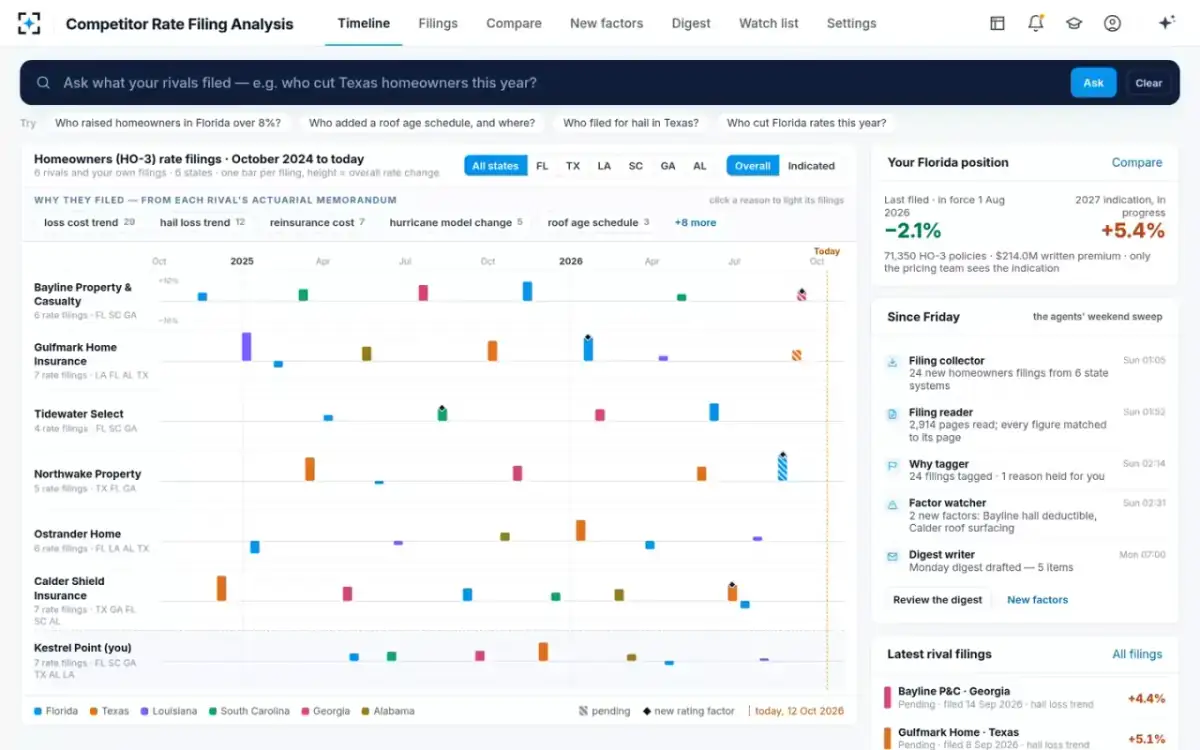
The weekend sweep on the right is what replaces the hunt: 24 new homeowners filings from six state systems, 2,914 pages read, and two new rating factors flagged before the analyst arrived.
The sample analyst, Rina Castellano, types "Who raised homeowners in Florida over 8%?" on a Monday morning. The answer names four of the twelve Florida rate filings her six rivals made since October 2024, three approved and one still pending, each with its filed change, its indicated change and the reason from the memorandum, and lights the four bars on the timeline. Every figure is checked against its page before the answer shows, and the solution's design target is about 11 seconds from question to cited answer.
The five people who act on rival filings see different parts of the same reading. The figure sets out what changes for each, and what stays theirs.
Five seats around one rival filing
Today
Answers “what are the others doing?” twice a week from searches and spreadsheets.
With agents
Asks in plain words and opens each filing on its memorandum passage.
Still theirs: What a finding means, and what goes in the digest
Today
Sees a rival’s change as a percentage, without the memorandum behind it.
With agents
Gets each new rating factor with the rival’s table set against the company’s own.
Still theirs: What the company files
Today
Gets the market picture when someone has time to build it.
With agents
Reads a Monday digest of five to eight items, every line cited.
Still theirs: Where to grow and where to hold
Today
Hears from agents that a rival got expensive and cannot check it quickly.
With agents
Opens the filing and sees exactly what was filed and when it takes effect.
Still theirs: Product and appetite in the state
Today
Finds regulators’ objection letters one filing at a time.
With agents
Is told of every objection letter to a watched rival, with the question asked.
Still theirs: The watch list and the company’s own filing
What stays with the insurance pricing analyst, and why
Judgment stays, and so does the send button. A rival's +8.6% in Florida means one thing if a roof age schedule contributed 3.1 points of it and another if it is all reinsurance cost; the solution can quote the memorandum, but only the analyst can say whether the rival is right about roofs. In the sample, the analyst reviews the Monday digest the agents draft, decides what each item means, and sends it; nothing goes out without that approval, and the company's own unfiled indication never appears in it.
The analyst decides what goes out, and to whom
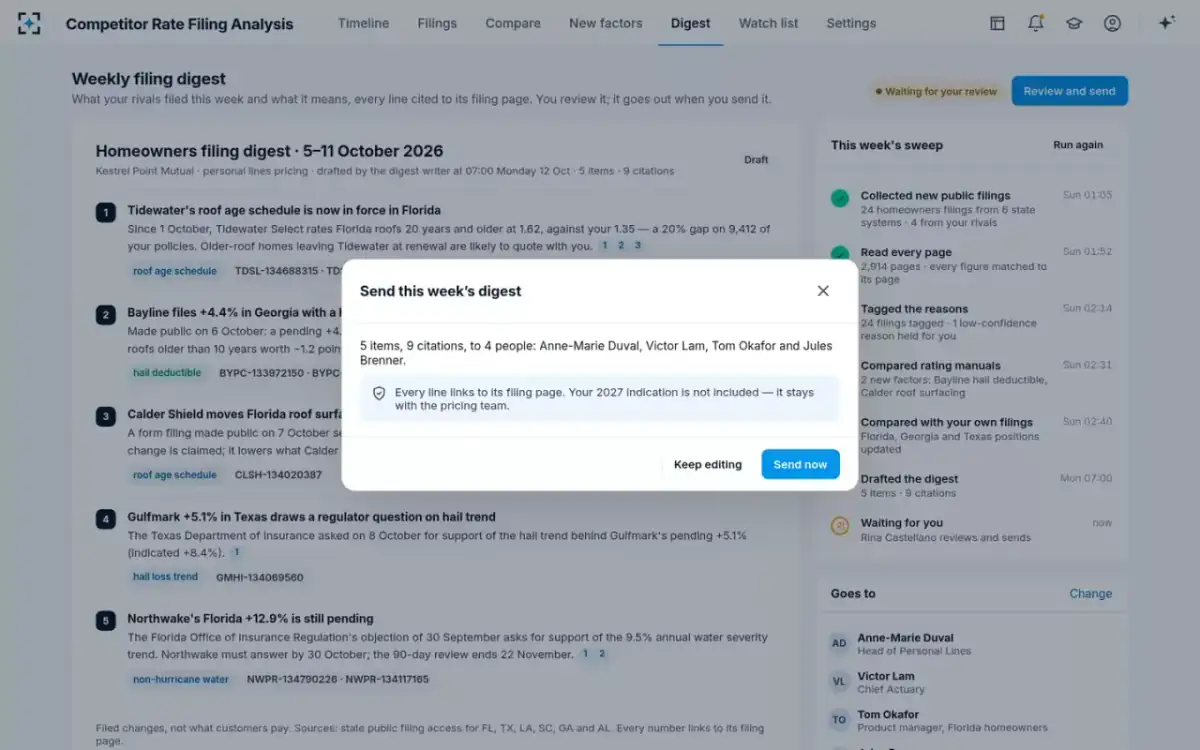
The analyst also owns the reading rules: which rivals and states are watched, when an alert is worth a ping, and the list of reasons the agents may note. A reason is kept only with the passage that states it, and the agents hold a low-confidence one for the analyst rather than guess. The agents and their limits sets out each one, with what it is never allowed to say, and the Competitor Rate Filing Analysis page shows the whole morning screen by screen.
Insurance pricing analyst jobs: the skills that now matter most
The core skills have not moved: data handling, ratemaking method, generalized linear models, and the regulatory sense to know what a state will accept. What changes is the weight between them. When finding and transcribing filings is no longer the bottleneck, the scarce skills are reading a memorandum critically, translating a rival's rating change into exposure on your own book, and writing a two-sentence finding a head of personal lines can act on.
Regulatory literacy grows in value too. The same filing reads differently under a prior approval law, where a pending +12.9% may never take effect, and a file-and-use law, where it may already be charged. An analyst who knows the clocks state by state, and who can tell an indicated change from a selected one, is the person whose reading the company trusts. Rate indication vs selected rate is the place to start.
Questions people ask
What does a pricing analyst do in insurance?
A pricing analyst in insurance builds the analysis behind a carrier's rates: experience data, trend, catastrophe loads, indications, rating factors and filing exhibits, usually for an actuary who signs. In personal lines the analyst also tracks what competitors filed, because a rival's public rate filing is the best evidence of where the market is moving.
Is an actuarial pricing analyst the same as a pricing actuary?
Not quite. An actuarial pricing analyst is often an actuary in training who builds models and exhibits; a pricing actuary holds the credential and signs the actuarial work in a rate filing. The Bureau of Labor Statistics counts only the second as an occupation: 31,200 actuaries held jobs in 2025.
What do insurance pricing jobs pay?
The Bureau of Labor Statistics does not publish pay for pricing analysts as such. For actuaries, the occupation most pricing roles lead to, the 2025 median was $130,000 a year, or $62.50 an hour, with employment projected to grow 9% from 2025 to 2035.
How many competitor filings does a pricing analyst need to follow?
More than most desks read. A Federal Reserve staff study found that the average homeowners insurer filed a rate change in a given state in 70% of years, and California alone published 157 homeowners filing entries in its 52 weekly notices to October 2026. Rule and form filings, where new rating factors appear, add to the rate filings.
Can a pricing analyst see what competitors charge customers?
Only partly. Filed rates and rating manuals are public in most states, but the underwriting rules that place a risk in a tier often are not, so a competitor's final premium for a given home can only be estimated. Competitor Rate Filing Analysis states what a rival filed and its status, never what a customer pays.
Will AI replace insurance pricing analysts?
The work that agents take over is collection, extraction and first reading: finding filings, copying figures and quoting the memorandum. The judgments a pricing analyst is paid for, what a rival's change means and what the company should file, stay with people; in the solution, the agents may not file anything or change a rate.