Colorado's quantitative testing requirements for life insurers come from two texts, and only one is in force. Under Regulation 10-1-1, a life insurer that uses external consumer data, or algorithms and models that use it, must keep a "documented description of quantitative testing conducted pursuant to requirements established by the Division" and report on its framework every 1 December. The Division has not adopted the regulation that would establish those requirements; its 2023 draft is still a draft. So it waived the testing description for the annual reports due 1 December 2024 and 1 December 2025 only, and said later reports would be expected to describe the testing done. Botminds' AI Bias & Fairness Testing runs the kind of tests the draft describes, with BIFSG group estimates, on every model version, which gives a life insurer something concrete to describe on 1 December 2026 whatever the Division decides about the waiver.
Colorado's life insurance testing rules, in three numbers
2reports
for which the testing description was waived: those due 1 December 2024 and 1 December 2025
Revised Bulletin B-10.004, reissued 22 October 2025
5points
gap in approval rates that would trigger variable-level testing under the 2023 draft rule
Draft, never adopted
10pages
maximum length of the annual compliance report, signed by an officer
Regulation 10-1-1, § 6.D
What are Colorado's quantitative testing requirements for life insurers?
In force today: a governance framework that must include a documented description of quantitative testing, and an annual report. Not in force: the rule that would say what the testing is. The Division's revised bulletin explains the gap in one sentence: "Because the Division has not yet adopted a regulation establishing the required quantitative testing referenced in Regulation 10-1-1, the quantitative testing reporting requirement is not applicable for the current reporting period" (Revised Bulletin B-10.004).
The bulletin was issued on 18 October 2024 and reissued on 22 October 2025, and it is explicit about its reach: "The waiver of this requirement is for the annual reports due December 1, 2024 and December 1, 2025 only; subsequent annual reports will be expected to include a description of the quantitative testing conducted." It also says "All other requirements outlined in Regulation 10-1-1 remain in effect," and, like every Colorado bulletin, that it establishes no binding norm (Colorado DOI notice, 22 October 2025).
As of late October 2026 the text on the Division's site still covers only the 2024 and 2025 reports. Whether the Division reissues it for 1 December 2026, adopts a testing rule, or expects a description of whatever testing insurers have chosen to do is an open question. The safe reading is the bulletin's own words: plan to describe the testing you conducted.
Five years from statute to the first life report expected to describe testing
- Statute to draft testing rule27 mo
- To first report, 1 Dec 2024: testing waived14 mo
- To second report, 1 Dec 2025: testing waived12 mo
- To third report, due 1 Dec 202612 mo
- Statute to amended rule in force51 mo
- Progress report, then first annual report, 1 Jul 20269 mo
- Next report, 1 Jul 202712 mo
Colorado SB21-169 testing requirements: what the statute itself says
The statute sets the goal and leaves the method to rules. An insurer may not, "with regard to any insurance practice," unfairly discriminate based on race, color, national or ethnic origin, religion, sex, sexual orientation, disability, gender identity or gender expression, or use external data and models in a way that does (C.R.S. § 10-3-1104.9(1)). The commissioner must adopt rules, after a public stakeholder process, that "establish means by which an insurer may demonstrate, to the extent practicable, that it has tested" its external data and models, line by line and practice by practice.
Those rules must require each insurer to describe its external data and how it uses them, to keep a risk management framework, to assess its results, and to "provide an attestation by one or more officers that the insurer has implemented the risk management framework or similar processes or procedures appropriately on a continuous basis." They must give insurers "a reasonable period of time" to remedy an unfairly discriminatory impact. And nothing in the statute "requires an insurer to collect" an applicant's race or the other listed traits, which is why every test begins with an estimate.
Regulation 10-1-1: the governance rule that is in force
Regulation 10-1-1 is the rule that applies today, to individually issued life insurance, private passenger auto and health benefit plans (3 CCR 702-10). An insurer that uses external data must keep a "risk-based governance and risk management framework" with fourteen documented components: governing principles, board oversight, senior management accountability, a cross-functional governance group, written policies, a complaints process, risk assessment, an "up-to-date inventory, including version control," an explanation of material changes, the description of quantitative testing, monitoring for drift, vendor selection, an annual review, and for health plans a provider's responsibility for prior-authorization decisions.
Life insurers report every 1 December. The report summarises compliance with those components, names the title and qualifications of each person responsible, must be "signed by an officer attesting to compliance with this regulation," and may run to "no more than ten (10) pages." An insurer that cannot attest files a corrective action plan instead. An insurer that uses no external data files an officer's attestation saying so, also by 1 December.
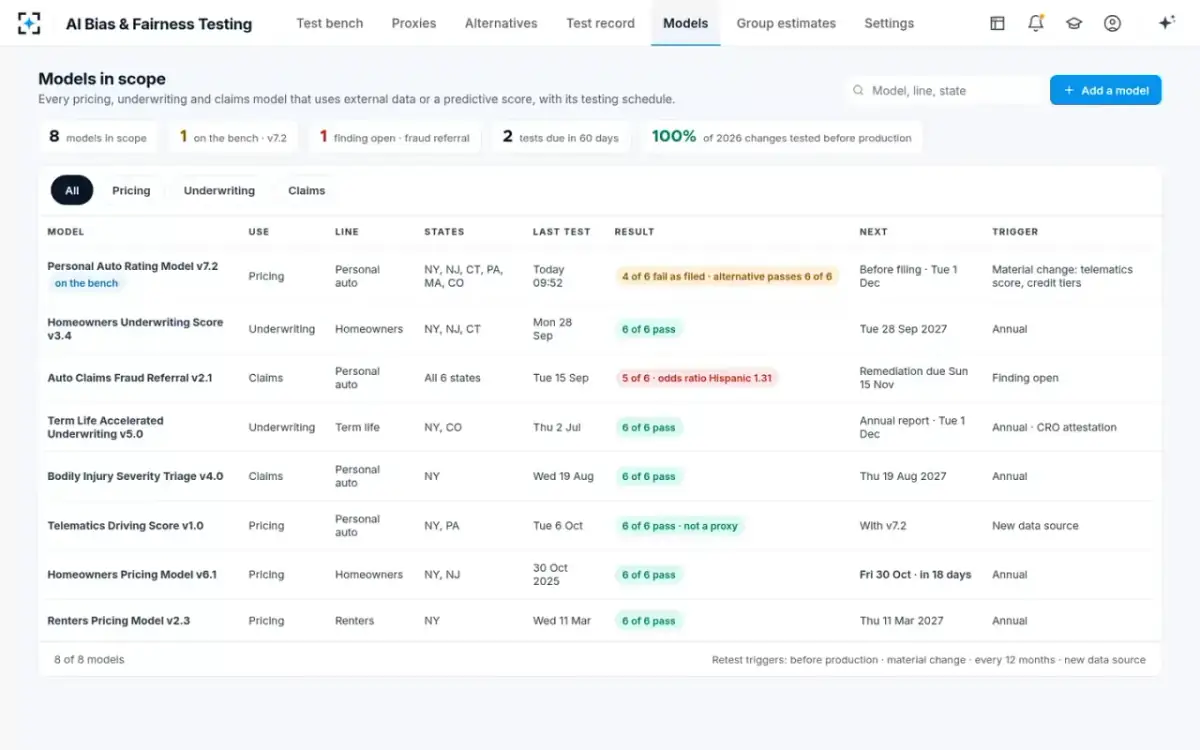
A life model on the same testing schedule as the rest of the book
Is there a Colorado regulation 10-2-101? What the draft testing rule is called
No regulation by that number is in force. The Division's unfair discrimination rules sit in 3 CCR 702-10, and the current version of that part contains one regulation, 10-1-1. The quantitative testing rule exists only as a draft headed "DRAFT PROPOSED New Regulation 10-2-xx," released "for informal comments on September 28, 2023" (Colorado DOI draft; Colorado DOI). At a stakeholder meeting on 17 June 2024, an industry association presented its own alternative draft. Neither has been adopted.
What the 2023 draft would make life insurers test
The draft is specific, which makes it the best available guide to what Colorado has in mind. It would require life insurers to estimate race and ethnicity with BIFSG, a method the draft attributes to the RAND Corporation, from the name and geolocation on the application, for four groups: Hispanic, Black, Asian Pacific Islander and White. Then it would run three tests.
The three tests in Colorado's unadopted 2023 draft
| Test | Model | Trigger for the next step |
|---|---|---|
| Application approval | Logistic regression of approved or denied, with estimated race as dummies and policy type, face amount, age, gender and tobacco use as permitted controls | A difference significant at p < .05 and, by marginal effect, five percentage points or more |
| Premium rate | Linear regression of premium per $1,000 of face amount, same controls | A difference significant at p < .05 and at least 5% above the average rate |
| Variable | Two regressions, with and without the race dummies; compare each external-data coefficient | Any external-data variable whose coefficient changes is deemed unfairly discriminatory and must be remediated |
Two features stand out. The draft's variable test is strict: any change in an external-data coefficient when race is added would count, with no size threshold. And it treats the BIFSG estimate as an input to a regression. A 2026 study that names the Colorado draft warns that proxy-based regression coefficients "become weighted mixtures of true group effects, systematically shrinking estimated disparities toward the majority group" (Xin, Hooker and Huang, 2026). A description of testing should say how that was handled. How BIFSG estimates race from surname and ethnicity covers the method and its limits.
Colorado auto insurance bias testing requirements
Private passenger auto insurers are under the same governance rule since its amendment took effect on 15 October 2025, with their own dates. They owed a narrative progress report by 1 December 2025, and their framework had to be available on request from 1 July 2026, when their annual compliance reports began (Regulation 10-1-1, §§ 5.C, 6.A, 6.C). The regulation's definition of external data for auto insurers names "telematics data" alongside credit scores and other sources.
There is no auto testing rule, adopted or in draft form on the Division's SB21-169 page. The Division issued a data call "to the top ten private passenger auto insurers based on direct written premium through December 31, 2023" and held an auto stakeholder meeting on 18 April 2025 (Colorado DOI). Auto insurers still owe the documented description of testing among the framework components; what they test is, for now, their choice to justify.
What to put in the 1 December 2026 description of quantitative testing
Use the regulation's own words as the outline: the description covers "the methodology, assumptions, results, and steps taken to address unfairly discriminatory outcomes." The checklist turns each word into what a reviewer will look for.
A description of quantitative testing a Colorado reviewer can follow
- Scope
Each external data source and each algorithm or model that uses it, by name and version, matched to the inventory.
- Methodology: group estimation
BIFSG or another method, data vintages, coverage, and whether probabilities or labels were used.
- Methodology: tests
Outcomes tested (approval, premium per $1,000), metrics, controls, significance level and thresholds, and who set them.
- Assumptions
Data period, exclusions and their reasons, reference group, and known limits of the estimate.
- Results
By group and by model, including tests passed, not only failures.
- Drivers
For any difference, the variables that produce it and how that was established.
- Steps taken
Remediation, alternatives considered and the decision, with dates and owners.
- Who is responsible
The title and qualifications of each person, as the annual report itself requires.
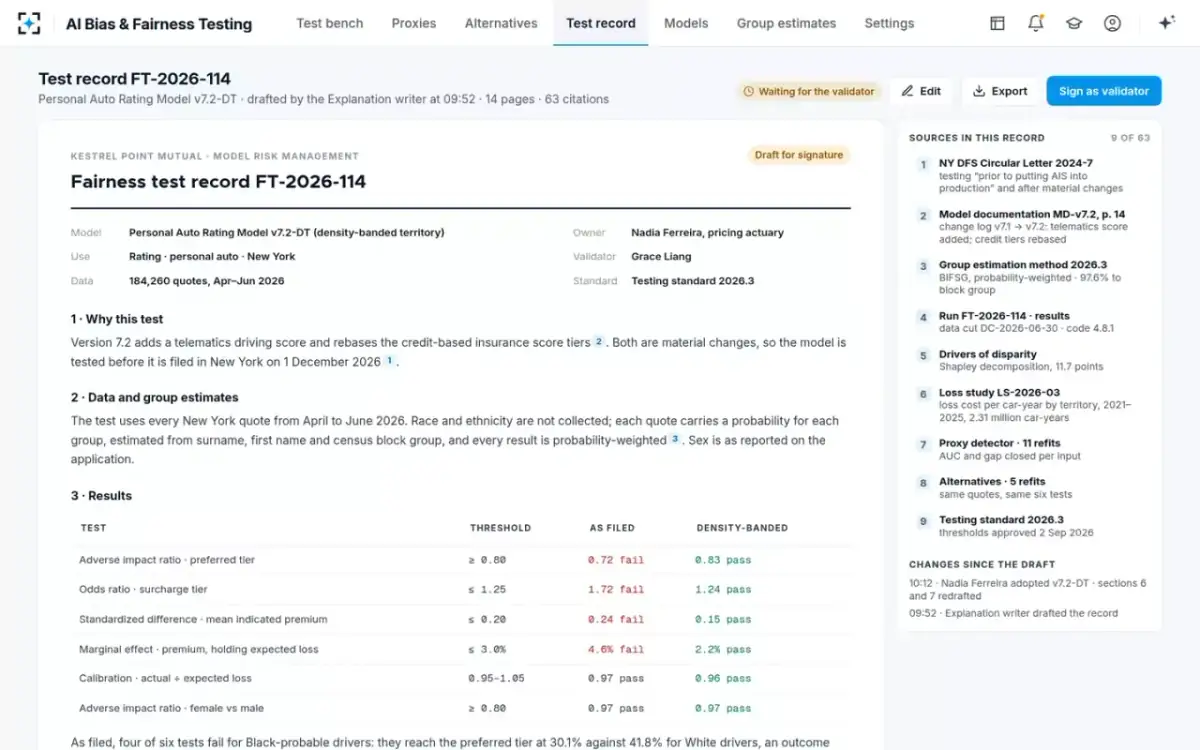
A test report that already has the sections the description needs
How Colorado's draft test compares with New York's metrics
Colorado's draft prescribes one method with fixed triggers; New York lists metrics and leaves the thresholds to the insurer. A life insurer writing in both states can run both, because they answer different questions.
Two states, two ways of testing the same life model
Colorado draft (life, unadopted): Draft exposed in 2023; never adopted.
New York Circular Letter No. 7: Final guidance issued 11 July 2024.
Colorado draft (life, unadopted): BIFSG, four named groups.
New York Circular Letter No. 7: Any accepted statistical method; the Department endorses none.
Colorado draft (life, unadopted): Regression marginal effects with permitted controls.
New York Circular Letter No. 7: Several metrics: adverse impact ratio, odds ratios, marginal effects, standardized mean differences, z- and t-tests, drivers of disparity.
Colorado draft (life, unadopted): p < .05 and five points (approval) or 5% (premium).
New York Circular Letter No. 7: Set by the insurer.
Colorado draft (life, unadopted): Variable test; remediation of any variable whose coefficient changes.
New York Circular Letter No. 7: Explanation, then a documented search for a less discriminatory alternative.
AI Bias & Fairness Testing runs New York's family of metrics against the insurer's own thresholds and adds driver decomposition and alternatives; a regression marginal effect with controls is one of its six tests. New York's testing requirements covers what happens when those metrics disagree.
SB26-189 and the life insurer: a separate Colorado law
Colorado's 2026 automated decision-making law is a different statute from SB21-169. It repeals and reenacts the artificial-intelligence provisions of SB24-205, covers "consequential decisions" that include insurance, and puts developer documentation duties in place "starting January 1, 2027." It also exempts specified entities so far as they comply with other legal obligations (SB26-189, as enacted; its place among the 2025–26 changes is in insurance regulatory updates). How that exemption applies to an insurer already under Regulation 10-1-1 is a question for counsel; the insurance testing obligations in this guide come from SB21-169 and stand on their own.
The tests behind a description, from estimate to signed report, are on the AI Bias & Fairness Testing page.
Questions people ask
When is the Colorado life insurance annual report due?
1 December each year, since 2024, for life insurers that use external consumer data or models built on it. Private passenger auto and health benefit plan insurers report on 1 July, starting in 2026. Reports are filed in SERFF as an annual report, one filing per insurer.
Who must sign the Colorado report?
Regulation 10-1-1 requires the report to be "signed by an officer attesting to compliance," and the statute speaks of an attestation "by one or more officers." If an insurer cannot attest, it must file a corrective action plan instead.
Do life insurers have to collect race for Colorado testing?
No. The statute says nothing in it "requires an insurer to collect" race or the other listed traits. The 2023 draft would have required estimating race and ethnicity with BIFSG from the name and geolocation on the application.
What if we do not use external consumer data at all?
Then the framework requirements do not apply, but the insurer must file an attestation signed by an officer, every 1 December, stating that it does not use external data or models that use it. The Division's filing guidance asks for it in SERFF as an annual report or certification.
Has Colorado adopted a quantitative testing regulation?
Not as of late October 2026. The Division's own bulletin says it has not adopted one, and the 2023 draft remains a draft. The waiver of the testing description covers the 1 December 2024 and 2025 reports only.
Does the Colorado testing law apply to commercial insurance?
Mostly not. The statute excludes insurers issuing commercial policies, except for business owners' and commercial general liability policies with annual premiums of $10,000 or less, and also excludes title insurance and surety bonds.