Unfair discrimination in insurance means treating people who present the same risk differently, in price, coverage or terms, without a sound actuarial reason. The NAIC's model Unfair Trade Practices Act defines it as discrimination "between individuals of the same class and of essentially the same hazard," and state rating laws require rates that are not "unfairly discriminatory." That is the first, actuarial test. A second test has been added for algorithms and external data: whether an input that does predict losses still produces worse outcomes for a protected class than the risk explains. Colorado wrote it into statute in 2021 and New York into guidance in 2024. The two tests can give different answers about the same model. Botminds' AI Bias & Fairness Testing runs both on every pricing, underwriting and claims model it tests, and writes down which input passes which test and why.
Unfair discrimination in insurance, in three numbers
8forms
of unfair discrimination listed in the NAIC’s model Unfair Trade Practices Act, from life rates to refusals by location
Model 880, § 4.H
$250,000
aggregate cap the model act sets for flagrant violations, at up to $25,000 each
Model 880, § 8
2012
year EU insurers had to stop using sex as a pricing factor, after the Test-Achats judgment
Court of Justice of the EU
What is unfair discrimination in insurance?
It is a difference in treatment between people who are alike in the risk they present. Insurance discriminates by design: it prices a 20-year-old driver differently from a 50-year-old because their expected losses differ. The law forbids the other kind. The NAIC model act lists "unfair discrimination" among unfair trade practices, beginning with life insurance: "Making or permitting any unfair discrimination between individuals of the same class and equal expectation of life in the rates charged" (NAIC Model 880, § 4.H(1)).
The American Academy of Actuaries puts the core idea in one sentence: "Unfair discrimination occurs when an insurer considers factors unrelated to actuarial risk when determining who they will insure, at what rate, and with what terms" (Academy, 2024). By that standard, discrimination supported by loss experience is "fair discrimination," and the insurer's job is to show the support.
Unfair discrimination insurance definition: the actuarial test
The first test asks whether a difference in rates reflects a difference in expected cost. Actuarial Standard of Practice No. 12, as quoted in the Casualty Actuarial Society's research, says rates "would be considered equitable if differences in rates reflect material differences in expected cost for risk characteristics." The CAS ratemaking principles add that a rate is reasonable and not unfairly discriminatory "if it is an actuarially sound estimate of the expected value of all costs associated with an individual risk transfer" (Mosley and Wenman, CAS, 2022).
Regulators apply that test to models too. The NAIC's AI bulletin reminds insurers that the property and casualty rating law "requires that property/casualty (P/C) insurance rates not be excessive, inadequate, or unfairly discriminatory," and that the insurer is responsible for that "regardless of the methodology that the Insurer used to develop rates" (NAIC, 2023). A machine-learned rating plan meets the same standard as a hand-built one.
The second test: protected classes and disproportionate outcomes
The second test asks whether a lawful input still lands disproportionately on a protected class, by more than the risk explains. The Academy separates three ideas that are easy to blur: "unlawful discrimination" against protected classes "regardless of actuarial support"; unfair discrimination, not supported by evidence; and "unjust" discrimination, which society considers undesirable even when it is supported statistically.
Colorado's 2021 statute turns the second test into law for external data and algorithms. Unfair discrimination includes using data or models "that have a correlation to race, color, national or ethnic origin, religion, sex, sexual orientation, disability, gender identity, or gender expression, and that use results in a disproportionately negative outcome for such classification or classifications, which negative outcome exceeds the reasonable correlation to the underlying insurance practice, including losses and costs for underwriting" (C.R.S. § 10-3-1104.9(8)(e)). New York's circular letter asks for a three-step assessment of the same question for underwriting and pricing models (NY DFS, 2024).
"If the insurance company decided to use the variable in rating, it would technically not be in violation of the rating law, as the alternative variable is predictive of loss. However, it would not be compliant with the spirit of the law"
Casualty Actuarial Society research paper (2022)
Where the two tests disagree
They disagree whenever an input predicts losses and also tracks a protected class. The CAS paper's thought experiment is a variable perfectly correlated with race: if race predicts loss, so does the variable, and the variable passes the actuarial test while failing the protected-class one. Real inputs are less extreme and more common.
Two tests of the same rating input
Actuarial fairness: Do rate differences reflect differences in expected cost?
Protected-class fairness: Do outcomes differ by protected class more than the risk explains?
Actuarial fairness: Loss studies, relativities, calibration of predicted to actual loss.
Protected-class fairness: Outcome rates by group, marginal effects holding risk constant, drivers of the gap.
Actuarial fairness: No.
Protected-class fairness: Yes, usually estimated from names and addresses.
Actuarial fairness: Rating laws and the unfair trade practices act.
Protected-class fairness: Colorado’s 2021 statute, New York’s 2024 letter; the NAIC bulletin encourages testing.
Actuarial fairness: Correlated with claims costs; a 2007 FTC study found the correlation was not simply a proxy for race.
Protected-class fairness: Black and Hispanic consumers were concentrated in the lowest scores in the same study.
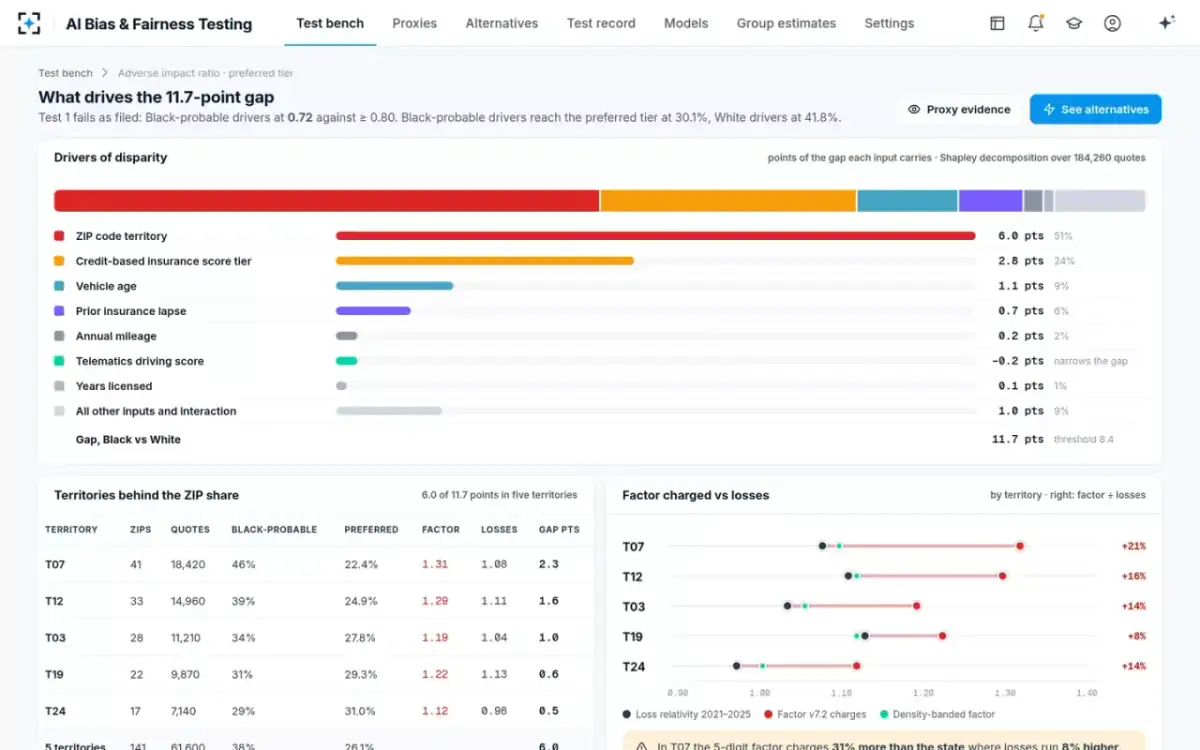
Actuarial fairness: In the worst territory the factor charges 31% above the state where losses run 8% above: partly unsupported.
Protected-class fairness: Carries 6.0 of an 11.7-point preferred-tier gap between Black-probable and White drivers.
The credit score shows the tests pulling apart cleanly: by the Academy's summary of the FTC's 2007 study, the scores predicted claims within racial groups, and Black and Hispanic consumers were still concentrated at the expensive end. The territory shows them pointing the same way: the factor overcharges relative to losses in the territories where the gap is concentrated. A test that runs only one of the two would miss half of each story.
What is unfair discrimination in life insurance?
In life insurance, the baseline rule is equal treatment of people "of the same class and equal expectation of life" (Model 880, § 4.H(1)). Pricing by age, health and tobacco use is fair discrimination; the Academy notes that "States generally allow life and disability insurance to differentiate by gender and disability in their risk classification" (Academy, 2024).
The second test has reached life insurance first. Colorado's governance regulation applies to individually issued life insurance, and life insurers using external data have filed annual compliance reports since 1 December 2024 (Colorado Regulation 10-1-1). New York's 2024 letter covers life underwriting and adds a disclosure rule for accelerated programmes: an applicant routed out of an AI-based process has "the right to know why." Colorado's quantitative testing requirements for life insurers sets out where that state's testing rule stands.
An example of unfair discrimination in insurance would be…
Most examples in the model act are refusals or limits of coverage for a reason unrelated to risk. The table lists the clearest ones, with the text they come from.
Examples of unfair discrimination in insurance, and the rule each breaks
| Example | Rule | Source |
|---|---|---|
| Refusing, or limiting, coverage because of an applicant’s race, religion, national origin, sex or marital status | Expressly listed | Model 880, § 4.H(5) |
| Refusing or cancelling property cover solely because of where the risk is, without sound underwriting and actuarial support | Location alone is not a reason | Model 880, § 4.H(3) |
| Refusing cover on a home solely because of its age | Age of the dwelling alone is not a reason | Model 880, § 4.H(4) |
| Refusing a driver solely because another insurer declined them | Another insurer’s decision is not a risk | Model 880, § 4.H(7) |
| Settling claims differently by the claimant’s race, gender, language or the territory insured | Claims practices must not discriminate | California, 10 CCR 2695.7(a) |
| Using external data whose effect on a protected class exceeds its reasonable correlation to the practice | The second test, in statute | Colorado, C.R.S. § 10-3-1104.9(8)(e) |
Can insurance companies discriminate based on race?
No. Race is a prohibited basis in the model act's refusal-to-insure provision and in Colorado's statute for every insurance practice, and New York's letter says an insurer should not use external data or AI unless it can show they are not "based in any way on any class protected pursuant to Insurance Law Article 26." That is unlawful discrimination in the Academy's sense: forbidden "regardless of actuarial support."
The live question is indirect. A model with no race input can still reproduce race's effect through inputs that correlate with it. That is why both Colorado and New York ask for outcome testing, not only a check of the input list. Proxy discrimination in insurance covers how a territory or another neutral input comes to carry race, and how to measure it.
Can insurance companies discriminate based on gender?
It depends on the line and the place. The model act bars refusing or limiting coverage "because of the sex" of an individual, but that provision is about access, not price. In the United States, life and disability insurers generally may price by sex, as the Academy notes. In auto insurance, California's regulation lists the factors an insurer may use beyond driving record, mileage and experience, and sex is not among them (10 CCR 2632.5).
Europe went further. The Court of Justice of the EU held in 2011 that "Taking the gender of the insured individual into account as a risk factor in insurance contracts constitutes discrimination," with unisex premiums and benefits required from 21 December 2012 (CJEU, Test-Achats). And Colorado's 2021 statute includes sex, sexual orientation, gender identity and gender expression among the classes an external data source must not unfairly disadvantage.
What is the penalty for unfair discrimination in insurance?
Under the NAIC model act, a commissioner who finds an unfair trade practice may order the insurer to stop and impose "a monetary penalty of not more than $1,000 for each violation, but not to exceed an aggregate penalty of $100,000," rising to $25,000 per violation and $250,000 in aggregate if the violation "was committed flagrantly in a conscious disregard" of the act, and may suspend or revoke the licence (Model 880, § 8). Breaking a cease-and-desist order carries up to $25,000 per violation (§ 11). State enactments set their own amounts.
Colorado's governance regulation lists the sanctions available for non-compliance: "civil penalties, issuance of cease and desist orders, and/or suspensions or revocations of license" (Regulation 10-1-1, § 9). Its statute also requires the Division's rules to give insurers time to remedy an unfairly discriminatory impact. The remedy is a cost of its own: a refiled rating plan, and possibly refunds to customers who were overcharged.
How a test shows which answer you have
A test has to measure both things: whether prices track losses for each group, and whether outcomes differ by more than risk explains. AI Bias & Fairness Testing does it in one run. Calibration of actual to expected loss by group is the actuarial test. The adverse impact ratio, odds ratio, standardized mean difference and marginal effect holding expected loss constant are the protected-class tests. The drivers of any gap, and the relation of each to risk, are where the two meet.
Drivers of the gap, beside the factor charged and the losses behind it
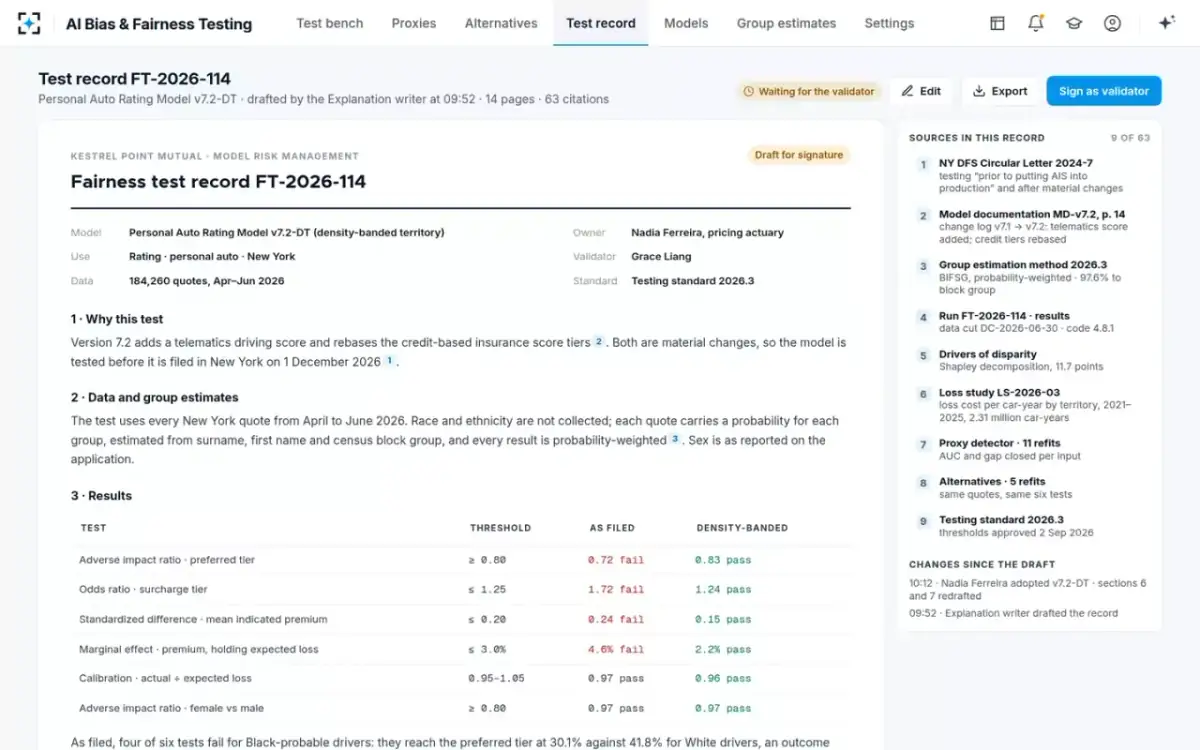
What the agents never do is decide which test wins when they disagree. The explanation writer drafts each input's relation to risk from the loss studies; an actuary decides whether it holds; the model risk validator signs. The checklist below is the short form of what a reviewer should see for every input that carries part of a gap.
Five things to show for an input that carries part of a gap
- Its relation to risk
A loss study or relativity table, and whether the factor charged matches the losses.
- How much of the gap it carries
Its share in a decomposition, and the gap closed when it is removed.
- How well it predicts group membership
A proxy-strength measure such as the area under the curve of the input alone.
- A fairer version, if one exists
Rebanded, coarsened or replaced, with accuracy kept and premium effect by group.
- Who decided, and why
The actuary’s judgment on the relation to risk and the model owner’s decision on the change.
The written explanation a regulator reads
How each metric is calculated is in the adverse impact ratio with probability weights; how regulators review a GLM rating plan's inputs is covered in what model risk asks before a GLM is filed. The full test is on the AI Bias & Fairness Testing page.
Questions people ask
What is the definition of unfair discrimination in insurance?
Treating people of the same class and essentially the same hazard differently in premiums, coverage or terms, in the words of the NAIC model act. Colorado's statute adds a second definition for external data and algorithms: a disproportionately negative outcome for a protected class that exceeds the input's reasonable correlation to the insurance practice.
Is it unfair discrimination to charge young drivers more?
Not if the difference reflects expected losses: that is fair discrimination in actuarial terms. Age is not among the traits Colorado's statute protects, though some states limit how specific factors may be used, so the answer always depends on the state and the line.
What is unfair discrimination in insurance claims?
Handling or settling claims differently for reasons unrelated to the claim. California's regulation, for example, bars claims practices based on a claimant's race, gender, income, language or the territory insured, and Colorado's statute covers claims management among the practices external data must not distort.
Is unfair discrimination the same as disparate impact?
Not quite. Unfair discrimination in insurance traditionally means a difference unsupported by risk; disparate impact means a neutral practice that falls harder on a protected class. Colorado's definition joins them by asking whether the impact exceeds what the risk explains.
Does the NAIC AI bulletin prohibit unfair discrimination?
Its force comes from existing law: it reminds insurers that the laws on unfair trade practices, claims and rates apply to decisions made with AI, and it expects a written programme for responsible use. It also "encourages" testing methods to find bias and potential unfair discrimination.
Who decides whether a rating factor is unfairly discriminatory?
The state insurance regulator, through rate review and market conduct examinations, applying the state's statute. The insurer's own actuaries and validators decide first, and must be able to show their reasoning; New York expects that documentation to be available on request.