Proxy discrimination in insurance is the use of a facially neutral input, such as ZIP code, credit history or occupation, that disadvantages a protected class because it stands in for membership of that class. It can happen with no intent at all: if race happens to predict losses in the data, a model denied race will find the inputs that carry its signal. Colorado's statute and New York's circular letter both ask insurers to look for it, and the method is concrete: measure how well an input predicts group membership on its own, how much of an outcome gap disappears when it is removed, and how much accuracy the model loses without it. Botminds' AI Bias & Fairness Testing runs those three measurements for every input of a pricing, underwriting or claims model and refits fairer versions; people decide whether to replace the input.
"a practice producing a disparate impact only amounts to proxy discrimination when the usefulness to the discriminator of the facially neutral practice derives, at least in part, from the very fact that it produces a disparate impact."
Anya Prince and Daniel Schwarcz, Iowa Law Review (2020)
What is proxy discrimination?
It is a kind of disparate impact with a specific mechanism: the neutral input is useful because it tracks the protected trait. Prince and Schwarcz, law professors at the universities of Iowa and Minnesota, separate two routes in their 2020 article. Historically a firm chose a proxy on purpose, "such as zip code," to discriminate. Today it can happen unintentionally "when membership in a protected class is predictive of a discriminator's facially neutral goal," so that the discrimination looks "rational" (Prince and Schwarcz, 2020).
The American Academy of Actuaries draws the same picture: regulators care about intentional discrimination and about disparate impact, and "Disparate impact may be caused by proxy discrimination, that is, when a facially neutral trait is used as a stand-in for a prohibited trait" (Academy, 2024). Not every disparate impact is proxy discrimination: an input can affect groups differently because it measures a real risk that is unevenly distributed. The test has to tell the two apart.
Proxy discrimination insurance law: what the rules say
No statute uses the phrase, but several now describe the thing. Colorado's defines unfair discrimination to include external data and models "that have a correlation to race" or another listed trait where the resulting disproportionately negative outcome "exceeds the reasonable correlation to the underlying insurance practice" (C.R.S. § 10-3-1104.9(8)(e)). That is a proxy test written as law: a correlation is allowed only as far as the risk justifies it.
New York's letter makes it a named assessment. "Insurers should evaluate the extent to which such ECDIS are correlated with (i.e., proxy for) status in any protected classes that may result in unfair or unlawful discrimination," and "If such correlations are identified, insurers should consider whether the use of such ECDIS is required by a legitimate business necessity" (NY DFS, 2024). The NAIC's 2020 white paper on reviewing rating models lists, among topics for future guidance, how regulators can tell when "a rating variable or rating plan becomes too granular" and whether model inputs "are not unfairly discriminatory or a 'proxy for a protected class,'" and defines a proxy variable as "any variable that indirectly captures the characteristics of another variable" (NAIC, 2020).
Can insurers use ZIP codes?
In most states, yes, as long as the rating is supported by loss experience. The NAIC model act forbids refusing, cancelling or limiting property and casualty cover "solely because of the geographic location of the risk, unless such action is the result of the application of sound underwriting and actuarial principles related to actual or reasonably anticipated loss experience" (Model 880, § 4.H(3)). Location with actuarial support is allowed; location without it is not.
Some states limit the grain. California lets auto insurers rate where a car is garaged through two optional factors, relative claims frequency and severity, each with "a maximum of twenty categories," built by "grouping the zip codes in the state into bands" with "similar average claims frequency" (10 CCR 2632.5(d)). That is a regulatory version of the fix this guide ends with: keep the risk in geography, at a grain coarse enough that it stops carrying neighbourhood composition. The Academy lists "ZIP code as a proxy for race, ethnicity, political affiliation, or socioeconomic status" among its examples of problematic proxies, so the burden is on the insurer to show which of those its territory is measuring.
How a territory comes to carry race
Through history and through data. The Casualty Actuarial Society's research recalls that in the 1930s the federal Home Owners' Loan Corporation drew colour-coded maps marking minority and poor areas as high risk, and that "Banks and insurance companies adopted the HOLC maps to guide lending and underwriting decisions" (Mosley and Wenman, CAS, 2022). Loss data from those areas today can reflect decades of under-investment as well as current risk.
Data-generating processes add more. The Academy cites a North Carolina study in which Black drivers "were 63% more likely to be stopped by police even though they drove less," which feeds motor vehicle records and, through them, prices (Academy, 2024). An input built from records like these can predict losses and still import a disparity that the losses do not justify.
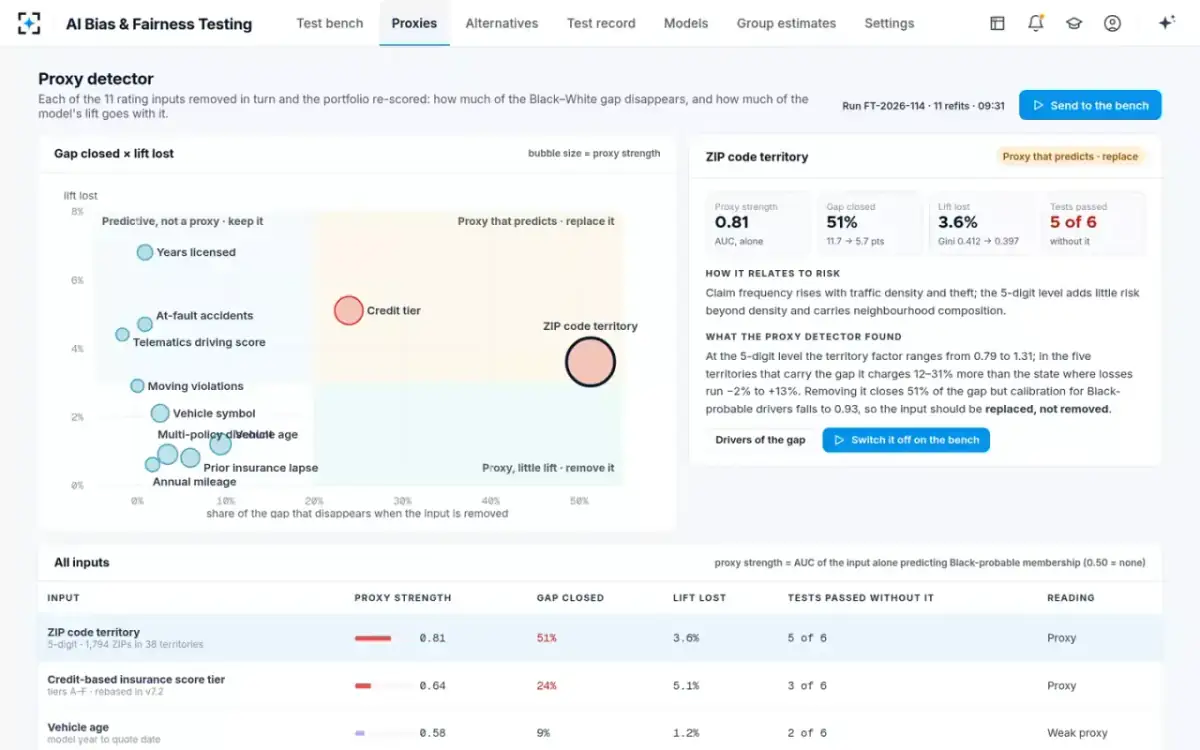
On a fictional personal auto rating model tested on 184,260 New York quotes, five-digit ZIP territory predicts Black-probable membership with an area under the curve of 0.81 on its own (0.50 would mean no information). In the worst territory, 46% of quotes are Black-probable, the preferred-tier rate is 22.4%, and the territory factor charges 1.31 times the state average where losses run 1.08 times. Part of that factor is risk; part of it is not.
Proxy variables discrimination test: three measurements per input
A proxy test asks three questions of each input: does it predict group membership, does it carry the outcome gap, and does the model need it for accuracy? The first is the input's proxy strength, measured as how well it alone sorts people into the group. The second is the share of the gap it carries, from a decomposition or from re-scoring the portfolio without it. The third is the lift the model loses when it goes. The figure shows the second for every input of the fictional model.
One input carries half the gap: share of a Black–White gap by input
The three measures together sort inputs into four kinds, which is the reading the proxy detector gives. An input that predicts group membership and carries the gap but adds little accuracy can simply go. One that carries the gap and the accuracy needs replacing with a version that keeps the second without the first. One that predicts losses and not group membership stays.
Four kinds of input, by the gap it carries and the accuracy it brings
Down: less accuracy lost without it · Right: more of the gap closed without it
The proxy detector on every input of the model
Remove, replace or keep: what the fairer version must keep
Removing a proxy is the obvious fix and often the wrong one. The Academy warns that "removing a disallowed factor and all variables that may proxy for a prohibited characteristic may cause a bias in another direction or produce poor results," and recommends understanding "how they are driving results" instead (Academy, 2024). The CAS paper's worked example found that dropping a protected attribute "does not necessarily produce unbiased predictions with respect to the protected attribute" (CAS, 2022).
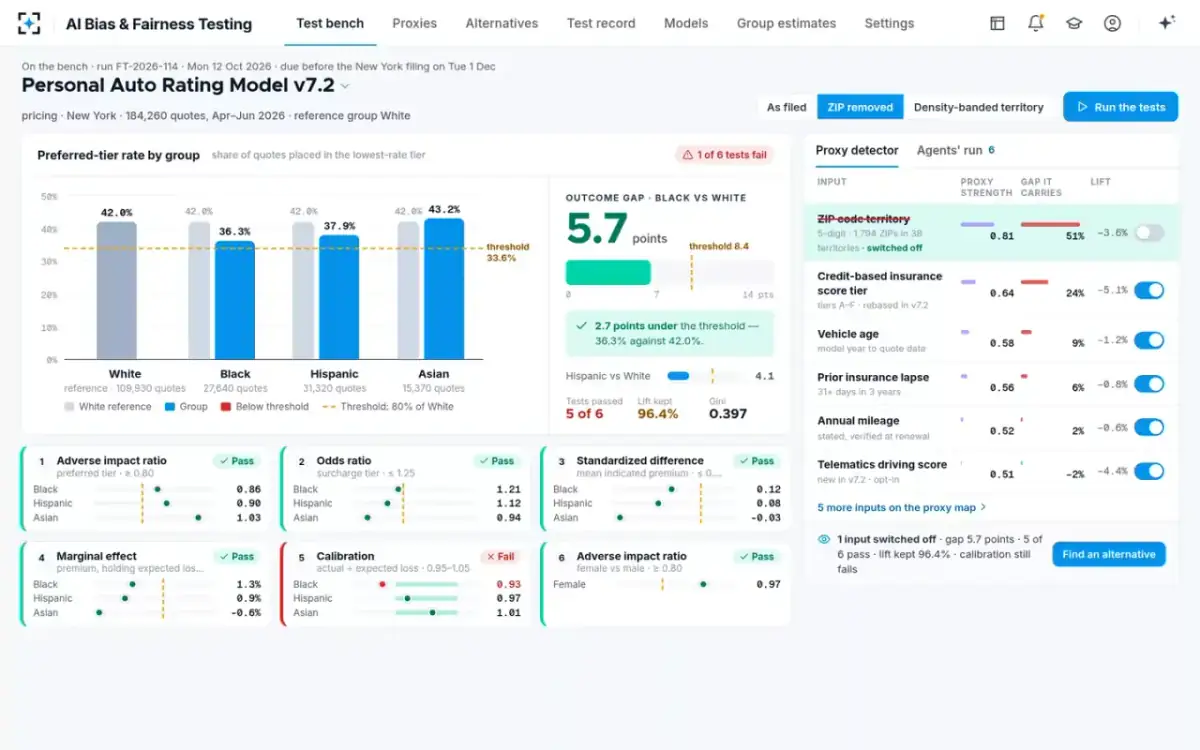
The fictional model shows both failure modes. Switching ZIP territory off cut the gap from 11.7 to 5.7 points and passed five of six tests, but calibration for Black-probable drivers fell to 0.93 and the model kept only 96.4% of its lift. Removing territory and credit together cut the gap furthest, to 3.6 points, and kept only 91.5%.
The fix that closes most of the gap is not the one that passes
ZIP territory removed: 5 of 6 tests, 96.4% of lift
- Gap closed · 51%
- Gap remaining · 49%
ZIP territory and credit tier removed: 5 of 6 tests, 91.5% of lift
- Gap closed · 69%
- Gap remaining · 31%
Density-banded territory: 6 of 6 tests, 99.3% of lift
- Gap closed · 38%
- Gap remaining · 62%
The replacement keeps what territory measures about risk and drops what it measures about neighbourhoods: county by five population-density bands, because claim frequency rises with traffic density and theft. In the fictional loss study, loss cost by density band rises steadily from 0.86 to 1.18, which is the relation to risk the written explanation cites. Mean premium for Black-probable drivers falls by $71, 9,412 quotes change tier, and the overall rate level is unchanged. The agents proposed it; the pricing actuary who owns the model adopted it.
Switching the proxy off, and seeing what breaks
Proxy discrimination examples beyond territory
Territory is the textbook case, not the only one. The table lists examples from the sources this guide relies on, with what each source says about them.
Proxy discrimination examples, and what the sources show
| Input | Why it can act as a proxy | Source |
|---|---|---|
| ZIP code | Listed by the Academy as a proxy for race, ethnicity, political affiliation or socioeconomic status | American Academy of Actuaries, 2024 |
| Name, read by text recognition | Listed as a proxy for gender, race, religion or age | American Academy of Actuaries, 2024 |
| Motor vehicle records | Black drivers in a North Carolina study were stopped more often though they drove less | American Academy of Actuaries, 2024 |
| Credit-based insurance scores | Black and Hispanic consumers concentrated in the lowest scores; the 2007 FTC study also found a correlation with claims not simply a proxy for race | American Academy of Actuaries, 2024, on the FTC report |
| Education and occupation | New York required insurers to show they were not unfairly discriminatory; insurers using them agreed to remove them | Casualty Actuarial Society, 2022, on NY Regulation 150 |
| Genetic test proxies | An AI with no genetic data can price on inputs that capture genetic risk | Prince and Schwarcz, 2020 |
Algorithmic proxy discrimination: why AI finds less intuitive proxies
Because it is built to find whatever predicts. Prince and Schwarcz argue that AIs "are inherently structured to engage in proxy discrimination whenever they are deprived of information about membership in a legally suspect class whose predictive power cannot be measured more directly," and that "Simply denying AIs access to the most intuitive proxies for such predictive but suspect characteristics does little to thwart this process; instead it simply causes AIs to locate less intuitive proxies" (Prince and Schwarcz, 2020).
Actuarial researchers frame it as indirect discrimination: "direct discrimination is prohibited, but indirect discrimination using proxies or more complex and opaque algorithms is not clearly specified or assessed" (Xin and Huang, 2023). The practical consequence is that a list of banned inputs cannot be the control. The test has to run on outcomes, every time the model learns something new.
Discrimination-free pricing: the academic fix, and its catch
An answer from actuarial research is to use the protected trait to remove its own influence. Lindholm, Richman, Tsanakas and Wüthrich give "a simple formula for discrimination-free pricing" that avoids both direct discrimination and indirect discrimination "resulting from implicit learning of protected characteristics from nonprotected ones." Their conclusion carries the catch: "discrimination-free pricing in general requires collection of policyholders' discriminatory characteristics" (Lindholm et al., ASTIN Bulletin). Prince and Schwarcz reach a similar remedy from the law side: models "that isolate only the predictive power of non-suspect variables."
The idea has a familiar shape for actuaries. The NAIC white paper defines a control variable as one "included when building the model" so that "other correlated variables do not pick up their signal," but whose relativities are not used in the rating algorithm (NAIC, 2020). Insurers mostly do not hold race, and Colorado's statute does not require them to collect it, so in practice the trait is an estimate. How to estimate race from surname and ethnicity covers that step; the two tests of unfair discrimination explains why an input can pass the actuarial test and still fail this one; and the full test, from estimate to signed report, is on the AI Bias & Fairness Testing page.
Questions people ask
What is an example of proxy discrimination?
A rating territory that charges more where a protected group is concentrated, beyond what losses there justify. On the fictional model in this guide, five-digit ZIP territory predicted group membership with an area under the curve of 0.81 and carried 51% of a preferred-tier gap.
Is proxy discrimination illegal in insurance?
Where it produces unfair discrimination, yes. Colorado's statute covers correlations to protected classes whose effect exceeds the reasonable correlation to the insurance practice, and New York asks insurers to assess proxy effects and justify any by legitimate business necessity. Elsewhere, general unfair discrimination laws apply.
How do you test for proxy variables?
For each input, measure how well it alone predicts group membership, how much of the outcome gap disappears when the portfolio is re-scored without it, and how much predictive accuracy the model loses. An input high on the first two and low on the third is the clearest proxy.
Is credit score a proxy for race?
It is correlated with race, and its use is contested. In the FTC's 2007 study, as summarised by the Academy of Actuaries, Black and Hispanic consumers were concentrated in the lowest scores, but scores also predicted claims within racial groups, so the correlation with claims was not simply a proxy for race. That is why outcome testing matters.
Does removing race from a model prevent proxy discrimination?
No. A model without race can learn race's effect from correlated inputs, which is the core of the proxy problem. Researchers argue the opposite approach, using the protected trait to remove its influence, works better, though it needs the trait or a good estimate of it.
What is unlawful proxy discrimination?
It is proxy discrimination that breaks a specific law: for example, using an input as a deliberate stand-in for a prohibited trait, or, in Colorado, using external data whose correlation to a protected class produces a negative outcome beyond what the insurance practice justifies.