When the CFPB withdrew 67 guidance documents on May 12, 2025, it did so in a single Federal Register notice: 8 policy statements, 7 interpretive rules, 13 advisory opinions and 39 circulars, bulletins and other guidance, with the withdrawals "applicable as of May 12, 2025". Among them were the 2013 bulletin on indirect auto lending and the ECOA, the 2022 circular on adverse action notices for credit decisions based on complex algorithms, and the 2022 interpretive rule on states' authority to enforce the Consumer Financial Protection Act. For a regulatory change team, a withdrawal is a change like any other: some policies, procedures, training and controls were written to meet that guidance, and they now need a decision. Regulatory change management usually means following new obligations from publication into policies before they take effect. Botminds' Regulatory Change Management treats removals the same way, mapping each one back to the sections that cite it.
A new rule and a removed one ask the same questions in reverse
A new rule arrives: Does it reach our products and states?
Guidance or a rule is removed: Did any of our policies, procedures or controls rely on it?
A new rule arrives: Sections that must now say something new.
Guidance or a rule is removed: Sections that cite it, quote it or were written to meet it.
A new rule arrives: How to comply by the effective date.
Guidance or a rule is removed: Keep the practice, change it, or retire it, and say why.
A new rule arrives: The new rule, from its effective date.
Guidance or a rule is removed: The statute and regulation underneath, and every other enforcer of them.
A new rule arrives: A violation from the effective date.
Guidance or a rule is removed: Procedures that cite dead guidance, or a costly practice kept for no reason.
Which CFPB guidance was withdrawn in 2025?
The notice listed 67 documents issued since the CFPB began operating in 2011 (90 FR 20084). It gave three reasons: that the Bureau would issue guidance only where it reduced compliance burdens, that it was "reducing its enforcement activities", and that "parties understand that guidance is generally non-binding". It also said the withdrawal "is not necessarily final. The Bureau intends to continue reviewing all guidance documents to determine whether they should ultimately be retained."
The 67 documents the CFPB withdrew on May 12, 2025, by type
For lenders, a handful of the withdrawn items stand out because policies were commonly written around them: Bulletin 2013-01 on indirect auto lending and compliance with the Equal Credit Opportunity Act; Bulletin 2012-04 on lending discrimination; Circulars 2022-03 and 2023-03 on adverse action notices; the 2021 interpretive rule on sexual orientation and gender identity discrimination under Regulation B; the 2022 advisory opinion on revocations and unfavourable changes to existing credit; the 2023 policy statement on abusive acts or practices; and Bulletin 2022-04 on repossession of automobiles. Each was cited in somebody's fair lending policy, collections procedure or adverse action procedure.
The CFPB guidance withdrawal list, grouped by the work it touched
Sorted by the part of a lender or bank it touched, the list reaches far beyond fair lending: credit reporting and collections account for 20 of the 67 items, and deposit and payment practices for another 8. The notice itself groups the documents only by legal form, which is the least useful order for a change team, because a compliance officer needs to know which owners to call, not which kind of document it was.
The 67 withdrawn documents by function, with the items lenders most often cited
| Function | Items | Examples from the list |
|---|---|---|
| Complaints, supervision and enforcement programs | 12 | No-action letter and sandbox policy statements; the state-enforcement interpretive rule; servicemember examinations; complaint data disclosure policies; Circular 2022-04 on data security |
| Credit reporting (FCRA) | 11 | Advisory opinions on file disclosure, background screening, permissible purposes and name-only matching; Circular 2022-07 on dispute investigations; the 2022 interpretive rule on FCRA preemption of state laws |
| Collections and debt | 9 | Advisory opinions on medical debt, time-barred debt and pay-to-pay fees; Bulletin 2013-07 on unfair, deceptive or abusive collection; Bulletin 2015-07 on in-person collection |
| Deposits, overdraft and payments | 8 | Circulars 2022-06 and 2024-05 on overdraft fees and opt-in; Bulletin 2022-06 on returned deposited item fees; remittance rule bulletins and statements |
| Fair lending and adverse action (Reg B) | 7 | Bulletins 2012-04 and 2013-01; Circulars 2022-03 and 2023-03; the 2021 interpretive rule on sexual orientation and gender identity; the 2022 advisory opinion on revocations; the 2023 small business lending statement |
| Unfair, deceptive or abusive practices and marketing | 7 | The 2023 policy statement on abusive acts or practices; circulars on contract terms, negative option marketing and digital steering; Bulletin 2016-03 on production incentives |
| Mortgage origination and servicing | 6 | Bulletin 2012-02 on loan originator compensation; the surviving family members bulletin; the contracts-for-deed advisory opinion; Bulletin 2021-02 on housing insecurity |
| Cards and other consumer credit | 6 | Bulletins 2012-06 and 2014-02 on card add-on products and promotional APRs; advisory opinions on earned wage access and private education loans; the buy now, pay later interpretive rule |
| Auto finance | 1 | Bulletin 2022-04 on mitigating harm from repossession (the 2013 indirect auto bulletin is counted under fair lending) |
The grouping changes the work. A withdrawal announced as "67 guidance documents" lands on the compliance officer's desk as one item; sorted by function it is nine conversations with nine sets of owners, from the card product lead to the collections manager. Botminds' Regulatory Change Management routes a removal the same way it routes a new rule: by the products and policy sections it touches, so each owner sees only the items that reach their procedures.
Is withdrawn CFPB guidance still enforceable?
The guidance is gone; the laws it interpreted are not. The CFPB said it "does not intend to prioritize the enforcement of such guidance against parties that do not conform to the guidance during the pendency of any withdrawal" (90 FR 20084). That is a statement about the Bureau's enforcement priorities. The Equal Credit Opportunity Act, Regulation B, Regulation Z and the prohibition on unfair, deceptive or abusive practices are unchanged by it.
The same notice points out who else enforces them. "The states maintain jurisdiction over many institutions also within the Bureau's regulatory purview," it says, and "State attorneys general may even bring actions to enforce the Dodd-Frank Wall Street Reform and Consumer Protection Act." Prudential regulators examine depository institutions against the same regulations. The FDIC's examination manual draws the line plainly: examiners "will not criticize a supervised financial institution for a 'violation' of supervisory guidance. Rather, any citations will be for violations of law, regulation, or non-compliance with enforcement orders" (FDIC examination manual). Guidance always explained how a regulator read the law; its withdrawal removes the explanation, not the law.
The withdrawal in three numbers
67
guidance documents withdrawn in one notice
0days
between publication and effect: applicable on May 12, 2025
3
review questions the Bureau set itself: statutory basis, consistency with the regulation, burden
What CFPB rules were rescinded in 2025, and which rescission was reversed?
The withdrawal was the largest single removal, not the only one. Between May 2025 and mid-2026, the CFPB's own Federal Register docket included rescinded rules, extended compliance dates and, in one case, a rescission that was itself withdrawn. Each needed a decision from a change team, and some needed the decision reversed.
CFPB removals and date changes a lender’s change team had to map, 2025–2026
| Published | Change | What it meant for policies |
|---|---|---|
| May 12, 2025 | 67 guidance documents withdrawn, applicable the same day | Every procedure citing one of them needed a keep, change or retire decision |
| May 15, 2025 | 2022 interpretive rule on states’ authority to enforce the CFPA rescinded, effective the same day | No change to state enforcement authority in the statute; policies citing the rule needed new references |
| May 16, 2025 | RESPA COVID-19 servicing protections rescinded, effective July 15, 2025 | Servicing procedures written for the 2021 protections could be revised |
| May 21, 2025 | State official notification rules rescinded by direct final rule, effective July 21 unless adverse comments | A change with a condition: track it to the date |
| July 21, 2025 | That direct final rule withdrawn; the notification rules stand | The May decision reversed; any procedure updated in between needed undoing |
| June 18 and Oct 2, 2025 | Small business lending (Section 1071) compliance dates extended | Implementation plans re-dated, not cancelled |
| May 1, 2026 | Revised 1071 rule; compliance date January 1, 2028 | One compliance date for all covered lenders |
| June 17, 2026 | 2020 advisory opinion on special purpose credit programs rescinded | Program documentation relying on the opinion needed review |
The May 21 rescission is the instructive one. It was a direct final rule, "effective July 21, 2025, unless significant adverse comments are received by June 20, 2025" (90 FR 21691). On July 21 the Bureau published a notice that the direct final rule "is withdrawn, effective July 21, 2025" (Federal Register). A change team that updated its procedures in May, as if the rescission were certain, had to change them back. Conditional changes need to be tracked to the condition, not to the publication.
Some removals were followed by replacements. The 2022 interpretive rule on the Fair Credit Reporting Act's limited preemption of state laws was among the 67; on October 28, 2025, the Bureau published a new document titled "Fair Credit Reporting Act; Preemption of State Laws" (Federal Register). For a lender's credit reporting procedures that is two changes, not one: the old reading retired in May and a new one to assess in October, each with its own owner and decision.
Other regulators made removals of their own over the same period. The OCC removed references to reputation risk from its compliance management handbook in March 2025 (OCC Comptroller's Handbook), so any procedure that cited reputation risk as an exam expectation needed a new footing.
Should we change policies after CFPB guidance is withdrawn?
Not automatically: map first, then decide section by section. Mapping a removal means finding every section that cites, quotes or was written to meet the removed item, then deciding for each whether the practice stays. The search is the same one a new rule needs, run in reverse: instead of looking for sections that cover a provision, look for sections that reference a document. A policy library split into owned, numbered sections makes that a lookup; a library of long documents makes it a reading exercise.
Sections touched by open changes, each with the passage that drives it
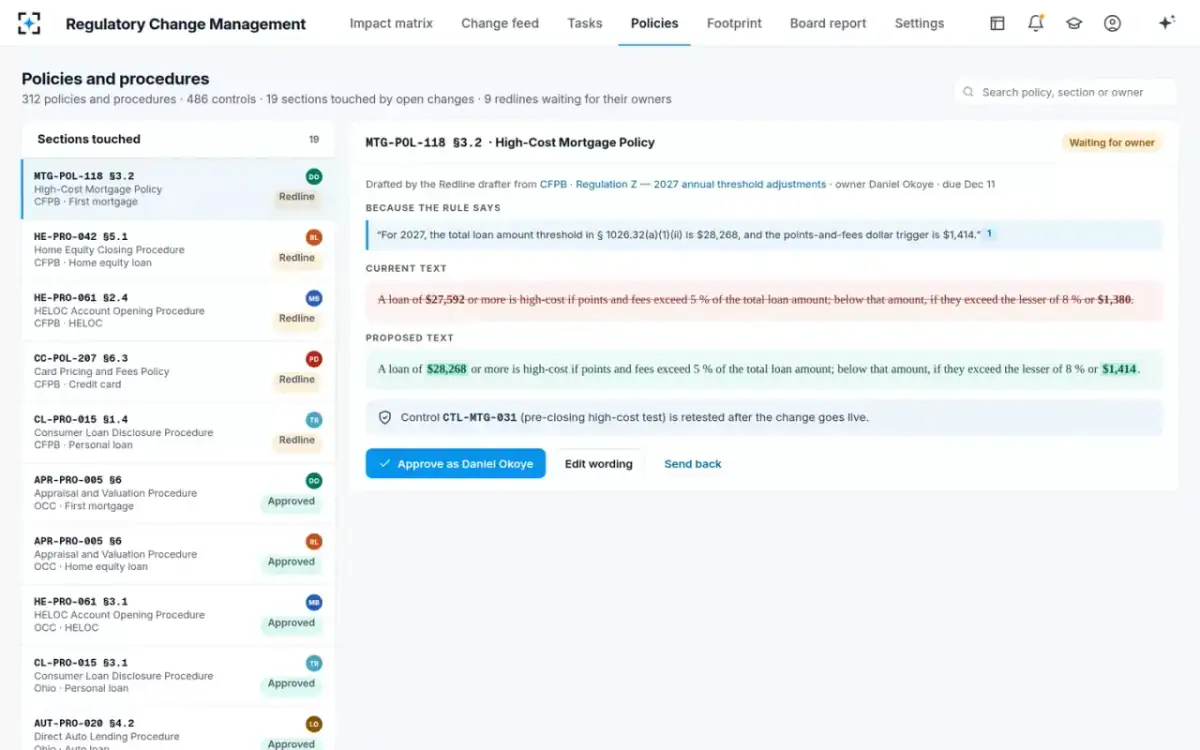
The decision for each section is not automatic. Some practices adopted to meet withdrawn guidance are still sound and still serve the underlying regulation; a lender that tightened dealer markup monitoring after the 2013 auto bulletin may well keep it, because the Equal Credit Opportunity Act still applies to the pricing. Others were costs carried only because the guidance asked for them. The point is that someone decides, and the decision and its reason are written down. In the solution, the redline drafter proposes the change for each section and the policy owner approves, edits or sends it back; nothing in the library changes without that approval.
A worked example: the 2013 indirect auto bulletin, section by section
Bulletin 2013-01 told indirect auto lenders that dealer markup discretion could create fair lending risk under the Equal Credit Opportunity Act, and many lenders built controls around it. Its withdrawal does not settle what those controls should become, because the risk the bulletin described is a reading of a statute that still applies. A change team that maps the withdrawal will typically find the bulletin cited in three places, and each needs a different answer.
One withdrawn bulletin, three sections, three different decisions
What the section says today: Cites Bulletin 2013-01 as the basis for capping dealer markup.
A defensible decision, with its reason: Keep the cap; replace the citation with ECOA and Regulation B, which still prohibit discrimination in any aspect of a credit transaction.
What the section says today: Quarterly disparity analysis by dealer, method taken from the bulletin’s description.
A defensible decision, with its reason: Keep or change: the analysis still serves the statute, but its method can now be chosen on the lender’s own risk assessment.
What the section says today: Explains the bulletin as current CFPB guidance.
A defensible decision, with its reason: Change: staff should not be told withdrawn guidance is in force, nor that the underlying law has gone.
The prudential regulators' own changes in 2025 complicate the same sections: the OCC and FDIC stopped examining for disparate impact, and Regulation B itself was amended in April 2026 on disparate impact, discouragement and special purpose credit programs. A fair lending policy touched by all three needs one owner who sees them together, which is the argument for logging removals in the same place as new rules.
What is the Section 1071 compliance date now? Delayed dates as changes
The Section 1071 compliance date is January 1, 2028, for all covered lenders, after two extensions and a revised rule. A delayed compliance date changes the work's timing, not its content, and it is easy to treat as no change at all. Section 1071 shows why it is not. The small business lending rule's compliance dates were extended twice in 2025 and replaced in May 2026 with a single date: "The compliance date for the rule is January 1, 2028." Implementation plans built around earlier dates needed re-dating; data collection projects had to decide whether to pause or continue; training schedules moved.
A revised rule on the matrix, with its date and owner moved accordingly
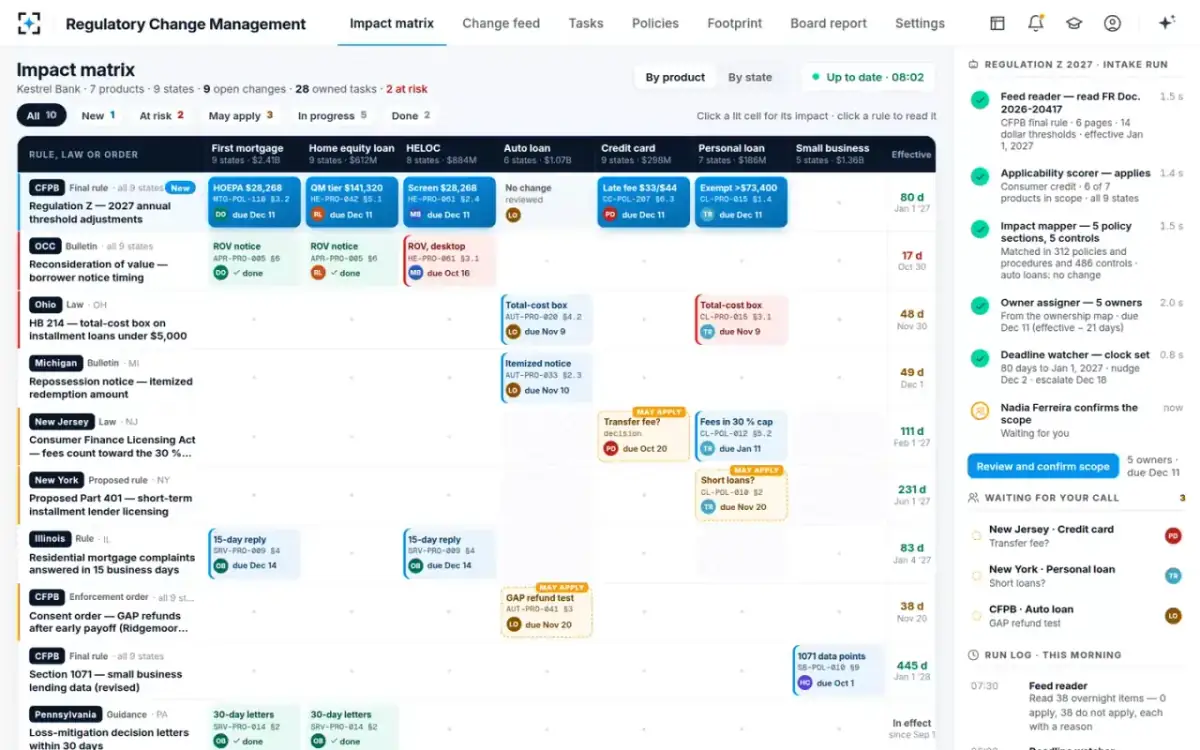
In the solution's sample data, on a fictional lender called Kestrel Bank, the revised 1071 rule sits on the matrix as its own row, with the small business policy section, its owner and a due date counted back from January 1, 2028. When a date moves again, the row moves, and the tasks under it are re-dated by the same rule rather than by hand. The calendar of dates that recur every year is a different problem, covered in the thresholds that reset every January 1.
A checklist for removals and reversals
When a rule or guidance is removed, rescinded or delayed
- Log it like a new rule
Source, date, effective date, verdict and reason. A removal that is not logged cannot be shown to have been considered.
- Search the library for citations, not only topics
Find sections that name the document, quote it or were adopted because of it.
- Decide keep, change or retire for each section
With a reason. Keeping a practice is a valid decision when the underlying law still supports it.
- Check what still binds
The statute and regulation, state law, and other regulators’ readings of the same rule.
- Track conditional changes to the condition
A direct final rule can be withdrawn; do not retire a procedure until the change is final.
- Re-date, do not delete, delayed work
Move owners’ due dates with the new compliance date and keep the history.
- Tell training and the business lines
Staff trained on the old guidance need to know what changed and what did not.
- Report removals to the committee
The board should hear what was retired and why, as it hears what was added.
The same evidence standard applies to a removal as to a new rule, which is set out in the regulatory change impact assessment an examiner reads. Asking whether a tool catches removals at all is one of the questions in choosing regulatory change management software. To see how the solution routes a changed rule to its owners, start from Regulatory Change Management.
Questions people ask
Can we stop doing what a withdrawn CFPB bulletin asked?
Only after checking what the underlying law requires and who else enforces it. Many bulletins described how the CFPB applied an existing statute or regulation to a practice; the statute still applies, states can still enforce the CFPA, and prudential regulators still examine against the regulations. Decide section by section and write down the reason.
Will the withdrawn guidance come back?
The CFPB said some might be reissued after review, against three tests: whether the guidance is statutorily prescribed, whether its interpretation is consistent with the statute or regulation, and whether it imposes or decreases compliance burdens. A change program should keep the history of each retired section so it can be restored if needed.
Were the Regulation B adverse action requirements withdrawn too?
No. Circulars 2022-03 and 2023-03, which explained how the CFPB read the adverse action rules, were withdrawn; the regulation itself was not. Regulation B still requires the statement of reasons to be specific and to indicate the principal reasons for the action, whatever model produced the decision.
Did the withdrawal touch the official interpretations in the regulations?
No. The 67 items are policy statements, interpretive rules, advisory opinions, circulars and bulletins published separately; the official interpretations that sit in the supplements to Regulations B, X, Z and the others are not on the list. Procedures that rely on the official commentary need no change on account of the withdrawal.
Does a rescinded rule need the same documentation as a new one?
Yes, if any policy, procedure, control or training relied on it. The examiner question is whether the institution responded "timely and satisfactorily to any variety of change", and a removal is a change.