The CFPB annual threshold adjustments for 2026 raised the Regulation Z high-cost mortgage (HOEPA) loan amount threshold to $27,592 and its points-and-fees dollar trigger to $1,380, moved the qualified mortgage 3% points-and-fees tier to loans of $137,958 or more, and lifted the Truth in Lending and Consumer Leasing Act exemption from $71,900 to $73,400. All of those took effect on January 1, 2026, from rules published on December 15, 2025, alongside new figures for the HPML appraisal exemption, the FCRA file disclosure charge, the HPML escrow exemption and the HMDA asset-size exemption. Regulatory change management usually means tracking new rules from publication to policy; the January resets are a different job, because their dates are fixed and their values follow from an index published in May. Botminds' Regulatory Change Management maps each reset to the policy sections, controls and loan system tables that carry the number.
The 2026 resets: seventeen days from publication, or seven months from the index
- Nothing to work from until the rule appearsMay 13 – Dec 15
- Publication to effect17 d
- April index reported May 13: expected values can be worked out216 days to prepare
- Confirm against the published rule17 d
What are the CFPB annual threshold adjustments for 2026?
They are the yearly inflation updates to dollar amounts written into Regulations Z, M, C and V, and they came as seven Federal Register documents in four weeks. Most are CFPB rules; the TILA and Consumer Leasing Act exemptions are issued jointly with the Federal Reserve, and the HPML appraisal exemption jointly with the Federal Reserve and the OCC. The statute or regulation behind each one fixes the index, the date and the rounding, so the agencies' role each year is arithmetic, not policy.
The 2026 threshold resets a consumer lender maps every year
| Threshold | 2025 | 2026 | Published / effective |
|---|---|---|---|
| HOEPA total loan amount (Reg Z §1026.32) | $26,968 | $27,592 | Dec 15 / Jan 1 |
| HOEPA points-and-fees dollar trigger | $1,348 | $1,380 | Dec 15 / Jan 1 |
| QM points and fees: 3% tier starts at (Reg Z §1026.43) | $134,841 | $137,958 | Dec 15 / Jan 1 |
| QM points and fees: flat-dollar tier cap | $4,045 | $4,139 | Dec 15 / Jan 1 |
| TILA and Consumer Leasing Act exemption (Regs Z and M) | $71,900 | $73,400 | Dec 15 / Jan 1 |
| HPML appraisal exemption | $33,500 | $34,200 | Dec 16 / Jan 1 |
| Consumer report file disclosure charge (FCRA, Reg V) | $15.50 maximum | $16.00 maximum | Dec 15 / Jan 1 |
| HMDA asset-size exemption (Reg C) | $58 million | $59 million | Jan 7 / Jan 7 |
| HPML escrow exemption, small creditor asset limit (Reg Z) | $2.717 billion | $2.785 billion | Jan 7 / Jan 7 |
| HPML escrow exemption, insured depository asset limit (Reg Z) | $12.179 billion | $12.485 billion | Jan 7 / Jan 7 |
Two adjustments did not happen, and they matter as much as the ones that did. The credit card minimum interest charge disclosure threshold stays "unchanged at $1.00", because it moves only when the cumulative index change adds a whole dollar (90 FR 57890). And the HOEPA annual percentage rate triggers, 6.5 percentage points over the average prime offer rate for most first liens and 8.5 for subordinate liens, are not indexed at all (12 CFR 1026.32). A threshold inventory should list the fixed numbers too, so nobody "updates" them by mistake.
What are the HOEPA thresholds for 2026?
A mortgage of $27,592 or more is high-cost on points and fees if they exceed 5% of the total loan amount; below $27,592, if they exceed the lesser of 8% or $1,380. The CFPB's rule puts it plainly: "For HOEPA loans, the adjusted total loan amount threshold for high-cost mortgages in 2026 will be $27,592. The adjusted points-and-fees dollar trigger for high-cost mortgages in 2026 will be $1,380." Both reflect "the 2.3 percent increase in the CPI-U index from April 2024 to April 2025" (90 FR 57890).
The cliff at the loan amount threshold is where errors hide. Take two home-equity loans, each with $1,500 in points and fees. At $25,000 the loan sits below $27,592, so the trigger is the lesser of $2,000 (8%) and $1,380: $1,500 exceeds it, and the loan is a high-cost mortgage under HOEPA. At $30,000 the trigger is 5%, or $1,500 exactly, and points and fees must exceed it, so the loan is not high-cost. A loan system still holding the 2025 figure of $26,968 tests the $27,000 loan against the wrong rule. A high-cost classification is not a disclosure footnote: it brings counseling, extra disclosures and restrictions that many lenders' policies do not allow at all.
What are the QM points and fees limits for 2026?
For 2026, a qualified mortgage's points and fees may not exceed 3% of the total loan amount at $137,958 or more; $4,139 from $82,775 to $137,958; 5% from $27,592 to $82,775; $1,380 from $17,245 to $27,592; and 8% below $17,245. These five tiers apply "for all categories of QMs", and the same loan amounts now mark the steps in the general QM price test (90 FR 57890).
What the 2026 QM points-and-fees limit allows, by loan size
The price test moved with them. A first-lien loan of $137,958 or more is a general QM only if its APR is less than 2.25 percentage points above the average prime offer rate; from $82,775 to $137,958 the margin is 3.5 points; below $82,775, and for manufactured-home loans under $137,958, it is 6.5 points. Subordinate liens get 3.5 points at $82,775 or more and 6.5 below. A pricing engine that classifies QM status carries all of these loan amounts, and every one changed on January 1.
What is the 2026 TILA exemption threshold, and which other dollar limits moved?
The TILA exemption threshold for 2026 is $73,400: consumer credit above that amount is generally outside the Truth in Lending Act unless it is secured by real property or a principal dwelling, or is a private education loan. The Federal Reserve and the CFPB raised it from $71,900, with a matching rule moving the Consumer Leasing Act threshold under Regulation M to the same figure (Regulation Z exemption rule; Regulation M). For an auto or personal loan line, this is the number that decides whether Regulation Z disclosures are owed at all.
The other three moved on their own schedules. The higher-priced mortgage loan appraisal exemption rose "from $33,500 to $34,200, effective January 1, 2026" (HPML appraisal rule). The maximum charge for a consumer's file disclosure under the FCRA "will be $16.00, an increase of $0.50 from 2025" (90 FR 57888). And the escrow exemption for higher-priced mortgages moved its two asset limits to $2.785 billion and $12.485 billion, from $2.717 billion and $12.179 billion, in a rule published and effective on January 7.
Seven rules in four weeks: the December cluster
The resets arrive together, and some arrive after the date they govern. Between December 15, 2025 and January 7, 2026, the agencies published seven threshold rules; five took effect on January 1. The last two were published and effective on January 7, including the HMDA rule under which "institutions with assets of $59 million or less as of December 31, 2025, are exempt from collecting data in 2026" (Regulation C threshold rule). A bank near $59 million learned its 2026 HMDA status a week into the year it applied to.
The January 2026 reset in four numbers
7
threshold rules published between December 15, 2025 and January 7, 2026
5
of them effective on January 1, 2026
17days
from publication to effect for the Regulation Z adjustments
2.3%
CPI-U increase, April 2024 to April 2025, behind the HOEPA and QM figures
A program that sets owners' due dates a fixed number of days before the effective date meets a problem here. A 21-day margin before January 1 means a December 11 due date, four days before the rule is published. The margin has to come from somewhere else, and for these rules it can: from the index.
Why are the thresholds adjusted every year?
Because the statutes and regulations that set them tie each one to a consumer price index, so the protection keeps its real value as prices rise. The Regulation Z commentary says the HOEPA and QM amounts "will be adjusted annually on January 1 by the annual percentage change in the CPI-U that was in effect on the preceding June 1" (90 FR 57890). But the indices and the rounding differ from rule to rule, and the differences decide how precisely a lender can predict the next value.
Three calculation methods behind the January numbers
Index and period: CPI-U in effect on June 1, which reflects April over April.
Rounding and quirks: Applied to the previous year’s unrounded amount, then rounded to the whole dollar, so the published figures cannot be rebuilt exactly from rounded ones.
Index and period: CPI-W in effect on June 1, April over April.
Rounding and quirks: The increase is rounded to the nearest $100; a fall in the index leaves the threshold unchanged.
Index and period: Average CPI-W for the twelve months ending in November.
Rounding and quirks: Known only in December, published in January, often effective on publication.
The 2026 cycle added a twist no calendar predicted. The federal lapse in appropriations in late 2025 left a gap in the price data (BLS): "The non-seasonally adjusted Consumer Price Index for Urban Wage Earners and Clerical Workers (CPI-W) for October 2025 was not reported by the Bureau of Labor Statistics", and the CFPB "excluded October 2025 from its calculation" of the HMDA and escrow thresholds (Regulation C threshold rule). A lender that had pre-computed those two figures from a twelve-month average had to recheck its method, not just its number, when the rule appeared.
When will the 2027 thresholds be published, and what will they be?
Expect the 2027 rules in December 2026 and January 2027, but most of the values can be estimated now. The index they use was reported on May 12, 2026: over the twelve months to April, the CPI-U "increased 3.8 percent" and the CPI-W "increased 3.9 percent" (Bureau of Labor Statistics). Those rises are well above the 2.3% and 2.1% behind the 2026 figures, so the 2027 moves will be larger.
Expected 2027 values from the April 2026 index, to confirm in December
| Threshold | 2026 | Expected 2027 | Index used |
|---|---|---|---|
| HOEPA total loan amount | $27,592 | about $28,640 | CPI-U, +3.8% |
| HOEPA points-and-fees dollar trigger | $1,380 | about $1,432 | CPI-U, +3.8% |
| QM points and fees: 3% tier starts at | $137,958 | about $143,200 | CPI-U, +3.8% |
| QM points and fees: flat-dollar tier cap | $4,139 | about $4,296 | CPI-U, +3.8% |
| QM points and fees: 5% tier starts at | $82,775 | about $85,920 | CPI-U, +3.8% |
| TILA and Consumer Leasing Act exemption | $73,400 | $76,200 or $76,300 | CPI-W, +3.9%, increase rounded to $100 |
| HPML appraisal exemption | $34,200 | about $35,500 | CPI-W, +3.9%, increase rounded to $100 |
| HMDA and escrow asset thresholds | $59 million; $2.785 billion; $12.485 billion | not yet estimable | CPI-W average to November 2026 |
The size of the 2027 move is itself a reason to prepare. At 3.8%, the HOEPA loan amount threshold moves by about $1,050 instead of the $624 it moved for 2026, so more loans fall into the band where the test changes. A pricing engine, a disclosure template and a vendor's loan origination system each need the new figure on January 1, and a vendor's release calendar is usually set long before December 15.
A sample threshold rule with each changed passage tied to its section and owner
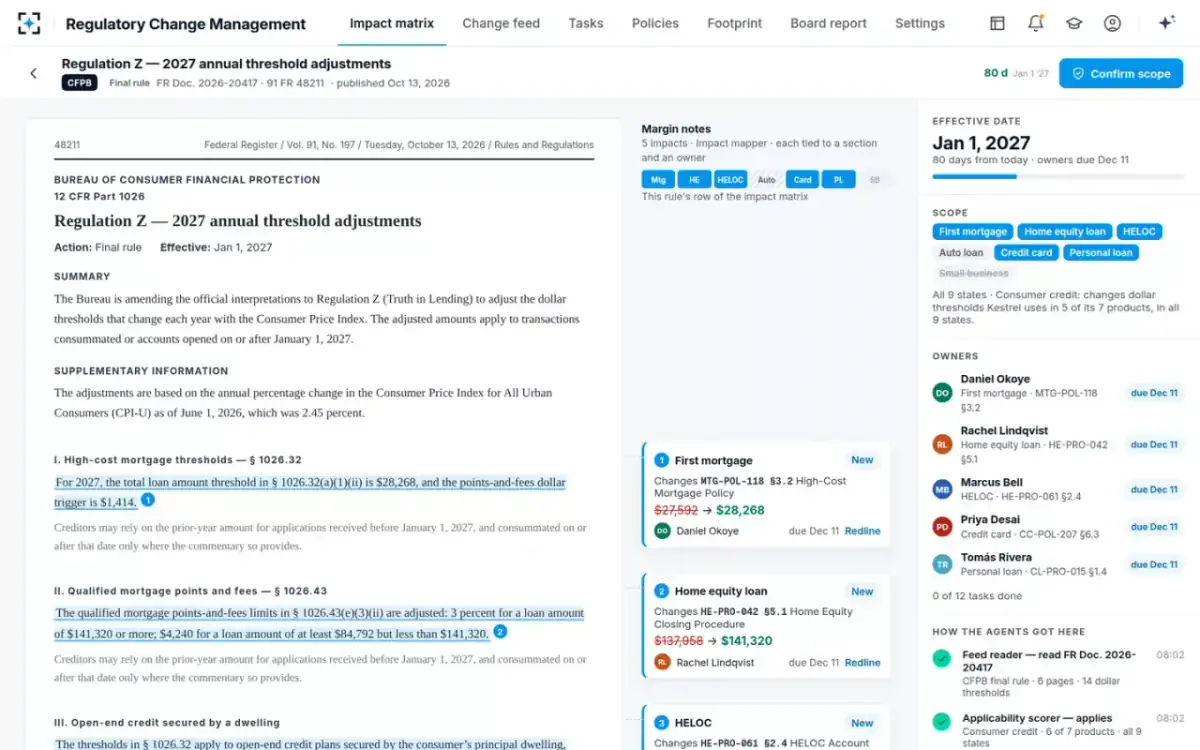
Where a threshold lives: policy, control and loan system
A threshold change is usually small in the policy and large in the systems. The HOEPA test runs in the loan origination system before closing; the QM points-and-fees tiers sit in pricing and underwriting rules; the TILA exemption decides which loans get Regulation Z disclosures at all. The OCC expects a bank to include "systems and applications in its change management processes to re-test results when regulatory changes occur" (OCC Comptroller's Handbook). For a reset, the retest is the evidence that the new number reached the place where loans are tested.
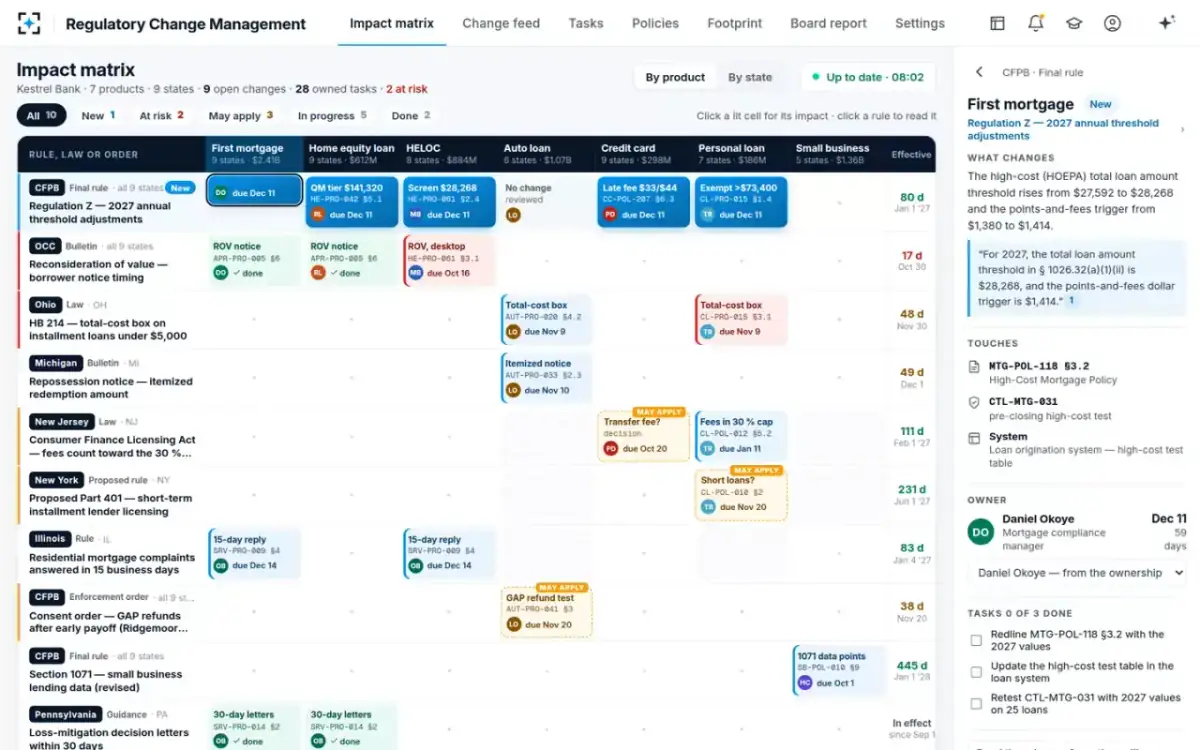
Take a fictional sample lender, Kestrel Bank, which lends in nine states across seven products, as a sample 2027 rule runs through the solution. On the first mortgage line, the rule touches section 3.2 of the High-Cost Mortgage Policy, the pre-closing high-cost test control and the high-cost test table in the loan origination system, with three tasks for the owner: the redline, the system table and the retest on 25 loans.
One threshold, three places: the policy section, the control and the system table
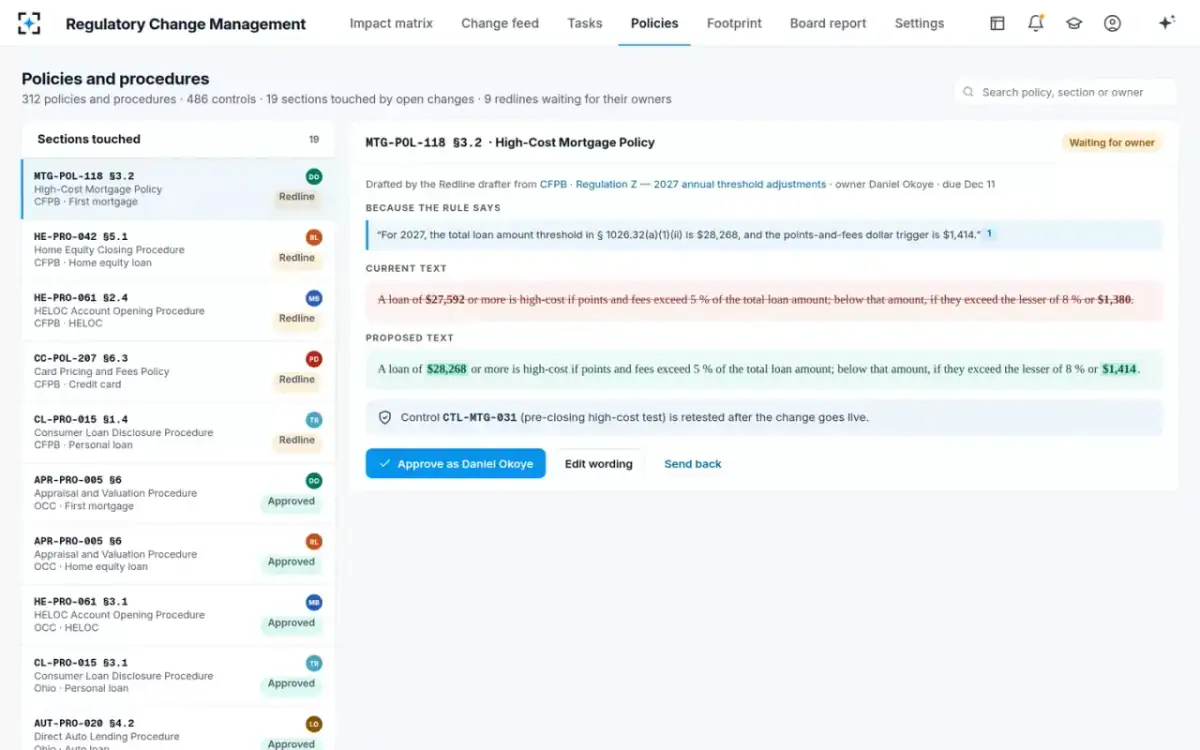
The policy owner then sees the drafted wording change: the current text with the old values struck through, the proposed text with the new ones, and a note that the control is retested after the change goes live. Nothing changes in the policy library until the owner approves it.
The redline for a threshold: old value struck, new value proposed, control to retest
A January reset calendar for consumer lenders
The resets reward a calendar that starts in spring. These steps work in a spreadsheet as well as in software; what matters is that each value has an owner and each place it is stored has a retest.
Preparing for next January’s threshold resets
- List every indexed threshold you use, and the fixed ones beside them
HOEPA, QM tiers, the TILA and Consumer Leasing Act exemption, the HPML appraisal exemption, escrow and HMDA asset thresholds, state amounts indexed the same way; and the APR triggers that do not move.
- Note where each value is stored
Policy sections, procedure text, loan system tables, pricing rules, disclosure templates and vendor systems.
- Compute expected values in May
From the April index reported in mid-May; mark them as expected until the rule confirms them.
- Book vendor releases for January 1
With a way to switch on the date rather than before it, and test loans either side of each new figure.
- Confirm against the published rules in December
Including rounding and any change of method, such as a missing month of index data.
- Retest each system in early January
Run test loans either side of each new threshold and keep the result.
- Watch the asset-size thresholds separately
Regulation C and escrow exemptions depend on year-end assets and can be published after January 1.
- Report the reset to the committee
What changed, where it was applied and how it was tested.
Why a monthly review cycle struggles with windows like these is covered in how to keep up with regulatory changes, and what follows when a date passes with a system still on the old number in the consequences of a missed effective date. Removals and moved dates, the opposite kind of change, are in the CFPB's 67 withdrawn guidance documents. To see a threshold rule mapped from publication to owner, start from Regulatory Change Management.
Questions people ask
What is the HMDA asset threshold for 2026?
$59 million, up from $58 million. Banks, savings associations and credit unions with assets of $59 million or less on December 31, 2025 are exempt from collecting HMDA data in 2026. The rule was published and took effect on January 7, 2026.
What is the FCRA disclosure charge for 2026?
A consumer reporting agency may charge at most $16.00 for a file disclosure in 2026, up $0.50 from $15.50 in 2025. The figure applies from January 1, 2026, under the CFPB rule published on December 15, 2025.
Did the credit card minimum interest charge threshold change for 2026?
No. It stays at $1.00, because it rises only when the cumulative index change adds a whole dollar, and the 2.1% rise in the CPI-W to April 2025 did not. Card disclosures that state the threshold need no change for 2026.
What are the HPML escrow exemption thresholds for 2026?
The small creditor asset limit is $2.785 billion and the limit for insured depositories and credit unions is $12.485 billion, up from $2.717 billion and $12.179 billion. Both follow a 2.5% rise in the average CPI-W for the twelve months to November 2025, computed without October, for which no index was reported.
Who publishes the annual threshold adjustments?
The CFPB publishes most of them alone, including HOEPA, QM, HMDA and the FCRA charge. The TILA and Consumer Leasing Act exemptions are joint rules with the Federal Reserve, and the HPML appraisal exemption is a joint rule of the OCC, the Federal Reserve and the CFPB. All appear in the Federal Register.
Can a lender use expected values before the rule is published?
For preparation, yes; for loans, no. The published rule is the authority, and its rounding can differ from an estimate. The safe practice is to build and test with expected values, then switch on January 1 with the published figures.