A 50-state survey of insurance law answers one question for every state, and it is accurate only cell by cell. Each state's answer has to pass four tests: it cites the passage that actually governs the question, that passage was the version in force on the date the question was asked, the answer is placed honestly as yes, no or "it depends", and the days in it are counted the way that state counts them. A survey with 50 good cells and one stale one is a survey that will fail an examination in one state. Most surveys are reviewed as a whole document; they should be scored one cell at a time.
This is the discipline built into 50-State Regulatory Research, Botminds' solution in which agents read every state's insurance codes, regulations and bulletins, cite each state's answer and check every citation against the version in force, before a compliance analyst accepts and counsel signs. The scoring method below works with or without it. The rules quoted were read on 27 October 2026; the draft cells in the scoring figure are illustrations written for this page, not any publisher's survey.
Why one insurance question has many right-looking answers
4tests
every state's answer must pass: passage, version, placement and day count
7–21days
the same acknowledgment clock in calendar days, across five rulebooks, from one Monday notice
15sections
of Washington's claims rules amended at once, effective 18 Oct 2026
17holidays
in Texas law, 9 national and 8 state, before optional ones
What makes a 50-state survey of insurance law accurate?
Accuracy means every cell would survive the question an examiner asks of a claim file: what did the rule in this state require on this date, and did you meet it? That breaks into four tests, and each catches a different kind of error. A survey can be beautifully cited and still fail the second test in a dozen states, or be current everywhere and still fail the fourth.
The tests are cumulative. A cell that cites the right passage from a superseded version is wrong, however good the citation looks. A cell with the right version but the wrong unit of days is wrong in a way that may not show until a holiday falls inside the window. And a cell that rounds "it depends" into "yes" is wrong for every claim that falls inside the exception. Scoring the four separately tells the reviewer not only how many cells fail but why, which is what decides whether the survey needs a re-read or a re-build.
How do you check a 50 state survey? Score every cell on four tests
Take each state's answer, open the cited text, and mark it pass or fail on each test. A cell passes only if it passes all four; the survey's score is the share of cells that do, reported by test. The figure shows how five plausible draft cells on one question, how quickly an insurer must acknowledge a first-party property claim, score against the rules as they stood on 27 October 2026.
Five draft cells on the acknowledgment question, scored on four tests
| State | Draft cell | Passage | Version | Placement | Days | Correct reading |
|---|---|---|---|---|---|---|
| Florida | Draft cell14 calendar days · §627.70131(1)(a) | Passage✓ | Version✗ | Placement✓ | Days✓ | Correct readingRight section, 2022 text. The statute now says 7 calendar days, for residential property insurers. |
| Texas | Draft cell15 business days · Ins. Code §542.055 | Passage✗ | Version✓ | Placement✓ | Days✗ | Correct readingThe statute says "the 15th day". Fifteen business days is the rule's presumption for other pertinent communications (28 TAC §21.203(2)). |
| New York | Draft cell15 days · 11 NYCRR 216.4(a) | Passage✓ | Version✓ | Placement✓ | Days✗ | Correct readingRight rule, but it says 15 business days. The placement for a 15-calendar-day standard happens to survive; the next question will not. |
| Washington | Draft cellDecide in 15 working days after proof of loss · WAC 284-30-380(1) | Passage✓ | Version✗ | Placement✗ | Days✗ | Correct readingTrue until 17 October 2026. Since 18 October: 30 calendar days after a notification of claim. |
| California | Draft cell15 calendar days · 10 CCR 2695.5(e)(1) | Passage✓ | Version✓ | Placement✓ | Days✓ | Correct readingPasses all four. |
Four of the five cells fail at least one test, and only one failure would be caught by a reviewer who checks that each citation exists. The Florida cell cites the right section; the New York cell cites the right regulation; both are wrong. That is the case for scoring by test rather than by reading the survey through: a reviewer looking for missing citations would pass three of the four failures.
Test one: does the citation point to the passage that governs?
The first test asks whether the cited text answers this question for this kind of insurer and claim, not merely whether it mentions the topic. Insurance rules are layered and scoped, so a passage can be real, current and beside the point.
Texas has two passages that both say 15 about acknowledgment. Its Insurance Code requires an insurer to acknowledge a first-party claim not later than "the 15th day" after it receives notice (§542.055(a)), or the 30th business day for an eligible surplus lines insurer. The department's rule on unfair claim settlement practices says, about pertinent communications in general, that an acknowledgment within 15 business days is presumed reasonably prompt (28 TAC §21.203(2)). A cell answering the first-party question from the rule gets the unit wrong while citing real Texas law.
Scope is the other trap. Florida's seven-day clock sits in a section whose definitions say "“Insurer” means any residential property insurer" (§627.70131(5)(b)), so it does not by itself answer the question for a commercial auto claim. Texas's prompt-payment subchapter does not apply to workers' compensation, title, mortgage guaranty, fidelity and surety, or marine insurance (§542.053). And the NAIC model regulation that many states follow states that it is not intended to cover workers' compensation, fidelity, suretyship or boiler and machinery claims. The test passes only when the passage's scope covers the line and claim type in the framed question.
Test two: was that version in force on the date asked?
The second test asks for the text as it stood on the survey's as-of date, which means every cell needs one. Section numbers survive amendments, so a citation can be right while the words have changed underneath it.
Washington's rule order WSR 26-17-089, filed 18 August 2026 and effective 18 October, rewrote the state's claims standards in one step. The time to answer the commissioner's inquiry about a complaint fell from fifteen working days to 10 business days from receipt of the inquiry (WSR 26-17-089; every clock the order moved is listed in claim handling guidelines by state), and the time to accept or deny a first-party claim moved from fifteen working days after proof of loss to 30 calendar days after notification (WAC 284-30-360(2) and 284-30-380(1) as amended). A Washington cell written in September is wrong in October, and a cell written in October is wrong for any claim handled before the 18th.
Regulators apply the second direction as strictly as the first. When Florida's Office of Insurance Regulation examined Hurricane Ian claims handled from September 2022 to December 2023, it measured acknowledgment against the 2022 text of §627.70131 and its 14-day clock, while noting that the 2023 statute had shortened it (Tower Hill Prime examination report, 21 July 2025). A survey cell therefore needs both the current version and the dated history, because the question "what did the rule require when this claim was handled?" arrives years later, in an exam.
Test three: is the placement honest, yes, no or conditions?
The third test asks whether the cell's verdict follows from the passage without rounding. Most 50-state questions are asked as a test of a company standard ("is 15 calendar days enough?"), and the honest answer has three values, not two. "Conditions" covers a rule with no fixed count, a count that depends on holidays, or an exception that changes the answer for some claims.
New York's Regulation 64 requires acknowledgment "within 15 business days" (11 NYCRR 216.4(a)). Fifteen business days is always at least 15 calendar days, so a 15-calendar-day standard is a clean yes. Washington's ten business days for an individual policy is a no: from a Monday notice it lands on day 14, one day before a 15-day standard. Texas is a yes for an admitted insurer and a conditions cell if the carrier writes surplus lines, where the clock is the 30th business day. Florida is a no for a residential property claim and needs its own framing for any other line. A survey that shows Texas as a plain yes is not wrong today, but it hides the exception the business needs to know about.
The rule for reviewers is simple: a condition is never rounded up to a yes. If the cell needs a sentence to explain when it is true, it is a conditions cell, and the sentence belongs in it.
Test four: whose calendar counts the days?
The fourth test asks whether the cell uses the state's unit of time and the state's definition of it. "Fifteen" is calendar days in the NAIC model, which defines "“Days” means calendar days"; it is business days in New York; and Texas counts business days without weekends or the holidays its own law recognizes (§542.051(1); worked through in Texas Insurance Code 542.060).
One Monday notice, six acknowledgment deadlines: calendar days elapsed
Holidays are where business-day cells quietly fail. Texas law lists nine national holidays and eight state holidays, including 19 January, 2 March, 21 April, 19 June, 27 August, the Friday after Thanksgiving, and 24 and 26 December, plus optional holidays for Rosh Hashanah, Yom Kippur and Good Friday (Gov't Code §662.003). A business-day deadline counted on a federal calendar comes out different from the Texas count in late December. Washington's October rewrite also replaced "working days" with "business days" in its acknowledgment and settlement rules; the count stayed the same, but a cell that recorded the old word now cites text that no longer exists. Counting conventions across a whole claim file are tested step by step in a claim file audit checklist.
Insurance laws and regulations by state: where to check each cell
Check against the state's own text: the legislature's statute site, the official administrative code or register, and the insurance department's bulletin index. Free copies such as Cornell's Legal Information Institute are convenient for regulations, but the official version is the one filed with the state; Texas's insurance department says of its own rule pages that the official versions are those filed with the Secretary of State.
NAIC materials are an index, not the text. The NAIC's state page for the property and casualty claims model lists each state's related statute or regulation with dates, but carries its own warning that readers "should consult state law for further details and for the most current information", and the edition we read is dated Fall 2023. Reading that chart is the subject of how to read the NAIC model law state adoption charts, and one state's full source stack is laid out in how to find state insurance regulations in Texas.
A reviewer's checklist for any cell in a 50 state survey of insurance laws
Eight checks before a cell is accepted
- The cell names its as-of date
Without it, test two cannot be run at all.
- The citation opens to a passage, not only a section
The reviewer should read the words that decide the answer.
- The passage covers this insurer, line and claim type
Residential property only in Florida; no workers' compensation in Texas's prompt-payment subchapter.
- The version was in force on the as-of date
Check the register for amendments between the text quoted and the date asked.
- The event that starts the clock matches the question
Notice of claim, proof of loss and receipt of all requested items are three different days.
- The unit is the state's unit
Calendar, business or working days, as the text says, not as the template assumes.
- Holidays are the state's holidays
A business-day count is only as good as the calendar behind it.
- Exceptions are written into the cell
Surplus lines, catastrophes, suspected fraud: if it changes the answer, the cell is "conditions".
How 50-State Regulatory Research scores its own cells
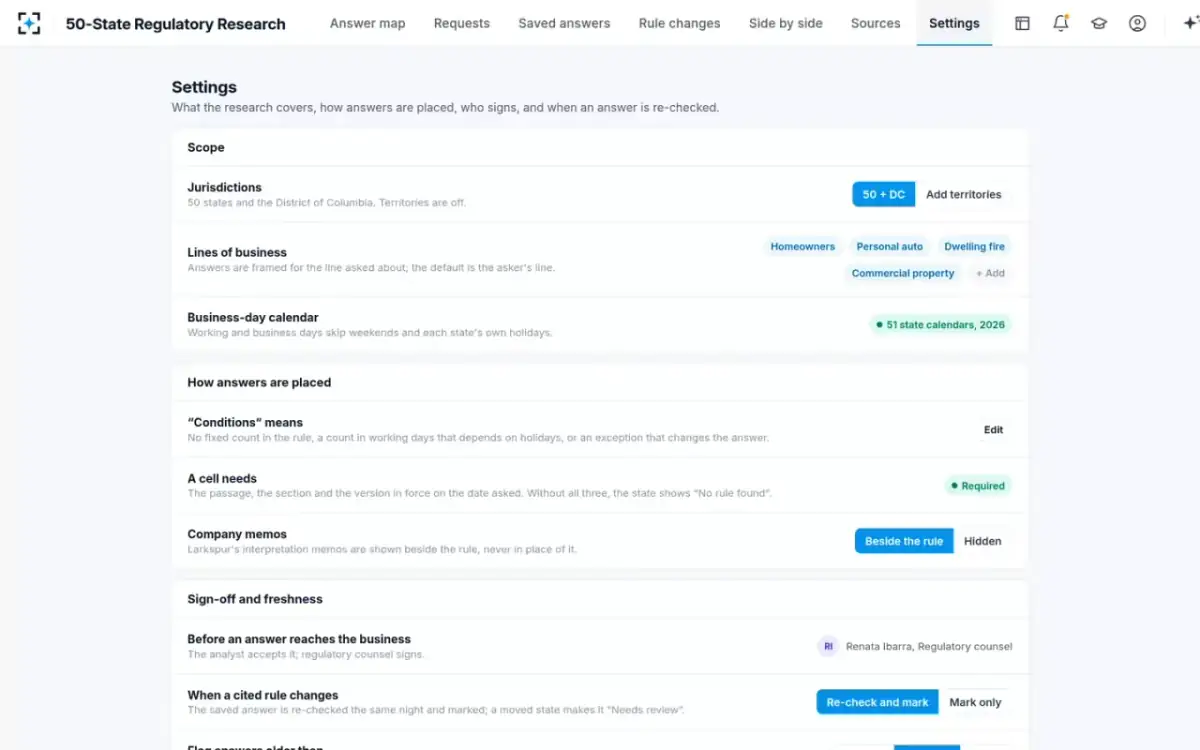
The solution applies the four tests as rules rather than as a review step at the end. A state's answer reaches the map only with its passage, its section and the version in force on the date asked; without all three the state shows "No rule found". The answer classifier places each state yes, no or conditions and shows its day-count arithmetic, and a separate citation checker re-reads every cell against its passage before the analyst sees it.
The rules a cell must meet, set where the team can see them
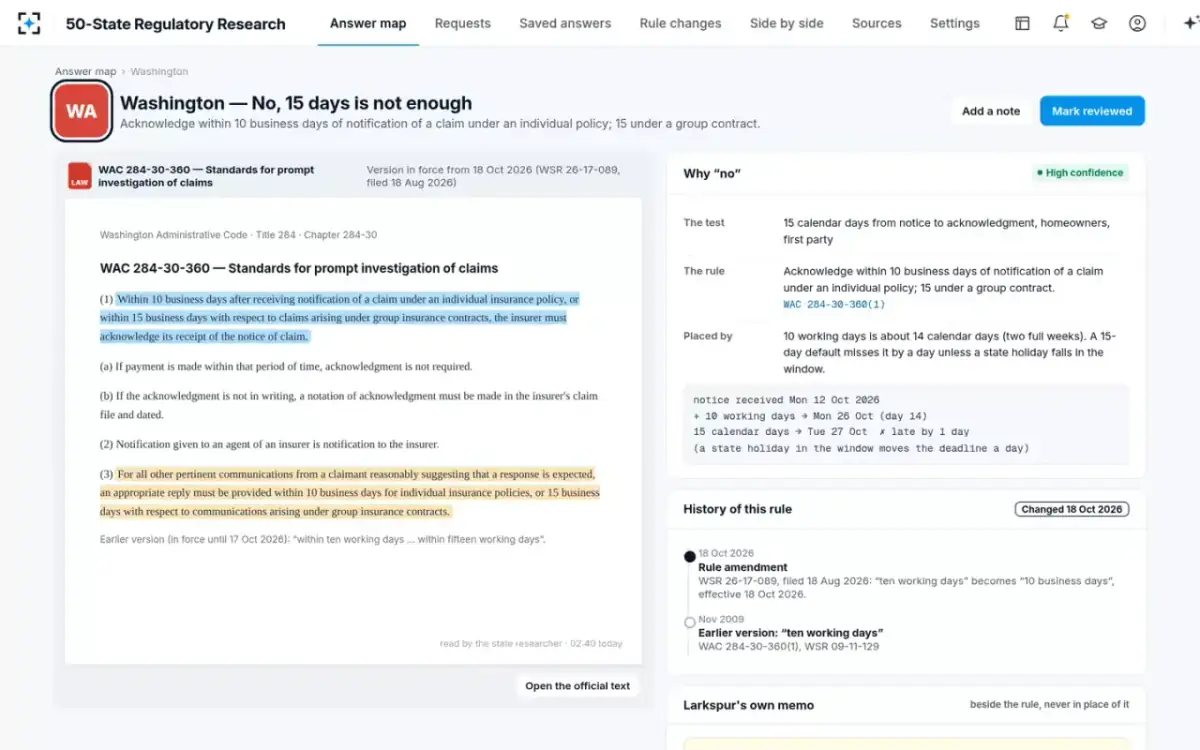
The arithmetic is shown on each state's page, so the analyst checks the placement rather than trusting it. On Washington, the sample answer shows notice received Monday 12 October, ten business days to Monday 26 October, day 14, and a 15-day standard landing one day late.
Washington, opened: the passage, the arithmetic and the rule's history
What the solution cannot do is decide a contested reading. When the text supports two readings, the question framer shows both and asks; when counsel disagrees with a placement, counsel's reading wins and the change is recorded. How the agents divide the reading and the checking is set out in AI and insurance compliance research.
Questions people ask
What is a 50 state survey of insurance laws and regulations?
One insurance question answered for each state, usually with the District of Columbia, with the statute, regulation or bulletin behind each answer. In insurance it is only usable if each answer also carries the date it was true, because the same section can say 14 days one year and 7 the next, as Florida's acknowledgment rule did.
How accurate are 50-state surveys?
There is no published measure, so score your own. Pick 20 cells, run the four tests against the primary text and count failures by test; a survey that fails mostly on version needs a re-check, while one that fails on passage or placement needs a re-read.
Do NAIC model laws make state insurance laws the same?
No. A model binds only where a state adopts it, and states edit as they adopt. The NAIC's claims model counts calendar days, New York counts business days, and Florida's statute sets 7 calendar days for residential property insurers.
What is the difference between business days and working days?
Usually nothing in the count, but the word matters for the citation. Washington replaced "working days" with "business days" in its claims rules from 18 October 2026 without changing the numbers; Texas defines a business day as any day other than a Saturday, Sunday or state-recognised holiday.
How often should a 50-state survey be re-checked?
Whenever a rule a cell cites changes, which means watching every state's register and bulletins, and at a fixed age as a backstop. In the sample configuration answers older than 180 days are flagged, and any answer citing a changed rule is re-checked the night the change is read.