There is usually no single legal time limit to report an accident to insurance: the deadline is in the policy's notice condition, read with state law, and a few states add hard dates for particular coverages. New York's no-fault benefits need written notice within 30 days of the accident. Florida's personal injury protection pays medical benefits only if initial treatment comes within 14 days, and a Florida property claim must be reported within a year. The insurer's side runs the other way and is shorter: once notified, it must acknowledge the claim within days, 7 to 15 depending on the state. Botminds' FNOL & Claims Triage Automation works on that second clock, reading every first notice as it arrives so the insurer's deadlines start with the claim already on the right desk.
This page is general information, not legal advice, and the rules are those in force when it was written; a policyholder's own policy and state law decide any real case. Examples of how a carrier handles late reports come from the solution running on a fictional carrier, Tallowmere Mutual, with sample data.
Your deadline and the insurer's, side by side, in seven jurisdictions
| Where | Reporting deadlines for the policyholder | The insurer’s first deadline |
|---|---|---|
| California | As the policy requires; separately, an SR-1 report to the DMV within 10 days if anyone is injured or property damage is over $1,000 | Acknowledge, send forms and instructions, and begin any necessary investigation within 15 calendar days of notice |
| Florida | PIP medical benefits need initial treatment within 14 days of the accident; a property claim must be noticed within 1 year of the loss (supplemental claims 18 months) | Property claims: review and acknowledge within 7 calendar days |
| New York | No-fault: written notice within 30 days of the accident; proof of claim for health services within 45 days of treatment | Acknowledge within 15 business days |
| Ohio | As the policy requires | Acknowledge within 15 days (calendar) |
| Pennsylvania | As the policy requires | Acknowledge within 10 working days |
| Washington | As the policy requires | Acknowledge within 10 business days (individual policies) |
| NAIC model | Not addressed | Acknowledge within 15 days |
What is the time limit to report an accident to insurance?
The time limit to report an accident to insurance is whatever the policy's notice condition says, read with any state law that changes it. State insurance codes recognise that the policy sets the clock: New York's law, for instance, deals with a provision that failure to give notice "required to be given by such policy within the time prescribed therein". Where a policy says "promptly" or "as soon as practicable" rather than a number of days, the answer is soon, and the risk of waiting is a dispute about what those words meant.
The NAIC's consumer guide gives the practical version: "To file a claim, call the phone number on your proof-of-insurance card as soon as possible." It adds that many insurers take claims through their apps. A policyholder who reports the same day loses nothing; one who waits weeks invites questions about what happened in between, and may lose benefits that have their own clocks.
How soon after an accident should you report it to insurance?
Report it as soon as you safely can, ideally the same day and before repairs, a rental or medical treatment begin. Three reasons sit behind that. Evidence fades: the other driver's details, photos of both cars and witnesses are easiest to capture at the scene. Some benefits have their own deadlines, set out below. And the insurer's obligations to you start at notice, so reporting early starts its clocks early.
"How long to contact insurance after an accident" also depends on whose insurance. A claim against the other driver's insurer is a third-party claim, with different rules and no policy of your own setting the deadline; the difference is set out in first party vs third party claims. Reporting to your own insurer is still advisable when the other driver was at fault, because your policy's notice condition may apply either way.
State laws that set a reporting deadline
A few state laws do put a number on it, usually for no-fault benefits or property claims. They are worth knowing because they turn "promptly" into a date that can be missed.
New York no-fault. The mandatory personal injury protection endorsement requires written notice of the accident "as soon as reasonably practicable, but in no event more than 30 days after the date of the accident", unless the injured person shows clear and reasonable justification for the delay. Claims for medical treatment have their own limit: written proof of claim "in no event later than 45 days after the date services are rendered".
Florida PIP. Florida's personal injury protection pays medical benefits, "to a limit of $10,000 in medical and disability benefits", only if the injured person receives initial services and care "within 14 days after the motor vehicle accident". This is a treatment deadline rather than a reporting one, but it is the one most likely to cost money if an injury is ignored for a fortnight.
Florida property. A property claim, including a reopened one, is barred unless notice was given "within 1 year after the date of loss", and "A supplemental claim is barred unless notice of the supplemental claim was given to the insurer in accordance with the terms of the policy within 18 months after the date of loss." For weather events the statute fixes how the date of loss is set.
What happens if you report an accident late?
A late report can let the insurer deny the claim under the policy's notice condition, but some states limit that, and New York is the clearest example. For liability policies issued in New York (its rule covers any "policy or contract insuring against liability for injury" to person or property), a failure to give timely notice "shall not invalidate any claim made by the insured, injured person or any other claimant," "unless the failure to provide timely notice has prejudiced the insurer," with exceptions.
New York also says who must prove prejudice, and the answer turns on how late the notice was. If notice came within two years of the time the policy required, "the burden of proof shall be on: (i) the insurer to prove that it has been prejudiced, if the notice was provided" within that period; if it came more than two years late, the policyholder or claimant must prove the insurer was not prejudiced. Other states take different approaches, from case law to statute, and the policy wording matters everywhere.
Reporting on day one against reporting weeks later
Reported the same day: Scene photos, the other driver’s card, witnesses, the car where it stopped.
Reported weeks later: Memories, a repaired or moved car, a police report if one was made.
Reported the same day: Pain noted at once; treatment inside any PIP or no-fault window.
Reported weeks later: A gap between the accident and treatment the insurer will ask about.
Reported the same day: Its acknowledgement and investigation clocks start now.
Reported weeks later: They start only when notice arrives.
Reported the same day: Your insurer hears your account first.
Reported weeks later: Your insurer may hear first from the other driver’s lawyer.
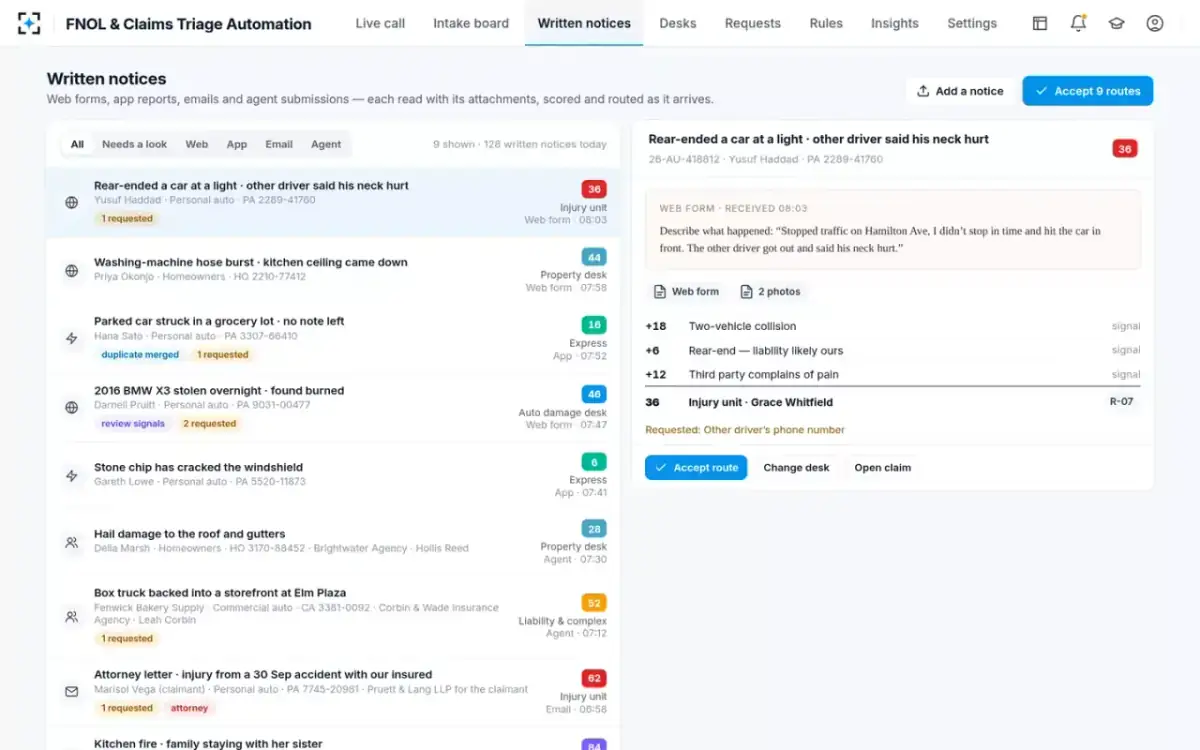
The last row is common enough that the sample carrier scores it. Among its morning's notices was an attorney letter, sent by email at 06:58, about an accident on 30 September involving an insured who had not reported it. The letter added +22 for representation and +10 because the insured had not reported, a score of 62, and it went to the Injury unit. A request for the insured's own account went out at 07:00 by text and email, with a call booked for 10:00 when he did not reply. For the carrier, a late report is a gap to close quickly; the insured's version still matters.
When the other side reports first: an attorney letter, scored and routed
Reporting an accident is not always filing a claim
Telling your insurer about an accident is not always the same as making a claim, and the difference has legal weight. California's claims regulation defines notice of claim as a notification that reasonably tells the insurer the claimant wishes to make a claim, and says the term "shall not include any written or oral communication provided by an insured or principal solely for informational or incident reporting purposes". An incident report satisfies the policy's duty to tell the insurer; it does not by itself start the insurer's claim clocks in California.
For a first-notice desk that creates a sorting job: is this caller reporting or claiming? The safe practice is to ask, and to note the answer. A caller who says "I just wanted you to know" about a minor scrape may later find damage the other driver will claim for. A notice taken as a report should still carry the date of loss, the parties and the police report number, so that a claim filed later starts from a complete file.
Do I have to report an accident to the DMV?
In some states, yes, and it is a separate duty from telling your insurer. California is a clear example: a driver, or their insurance agent, broker or legal representative, must send an SR-1 report to the DMV "within 10 days if someone is injured (no matter how minor the injury) or killed, or property damage is over $1000". The DMV is explicit that "An SR-1 report is required in addition to any other report made to the police, CHP, or your insurance company."
The SR-1 also asks for the other party's vehicle and insurance information, which is one more reason to collect it at the scene. Other states set their own thresholds and forms through their motor vehicle departments; a report to the police, the DMV and the insurer are three different things, and in California, at least, one does not satisfy another.
How long does an insurer have to acknowledge a claim?
In the rules shown here, an insurer has from 7 calendar days to 15 business days to acknowledge a claim once it receives notice, depending on the state and on how days are counted. The NAIC's model regulation says every insurer must acknowledge notice "within fifteen (15) days" unless it pays within that time. State rules vary around that number.
Days an insurer has to acknowledge a claim after notice
Acknowledging is more than saying "received". In California the same 15 days cover sending the forms and instructions the claimant needs and beginning any necessary investigation. In Pennsylvania, sending the claim forms, instructions and reasonable assistance within 10 working days counts as the acknowledgement. Several states also treat notice to the insurer's agent as notice to the insurer, so the clock can start before the claims department has the file.
What a first-notice desk owes a policyholder who reports
A first-notice desk owes every caller the same things whether the report is early or late: take the notice, acknowledge it, say what is needed and when, and route it to someone who can act. The date of loss and the date of notice both go on the file, because the policyholder's deadline is measured by one and the insurer's by the other. Refusing to take a notice because it seems late is not the desk's call; coverage and notice defences belong to the adjuster.
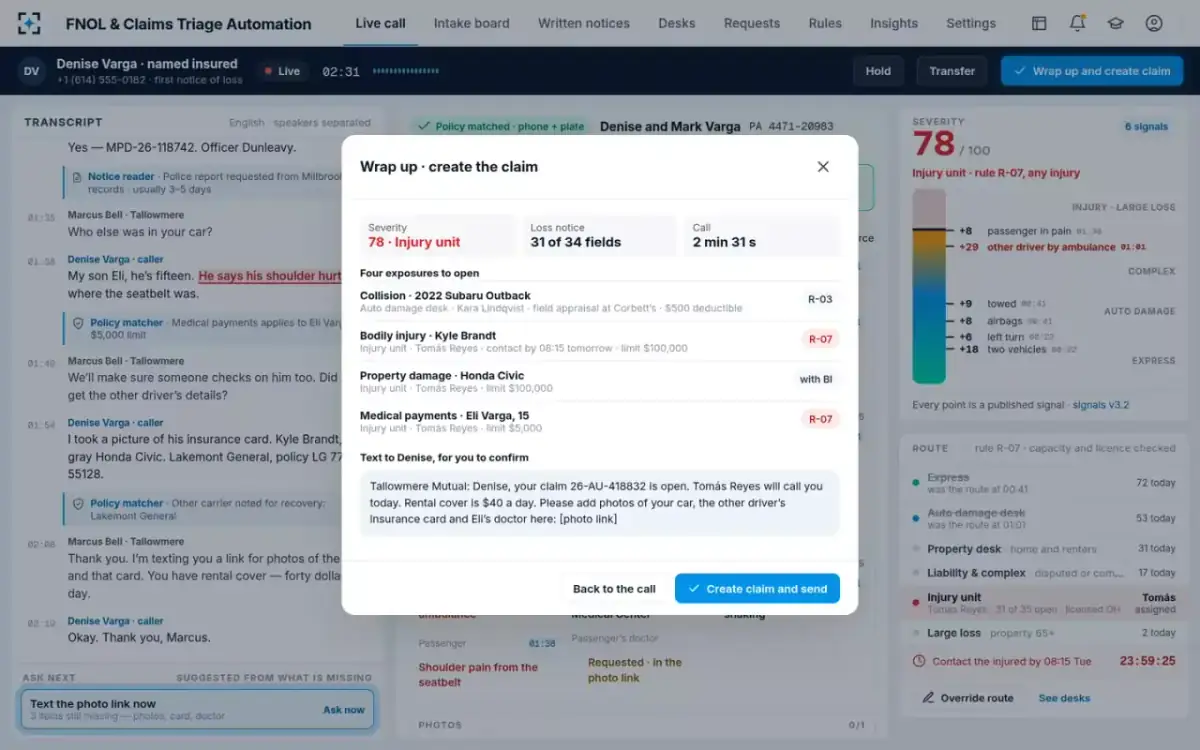
On the sample carrier, a claim is acknowledged during the call or within one business day, well inside every state window in the chart, and the text names the claim, the adjuster and what is still needed. The sample call's text went at 08:16, two minutes after the phone rang. How each of those minutes was used is traced in the claims FNOL process flow, and what the insurer's clocks cost when a notice waits is set out in why FNOL is important in claims processing.
An acknowledgement sent before the caller hangs up
What to have ready when you report an accident to insurance
- Your policy number, or the name on the policy
The phone number on your proof-of-insurance card is the fastest way in.
- Date, time and exact place
And the date you are reporting, if it is later.
- The other driver’s name, insurer and policy number
A photo of their insurance card is enough.
- Who was hurt, in either car, and where they went
Even if it seems minor; some benefits depend on early treatment.
- The police report number and officer, if police came
The report itself can take days to arrive.
- Photos of both cars and the scene
Taken before repairs or towing where it is safe to do so.
Questions people ask
How long do you have to report a claim?
As long as your policy's notice condition allows; read it for the exact words, which may not name a number of days. Some states set hard limits for particular claims: New York no-fault benefits need written notice within 30 days of the accident, and a Florida property claim must be reported within one year of the loss.
Is there a time limit on reporting an accident if no one was hurt?
The policy's notice condition still applies, and some states require a report to the motor vehicle department above a damage threshold. In California that threshold is property damage over $1,000, with the SR-1 due within 10 days. Reporting promptly also lets your insurer hear your account before any claim by the other driver.
Can an insurer deny a claim because it was reported late?
It can raise late notice under the policy, but state law may limit the defence. For liability policies issued in New York, late notice does not invalidate a claim unless it prejudiced the insurer, and if notice came within two years of the policy's deadline the insurer must prove that prejudice.
Does reporting an accident mean I have filed a claim?
Not necessarily. California's claims regulation excludes a communication made solely for informational or incident-reporting purposes from its definition of notice of claim. Tell the insurer clearly whether you want to make a claim, and ask it to note the date you reported either way.
How long does the insurer have to respond after I report?
In the rules shown here, from 7 calendar days to 15 business days to acknowledge, depending on the state: 7 calendar days for Florida property claims, 10 working days in Pennsylvania, 10 business days in Washington, 15 calendar days in California and 15 business days in New York. Further deadlines follow for investigating and deciding.