FNOL is important in claims processing because the first notice of loss starts the claim's clocks. The deadline to acknowledge it, to begin investigating, to accept or deny, to send a status letter and, in some states, to start paying interest all count from the day the insurer, or its agent, was told. None of them pauses while the claim waits in a shared inbox or sits on the wrong desk. A first notice that takes two days to reach the right adjuster has spent two days of every window before anyone with authority has read it. Botminds' FNOL & Claims Triage Automation exists to close that gap: it reads, sizes and routes each first notice as it arrives, so the clocks and the right adjuster start together.
The scale makes the point. NHTSA counted, for 2019, "36,500 people killed, 4.5 million people injured, and 23 million vehicles damaged in motor vehicle crashes in the United States." Most of those losses begin as a first notice somewhere. The examples below use a fictional carrier, Tallowmere Mutual, and its sample data; figures marked as targets are the solution's design goals, not a customer's results.
One sample carrier, the quarter before go-live and after
1.9days
median from first notice to the right desk, the quarter before (sample)
14min
the design target for the same measure with the solution
61%
of injury claims contacted within 24 hours before (sample); the target is 96%
1.6%
of 4,912 first notices moved after routing in 30 days (sample), from 11.8%
FNOL meaning in insurance: notice, not paperwork
FNOL stands for first notice of loss: the first time an insurer is told that a loss has happened and a claim may follow. In insurance terms what counts is the notice, not the form. California defines notice of claim as any written or oral notification that reasonably tells the insurer a claim is being made, and it bars an insurer from requiring written notice unless the policy says so. A phone call, an email, an app report or a word to the agent can each be the first notice.
That is why the first notice of loss is a legal event as well as an operational one. Ohio's regulation defines notification of claim as any notification under the policy "to an insurer or its agent, by a claimant, which reasonably apprises the insurer of the facts pertinent to a claim". From that moment, the insurer's obligations run. What happens inside the insurer next (whether the notice is read today or Thursday, whether it lands on the right desk) is invisible to the clock.
When does the claim clock start?
The claim clock starts at notice of claim in almost every acknowledgement rule, and increasingly for the investigation and decision too. Some decision clocks still count from proof of loss, but in every rule in the table the first clock starts at notice. The table lists the clocks a first notice starts in the NAIC's model and in five states.
Clocks that start when the insurer receives notice of a claim
| Rule | What must happen | Within | Counted from |
|---|---|---|---|
| NAIC Model 902 §6 | Acknowledge the notice | 15 days | Notification of claim |
| NAIC Model 902 §7B | Letter giving reasons more time is needed | 45 days, then every 45 | Initial notification |
| California 10 CCR 2695.5(e) | Acknowledge, send forms and instructions, begin any necessary investigation | 15 calendar days | Notice of claim |
| Ohio 3901-1-54(F) | Acknowledge the claim | 15 (calendar) days | Notification, including notice to an agent |
| New York 11 NYCRR 216.4 | Acknowledge the notice | 15 business days | Notification, including notice to an agent |
| Pennsylvania 31 Pa. Code 146.5 and 146.6 | Acknowledge; complete the investigation | 10 working days; 30 days | Notification (notice to an agent dates from the insurer’s receipt) |
| Washington WAC 284-30-360 to -380, as amended | Acknowledge; complete the investigation; tell a first-party claimant whether the claim is accepted or denied | 10 business days; 30 calendar days; 30 calendar days | Notification of claim |
| Florida 627.70131 (property) | Review and acknowledge; pay or deny; interest on late payment | 7 calendar days; 60 days | Receipt of the communication or notice of the claim |
Washington's 2026 amendment shows the direction one regulator has taken. Its decision clock used to run from proof of loss. As amended, it runs 30 calendar days from receipt of a notification of claim, by which time "the insurer must notify the first party claimant whether the claim has been accepted or denied". A first-party claim in Washington now has 30 days from the first call to a decision, and every day the notice spends unread comes out of those 30.
Notice to an agent is notice to the insurer
The clock can start before the claims department knows the claim exists, because in many states notice to an agent counts. Ohio, New York and Washington each say so in nearly the same words. California goes further: "Failure of an insurance agent or claims agent to promptly transmit notice of claim to the insurer shall be imputed to the insurer". A claim emailed to an agency on Friday evening and forwarded on Monday has, in effect, used three days of California's fifteen before the carrier opens it.
Pennsylvania is the exception that proves the rule: notification to an agent is notification to the insurer, "dating from the time the insurer receives notice". Even there the agent's delay is the policyholder's experience of the carrier. On the sample carrier's morning, 17 of 186 first notices came from agents, and one of them, a hail claim, arrived without a date of loss. The request went back to the agency at 07:31 and the answer came at 07:55. An agent channel read on arrival keeps those notices on the same clock as a phone call.
What does a misrouted claim cost?
A misrouted claim costs time first, and time turns into money along three lines: the regulatory windows, the daily costs the policy is paying, and the injured party's first day. No public source measures misrouting across carriers, so the figures below are the sample carrier's and Botminds' own estimate, and the arithmetic is ours. A carrier can rebuild it from its own files.
One auto first notice, by hand and with the solution, in hours
- Call and typing
- Waiting in a shared inbox to be assigned16 h
- Moving a misrouted claim to the right desk24 h
- A second call for photos and details8 h
- Call, notice, route and text
The regulatory line is the simplest. At the sample carrier's 1.9-day median, a misrouted or unassigned claim spends a measurable share of each window before the right adjuster sees it. On a Florida property claim that is more than a quarter of the 7-day acknowledgement window; on a California claim, about an eighth of the 15 days to acknowledge and begin investigating.
Share of each window spent before the claim reaches the right desk, at 1.9 days
The daily-cost line runs in parallel. A collision with rental cover pays for a car every day the repair waits, and the repair cannot start before an appraiser is assigned; the sample policy's rental is $40 a day. A car at a tow yard accrues storage, and Washington's amended rule now requires a first-party claimant to be given "a clear written explanation of how applicable storage and towing fees are covered under the policy within five business days of the notification of claim". For total losses, what a totaled car costs while it waits is priced line by line on a sibling solution's guide.
Interest from the day of notice
In Florida property claims, delay at first notice has a direct price. The statute requires an insurer to pay or deny within 60 days of notice of an initial, reopened or supplemental claim, and on late payment it says: "Interest begins to accrue from the date the insurer receives notice of the claim." The interest clock does not start when the adjuster is assigned or when the inspection is booked; it starts at first notice.
Florida is the sharpest example, not the only one. Every rule in the table above is measured against the date of notice, and an examiner reading a file will compare that date with the date of the first real action on it. The NAIC model regulation expects each claim file to be detailed enough to rebuild what the insurer did and when (Model 902, section 4), so a file that shows two quiet days after notice will show them to whoever reads it.
The injured party's first day
The delay that matters most to an injured person is the one between an injury being mentioned and an injury adjuster calling. None of the rules in the table above times it, which is why carriers set their own clocks. The sample carrier's injury unit works to 24 hours from the moment the injury is heard, and before go-live it reached 61% of injured parties within that window.
The persona behind the sample injury unit puts the reason bluntly: "If I hear about the ambulance on day three, the claimant already has a lawyer." That is a fictional adjuster's view, not a statistic, but the routing logic follows from it. On the sample call, the claim moved to the injury unit at 01:01, the second the caller said the other driver was taken by ambulance, and the 24-hour clock started then, not when someone read the notes. The first-notice timing for that call is traced in the claims FNOL process flow.
Routing to a desk is half of it: the adjuster needs room and a licence
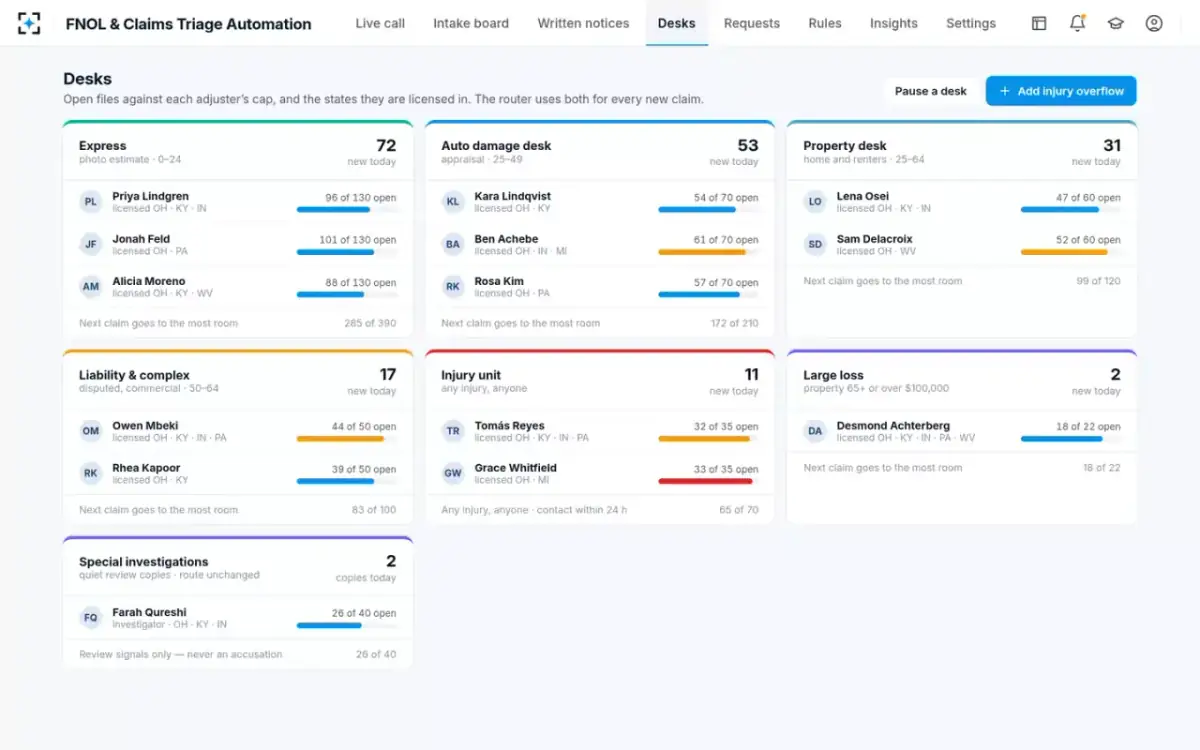
Why a fast first notice of loss is not enough on its own
A first notice taken fast and routed wrong is still a slow claim. The sample carrier's quarter before go-live shows the pattern: 11.8% of first notices moved desk after their first routing. Each move is a second queue, and the clocks above do not reset for it. After go-live, the sample figure was 1.6%: 4,833 of 4,912 notices over 30 days stayed where they were routed, and most of the moves were from Express to the Auto damage desk after photos showed hidden damage.
That move is worth understanding. A photo that shows more damage than the caller described is new information, not a routing error, and a good triage design expects some claims to move for that reason. The measure to watch is not zero moves but the moves the first notice could have prevented: an injury said on the call and missed, a commercial vehicle not recognised, a home that cannot be lived in routed as a small water claim. How to measure those before buying is set out in how to test claims triage solutions.
What a first notice of loss should leave behind
A first notice of loss done well leaves four things behind within the hour: the claim on the right desk, with an adjuster who has room and a licence; the acknowledgement sent and noted; the missing items requested; and a file that shows when each of those happened. On the sample call that took 2 minutes 31 seconds and two confirmations by the first-notice specialist. The text with the claim number, the adjuster's name, the rental cover and the upload link went at 08:16; the claim was created at 08:17.
Missing items asked for the same morning, with replies
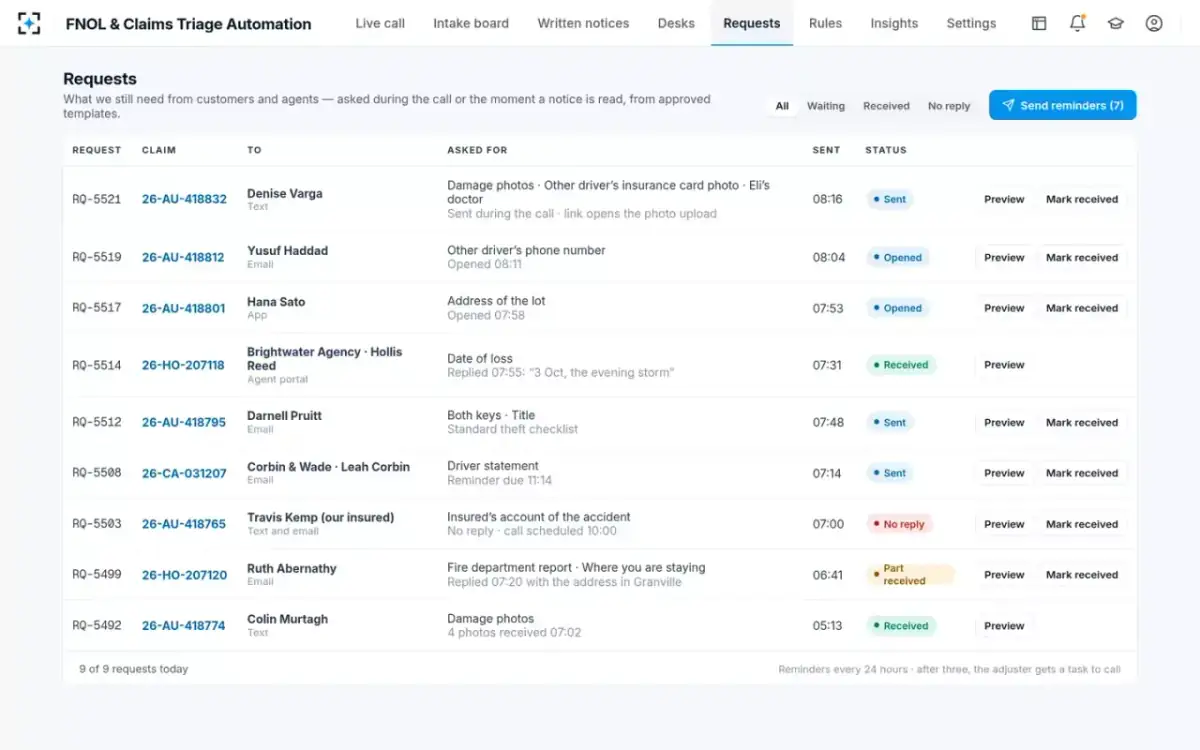
For the inputs a carrier needs to run first notice this way, see insurance FNOL automation: what a carrier brings on day one.
Questions people ask
What does FNOL stand for in claims?
First notice of loss: the first report to an insurer that a loss has happened. In claims it also names the intake process that turns that report into an assigned claim. Most acknowledgement deadlines count from it; California's, for example, is 15 calendar days.
What is a first notice of loss in insurance terms?
Any notice, written or oral, that reasonably tells the insurer or its agent the facts of a loss and that a claim may be made. California does not let an insurer insist on written notice unless the policy requires it. In Ohio, New York and Washington, notice to the insurer's agent counts as notice to the insurer.
When does the insurer's clock start on a claim?
At notification of the claim, for acknowledgement in every rule listed here, and for investigation in Pennsylvania and Washington. Since 18 October 2026, Washington also counts its 30-day accept-or-deny deadline for first-party claims from notification. Florida property claims accrue interest on late payment from the date the insurer receives notice.
How much does a misrouted claim cost?
No public source measures it across carriers. It costs time out of every regulatory window, daily costs such as rental and storage, and, for injuries, the first contact with the injured person. On the sample carrier, 1.9 days to the right desk was more than a quarter of Florida's 7-day property acknowledgement window.
Why does an injury change the importance of FNOL?
Because the first contact with an injured person shapes the rest of the claim, and no statute sets that clock for the carrier. The sample carrier sets its own: 24 hours from the moment an injury is heard, with a design target of 96% met against 61% before. The claim moves to the injury unit the moment the injury is mentioned.