A claims FNOL process flow is the sequence a carrier runs from the moment a loss is reported to the moment the claim sits with the right adjuster: identify the caller and the policy, capture the loss, size it, route it, acknowledge it and ask for what is missing. On paper the steps run in order. On a phone call they run at once, because the caller decides what comes out when, and the detail that should decide the route (an injury, a third car, a commercial vehicle) can come out at any second. Botminds' FNOL & Claims Triage Automation runs every step as the call happens, so the route can change mid-sentence, and keeps two steps for the first-notice specialist: confirming the claim and confirming every message before it is sent.
This guide follows one call on a fictional carrier, Tallowmere Mutual: Denise Varga, a policyholder, reporting a left-turn collision at 08:14 on Monday 12 October. The people, claims and times are sample data, not a customer's results.
The FNOL process flow on one call: six agents, one person
Agent
Call listenerTranscribes the call live, separates the two speakers and stamps each line with the call clock.
Never: Speaks to the caller.
Agent
Policy matcherMatches caller and plate to the policy; checks it was in force and paid on the date of loss; lists coverages.
Never: Confirms or denies coverage.
Agent
Notice readerFills the loss notice from what is said, each field with its call time; suggests the next question.
Never: Guesses a value; a gap stays empty and is asked for.
Agent
Severity scorerAdds published severity signals heard in the call, each with its reason and sentence.
Never: Decides fault or calls a claim fraudulent.
Agent
RouterApplies routing rules in order; picks the adjuster with room under their cap and a licence in the loss state.
Never: Assigns over an adjuster’s cap without the supervisor.
Agent
Follow-up writerDrafts the acknowledgement and the request for missing items from approved templates.
Never: Sends anything the specialist has not confirmed.
A person decides
First-notice specialistAsks the questions, then confirms the claim with its exposures and confirms the text. Nothing is created or sent before both.
What is FNOL in claims?
FNOL, the first notice of loss, is the first report to an insurer that a loss has happened, and in claims it also names the process that turns that report into an assigned claim. Its importance is legal as much as practical: the rules on acknowledging, investigating and deciding a claim count from notice. California requires an insurer, within 15 calendar days of notice of claim, to acknowledge it, send forms and instructions, and "begin any necessary investigation of the claim". Whatever the FNOL process does in its first minutes is done inside that window.
The process has two halves. Intake captures the claim: who, which policy, what happened. Triage decides what kind of claim it is and where it goes: express photo estimate, an appraiser, the property desk, the liability desk, the injury unit, large loss. Where intake and triage are separate teams, the halves run in sequence, with intake on the phone and triage later from a queue. The trace below runs them together, which is the design choice the rest of this page tests.
The claims FNOL process flow in ten timed steps
The FNOL steps on the sample call came in ten moments over 151 seconds, each one written to the claim's run log with its call time. The table is that log in plain words. Read down the time column and the order is the caller's, not a flow chart's: the policy at 7 seconds, the first route at 22, a new route at 41, and the route that held at 61.
FNOL steps on one call, from the claim's run log
| Call time | Who | What happened |
|---|---|---|
| 00:00 | Call listener | Transcript starts: English, two speakers separated, every line stamped with the call clock. |
| 00:07 | Policy matcher | Caller phone and plate match policy PA 4471-20983, in force on the date of loss and paid to 1 November; coverages and limits shown. |
| 00:22 | Notice reader · Severity scorer | 14 fields from the first account; +18 two vehicles, +6 left turn across traffic: score 24, Express. |
| 00:41 | Notice reader · Severity scorer · Router | Airbags, not drivable, towed to Corbett’s: +8, +9, score 41, Auto damage desk, Kara Lindqvist (54 of 70 open). |
| 00:43 | Notice reader | Suggests the next question from what is empty: "Was anyone hurt, in either car?" |
| 01:01 | Severity scorer · Router | "The other driver was taken by ambulance": +29, score 70; rule R-07 moves the claim to the Injury unit, Tomás Reyes (31 of 35, licensed in Ohio); 24-hour contact clock starts. |
| 01:26 | Notice reader | Police report number and officer captured; the report requested from the police records unit. |
| 01:38 | Severity scorer · Policy matcher | Passenger, 15, has shoulder pain: +8, score 78; medical payments ($5,000) noted for him. |
| 01:54 | Notice reader · Policy matcher | Other driver, vehicle, carrier and policy read off his insurance card; the other carrier noted for recovery. |
| 02:31 | Follow-up writer · specialist | Wrap-up: four exposures and a text drafted; the specialist confirms both. Text sent 08:16, claim created 08:17. |
00:00 to 00:14: who is calling, and which policy
The first step is identification, and it should take seconds, not a search. The sample call rang with a caller ID that matched a policyholder. Seven seconds in, the policy matcher had a second key, the plate, and showed the policy: personal auto in force from 1 March 2026 to 1 March 2027, paid to 1 November, one prior glass claim, bodily injury limits of 100/300, collision with a $500 deductible, rental at $40 a day and medical payments of $5,000.
Two keys is a deliberate rule. A phone number alone can belong to a relative on another policy, and a wrong match fills the notice with the wrong coverages, which an adjuster may not notice until the first payment. The match also does not decide anything: it lists the coverages that may apply. At 00:14 the specialist could say "I have your policy here. Tell me what happened, in your own words", which is the line a caller needs to hear first.
00:22 to 00:43: the first account, scored at 41
The caller's first account, at 00:22, carried most of the loss: a left turn from Route 61 on the yellow arrow, a car coming the other way, damage to the front passenger side. The notice reader filled 14 fields from that one paragraph. The severity scorer heard two signals, a two-vehicle collision (+18) and a left turn across traffic (+6), and the score of 24 put the claim in the Express band for a photo estimate.
00:43: score 41, Auto damage desk, and the question nobody has asked yet
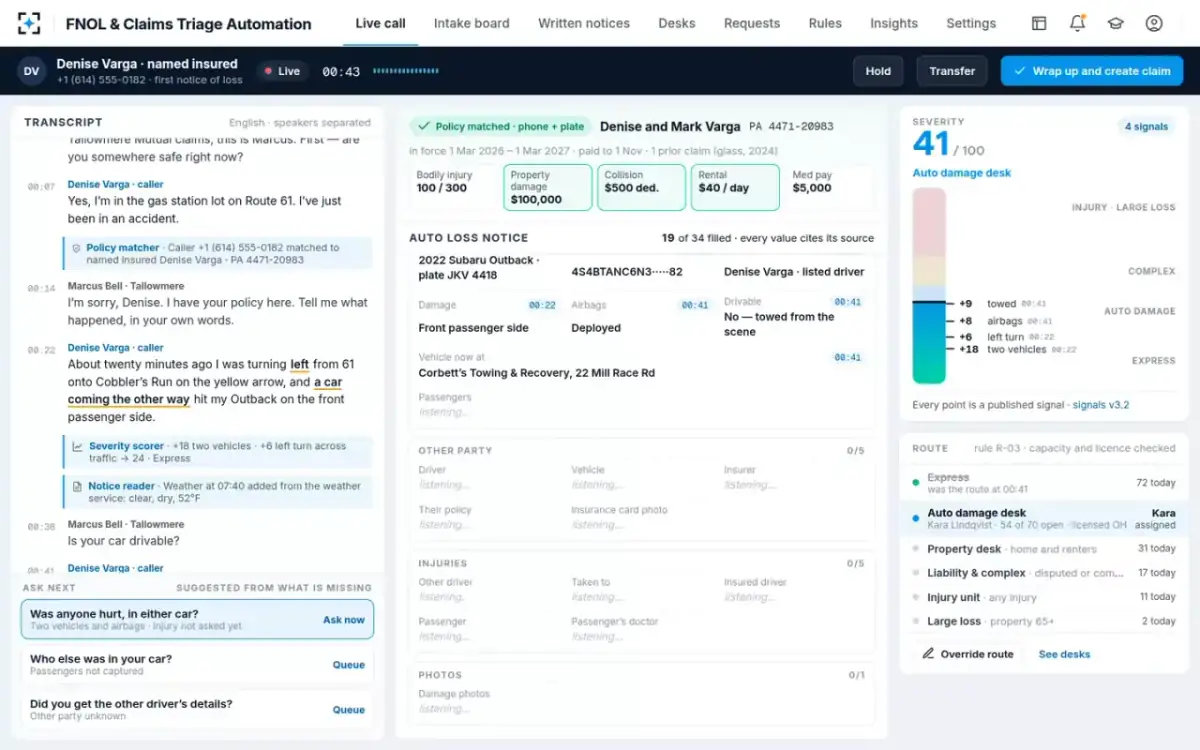
At 00:38 the specialist asked whether the car was drivable. The answer added two more signals, airbags deployed (+8) and not drivable, towed (+9), and the location of the car, Corbett's Towing & Recovery. The score rose to 41 and the router moved the claim from Express to the Auto damage desk, choosing Kara Lindqvist, who had 54 of 70 files open and a licence in Ohio.
Two routes in twenty seconds is not noise. It is what triage looks like when it runs on what has been said so far, and it is why the route is shown to the specialist but nothing is created until wrap-up. A process that routed at 00:22 and stopped listening would have sent an airbag collision to a photo estimate.
01:01: the sentence that moves the claim, and how claims triage works
Claims triage works by adding up severity signals in what was said and then applying routing rules in a fixed order, and on this call one rule overrode the score. The specialist asked the suggested question at 00:55. At 01:01 the caller said the other driver "was taken by ambulance". The scorer added 29 points and the score went to 70, but the score was not what moved the claim: rule R-07 sends any injury, to anyone, to the Injury unit, whatever the score. The router struck the Auto damage desk, chose Tomás Reyes in the Injury unit, and started a 24-hour clock to contact the injured driver.
"Any injury to anyone — always."
The routing rule on the sample carrier's rules screen
The ordering is the point. A score blends many signals and can be argued with; a rule that any injury goes to the injury desk cannot be outvoted by a low score. On the same morning a web-form notice scored 36 (two vehicles, a rear-end collision, a third party complaining of pain) and went to the Injury unit under the same rule. The rules are applied in order, R-01 to R-08, and R-07 always wins.
01:01: one sentence, three changes on screen
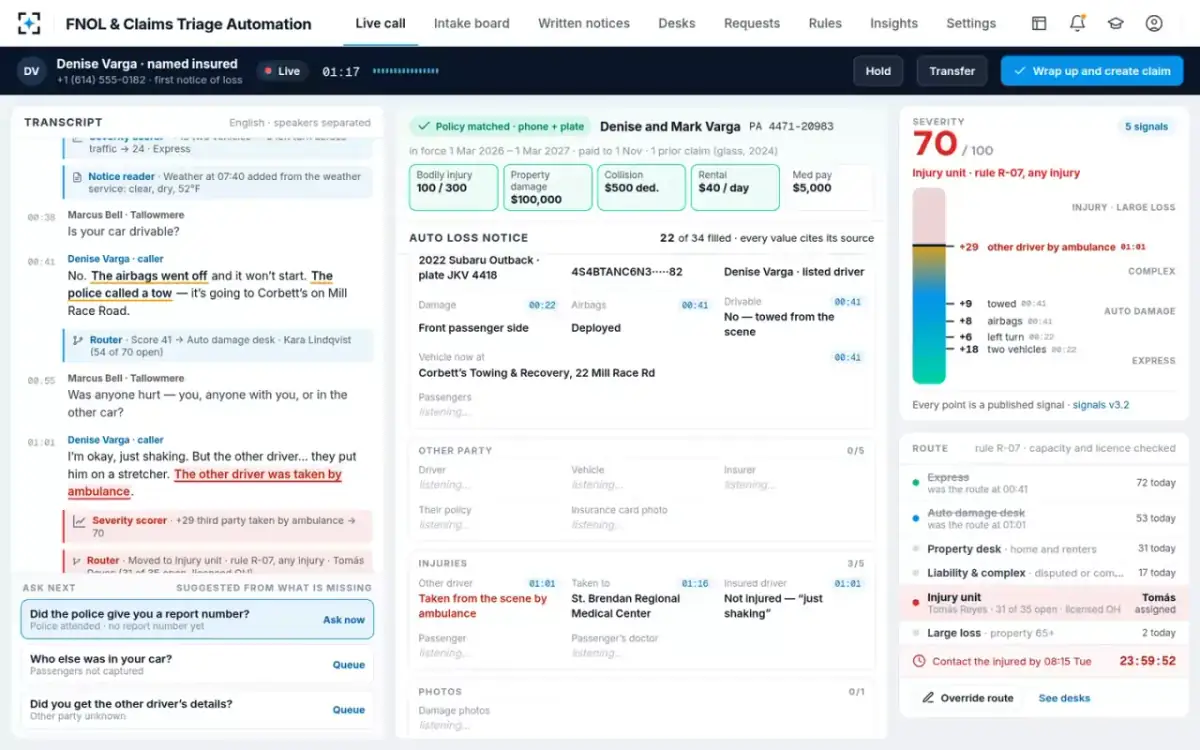
Where the claim was routed, second by second, until the specialist confirmed
- No route yet0–22 s
- Express19 s
- Auto damage desk20 s
- Injury unit (R-07)90 s
- Score 00–22 s
- Score 2419 s
- Score 4120 s
- Score 7037 s
- Score 7853 s
01:16 to 02:20: finishing the notice while the caller is still on the line
After the route, the call is about completeness. The caller said where the other driver was taken (St. Brendan Regional Medical Center, 01:16), gave the police report number and officer (01:26), mentioned that her 15-year-old son's shoulder hurt (01:38, +8, score 78), and read the other driver's name, car, carrier and policy off his insurance card (01:54). The policy matcher noted that medical payments applied to her son and that the other carrier was a recovery source.
The prompts then turned to what was still missing: photos of the car, a photo of the other driver's insurance card and the son's doctor. At 02:08 the specialist told the caller a link was on its way and that her rental cover was $40 a day. Three items that would usually need a second call were requested before the first one ended. The detail of what each field holds and where it came from is set out in the automobile loss notice form, field by field.
2 minutes 31 seconds: the two FNOL steps a person owns
At wrap-up the specialist owns two steps: confirming the claim with its exposures, and confirming the message to the customer. The wrap-up window proposed four exposures (collision on the insured's car with the Auto damage desk; bodily injury and property damage for the other driver, and medical payments for the son, all with the Injury unit) and the text: claim number, who will call today, the rental cover and the upload link. Nothing existed until the specialist clicked. The text went at 08:16; the claim was created at 08:17.
Why keep people at exactly these two points? The claim is the carrier's first act on the policyholder's behalf, and the text is the carrier speaking to her; both are what a regulator, a court or the customer will read later. Everything before them is a proposal that can be corrected; these are commitments. The NAIC's model regulation asks that each claim file contain "Detailed documentation" so as to "permit reconstruction of the insurer's activities relative to each claim", and Ohio's rule puts it as "An insurer must be able to reconstruct its activities in regard to any claim". A run log with a call time on every step, ending in a named person's confirmation, is that reconstruction.
What happens after FNOL?
After FNOL, the assigned adjuster contacts the parties, the vehicle is inspected, and the investigation runs toward a decision, each on a clock that started at notice. On the sample claim, the injury adjuster's 24-hour contact clock was already running at 01:01, and the collision exposure was set for a field appraisal at the tow yard. The state clocks that follow notice are short.
New York, for example, gives an insurer "six business days following receipt of notice of claim to inspect the insured's damaged motor vehicle" on a first-party auto physical damage claim. Pennsylvania requires that "Every insurer shall complete investigation of a claim within 30 days after notification of claim, unless the investigation cannot reasonably be completed within the time." Washington, since 18 October 2026, requires the insurer at notification to tell the claimant of the right to request an in-person inspection of the vehicle (WSR 26-17-089). Each of those clocks is already counting when the claim reaches its desk, which is why a misrouted first notice costs days the rules do not give back.
Where a claims process flow chart breaks in practice
A process flow chart breaks at the hand-offs, and the sample call shows where each one sits. A typical claim process flow chart draws intake, triage and assignment as separate boxes with arrows between them. Each arrow is a queue. If triage reads the notice after the call, the injury said at 01:01 waits for someone to read it. If assignment happens from a shared inbox, the claim waits for a supervisor. If the request for photos is a second call, it waits for the customer to answer.
Five hand-offs to check on your own FNOL process
- Is the policy identified on two keys before the account starts?
A single-key match can attach the wrong coverages to the notice.
- Does the score update as the call goes on, or once at the end?
On the sample call the route changed three times in 39 seconds.
- Can any rule override the score?
An injury to anyone should route to the injury desk whatever the score; test it with a low-scoring injury.
- Is the adjuster chosen with their open files and state licence in view?
Routing to a desk is not the same as reaching an adjuster who can take the claim.
- Are missing items asked for before the call ends?
A second call for photos is a queue of its own, and the customer sets its pace.
Written notices go through the same flow without the conversation: the notice reader fills the notice from a web form, an app report, an email or an agent's submission and its attachments, and the same score and rules apply. Whether a triage design catches injuries reliably is a question for testing, not for a flow chart; how to test claims triage solutions with planted injuries sets out a method.
Questions people ask
What are the FNOL steps?
Identify the caller and the policy, capture the loss, size it, route it to a desk and an adjuster, acknowledge it and ask for what is missing. On the sample call they overlapped: the policy was matched at 7 seconds and the route changed three times before the caller hung up. A person confirmed the claim and the message at the end.
What does an FNOL step definition include?
For each step, define who does it, what it produces and what it may never do. On the sample carrier, the policy matcher lists coverages but never confirms them, the scorer never decides fault, and the router never assigns over an adjuster's cap without the supervisor. Those limits are as much part of the definition as the output.
How long should the FNOL process take?
No public source sets a standard duration for the call itself, and we do not quote one. The regulatory windows are what count: in California the insurer has 15 calendar days from notice to acknowledge, send forms and begin investigating. The sample carrier's design target is 14 minutes from first notice to the right desk, from about two days by hand.
Does the claims process flow differ for written notices?
The steps are the same, but the account arrives complete and in the writer's order, with attachments. On the sample morning a web form scored 36 and still went to the Injury unit because the other driver said his neck hurt. Missing items, like the other driver's phone number, are asked for the moment the notice is read.
Who decides coverage in the FNOL process?
The adjuster, after the claim is assigned. In the sample flow the policy matcher shows the policy, whether it was in force and paid on the date of loss, and the coverages that may apply, and nothing more. Fault, reserves and payment also stay with the adjuster.