Insurance FNOL automation takes a first notice of loss, by phone, web form, app, email or agent, and turns it into a structured claim on the right desk without anyone retyping it. To do that it needs five things a carrier already owns: access to the conversation or the written notice, read access to the policy and billing systems, the carrier's routing rules, the list of desks and adjusters with their caps and licences, and the templates for the messages a customer receives. Botminds' FNOL & Claims Triage Automation is built from exactly those inputs. The one buyers most often underestimate is the routing rules, because in some claims departments they live in supervisors' heads rather than on paper.
This guide is for the claims IT lead, the project manager and the claims operations owner who will be asked "what do you need from us?" Examples come from the solution on a fictional carrier, Tallowmere Mutual, with sample data; the legal points come from statute and regulation, linked where they appear.
What one sample carrier's setup comes to
34
loss-notice fields on its auto notice, in six sections
8
routing rules, applied in order, R-01 to R-08
6
desks, plus a special investigations queue for quiet copies
2
languages for transcripts, prompts and messages: English and Spanish
What insurance FNOL automation does, and the scope to agree first
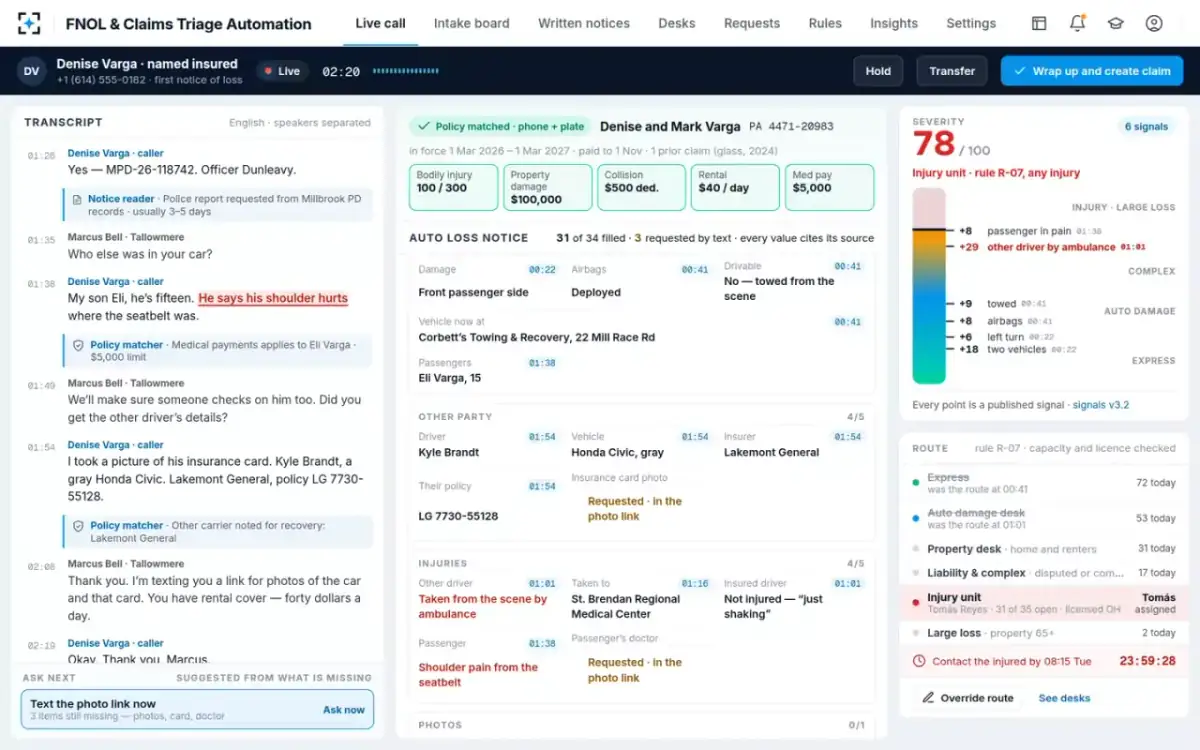
FNOL automation listens to or reads the first notice, fills the loss notice with each value tied to its source, matches the policy, scores severity, routes the claim to a desk and an adjuster, and drafts the acknowledgement and the request for anything missing. In the solution those are six agents: the call listener, the notice reader, the policy matcher, the severity scorer, the router and the follow-up writer. A first-notice specialist confirms the claim and every message before anything is created or sent.
The scope to agree before any data moves is what the automation will not do. The solution never confirms or denies coverage, never decides fault, never calls a claim fraudulent, and never sends a message or assigns over an adjuster's cap without a person. Those limits change the inputs: a tool that decides coverage needs policy forms and endorsements interpreted; one that only lists coverages needs a read of the policy's coverage lines and limits. Writing the limits down first keeps the input list short.
What data do you need to automate FNOL?
You need nine inputs, and for each a minimum that is enough to start and an ideal that is worth reaching. The table sets them out with the owner who usually holds them. None requires new data collection; all of it exists somewhere in a working claims department.
FNOL automation inputs: the minimum to start, the ideal, and who owns each
| Input | Minimum to start | Ideal | Usually owned by |
|---|---|---|---|
| Your loss-notice fields | The fields your adjusters need today, by line | Mapped to your claims system, with which ones are required to open each exposure | Claims operations |
| Routing rules | The rules your supervisors apply now, written as if-then lines in order | Each rule with its reason, the desk it sends to, and which rules override the score | Claims operations director |
| Severity signals | A starting set: injury, vehicles, airbags, tow, commercial vehicle, attorney | Your own signals and weights, tried on last week’s notices before approval | Claims operations director |
| Desks and adjusters | Desk names and who sits on each | Each adjuster’s cap on open files and the states they are licensed in | Intake supervisor |
| Policy and billing lookups | Read access: policy by phone, plate, name or address; in force and paid on a date; coverages and limits | Prior claims and the other party’s carrier for recovery | Policy administration owners |
| Call audio | A live stream from the claims line, or recordings for a first replay | Both speakers separated, with your recording announcement | Telephony and compliance |
| Written channels | The claims mailbox and web form | App, agent portal and attachments: photos, police reports, repair quotes | Digital and agency teams |
| Message templates | Your current acknowledgement and missing-items letters | Text and email versions, in each language you serve | Compliance and customer experience |
| State clock table | The acknowledgement rule for each state you write | Each rule with its citation and how days are counted | Compliance |
Two inputs deserve early attention. The first is adjuster capacity: some desks assign by habit, and a cap on open files per adjuster has never been written down. The second is the state clock table. Claims departments know their acknowledgement deadlines, but not every one keeps them as a table with the citation and the counting rule, and the counting rule differs: California counts 15 calendar days, New York 15 business days, Pennsylvania 10 working days.
Write the routing rules down first
Routing rules are the input that decides whether FNOL automation works, and often the one that has to be written from scratch. A supervisor who has assigned claims for years can apply dozens of rules without naming them. Automation cannot apply a rule nobody has written, and it will apply a badly written one consistently, on every claim.
Write each rule as a line with a condition, a destination and an order. The sample carrier has eight. Auto claims scoring up to 24 with no injury go to Express for a photo estimate (R-01); glass-only claims go to a glass partner (R-02); auto claims scoring 25 to 49 with no injury go to the Auto damage desk (R-03); home and renters claims scoring 25 to 64 to the Property desk (R-04); higher-scoring auto claims, or any commercial vehicle, to Liability & complex (R-05); property scoring 65 or more, or with an estimate over $100,000, to Large loss (R-06). R-07 sends any injury to anyone to the Injury unit, and it always wins. R-08 sends a quiet copy to special investigations when review signals are present, leaving the route unchanged.
Eight rules in order, and a way to test a change before it goes live
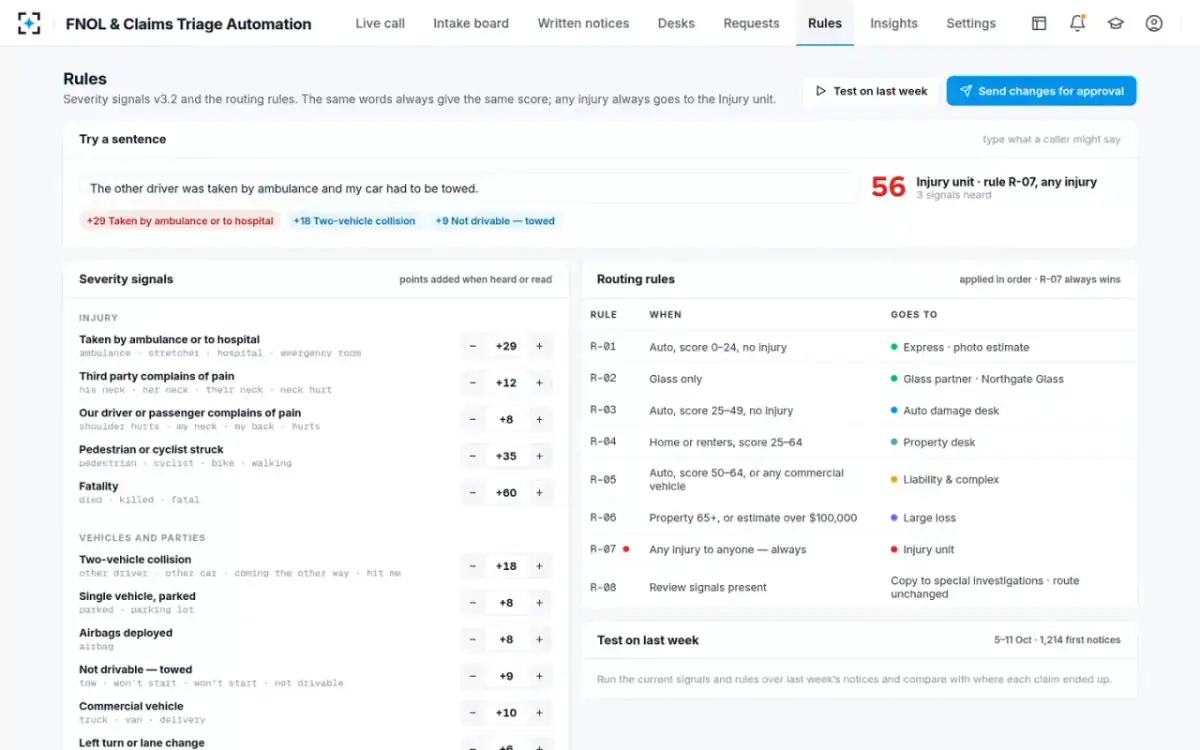
Then test the rules on notices you already have. The sample carrier replays any change on the previous week's first notices before sending it for approval. One example from its screens: a drafted rule to send any pedestrian or cyclist struck straight to the Injury unit would have changed nothing on the 1,214 notices of the week before, because both cyclist claims had already reached the Injury unit through R-07. That is a useful result. It shows the new rule is redundant today and protective tomorrow, and the director can approve it knowing its effect.
Desks, caps and licences: the router's other inputs
Routing to a desk is half the job; the other half is choosing the adjuster, and that needs two inputs: open files against a cap, and licences by state. The sample router picks the adjuster on the chosen desk with the most room under their cap and a licence in the loss state. An assignment over the cap needs the intake supervisor's approval, and a desk can be paused.
Caps and licences: what the router reads for every new claim
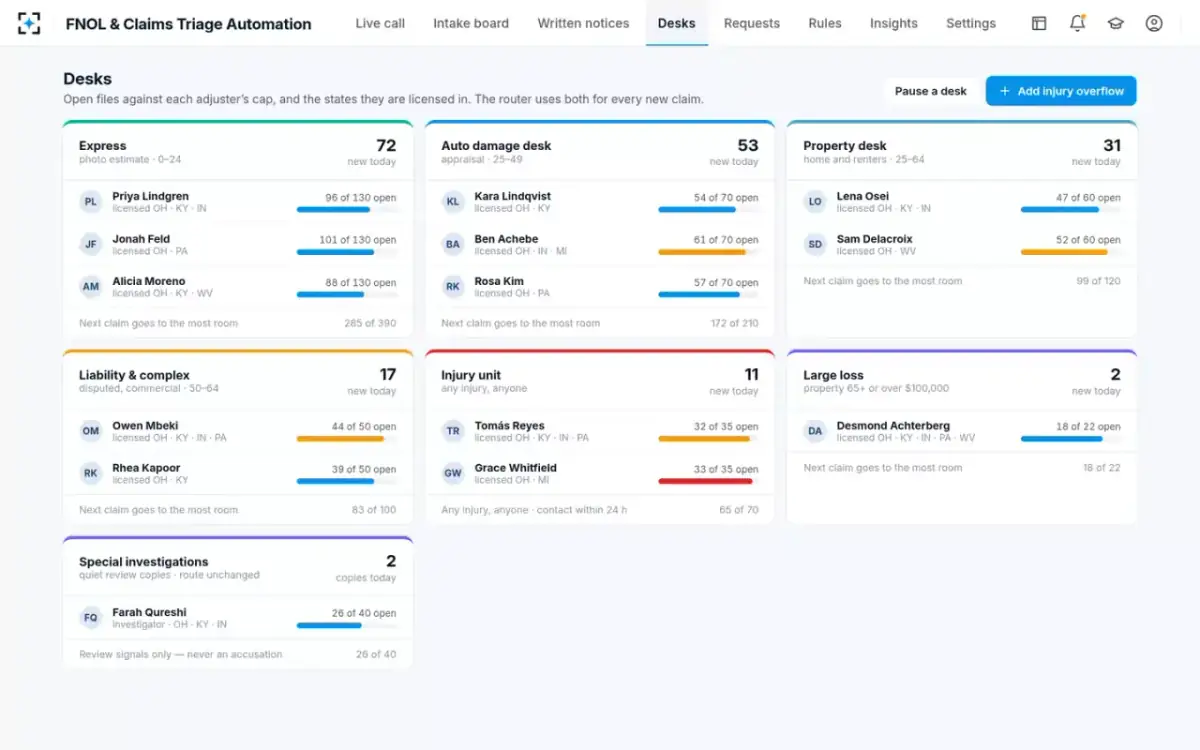
The data usually exists in pieces. Caps live in a supervisor's spreadsheet; licences live with compliance; open-file counts live in the claims system. Bringing them together is a day-one task, and it often surfaces something useful on its own: an adjuster licensed in four states and assigned claims from one, or a desk whose cap has not changed since it had twice the staff.
Can you record a claims call for FNOL automation?
Yes, with the consent the law requires, and that depends on the state. Federal law allows recording where a party to the call consents: it is not unlawful to intercept a call "where one of the parties to the communication has given prior consent to such interception" (18 U.S.C. 2511(2)(d)). Some states require every party's consent. Washington's statute bars recording a private telephone call "without first obtaining the consent of all the participants in the communication".
Washington also shows how a claims line meets an all-party rule: consent is considered obtained when one party announces that the call is about to be recorded, and "PROVIDED, That if the conversation is to be recorded that said announcement shall also be recorded." In practice, a recorded announcement at the start of the claims call, where the carrier plays one, is the input the call listener needs. Check it with counsel for every state you write, and make sure live transcription is covered by the same notice as recording. The solution's call listener stops when the call ends and never speaks to the caller.
Can FNOL automation read photos and police reports?
Yes: reading attachments is part of the notice, and software reading images of damage is not new. The Bureau of Labor Statistics notes that "computer software can evaluate photographs of damaged property and calculate an estimated claim amount". In the solution, the notice reader reads photos, police reports and repair quotes attached to written notices or uploaded after a call, and ties each value it takes from them to the page or photo.
Two limits apply. Reading a photo to fill a field is not an estimate; damage valuation belongs to the appraiser. And a photo request must never become the only door. Washington's amended motor-vehicle rule says "Insurers must not require any claimant or the claimant's repair facility to solely use an internet-based application as the platform to provide claim related information." The upload link is an option alongside email, post, fax and delivery in person, and the automation must read what arrives through each.
The claims intake workflow, before and after the automation
The claims intake workflow does not change its steps; it changes who does them and when. The comparison below is the sample carrier's, but most desks will recognise the left column.
Claims intake and workflow on one auto first notice
By hand: Searched in a second window while the caller talks.
With FNOL automation: Matched on two keys in the first seconds; coverages and limits shown.
By hand: Typed from memory and notes, in the screen’s order.
With FNOL automation: Filled as it is said, each value with its call time.
By hand: Judged by the representative or a supervisor later.
With FNOL automation: Scored from published signals, each with its sentence.
By hand: Assigned from a shared inbox, often the next day.
With FNOL automation: Routed by rules in order, to an adjuster with room and a licence.
By hand: A second call or letter once the adjuster starts.
With FNOL automation: Requested by text or email before the call ends.
By hand: Implicit; the claim exists once typed.
With FNOL automation: Explicit; the specialist confirms the claim and every message.
Templates and the acknowledgement: the words the customer reads
Message templates are a compliance input, not a design task, because the acknowledgement is a regulated act. The NAIC's model regulation says "Every insurer, upon receiving notification of a claim shall, within fifteen (15) days, acknowledge the receipt of such notice unless payment is made within that period of time." Bring the letters you send today; the follow-up writer drafts from them, in the customer's language, with one link for every missing item, and never promises coverage or payment.
The sample text reads: "Tallowmere Mutual: Denise, your claim 26-AU-418832 is open. Tomás Reyes will call you today. Rental cover is $40 a day. Please add photos of your car, the other driver's insurance card and Eli's doctor here: [photo link]". It names the claim, the person, one coverage fact from the policy and the three missing items, and it went only after the specialist confirmed it. Reminders follow every 24 hours, and after three the adjuster gets a task to call.
Day-one checklist for an insurance FNOL automation project
- Write the routing rules as numbered lines, in order
Condition, destination, reason. Mark the ones that override the score.
- List desks, adjusters, caps and state licences in one table
Who may take what, and how many.
- Export last week’s first notices with where each ended up
The replay set for every rule change, and the first test.
- Confirm the recording and transcription announcement per state
With counsel, before any live call is streamed.
- Collect the acknowledgement and missing-items templates
In every language you serve, with compliance sign-off.
- Build the state clock table with citations
Acknowledgement deadline and how days are counted, for each state you write.
- Name the approvers
Who confirms claims, who approves overrides, who approves rule changes.
How long to implement FNOL automation, honestly
How long it takes depends on the inputs above, not on the software; we do not quote a number of weeks that a carrier's own rule-writing will decide. The sequence that works is fixed, though. Start by replaying last week's written notices and recorded calls through the rules, compare the solution's desk with where each claim ended, and fix the rules until the disagreements are explained. Then switch on one channel live, with the specialist confirming every claim, and measure first desk against final desk every week.
The governance work runs alongside. The NAIC's model bulletin on AI asks insurers to govern AI systems they use, including those from vendors, and the documentation of rules, approvals and test results is what that program draws on. Washington's 2026 rule names the trend directly: the commissioner noted that "the insurance industry is changing their claim process from an in-person, on-site, loss examination to the use of artificial intelligence and photo-based loss adjusting to maximize efficiencies". A carrier that can show its rules, its tests and its approvals is answering that concern before it is asked. The test design to use before switching on is set out in how to test claims triage solutions; the vendor questions are in FNOL software: 15 questions to ask before you buy.
Where FNOL automation does not fit
FNOL automation fits a carrier that takes first notices across several channels and routes them to more than one desk. It fits badly in three cases. Where the claims line cannot share audio or recordings, the call half has nothing to listen to; written notices can still start alone. Where routing is entirely by line of business with no severity distinction, there is little to triage, and the value is in the notice and the requests rather than the route. And where a carrier wants the first notice to settle claims on its own, it wants a different tool: in this design every payment, like coverage and fault, stays with the adjuster.
What the inputs produce: a filled notice before the caller hangs up
Questions people ask
What is FNOL automation?
It is software that turns a first notice of loss, from a call, web form, app, email or agent, into a structured claim without retyping, then sizes it and routes it to the right desk. In the solution described here it also drafts the acknowledgement and the request for missing items. A person confirms the claim and every message before either is created or sent.
Does FNOL automation need access to the claims system?
Read access is enough to start: prior claims on the policy and open files per adjuster. Writing the new claim and its exposures into the claims system comes once the specialist confirms each claim. The sample carrier's claims open with four exposures from one call, each with the adjuster who handles it.
Does FNOL automation work in Spanish?
It should, if your callers speak Spanish, and it should be tested separately. The sample carrier's transcripts, prompts and messages run in English and Spanish. Test injury mentions in Spanish as their own group, because a pass in English says nothing about them.
Can you record a claims call without telling the caller?
Not in an all-party consent state. Federal law allows recording where one party consents, but Washington, for example, requires every participant's consent, which an announcement at the start of the call can satisfy if the announcement itself is recorded. Check every state you write with counsel.
Who should own an FNOL automation project?
Claims operations, with IT, compliance and the intake supervisor as named owners of their inputs. The routing rules, signals and clocks are claims decisions; the sample carrier lets only its director of claims operations approve changes to them. IT owns the connections; compliance owns the templates and the state clock table.