An automobile loss notice form is the first notice of loss for a car claim: who is reporting, which policy, what happened, where and when, the vehicles, the other party, any injuries and the photos. Whether it is a paper form, a web form or a screen a claims-line representative fills in, it is the document every later decision rests on, from the desk the claim goes to and the first injury call to the subrogation demand months later. The hard part is not the list of fields. It is that a caller tells the story in her own order, and each value has to come from somewhere a reviewer can check. Botminds' FNOL & Claims Triage Automation fills the notice while the customer talks and ties every value to the sentence, page or photo it came from.
The examples below follow one call through the solution: a left-turn collision reported to Tallowmere Mutual, a fictional carrier, by a fictional policyholder. Every figure describing that call is sample data, not a customer result. The rules come from state regulators, the NAIC and NHTSA, linked where they appear.
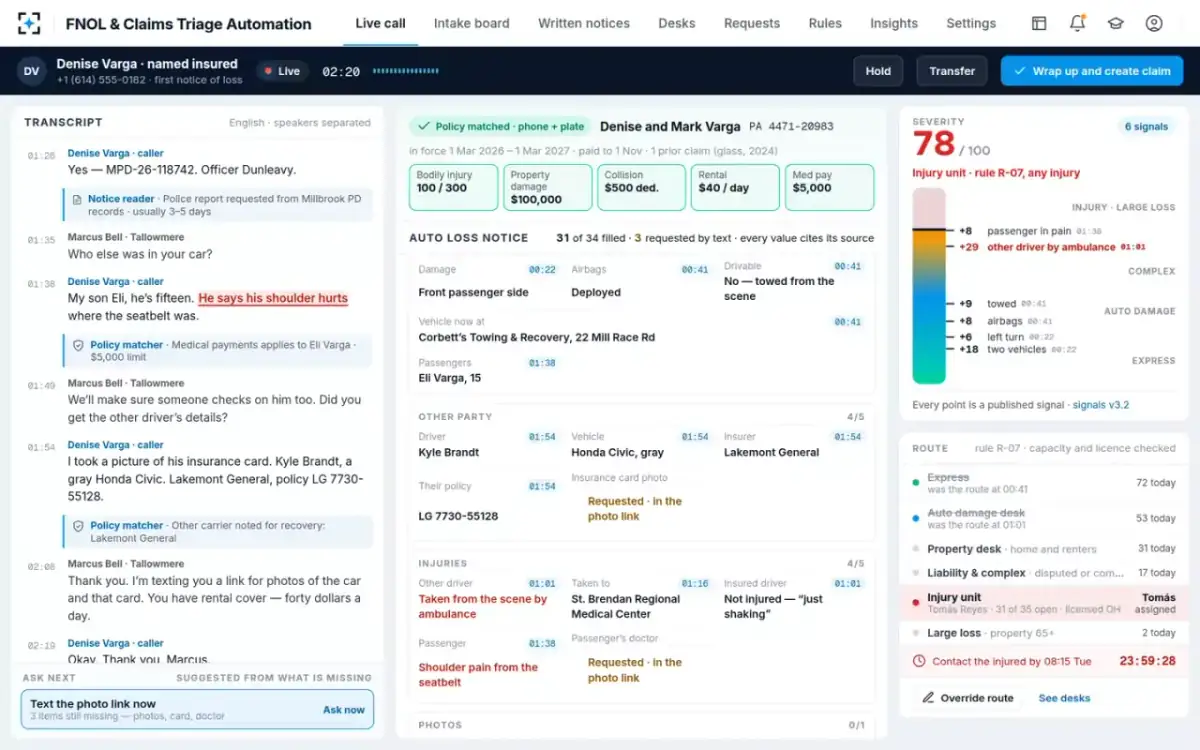
One auto loss notice, filled during a 2-minute-31-second call
34
fields on the sample auto loss notice, in six sections
31of 34
filled before the caller hung up, each stamped with its call time
3
still missing, requested by text during the call
7s
into the call when the policy was matched by phone and plate
What is an automobile loss notice form?
An automobile loss notice is the carrier's structured account of a car accident or other auto loss, opened the moment the carrier is told. It is not proof of loss and it is not a coverage decision. It is the list of what the carrier knows on day one, and the starting line for the rules that follow: California, for example, gives an insurer "in no event more than fifteen (15) calendar days" from notice of claim to acknowledge it, send forms and instructions, and begin any necessary investigation.
The industry's standard paper version is ACORD 2, the Automobile Loss Notice; ACORD 1 is the property counterpart. Carriers also take first notices on their own phone, app and web screens, and those screens carry the carrier's own field list. The sample carrier's notice has 34 fields in six sections, which is close to what a loss notice needs to route a claim and open its exposures, and far short of what an adjuster will eventually collect.
The notice also starts other people's work. A field appraiser needs the vehicle's location and drivability. An injury adjuster needs to know who was hurt and where they were taken. A recovery specialist needs the other driver's carrier and policy. A notice that captures those three things on the first call saves three follow-up calls, and the sample carrier's notice is built around exactly that.
What information is needed to file a car insurance claim?
To file a car insurance claim a policyholder needs the policy or the insured's name, the date, time and place of the accident, a short account of what happened, the vehicles involved, the other driver's name, insurer and policy, any injuries, and the police report number if police came. The NAIC's consumer guide adds the other car's make, model, year and plate, witnesses' contact details, the officer's name and badge number, road and weather conditions, and a photo or sketch of the scene (NAIC, "What You Should Know About Filing an Auto Claim").
The state's own accident form asks for much the same. California's DMV tells drivers to gather their licence, plate or VIN, their insurance details and the "Other party's vehicle and insurance information, if applicable" before filing the state report. A carrier that asks for the same items in the same words makes the caller's job easier, because the caller has often just written them down for the police.
What the policyholder does not need is a finished account. California's regulation says an insurer "may not require that the notice of claim under a policy be provided in writing unless such requirement is specified in the insurance policy or an endorsement thereto". A phone call is a notice. The form exists for the carrier's benefit, and filling it is the carrier's job.
The 34 fields, section by section, and where each answer came from
The sample notice groups its fields the way the claim will later be split: the policy, the loss, the insured vehicle, the other party, the injuries and the photos. Each section serves a different desk, and each has its natural source. The table below lists them with the source that filled each one on the sample call, and the later document that can confirm it.
Field-to-source map for one auto first notice of loss
| Section | Fields | Filled on the sample call from | Confirmed later by |
|---|---|---|---|
| Reported by and policy (7) | Policy · named insured · phone · address · reported by · in force on the date of loss · coverages that apply | Caller ID and plate matched to the policy system at 00:07 | Policy administration and billing |
| The loss (8) | Date and time · location · type of loss · what happened · weather · police · report number · officer | The caller at 00:07 and 00:22; report number and officer at 01:26; weather from a weather service | Police report, days later |
| Insured vehicle (8) | Vehicle · VIN · driver · damage · airbags · drivable · where it is now · passengers | Policy (vehicle, VIN); caller at 00:22, 00:41 and 01:38 | Photos; field appraisal |
| Other party (5) | Driver · vehicle · insurer · their policy · insurance card photo | Caller reading the other driver’s card at 01:54; the photo requested by text | The photo, then the other carrier |
| Injuries (5) | Other driver · where taken · insured driver · passenger · passenger’s doctor | Caller at 01:01, 01:16 and 01:38; the doctor requested by text | Medical bills and the police report |
| Photos (1) | Damage photos | Requested by text during the call | The photos themselves |
Two sections fill themselves. The policy block comes from the policy and billing systems once the caller is identified: the named insureds, the vehicle and VIN, whether the policy was in force and paid on the date of loss, and the coverages with limits and deductibles. On the sample call that took seven seconds and two matching keys, and it meant the representative never asked for a policy number. Weather is the other self-filling field; the notice reader adds it from a weather service for the time and place of loss ("clear, dry, 52°F" at 07:40 on the sample).
The remaining fields are said, and the order they are said in is the caller's, not the form's. The next section shows how far apart that can be.
Which fields the caller says, and when
A caller answers the form out of order, and the fields that matter most for routing often come last. On the sample call the first account at 00:22 gave the location, the manoeuvre, the other car and the damage. The airbags, the tow and the yard came at 00:41. The injury that changed the claim's desk came at 01:01, only because the representative asked.
When each part of the notice was said on a 151-second call
- Caller ID and plate matched
- Rest of the call
- Waiting
- Where, how, damage, airbags, tow36 s
- Rest of the call
- Not yet asked61 s
- Ambulance, hospital, passenger37 s
- Rest of the call
- Not yet asked86 s
- Report number, officer, other driver28 s
- Rest of the call
That is why a notice filled in the caller's order needs prompts in the carrier's order. In the solution, the suggested next question comes from what is still empty: at 00:43, with two vehicles and deployed airbags on the notice and no injury question asked, the prompt was "Was anyone hurt, in either car?" Asked at 00:55, it produced the sentence that moved the claim. Without the prompt, the injury might have come out at the end of the call or in an email days later, which is the failure the injury contact clock exists to prevent.
31 of 34 fields, each with the call time of the sentence it came from
What the police report can confirm later, and what it cannot
A police crash report confirms many loss-notice fields, but it arrives days after the call and was written for traffic safety, not for the claim. The sample screen notes that a report from the local police records unit usually takes three to five days. Until then, the notice carries the caller's version, and the field-to-source map shows which values rest on one person's word.
NHTSA publishes the guideline states use to design their crash reports: the Model Minimum Uniform Crash Criteria, now in its 6th edition. It sets standard data elements for the crash (date, time, location, weather, light, manner of collision), each vehicle (VIN, plate, damaged areas, whether it was towed) and each person (injury status, how they were taken to a medical facility, air bag deployment). NHTSA states that the guideline's contents "do not have the force and effect of law", so states adopt it to different degrees; but where a state follows it, the report's fields line up closely with the notice's.
The caller's account against the police report, for the same loss-notice fields
On the first call: "About twenty minutes ago… turning left from 61 onto Cobbler’s Run"
On an MMUCC-style crash report: Crash date and time; route number or road name; relation to junction
On the first call: A left turn on the yellow arrow; the other car "coming the other way"
On an MMUCC-style crash report: Manner of collision; contributing circumstances; citations issued
On the first call: "The airbags went off and it won’t start"
On an MMUCC-style crash report: Damaged areas; extent of damage; vehicle towed; air bag deployed
On the first call: "They put him on a stretcher"; "he says his shoulder hurts"
On an MMUCC-style crash report: Injury status on the KABCO scale; transported to first medical facility by
On the first call: Read off the other driver’s insurance card
On an MMUCC-style crash report: Name of each person involved; vehicle owner and address; licence plate number
The injury line deserves a closer look, because the crash report's scale is broader than many triage rules. MMUCC's "Possible Injury" category covers "claim of injury, limping, or complaint of pain or nausea" with no visible wound. A passenger who says his shoulder hurts is a possible injury on the report, and he should be one on the notice too. The sample carrier's rule is simpler still: any injury, to anyone, routes to the injury desk, whatever the severity score.
Why a loss-notice field without a source is a liability
A loss-notice value with no source cannot be checked, and an unchecked value travels. The vehicle's location goes to the appraiser, the injured party's name goes to the injury adjuster, the other carrier goes to subrogation. If the caller said "Corbett's" and the representative typed a different yard, the appraiser drives to the wrong place, and nobody can see why without replaying the call.
Sources also protect the carrier when the story changes. A first account that put the other car "coming the other way" and the insured turning left will be read again when liability is disputed. In the solution, each field keeps the call time of its sentence, and one click plays the transcript at that point. The claim file shows, for instance, that "taken from the scene by ambulance" was said at 01:01 and "St. Brendan Regional Medical Center" at 01:16. Written notices work the same way, with the field tied to the form field, page or photo it came from.
The finished claim: every point and every field traced to the call
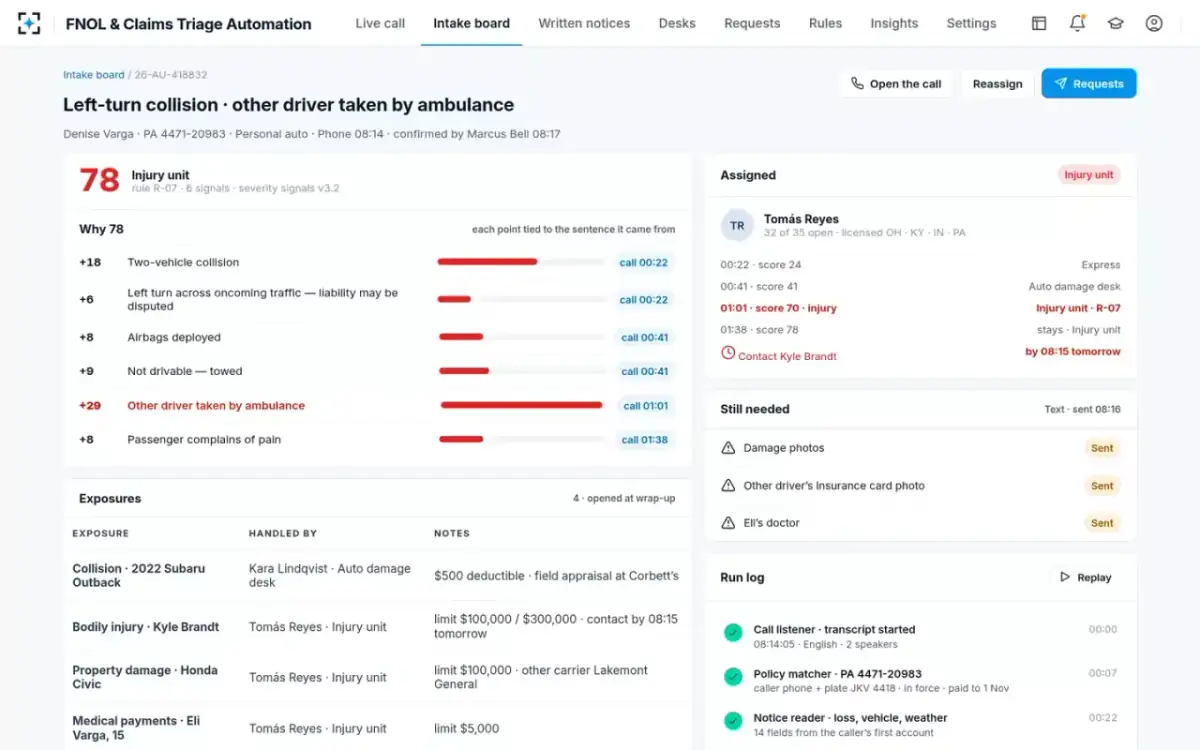
The rule the notice reader works to is the one a good trainer teaches: never guess a value. A field the caller did not give stays empty and goes on the missing list; it is not filled from a likely default. That is what made the three missing items on the sample call visible enough to request before the caller hung up.
Loss-notice fields that most need a source on the first call
- Date, time and place of loss
They decide whether the policy was in force and which state’s rules apply. Keep the caller’s exact words as well as the parsed value.
- Who was driving, and who was in each car
Each injured person may become an exposure of their own, under a different coverage.
- Any injury, to anyone
Including complaints of pain. Note who said it and when; it starts the injury contact clock.
- Where the vehicle is now
The appraiser and the storage bill both depend on it.
- The other driver’s carrier and policy
Taken from the insurance card where possible, with the photo requested.
- Police report number and agency
The confirming document arrives days later; the number is what retrieves it.
The ACORD loss notice form against a carrier's own first notice of loss form
The ACORD loss notice form and a carrier's own first notice of loss form serve different senders. ACORD's forms let an independent agent report a claim to any carrier in one familiar layout, so an agent's submission may arrive as a filled PDF. A carrier's own intake screen is built for its routing: its desks, its severity signals, its coverages.
The difference matters when the notice arrives in writing. A first notice of loss form fillable as a PDF still has to be read into the carrier's structure, and the agent's version may answer questions the carrier did not ask and skip the one it needs. In the solution, an agent's submission is read like any other written notice, its fields mapped into the carrier's notice with the page each came from, and what is missing is asked for in a reply to the agent. On the sample morning, an agency's hail claim arrived without a date of loss; the request went out at 07:31 and the agent answered at 07:55: "3 Oct, the evening storm".
Whatever the form, the carrier's duty to help is the same. The NAIC model act lists as an unfair practice "Failing to provide forms necessary to present claims within fifteen (15) calendar days of a request with reasonable explanations regarding their use". California requires an insurer to provide the claimant "necessary forms, instructions, and reasonable assistance" within its 15-day window. A notice reader that lists the missing items, and a text that asks for them with a link, is that assistance done on the first day instead of the fifteenth.
Property loss notice form: what changes for a home claim
A property loss notice asks the same first questions (who, which policy, when, what happened) and then turns to the dwelling: the cause, the rooms affected, whether the water is still running, and whether the family can stay in the house. Those last answers decide the desk and the first payment. A kitchen fire with "family staying with her sister" on the sample board went straight to the large-loss desk, and the request for a fire department report also asked where the family was staying.
Property rules can be tighter. Florida's statute for property claims requires an insurer to "within 7 calendar days, review and acknowledge receipt" of a claim communication, and where it is a notice of claim the acknowledgment "must provide necessary claim forms, and instructions, including an appropriate telephone number". A property notice that is filled and acknowledged on the call starts that week with nothing outstanding on the carrier's side. The deadlines on both sides of a first notice are set out state by state on a separate page.
Photos on the notice: requested, never required as the only evidence
Photos are the one notice field most carriers now request by link during the call, and Washington's new claims rule limits how far a carrier can lean on them. Its motor-vehicle section, in force since 18 October 2026, says "Insurers shall not require the claimant to agree to only photo-based evaluation of damage as a condition of coverage." The photo field on a notice is a request, not a condition, and a notice that cannot be completed without photos is the wrong design for that state.
On the sample call, the photo link went out at 08:16, while the caller was still on the line, with one upload page for the damage photos, the other driver's insurance card and the passenger's doctor. The requests list then sends a reminder every 24 hours, and after three reminders the adjuster gets a task to call. How the photo request fits into the rest of the call is traced second by second in the claims FNOL process flow; the six agents and two people behind it, and the inputs a carrier supplies, are in what insurance FNOL automation needs on day one.
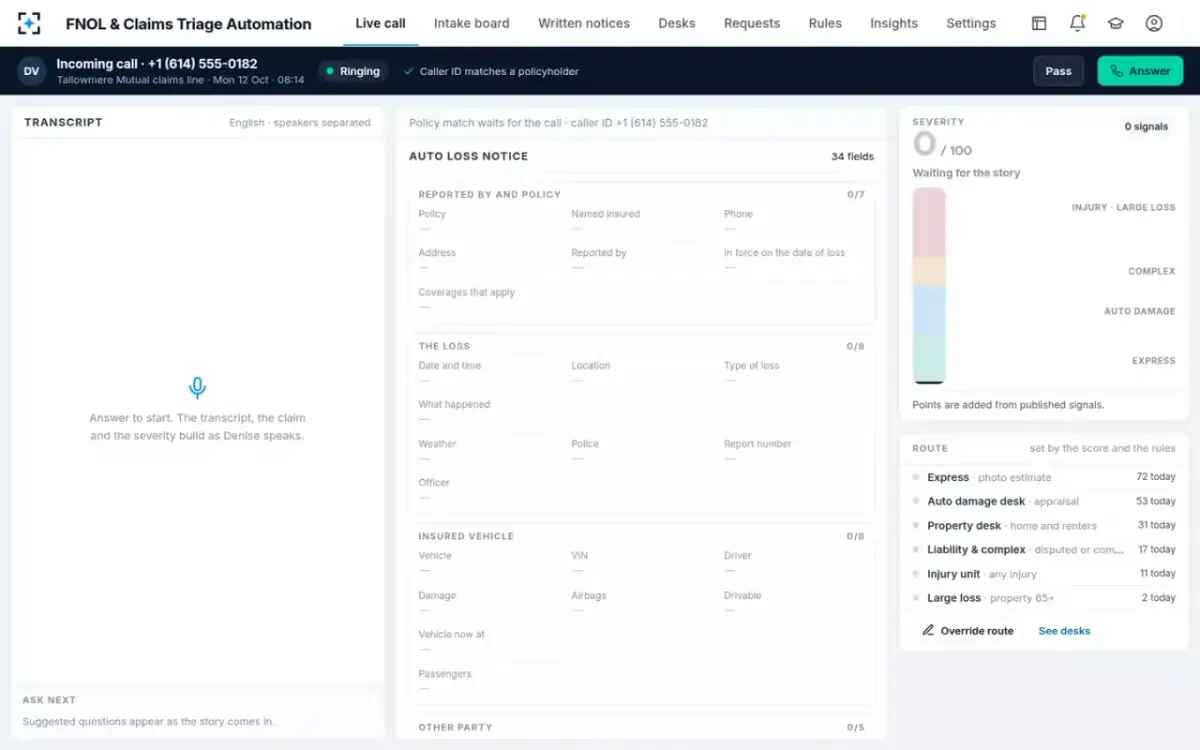
Before the first word: an empty notice of 34 fields and a known caller
Questions people ask
What is a notice of loss?
A notice of loss is the policyholder's or claimant's first report to the insurer that a loss has happened and a claim may follow. California defines notice of claim as any written or oral notification that reasonably tells the insurer a claim is being made, and it starts the insurer's 15-day clock to acknowledge, send forms and begin investigating. Some states treat a call to the agent as notice to the insurer.
What is the ACORD automobile loss notice?
It is ACORD 2, the industry's standard paper form for reporting an auto claim, used mostly by independent agents sending claims to several carriers. ACORD 1 is the property equivalent. A carrier still has to read either one into its own claim structure.
Is there a first notice of loss form fillable online?
Most carriers offer a web or app version of their own first notice of loss form, and agents often send a fillable ACORD PDF. For auto claims, Washington's 2026 rule says a carrier must not make an internet-based application the only way to send claim information; email, post, fax and in-person delivery must also be accepted.
What happens if the loss notice is incomplete?
The claim still opens; an incomplete notice is normal. The carrier must help: the NAIC model act treats a failure to provide forms within 15 calendar days of a request as an unfair practice, and California requires forms, instructions and reasonable assistance within 15 days of notice. Asking for the missing items during the call shortens that wait to minutes.
Does a property loss notice form ask for different information?
Yes. After the policy and the date, it asks about the cause, the damaged rooms, whether damage is ongoing and whether the home can be lived in, because those decide the desk and any advance for living expenses. In Florida, a property claim must be acknowledged within 7 calendar days, with the forms, instructions and a phone number.