A Medicare conditional payment letter, or CPL, is the notice from Medicare's recovery contractor listing the medical items and services Medicare has paid that it considers related to an injury claim, with an interim total that Medicare expects to be repaid when the claim settles. Medicare pays "conditionally" because another payer, such as a liability insurer, may be responsible, and the payment must be repaid from any settlement, judgment or award. For a casualty claim department the letter matters twice: it puts a documented amount into the claim that the settlement has to satisfy, and it starts a sequence of CMS clocks, from a 30-day response window to interest on an unpaid demand. Botminds' Case Reserve Adequacy Review treats Medicare entitlement as a material fact that opens a reserve review, and tests every open bodily-injury file against a rule that the conditional payment amount is reserved once known.
The rules below come from CMS's own pages and the Medicare Secondary Payer statute, linked where used. Product examples are sample data from a fictional insurer.
The Medicare clocks a casualty file can carry
65days
after the Rights and Responsibilities letter, CMS sends the CPL
30days
to respond to a conditional payment notice before a demand issues
60days
from a demand letter before interest is assessed
$365,000
maximum Section 111 penalty for any one late record
What is a Medicare conditional payment letter?
It is CMS's itemised statement of what Medicare has paid for care related to a pending liability, no-fault or workers' compensation claim, sent so the parties can check it and allow for it in a settlement. The legal basis is the Medicare Secondary Payer statute, under which Medicare may pay when a primary plan, including "an automobile or liability insurance policy or plan", has not paid promptly, but "Any such payment by the Secretary shall be conditioned on reimbursement to the appropriate Trust Fund" (42 U.S.C. § 1395y(b)(2)).
When the case is reported, the Benefits Coordination and Recovery Center sends the beneficiary a Rights and Responsibilities letter, and "Within 65 days of the issuance of the RAR Letter, the BCRC will send the CPL and Payment Summary Form (PSF)" (CMS). The CPL "includes the BCRC’s best estimate, as of the date the letter is issued, of the amount Medicare should be reimbursed", and CMS calls it interim "because Medicare may make additional payments while the case is pending". A copy goes to anyone holding the beneficiary's signed consent, including, CMS notes, a potential third-party payer that has submitted a Consent to Release.
The amount on the letter is therefore a floor, not a final figure. On a claim like the bodily-injury files in this series, where a claimant may still be treating months after the accident, every new Medicare payment for related care raises it.
CPL or CPN: which letter, which clock?
The CPL comes while a case is pending; a conditional payment notice, or CPN, comes when the case has already settled or when Medicare is recovering directly from an insurer, and it carries a deadline. CMS's attorney guidance says a CPN "is issued to the beneficiary in lieu of a CPL when a settlement, judgment, award, or other payment has already occurred", and that if no response arrives within 30 calendar days "a demand letter will automatically be issued requesting repayment on all conditional payments related to the case without a proportionate reduction for fees or costs" (CMS).
On the insurer side the same names mean slightly different things. When Medicare pursues the insurer as the debtor, typically where it has ongoing responsibility for medicals, its Commercial Repayment Center sends the insurer a CPN with a 30-day window. If the beneficiary reports a no-fault or workers' compensation situation before the insurer has reported it under Section 111, the insurer instead receives a CPL, which "provides the same information as a CPN, but there is no specified response timeframe" (CMS).
The conditional payment letter and the conditional payment notice
Conditional payment letter (CPL): While the case is pending, within 65 days of the Rights and Responsibilities letter.
Conditional payment notice (CPN): When the case has already settled, or when Medicare recovers directly from an insurer.
Conditional payment letter (CPL): The beneficiary, and parties with a consent or proof of representation on file.
Conditional payment notice (CPN): The beneficiary or the insurer as debtor, with courtesy copies.
Conditional payment letter (CPL): None specified; disputes of unrelated claims can be sent at any time.
Conditional payment notice (CPN): 30 days, or a demand letter issues automatically.
Conditional payment letter (CPL): Interim: Medicare may keep paying while the case is open.
Conditional payment notice (CPN): Conditional payments related to the case, before the demand.
Conditional payment letter (CPL): A documented floor the settlement must satisfy; update it at each review.
Conditional payment notice (CPN): A demand and interest clock are close; the amount is near final.
How long does an insurer have to respond to a conditional payment notice?
Thirty days from the date on the notice, after which the Commercial Repayment Center issues a recovery demand automatically. In that window the insurer, or its recovery agent, can dispute claims it considers unrelated to the injury, through the CRC or the Medicare Secondary Payer Recovery Portal. The demand letter, when it comes, includes a claims listing and the total owed and "requests reimbursement within 60 days of the date of the letter" (CMS).
The appeal clock is separate and longer: "An applicable plan has 120 days from the date the applicable plan receives the demand letter to file an appeal. Receipt is presumed to be within 5 calendar days absent evidence to the contrary." An appeal does not stop interest, which is why CMS notes an insurer "may choose to pay the demand amount while appealing" and receive a refund if it wins (CMS). For a claim department each of these dates belongs in the diary the day the notice arrives, and Medicare status is worth flagging earlier still, when the medical records in an injury demand are summarised.
When does interest start on a Medicare demand?
On the date of the demand letter, though it is only assessed if the debt is not resolved in time. CMS's beneficiary guidance says "Interest accrues from the date of the demand letter and, if the debt is not repaid or otherwise resolved within the time period specified in the recovery demand letter, is assessed for each 30 day period the debt remains unresolved", with payments applied to interest first (CMS). The statute sets the same 60-day principle for primary plans, allowing interest if reimbursement is not made within the 60-day period after notice is received (42 U.S.C. § 1395y(b)(2)).
After that the clocks escalate. CMS sends an Intent to Refer letter on day 90 after the demand if full payment or a valid documented defense has not arrived, and refers the debt to the Treasury 60 days later, 150 days after the demand. The page adds the line every claim manager should know: "The law authorizes the Federal government to collect double damages from any party that is responsible for resolving the matter but which fails to do so" (CMS).
Three Medicare clocks a casualty claim department has to diary
- Respond or dispute30 days
- Demand: repay60 days
- Repay before interestday 0–60
- Interest per 30 daysday 60–90
- Intent to referday 90–150
- Disputes, 11 business days each120 days
- Settle in 3 days, report in 303 + 30 days
What is the final conditional payment process?
It is CMS's route to a fixed, time-stamped conditional payment amount just before settlement, so the parties settle against a number that will not move. It is run entirely on the recovery portal, is "only available for liability cases and workers’ compensation cases", and "Can only be started ONCE per case" (CMS). Starting it tells the BCRC the case is within 120 days of settlement and guarantees that disputes submitted through the portal are answered within 11 business days.
The end of the process is tight. The final amount has to be requested when the case is within three business days of settlement, the case has to settle within three business days of that request, and the settlement details have to be reported within 30 calendar days; missing any of them voids the process and it cannot be restarted. For smaller cases CMS offers two shortcuts: a self-calculated amount where the settlement does not exceed $25,000, the injury is from physical trauma and treatment ended at least 90 days earlier, and a fixed-percentage option for small physical-trauma liability settlements (CMS).
On the insurer side the process has a consequence worth knowing. If an insurer that is the debtor starts it, CMS says, "Initiating this process will close the applicable plan’s case and transition the debt to the beneficiary" (CMS). That changes who repays, not whether Medicare is repaid.
Should a case reserve include Medicare conditional payments?
It should reflect them, in one of two ways depending on who will pay. Where the insurer itself owes Medicare, for example as the debtor on a CPN, the conditional payment amount, plus interest if the dates slip, is a cost the insurer will pay and belongs in the reserve. Where the beneficiary repays Medicare out of a liability settlement, the conditional payments are not an addition to the settlement, but they are a documented floor under it: a settlement that does not cover Medicare's claim plus fees is hard to close, and the medical bills Medicare paid are part of the specials the reserve already prices.
Ignoring them is the expensive option. The statute requires a primary plan to reimburse Medicare once its responsibility is demonstrated, and responsibility may be demonstrated "by a judgment, a payment conditioned upon the recipient’s compromise, waiver, or release (whether or not there is a determination or admission of liability)" (42 U.S.C. § 1395y(b)(2)). The United States may recover from any entity required to make payment under a primary plan and "collect double damages against any such entity". A liability settlement paid without protecting Medicare's interest can leave the insurer exposed to paying the same medical bills again.
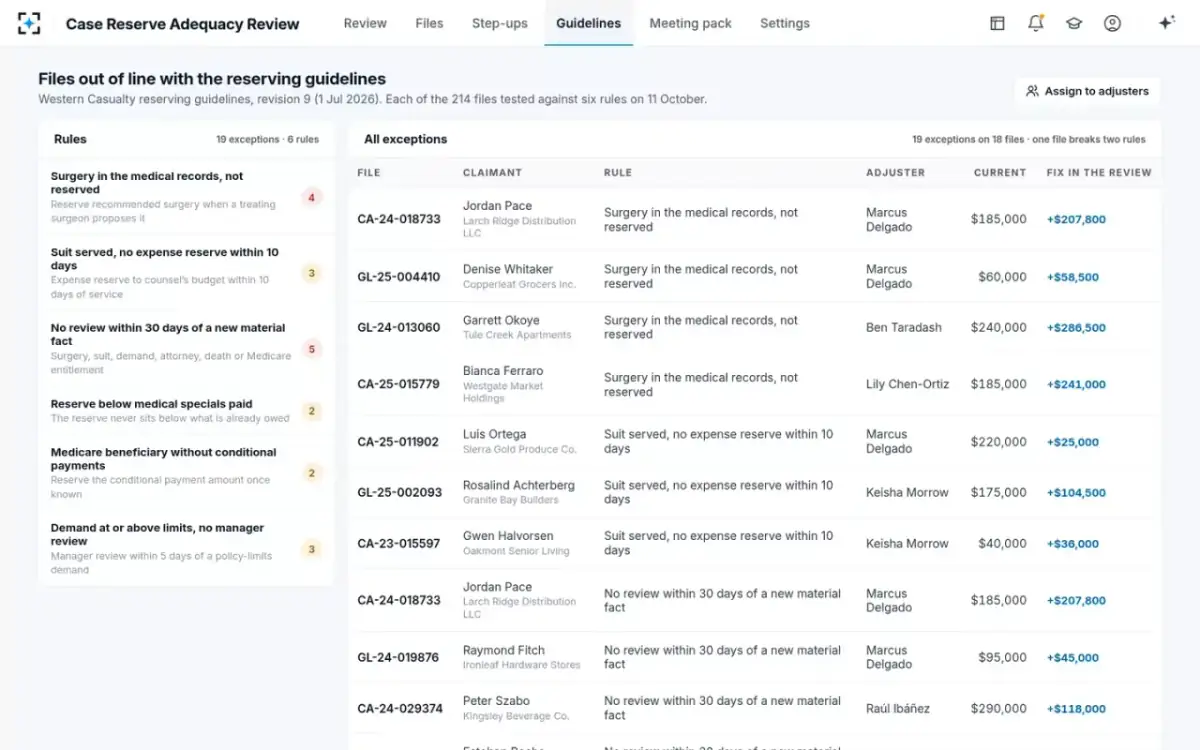
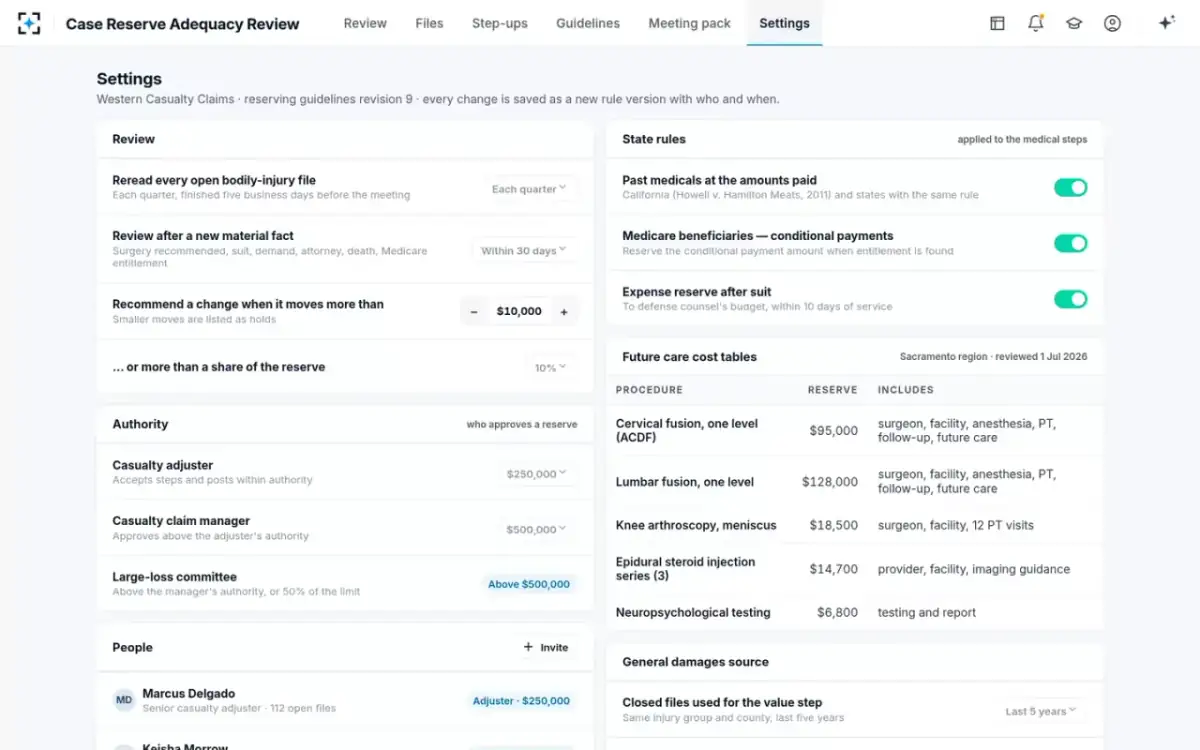
The problem statement behind Case Reserve Adequacy Review names this directly: a Medicare conditional payment can move the number in a known direction that nobody priced. In the sample insurer's settings, a toggle reserves the conditional payment amount once Medicare entitlement is found, and a guideline rule flags any Medicare beneficiary whose file has no conditional payments reserved. In the fourth-quarter review that rule caught two files, and one open general liability file shows a recommended change of +$26,000 with Medicare entitlement as its trigger.
Medicare entitlement as a reserving rule, tested on every open file
Section 111: the insurer's own reporting clock
Separately from recovery, liability insurers report settlements and ongoing medical responsibility for Medicare beneficiaries to CMS under Section 111, and late reports now carry civil money penalties. CMS's final rule sets per-day penalties that rise with lateness, from $250 a day to $1,000 a day for a report three or more years late, each "as adjusted annually", and states that "the total penalty for any one instance of noncompliance by an NGHP RRE for a given record identified by CMS will be no greater than $365,000" (88 FR 70363). The rule's provisions are "applicable on or after October 11, 2024".
Section 111 is a reporting obligation, not a reserve item, but it shares the same trigger: knowing the claimant is a Medicare beneficiary. A reserving review that checks entitlement at every material fact gives the reporting team the same information at the same time. CMS's current penalty schedule, audits and the workers' compensation set-aside rules are covered in the sibling guide on CMS Medicare set-asides for workers' compensation.
What a reserving guideline should say about Medicare
That entitlement is a material fact with a review clock, that the conditional payment amount is reserved or tracked as soon as it is known, and that every CMS date is diaried the day the letter arrives. Most of this is not new law; it is turning CMS's process into rules the claim desk follows on every file, rather than at settlement when the CPL is first requested.
Medicare rules for a casualty reserving guideline
- Check Medicare entitlement at first notice and at every review
Treat a finding of entitlement as a material fact with the same review clock as a surgery or a suit.
- Obtain the current conditional payment amount
From the CPL, the BCRC or the recovery portal, and refresh it at each review, because the CPL amount is interim.
- Reserve or track it explicitly
As a cost where the insurer is the debtor; as a documented floor under the settlement where the beneficiary repays.
- Diary every CMS date the day the letter arrives
30 days on a CPN, 60 days on a demand, 120 days to appeal, and the three-business-day window of the final process.
- Dispute unrelated charges with documents
CMS asks for documentation that claims are not related to the injury; allow 45 days for its review.
- Pay to stop interest when appealing
Interest continues during an appeal; CMS refunds if the appeal succeeds.
- Share entitlement with the Section 111 reporting team
The same fact starts the reporting obligation and its penalty clock.
The state and federal rules applied to every medical step
Where Case Reserve Adequacy Review fits on Medicare files
The solution reads what the claim file already holds, including Medicare correspondence, and makes Medicare entitlement part of the reserve review: it opens a review within the insurer's clock, tests whether the conditional payment amount has been reserved, and puts the exception and the recommended fix in front of the adjuster with the documents behind it. The reserve recommendation, like every other, is accepted by the adjuster and approved above authority. How rules like these are kept as versioned settings is covered separately.
It does not correspond with CMS, file disputes or appeals, make Section 111 reports or calculate set-asides; its agents never contact claimants, counsel or third parties and never change a payment. Those remain with the claim and Medicare compliance teams. What it removes is the gap in which entitlement is known somewhere in the file and absent from the reserve.
Questions people ask
What is a Medicare conditional payment letter?
It is CMS's letter listing the related items and services Medicare has paid on an injury claim another payer may owe, with an interim total to be repaid from any settlement. CMS sends it within 65 days of the Rights and Responsibilities letter and treats the amount as interim because Medicare may keep paying.
How long does an insurer have to respond to a conditional payment notice?
Thirty days from the date on the notice; after that the Commercial Repayment Center issues a demand letter automatically. The demand then asks for repayment within 60 days, and an appeal can be filed within 120 days of receiving the demand.
When does interest start on a Medicare demand?
Interest accrues from the date of the demand letter and is assessed for each 30-day period the debt remains unresolved after the period stated in the demand. It keeps accruing during an appeal, so paying while appealing avoids it, with a refund if the appeal succeeds.
What is the final conditional payment process?
It is a portal process for liability and workers' compensation cases that fixes a time-stamped conditional payment amount just before settlement. It can be used once per case, starts within 120 days of settlement, answers disputes within 11 business days, and requires settlement within three business days of requesting the final amount.
What are Section 111 reporting penalties?
Civil money penalties for late Section 111 reports by liability, no-fault and workers' compensation insurers, applicable on or after 11 October 2024. They run per day, rising from $250 to $1,000 with lateness, adjusted annually for inflation, up to $365,000 for any one late record. CMS says it has enforced them since 11 October 2025 and audits a random sample of 250 records each quarter from January 2026.
Should a reserve include Medicare conditional payments?
A reserve should reflect them: as a cost where the insurer is the debtor, and as a documented floor under the settlement where the beneficiary repays from the proceeds. Ignoring them risks paying twice, because the statute lets the United States recover from a primary plan and collect double damages.