Reserving committee terms of reference are the written mandate of the management committee that decides an insurer's booked loss and loss adjustment expense reserves: its purpose, its members and chair, its quorum, how often it meets, what it receives, what it decides, and how its decisions are minuted and reported to the board. Most terms of reference stop at the first half of that list. The second half, what the committee receives, is where reserve governance succeeds or fails, because a committee can only decide well on evidence that names the segments, accident years and claims behind a movement. NAIC regulators already publish the questions they ask about adverse development; terms of reference that make those questions standing agenda items, each with its evidence, give the committee what the regulator will later ask for. Botminds' Loss Development Monitoring prepares that evidence between meetings, so that a moving accident year reaches the committee with its claims, its range and the reserving actuary's view.
The regulatory expectations below come from the NAIC's Actuarial Opinion Working Group and the Actuarial Standards Board; the draft clauses are ours. The example items come from a sample casualty book in the solution, with fictional companies and claims.
Who sits on a reserve committee, what reaches them today, and what stays their decision
Today
Meets adverse development in the committee papers, two weeks after quarter-end.
With agents
Has read it in the weekly development summary since the month it broke.
Still theirs: The recommendation to book, and the year-end opinion if also appointed actuary.
Today
Sees the indication and the booked figure, rarely the claims behind the movement.
With agents
Sees both indications and the claims that explain the gap between them.
Still theirs: The booked reserve as management’s best estimate.
Today
Rebuilds the story of each moving accident year from the claim files under deadline.
With agents
Presents items queued with their numbers, claims and range, and her own reason.
Still theirs: The view on each flag: watched, explained or for the review.
Today
Is asked after the meeting what happened on the claims behind a movement.
With agents
Sees the same claims and note passages before the meeting.
Still theirs: Case reserves and claim strategy.
Today
Assembles the papers by hand from triangles, notes and claim screens.
With agents
Starts from a queue where each item carries its evidence.
Still theirs: The minute: what was decided, by whom, and why.
What is a reserving committee?
A reserving committee is the management body that reviews the actuaries' estimates of unpaid claims each quarter and decides the reserves the company books. It exists because the reserve is management's figure, not the actuary's: the actuary produces indications and ranges, and management books a single number on the balance sheet. The NAIC's Actuarial Opinion Working Group draws the line precisely: "Management is limited to reporting single values on lines 1 and 3 of the Liabilities, Surplus, and Other Funds page of the balance sheet. However, actuarial estimates are uncertain by nature, and point estimates do not convey the variability in the projections" (NAIC AOWG, 2026). The committee is where that variability is weighed and a single value chosen.
It is distinct from the board's own oversight. The appointed actuary reports to the board of directors every year under the NAIC instructions, and the board's minutes must record how. The reserve committee sits below the board, meets more often, and does the work that lets the board's annual conversation be informed rather than ceremonial.
What should reserving committee terms of reference include?
Terms of reference should fix the committee's purpose, composition, frequency and decisions, and, as standing items, the questions it must answer and the evidence it must see. The draft clauses below are written for a US property and casualty insurer and can be adapted; the standing questions in clause six are taken from the NAIC's guidance on persistent adverse development.
Draft terms of reference for a reserving committee, clause by clause
- 1. Purpose
To review the actuarial indications for loss and loss adjustment expense reserves each quarter, decide the reserves to be booked as management’s best estimate, and report to the board.
- 2. Membership and chair
Chief actuary (chair), chief financial officer, head of claims, head of reinsurance; reserving actuaries attend to present. The appointed actuary attends at least the year-end meeting.
- 3. Quorum
The chair or the CFO and two other members; no decision on an item without the presenting actuary.
- 4. Frequency
Quarterly after each close, before the quarterly statement; additionally when a monitored accident year is proposed for the reserve review between meetings.
- 5. Inputs, circulated before each meeting
Indications by segment and accident year with ranges; actual against expected development since the last review; items proposed for review with their claims and reasons; the gap between indicated and booked reserves.
- 6. Standing questions
For any adverse development: concentrated or broad; carried reserve against the actuary’s estimate; company-specific or industry-wide; by accident year or calendar year.
- 7. Decisions
The reserve to book by segment; whether a monitored item is watched, explained or re-selected; questions for the year-end review.
- 8. Departures from the indication
Where the booked reserve differs materially from the actuarial central estimate, the minute records the amount, the reason and the support.
- 9. Minutes and reporting
Each decision with who decided and why; a summary to the board each quarter, including the appointed actuary’s view of the risk of material adverse deviation at year-end.
- 10. Review of these terms
Annually, with the monitoring thresholds that decide what reaches the committee between meetings.
Who sits on an insurance reserve committee?
Typically the chief actuary or the CFO as chair, the CFO or controller, the head of claims, often the head of reinsurance or ceded accounting, and the chief risk officer, with the reserving actuaries presenting. The composition matters for what it puts in the room. A committee without claims leadership hears that an accident year moved but not why; one without reinsurance hears the gross figure and not what the company retains. On the sample book, the largest moving accident year was $4.9 million gross and $4.2 million net of the $700,000 ceded under the casualty excess of loss treaty.
Independence matters too, in the opposite direction. The committee is management; the appointed actuary's opinion is meant to be the actuary's own. Where the chief actuary is also the appointed actuary, the minute should make clear when the committee is deciding as management and when the actuary is speaking as the signer of the opinion.
How often does a reserve committee meet?
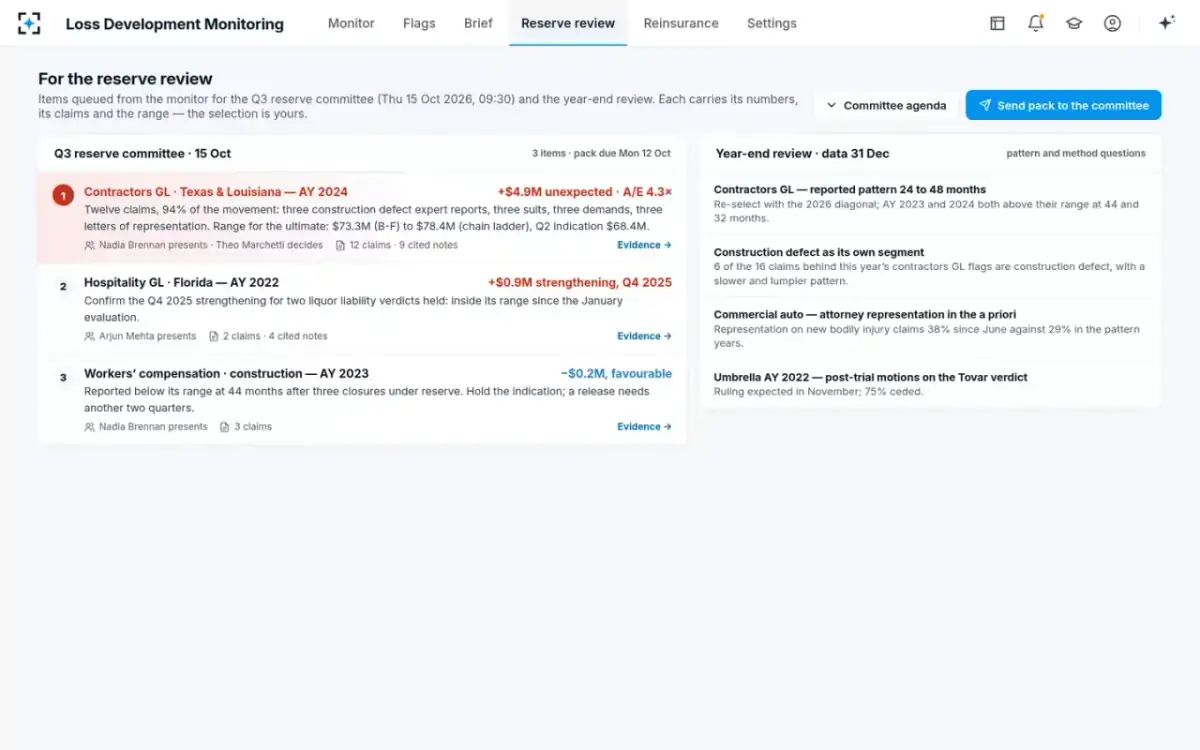
Usually quarterly, after each quarter's close and before the quarterly statement is filed, with the year-end meeting the most important because it feeds the annual statement and the statement of actuarial opinion. Terms of reference should also allow for a meeting, or a written item, between quarters when monitoring proposes a reserve review. On the sample book the third-quarter committee met on Thursday 15 October 2026, with the papers due on Monday 12 October; the item that led it had been flagged on 3 August.
The committee queue: each item with its numbers, claims, presenter and decider
The standing questions: what the regulator will ask, asked first
The NAIC's Actuarial Opinion Working Group lists the questions state regulators commonly have when an appointed actuary comments on persistent adverse development in the Actuarial Opinion Summary (NAIC AOWG, 2026). They are good questions for any committee, every quarter, and the evidence that answers each can be prepared before the meeting.
The regulators' four questions on adverse development, and the evidence a committee item should carry
| The regulators’ question | Evidence for the committee | On the sample book |
|---|---|---|
| “Is development concentrated in one or two exposure segments, or is it broad across all segments?” | Actual against expected by segment and accident year since the last review. | Half of $9.5M unexpected across eight segments in one accident year. |
| “How does development in the carried reserve compare to the change in the Appointed Actuary’s estimate?” | The booked reserve beside both indications, and the gap between them. | $68.4M at Q2; $73.3M Bornhuetter-Ferguson; $78.4M chain ladder. |
| “Is development related to specific and identifiable situations that are unique to the company?” | The claims that moved and the note passages that came first. | Twelve claims, 94% of the movement; construction defect expert reports and Harris County suits. |
| “Does the development or the reasons for development differ depending on the individual calendar or accident years?” | Each flagged accident year separately, with when it left its range. | Accident year 2024 out from 31 months; 2023 over the top of its range for the first time at 44 months. |
The same guidance is blunt about what does not count as an answer. Where IRIS reserve ratios are unusual, the Working Group will not accept reserve strengthening or adverse development as the explanation and expects the company-specific factors; the consequences for earnings and for that comment are in what reserve strengthening is. A committee that has asked the four questions every quarter has those factors in its minutes before the year-end opinion is drafted.
What does the reserve committee decide?
The committee decides the reserves to book, segment by segment, and what to do about each item in front of it: keep watching, accept an explanation, or re-select. Its hardest decisions are departures from the actuarial indication, booking above or below the actuarial central estimate, and those need the most care in the minute. In 2020 the SEC charged an insurer and its former CFO over judgmental adjustments to reserves that, the complaint alleged, did not properly consider the actuarial analyses and lacked sufficient documentation of management's best estimate; the parties settled without admitting or denying the allegations (SEC Litigation Release No. 24838). Clause eight of the draft exists for that reason.
A committee decides on what it is shown. Terms of reference that fix the questions also fix what has to be shown, and that is most of reserve governance.
The committee does not decide the appointed actuary's opinion. Under ASOP No. 36, revised in 2024 and effective for opinions issued on or after 1 October 2024, the actuary judges whether the carried reserves make a reasonable provision against a range of estimates the actuary considers reasonable, and whether there is a risk of material adverse deviation (ASOP No. 36). A committee that books near the bottom of a wide range should expect that judgment to be harder.
Does the appointed actuary attend the reserve committee?
Often, and at year-end it should be expected. The NAIC instructions require the appointed actuary to report to the board every year; the Working Group "strongly encourages the Appointed Actuary to present their analysis in person so the risks and uncertainties that underlie the exposures and the significance of the Appointed Actuary’s findings can be adequately conveyed and discussed" (NAIC AOWG, 2026). It adds that the board should be made aware of the actuary's opinion on the risk of material adverse deviation, its sources, and the amount the actuary judges material. The reserve committee is where that view is first tested against management's numbers, so the appointed actuary's attendance at the year-end meeting is the natural rehearsal for the board.
How should adverse development be presented to a committee?
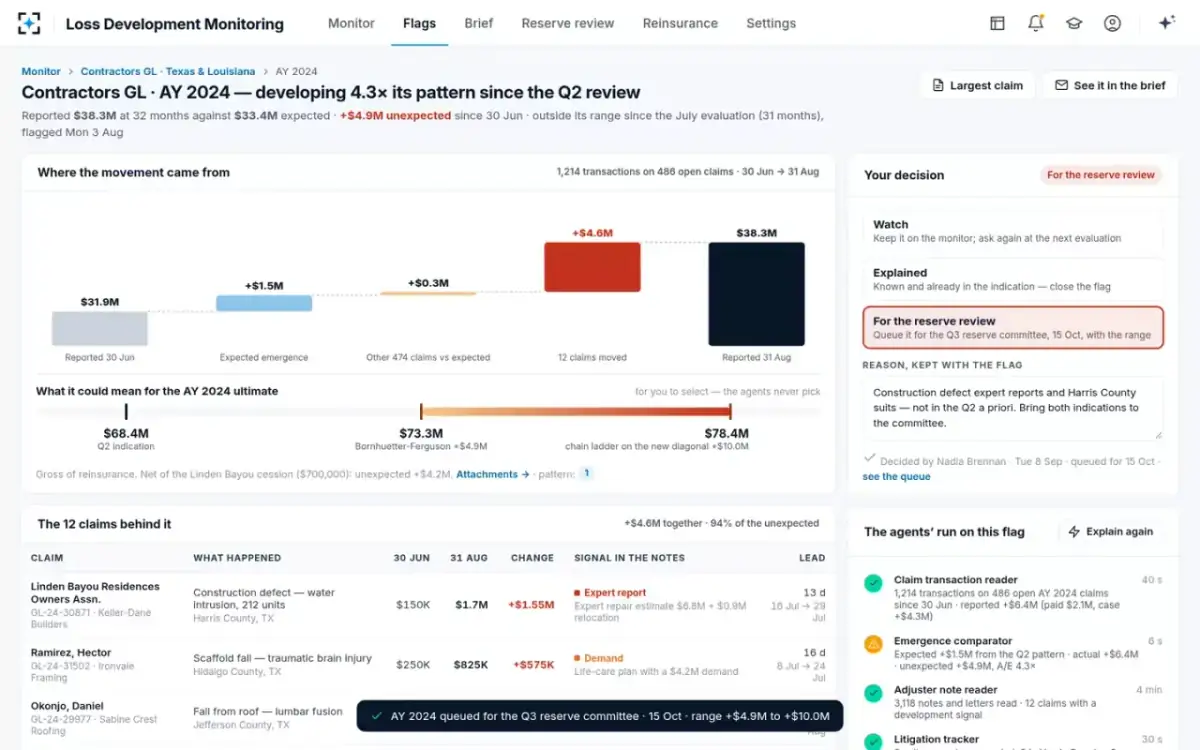
As an item with five parts: the movement in dollars against what the last review expected, when it started, which claims caused it and why, what it could mean for the ultimate under more than one method, and the presenting actuary's view of what to do. On the sample book, the lead item for the third-quarter committee read: contractors general liability, accident year 2024, $4.9 million unexpected since the second-quarter review, outside its range since the July evaluation, twelve claims carrying 94% of the movement, each preceded by a signal in the notes, and a range for the ultimate from $73.3 million to $78.4 million against $68.4 million at the second-quarter review.
From a monitored break to a minuted decision: the path a committee item takes
Agent
Emergence comparatorFlags the accident year at the evaluation its curve leaves its expected range, with expected, actual, range and A/E.
Never: changes a selected pattern, ultimate or indication.
Agent
Adjuster note reader and litigation trackerAttribute the unexpected to the claims that moved and mark the signals in their notes, each with its passage.
Never: infers a signal the text does not state.
A person decides
Reserving actuaryMarks the flag for the reserve review and records the reason; the agents may propose it after two evaluations outside the range, but she decides.
Agent
Summary writerDrafts the committee evidence with both indications side by side and every number sourced.
Never: selects an ultimate or recommends a reserve.
A person decides
Chief actuary and committeeDecide what is booked; the minute records the decision, who made it and why.
The reserving actuary's decision and reason, kept with the flag for the committee
What evidence should go to a reserve committee?
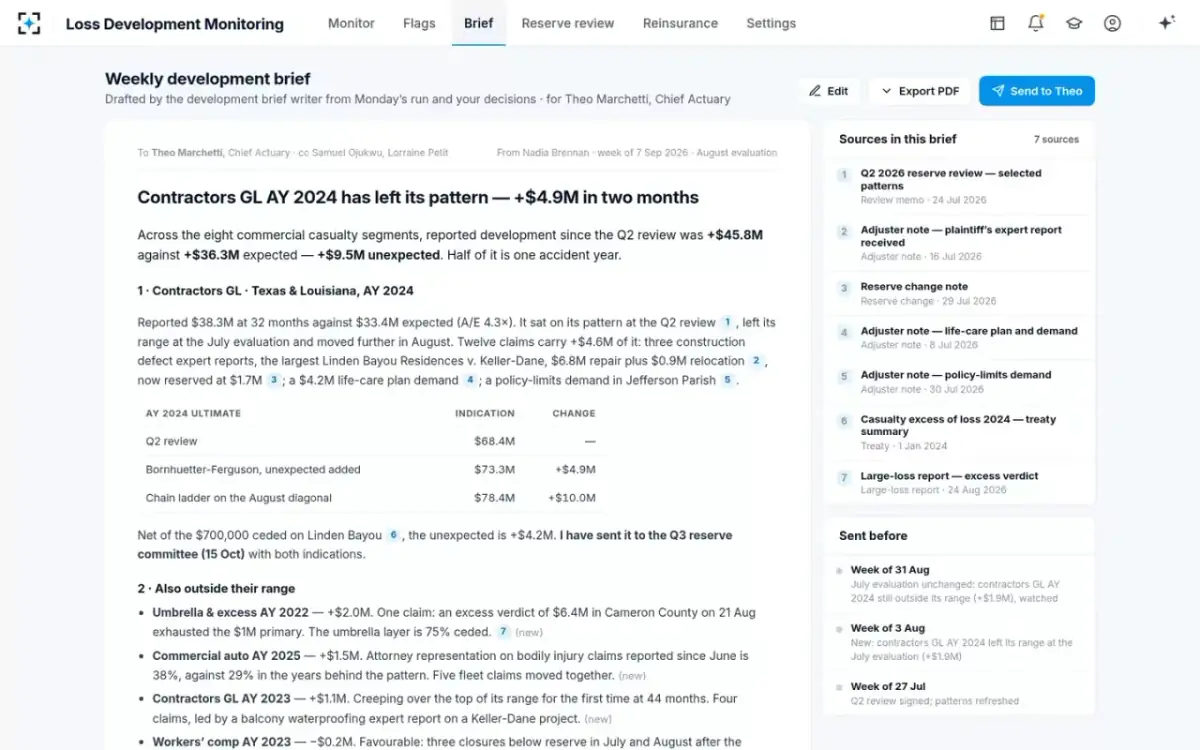
Enough for a member who has not seen the claim files to understand and challenge the item: the numbers with their arithmetic, the claims with the passages that explain them, both indications, the net effect after reinsurance, and the presenter's view. Not so much that it buries them: papers that reproduce every triangle hide the three items that matter. A weekly development summary for the chief actuary between meetings means the committee papers confirm what the chair already knows, rather than introducing it.
Between meetings: the weekly development summary the chair reads
Loss Development Monitoring prepares that evidence and stops there. It compares every segment and accident year with the last signed review each week, attributes movement to claims and passages, shows the effect gross, ceded and net, drafts the summary and the committee item, and keeps every decision with its reason in the audit trail. It does not decide items, book reserves or write the minute; the committee does. What a reserving actuary's quarter looks like around this cycle is set out in what a reserving actuary does, week by week, and the industry backdrop of 2025's development in prior year reserve development in 2025.
Questions people ask
Is a reserving committee required by regulation?
The NAIC framework centres on the appointed actuary's annual opinion under Model #745 and the actuary's report to the board. A management reserve committee is how many insurers organise the quarterly decision in between, and its terms of reference are the company's own; the booked reserve is management's figure and needs a documented process.
What is the difference between a reserve committee and an audit committee?
The reserve committee is management deciding the reserve to book; the audit committee is a board committee overseeing financial reporting and the external auditor. The audit committee often receives the reserve committee's conclusions and the appointed actuary's view rather than making reserve selections itself.
Should the reserve committee see ranges or a point estimate?
Both. Management books a single value, but the NAIC Working Group notes that point estimates do not convey variability, and the board should know the appointed actuary's view of the risk of material adverse deviation. Showing Bornhuetter-Ferguson and chain ladder indications side by side is one simple way to show the range.
How long should reserve committee papers be?
Long enough for each decision item to carry its evidence and short enough that the items stand out. Papers built from items queued during the quarter, each with numbers, claims and the presenter's reason, usually needs a few pages per item rather than every triangle.
Who writes the reserve committee minutes?
Usually a committee secretary or an actuarial analyst, approved by the chair. The minute should record each decision, who made it and why, especially any departure from the actuarial central estimate.