A large loss report in insurance is the claim department's report on an individual claim whose reserve or incurred value has crossed a set threshold: what happened, coverage, liability, damages, the reserve and why, litigation and next steps. It goes to claims leadership and often to reinsurance, and it is written to manage the claim, not to explain development to the reserving actuary. Yet the events it reports, a plaintiff's expert report, a suit served, a policy-limits demand, are written in the adjuster's notes first, often weeks before the case reserve changes, and the case reserve change reaches the actuary's triangle weeks after that. Botminds' Loss Development Monitoring reads adjuster notes, large-loss reports and defense counsel letters every week, marks those signals with their passages, and measures how many days each one led the reserve, so the reserving actuary sees a large loss when the claim file does.
This page is about the internal report. Some insurers also publish studies of large claims under similar names; those are company publications and not discussed here. The method sources are the Casualty Actuarial Society's study text and the Actuarial Standards Board; the claims are from a sample casualty book in the solution, with fictional companies and people.
One large loss from the adjuster's note to the reserving actuary: 18 days with monitoring, about 84 without
- Note to reserve13 d
- Flag5 d
- Note to reserve13 d
- Waiting for quarter-end63 d
- Data8 d
What is a large loss report in insurance?
It is a claim-level report that a claim department prepares for claims above its large-loss threshold, so that senior claims staff can review strategy and authority, and so that others with an interest, reinsurance above all, are told in time. The CAS study text describes the practice from the actuary's side: "Claims departments often maintain reports that routinely track the individual experience of claims exceeding a certain threshold" (Friedland, CAS). The report is the claim department's instrument; its timing follows claim events and authority levels, not the reserving calendar.
That is the source of the gap this page is about. A large loss report is usually triggered by a reserve crossing a threshold or by a claim event, and it is read by people who manage the claim. The reserving actuary often meets the same claim later and in aggregate, as part of an accident year that developed more than expected on the next diagonal, and then goes back to the claim department to find out why.
What threshold defines a large claim for reserving?
There is no single threshold, and the claim department's and the actuary's usually differ. The CAS text is explicit: "The determination of the size criteria of a large claim is not a precise science." It lists what actuaries weigh: the number of claims over the threshold each year, size relative to policy limits, size relative to reinsurance limits, the credibility of internal data on large claims and the availability of external data. And it gives the typical mismatch: a claim department may require monthly reporting on all claims above $100,000, while for the actuary a large claim may be one with a reported value above $1 million (Friedland, CAS).
The reinsurance retention is often the natural line, because a claim that may reach a treaty layer is a claim the reinsurer must hear about. On the sample book the casualty excess of loss retention is $1 million, and the solution lists every moving claim that reaches 50% of it for the reinsurance accountant, who sends the notices. Twelve claims carried the accident year 2024 break; only one exceeded the retention, but five were above the notice line.
What goes in a large loss report?
A good large loss report tells a reader who has not seen the file what the claim is, what it may cost and why the reserve is what it is. The checklist below is our summary of the content a reserving actuary needs from it; claim departments organise reports in their own formats.
What a large loss report should carry if the reserving actuary is to use it
- The claim and its accident date
Insured, claimant, line and segment, and the accident year it will develop in. A construction defect claim should say how its date of loss was set.
- Coverage and limits
Policy, limits per occurrence and aggregate, any coverage position, and the treaty layer the claim sits in.
- Liability and damages
Expert reports, life-care plans, medical specials, repair estimates: the figures, with the document each came from.
- Litigation
Suit served or amended, venue, counsel, demands with amounts and deadlines, mediation dates.
- The reserve, its history and its rationale
Case reserve now and before, the date of each change, and what moved it. A reserve without a reason helps nobody downstream.
- What changed since the last report
The new event and the date it was first known, which is often earlier than the reserve change.
- Reinsurance notice
Whether the claim has reached the treaty’s notice line, and whether notice was sent.
- Next steps and dates
Expected decisions, hearings, deadlines on demands, and when the reserve will be revisited.
Who receives large loss reports?
Claims leadership first, then whoever the company's process names: reinsurance and ceded accounting for treaty notices, underwriting for accounts with repeat exposure, sometimes finance for large single movements. The reserving actuary is often not on the list, or receives the reports as a monthly bundle. The CAS text treats them as "One starting point for the actuary", which is the right instinct and a weak process: a bundle of reports on claims above the claim department's threshold is not the same as knowing which accident years they moved and by how much.
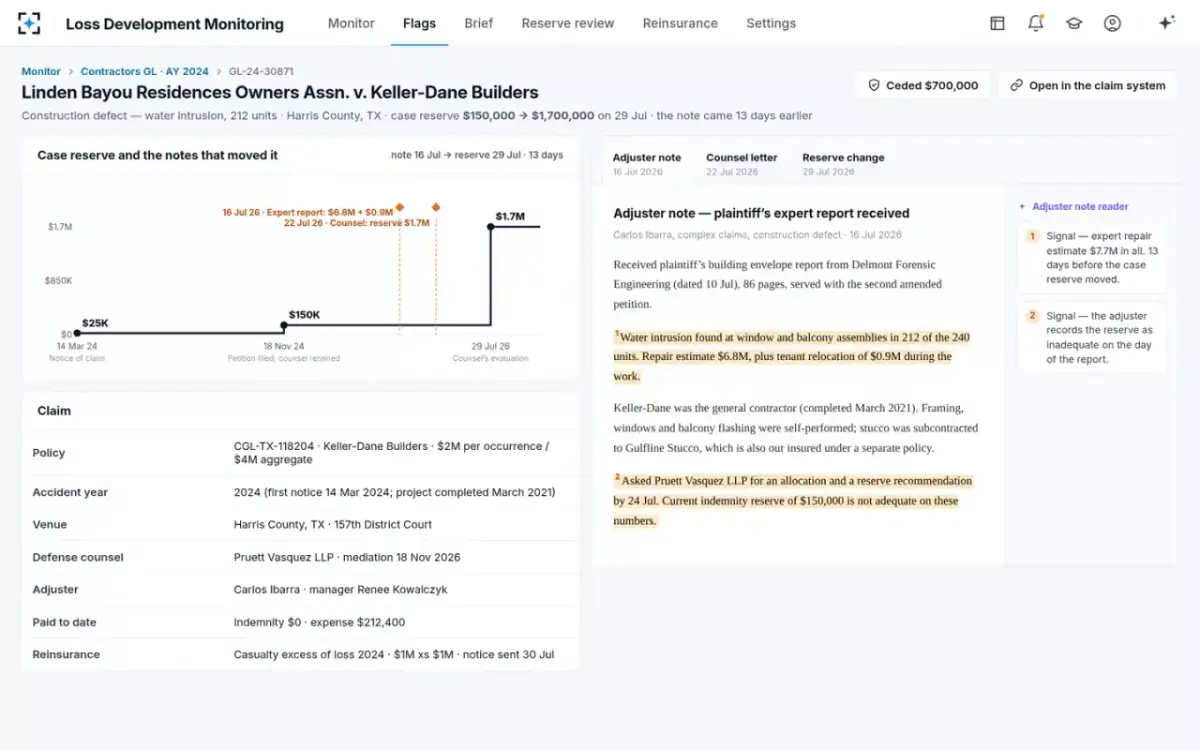
For reinsurance the timing matters in a different way. A treaty's notice clause is a contract term, and a claim that reaches its notice line is a matter for the reinsurance accountant regardless of reserving. On the sample book, the largest claim was above the $1 million retention, so $700,000 of its $1.7 million reserve was ceded, and notice had been sent on 30 July, the day after the reserve changed.
How do large losses affect loss development?
They dominate it in long-tail casualty, and they distort the methods that project it. The CAS text warns that "the presence of unusually large claims can distort some of the methods used for estimating unpaid claims", and that actuaries may exclude them from the development projection and add a case-specific provision for the reported large claims and a smoothed provision for unreported ones (Friedland, CAS). Either way, the actuary needs to know which claims moved.
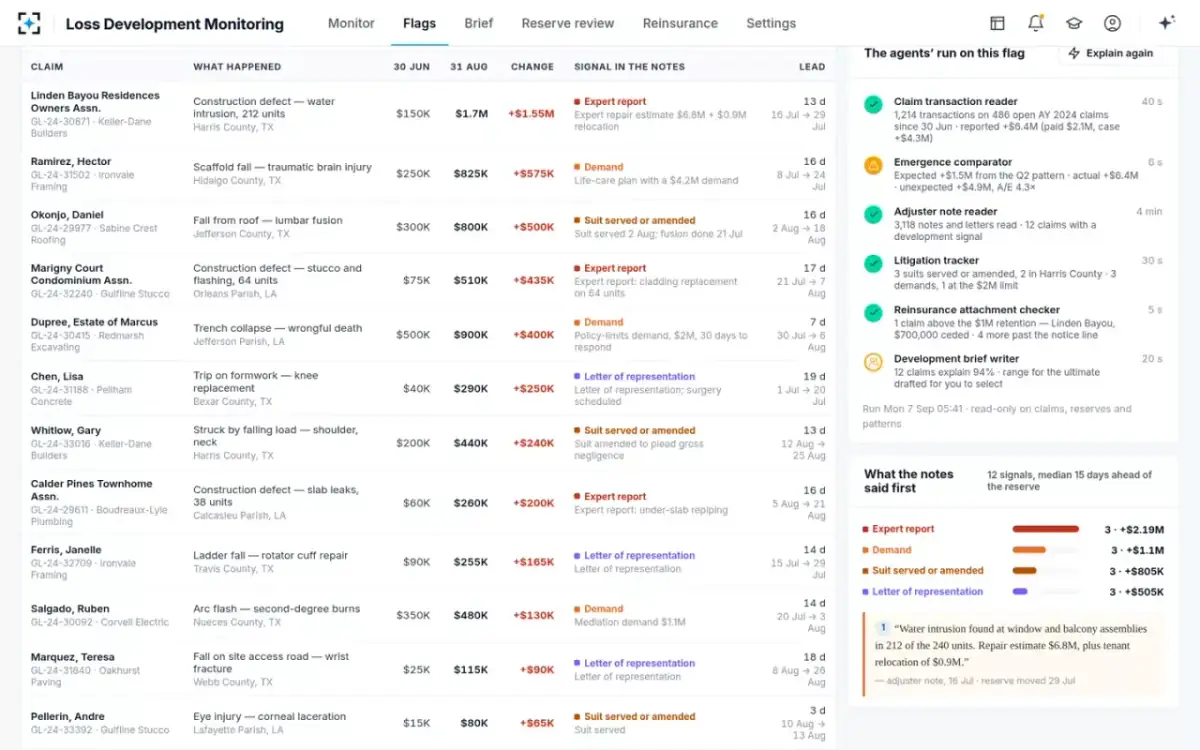
On the sample book, accident year 2024 of contractors general liability reported $6.4 million between the second-quarter review and the end of August against $1.5 million expected. Twelve claims accounted for $4.6 million, 94% of the unexpected; the other 474 open claims added $0.3 million above expectations between them. A monitor that only reported the accident year's total would have shown a hot cell. One that attributes the movement shows twelve claims, three of them construction defect expert reports worth $2.19 million of reserve increases between them.
The twelve claims behind one accident year's break, each with the signal that came first
What signals in claim notes predict reserve increases?
The events that put a new number or a new risk on a claim: an expert report on damages, a letter of representation, a suit served or amended, a demand, a surgery recommended or scheduled, a verdict or adverse ruling, and the adjuster recording that the reserve is inadequate. Closure below reserve is the favourable counterpart. These are the eight signals Loss Development Monitoring reads, each switched on or off by the reserving team. They are not predictions; they are the claim file stating something the reserve has not yet reflected.
How many days each note led its case reserve change, on the twelve claims behind the sample break
How long after a demand does the case reserve change?
On the sample book, between seven and sixteen days: seven for a policy-limits demand with 30 days to respond, fourteen for a $1.1 million mediation demand, sixteen for a demand built on a $4.2 million life-care plan. Across all twelve claims the median lead of the note over the reserve was 15 days. We know of no figure for this lag published by a regulator or research body, and it would vary by company, line and authority structure anyway; the useful number is your own.
How far the note led the reserve on the sample break's twelve claims
Twelve claims, by days of lead
- Up to 7 days · 16.7%
- 8 to 14 days · 33.3%
- 15 to 19 days · 50%
Measuring it on closed claims is straightforward. Take the large claims that closed or moved materially in a past year; for each, find the first note that records the event behind the move, the date of the case reserve change that priced it, and the date the accident year's development first showed it in the reserving data. The first gap is the claim desk's lag, a subject in its own right covered from the claim side in stair stepping reserves. The second is the reserving team's, and it is the one a monitor shortens.
The adjuster usually writes it down the day it happens. The question is how long it takes the reserving actuary to read it.
Should actuaries read adjuster notes?
They should have what the notes say, and the professional framework points there. The CAS text sets the tone early: "Equally important to collecting quantitative data is developing an understanding of the environment in which the insurer operates", which is why it devotes a chapter to meeting the management of the claims and underwriting departments (Friedland, CAS). ASOP No. 43 asks the actuary to consider changing conditions, including changes in claims practices, that the experience data may not yet reflect (ASOP No. 43).
Reading every note by hand is not realistic; a casualty book produces thousands a week. On the sample book, one weekly run read 2,906 adjuster notes, 61 large-loss reports and 44 defense counsel letters and marked 37 development signals. That is the case for a reader that marks only the events that matter, cites the passage for each, and never infers what the text does not state, so the actuary reads the twelve passages that explain a break rather than the three thousand that do not. How that reading fits into the weekly run, and how it is validated, is in AI in actuarial reserving, one run traced.
The note, the passage and the reserve change it led by 13 days
From large loss report to reserve committee
A large loss becomes a reserving question when it moves an accident year away from its expected development, and a committee question when the reserving actuary decides it should. On the sample book, the twelve claims behind the accident year 2024 break, with their passages, went to the third-quarter reserve committee as the evidence for one item: the movement, the claims, the range for the ultimate and the actuary's reason. The claim department's large loss reports did not change; what changed is that the reserving side read the same events in the same week and tied them to the accident year they moved. How committee items should be framed is in reserving committee terms of reference.
Loss Development Monitoring does not replace large loss reporting, set case reserves or contact anyone outside the company; the claim department keeps its reports and its authority, and the reinsurance accountant sends treaty notices. It reads what the claim department writes, measures how far it leads the reserve, and puts the claims behind every flagged accident year in front of the reserving actuary. For a property-side view of what makes a claim large and why such claims stay open, see what is a large loss claim.
Questions people ask
What is considered a large loss in casualty insurance?
Each company sets its own thresholds, and the claim department's and the actuary's often differ; the CAS study text's example contrasts monthly claim reporting above $100,000 with an actuarial large-claim threshold of $1 million. Policy limits and reinsurance retentions are common reference points.
How often are large loss reports updated?
It depends on the company's claim procedures: commonly on each significant event and at regular intervals such as monthly for claims above the threshold. The CAS text's example describes monthly reporting required by a claim department's internal controls.
Why do actuaries remove large claims from development triangles?
Because unusually large claims can distort age-to-age factors and projections. The CAS text describes excluding them from the initial projection and adding a case-specific provision for reported large claims and a smoothed provision for the unreported ones.
Do large loss reports go to reinsurers?
Whether and when depends on each treaty's notice clause, which is a contract term. On the sample book, claims reaching 50% of the $1 million retention are listed for the reinsurance accountant, who sends the notices.
Can a large loss report predict adverse development?
A single report records one claim's change; adverse development is an accident year moving beyond expectations. Reading the events behind every large claim, and tying them to the accident year they move, is what turns those reports into an early view of development.