A large loss claim is a property insurance claim that a carrier routes away from its ordinary claims desk to a senior adjuster or a dedicated major and complex loss unit, because of its size and its moving parts. No statute or regulator defines the term. Each carrier sets its own threshold, usually in dollars of expected incurred loss, and what marks a large loss in practice is that the building, the stock and equipment, the business's lost income and its extra expenses are all being adjusted at once, with engineers, accountants, contractors and lawyers each sending documents for months. Botminds' Large Loss Claims Management is software built for that kind of claim: it puts each coverage part on its own lane of one timeline, and six agents read every document as it arrives so that the adjuster, the director and the reinsurer see the same current picture.
The reason large losses need their own handling shows up in public data. When Florida's regulator published the status of every claim from Hurricane Milton fourteen months after landfall, almost every homeowners claim was closed. Fewer than half of the commercial property claims were.
Hurricane Milton's commercial property claims, fourteen months on
23,901
commercial property claims reported to Florida insurers
6.2% of all Milton claims
$1.03B
incurred on those claims
18.3% of the storm’s insured losses
47.5%
of commercial property claims closed
against 94.0% for homeowners
12,541
commercial property claims still open
7,339 of them with payments made
What makes a claim a large loss?
Size starts it, structure defines it. A carrier's threshold might be $1 million, $2.5 million or $5 million of expected incurred loss; the fictional sample carrier used throughout these guides sets it at $2.5 million, a setting it can change. But a $3 million claim for a single destroyed warehouse building with no tenant income at stake can be simpler to adjust than a $1.5 million fire that shuts a food plant, because the second one carries a business income claim whose amount depends on a date nobody yet knows.
Three features recur on the claims that get routed to a large loss unit. More than one coverage part is in play, typically building, business personal property or stock, business income and extra expense, each with its own limit and its own proof. Outside experts are needed to establish the facts: a cause-and-origin investigator, a structural engineer, a forensic accountant, a salvor. And the claim depends on events that have not happened yet, above all the date the property will be rebuilt, which drives how much lost income the policy pays.
That last feature is why a large loss cannot be closed in one pass. The standard business income form measures lost income during a "period of restoration" that, in the wording quoted by a federal court, ends on "The date when the property at the described premises should be repaired, rebuilt or replaced with reasonable speed and similar quality". Until the rebuild is far enough along to fix that date, the income loss is a projection. The restoration date that moves with every contractor schedule is the single largest reason these claims stay open.
Large loss claims in numbers: Florida's commercial property row
Florida's Office of Insurance Regulation publishes claim outcomes by line of business after each major storm, and its tables separate commercial property from homeowners. Insurers report the counts and incurred losses on dates the regulator sets, and the regulator cautions that each snapshot changes as claims are handled, so a table is a photograph, not a final result. It is still a clear public picture of how commercial claims behave against residential ones.
Share of Milton claims closed after fourteen months, by line
The dollars explain part of the gap. Milton's commercial property claims averaged about $43,000 of incurred loss each, against about $12,200 for homeowners claims (our arithmetic: $1,028,401,242 over 23,901 claims, and $2,952,063,513 over 242,719). The regulator's definition matters here: incurred losses "include indemnity case reserves and payments to date", so the commercial figure contains reserves still waiting to be paid, and the average blends small shop claims with very large ones. A claims leader reading it should take away the shape, not a benchmark: a commercial property claim is several times larger, and the open ones carry most of the unresolved money.
Milton in Florida: commercial property is a small share of claims and a large share of dollars
Share of claims
- Commercial property · 6.2%
- Every other line · 93.8%
Share of incurred loss
- Commercial property · 18.3%
- Every other line · 81.7%
Why do commercial claims take so long?
Commercial property claims take longer because the claim cannot be finished until the slowest of its parts is finished, and the slowest part usually waits on a rebuild. A homeowners claim after a hurricane can be one roof, one estimate and one payment. A commercial claim adds stock that has to be inspected and salvaged, an income loss that has to be measured month by month against the business's own books, and extra expenses such as temporary premises or outsourced production that run until normal operations return.
The pace is also set by documents the carrier does not control. The engineer's report decides the scope; the contractor's schedule decides the rebuild date; the forensic accountant's interim reports measure the income loss to date; the insured's sworn proofs of loss arrive per coverage part. Each one can move the others. When the contractor's steel slips, the restoration date slips, the income loss grows and the reserve no longer holds. The way those lanes run side by side is set out in the commercial insurance claims process, lane by lane.
The law presses less, too. Florida's rule that an insurer must pay or deny a property claim within 60 days of notice covers commercial structures only "if the insured structure is 10,000 square feet or less", and the rule does not reach nonresidential commercial policies that cover property in more than one state. A 41,000-square-foot plant, or a multi-state commercial program, falls outside that clock entirely. Other states' handling rules still apply, but the hard deadline that drives a homeowners desk does not.
The same storm, three snapshots: how long commercial claims stay open
Florida's tables for its three most recent major hurricanes were captured at different distances from landfall, which makes them a rough clock. At about eight months after Helene, 42.7% of commercial property claims were closed. At fourteen months after Milton, 47.5%. At about twenty-nine months after Ian, 79.8%, which still left about 6,600 commercial property claims open more than two years after the storm.
Three Florida hurricanes: commercial property closes far later than homeowners
| Storm and snapshot | Months after landfall | Commercial property closed | Homeowners closed | Commercial property claims |
|---|---|---|---|---|
| Helene, data as of 10 June 2025 | about 8 | 42.7% | 93.3% | 7,137 |
| Milton, data as of 9 December 2025 | about 14 | 47.5% | 94.0% | 23,901 |
| Ian, data as of 4 March 2025 | about 29 | 79.8% | 95.2% | 32,850 |
Rebuild costs kept rising while these claims stayed open. The producer price index for goods that go into commercial and healthcare structures rose from 118.1 in January 2020 to 186.8 in September 2026, an increase of 58.2% (BLS data via FRED; our arithmetic), and by 9.1% in the twelve months to September 2026 alone. A reserve set on the first estimate of a large rebuild ages quickly when the rebuild runs into a second year.
Large loss claims that stayed open for years, in court records
Court opinions are the only public record of individual large commercial claims, and they show the same pattern from the inside: the parties agree on most of the loss and fight for years over one date or one line of the income calculation. Three cases from federal courts make the point.
Three commercial losses, each held open by one disputed term
| Loss | What was agreed | What stayed in dispute | How long |
|---|---|---|---|
| Restaurant fire, Chesapeake Beach, Maryland, February 2015 | Coverage, and a month-by-month calculation of lost income | Whether the period of restoration was 12 months or 15. The insurer paid $436,364 for 12; an appraisal panel had added up $671,639 over 15. | Federal opinions in 2018 and 2022 |
| Warehouse damaged by Hurricane Katrina, Louisiana, August 2005 | A 15-month restoration period, on appeal | About $12.3 million of continuing expenses that the insured’s revenue during partial reopening had already covered | Appeal decided August 2010 |
| Warehouse fire, New Jersey, September 2013 | Business income was covered | The period of restoration: 23 months on the insurer’s rebuild estimate, 35 in a public adjuster’s report, 72 on the insured’s contract theory | Opinion August 2018 |
In the Maryland case, the insured's appraisal award listed losses from February 2015 through April 2016, and the insurer paid the same monthly figures for twelve months only (2018 opinion). The court held that the award "cannot be confirmed as drafted" because it stated a period of restoration that was outside the appraisal. Four years later the insured's new suit was still being argued (2022 opinion). In the Louisiana case, the insurer had advanced $3 million and valued the loss at $3,247,070; the insured claimed $24,970,551 at trial, and the appeal turned on how expenses were offset by income during a partial reopening (Fifth Circuit). In New Jersey, the building was never rebuilt at all, and the court still measured the income loss by when it should have been (2018 opinion).
None of these were exotic claims. They were ordinary commercial fire and storm losses where one date or one formula was worth hundreds of thousands, or millions, of dollars. That is the defining risk of a large loss: not complexity in general, but a small number of assumptions with very large consequences, often set early and revisited late.
What is a large loss threshold?
A large loss threshold is the dollar level of expected incurred loss at which a carrier reassigns a claim to its large loss unit; it is an internal rule, not a regulatory one, and it varies by carrier and line. In the sample carrier's rules it sits beside the authority levels and the reinsurance retention, for a practical reason: a claim that could reach a per-risk treaty's retention needs a senior adjuster, a director's attention and a reinsurer notified.
Government programs that run their own claims draw the same distinction in their own terms. FEMA's flood insurance manual, for example, tells adjusting firms to review "less frequent or more complex claim types" closely and notes that "A salvor or CPA may be required" to support a commercial inventory or other complex claim items. The trigger there is the kind of work the claim needs, which is the better test for a carrier too: a claim that needs an accountant to measure lost income and an engineer to fix the scope is a large loss whatever its first estimate.
In the solution, the threshold is a setting the carrier chooses ($1 million, $2.5 million or $5 million of incurred loss), along with the reserve change an adjuster may make alone and the director who approves anything above it.
Large losses need their own unit and their own clock
A large loss needs a different way of working, not a faster version of the homeowners desk. A homeowners desk is built for volume: standard estimates, quick payments, a status that is either open or closed. A large loss is a single project that lasts a year or more, and what goes wrong is rarely speed. It is drift: the engineer's estimate, the contractor's schedule, the accountant's baseline and the reserve each made on different days, from different assumptions, and nobody re-reading them together until a quarterly review.
Signs a claim belongs with the large loss unit, whatever its first estimate
- Two or more coverage parts will pay
Building plus stock, or any claim with business income or extra expense.
- An expert is needed to fix the facts
Cause and origin, structural engineering, forensic accounting or salvage.
- The amount depends on a future date
Any business income claim: the loss is measured to a restoration date that has not arrived.
- The rebuild needs permits or long-lead equipment
Code upgrades and specialist plant are what push restoration dates out.
- The insured has a public adjuster or counsel
Disputes over the period of restoration or the income baseline are likely and costly.
- The reserve could reach a reinsurance retention
The reinsurer will need notice and a reasoned reserve history.
The people who carry these claims are senior adjusters who hold the whole loss together across ten or more parties. What their work actually consists of is the subject of the large loss property adjuster, and what the claim's money depends on is laid out in period of indemnity vs period of restoration.
How Large Loss Claims Management keeps a large loss current
The solution treats each large loss as a timeline with a lane per coverage part, and keeps it current as documents arrive. Take the fictional sample desk it runs on: six open large losses belonging to one general adjuster, Renata Okafor, inside a unit that holds 14 open losses with $212.4 million reserved. Every company and person named here is invented, and every figure is sample data, not a customer result.
Six large losses, each with how much of each reserve is paid and its next decision
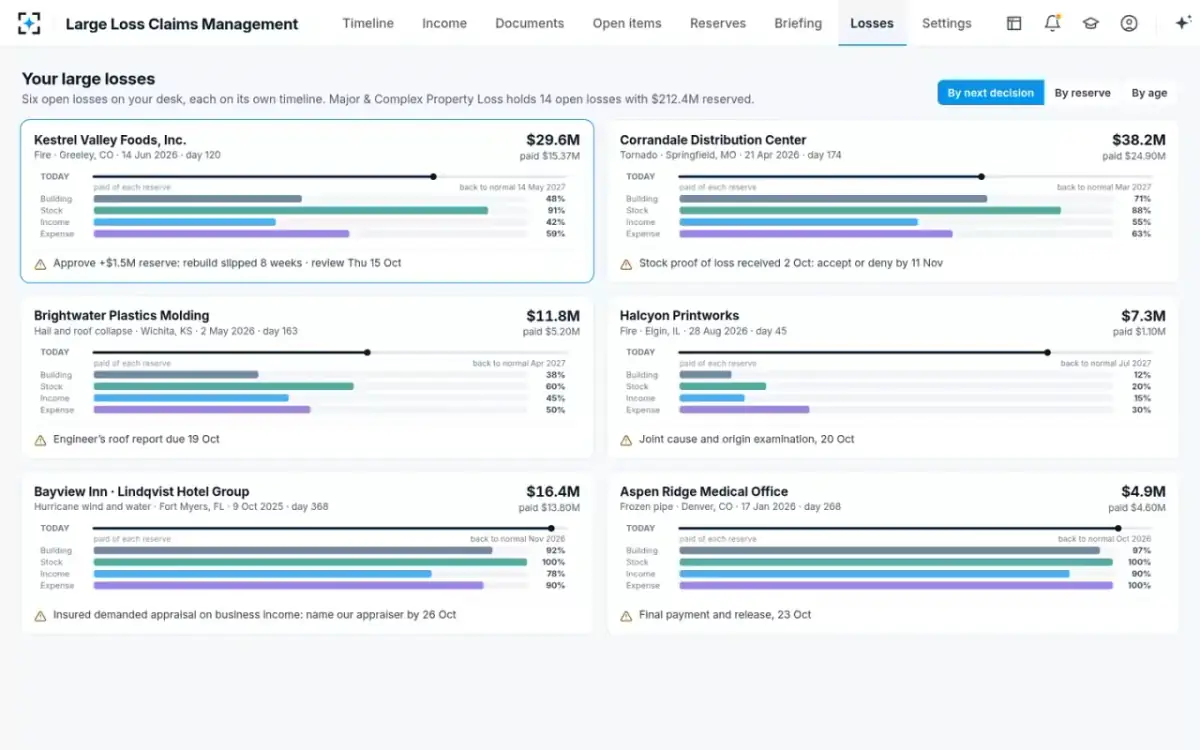
Two things on that screen are what a large loss unit usually lacks. The first is the next decision on every loss, stated in a line: on the Fort Myers hotel, a year after the hurricane, it is naming the carrier's appraiser because the insured has demanded appraisal on business income, the same kind of dispute as in the Maryland case above. The second is the share of each reserve already paid, per coverage part, which shows at a glance where the money still at risk sits. On the frozen-food plant, the stock reserve is 91% paid and business income 42%.
One loss across a year: a lane per coverage part
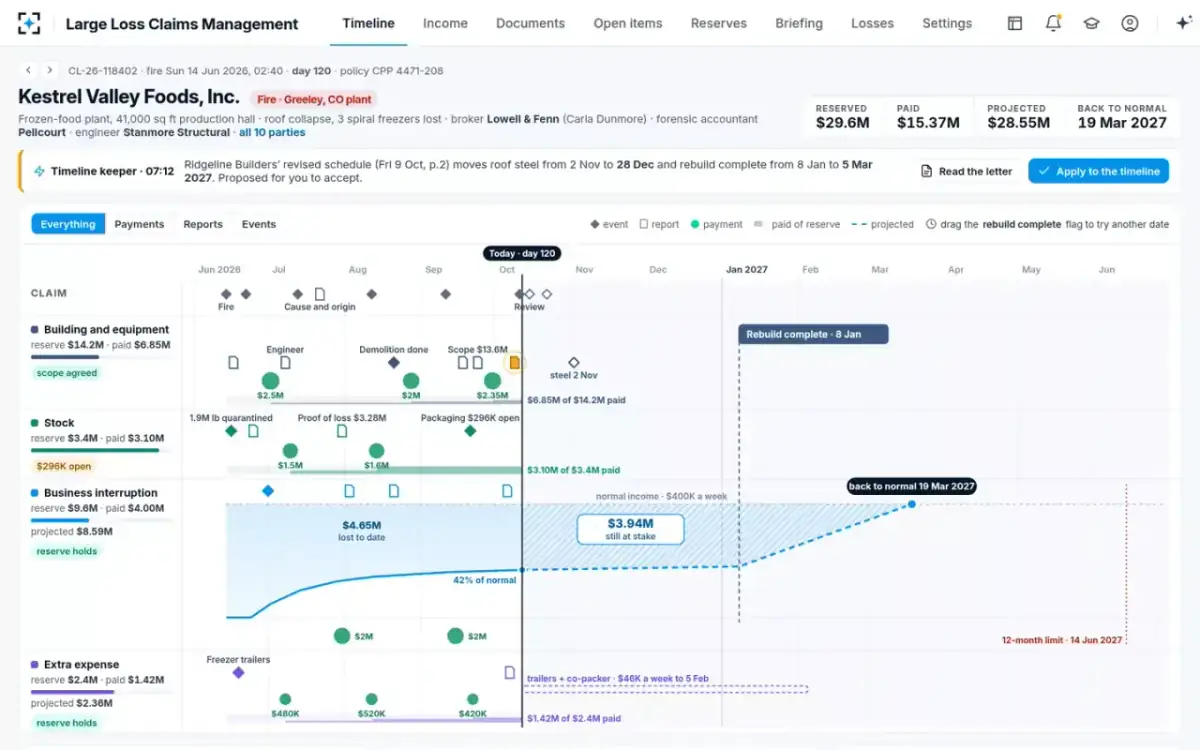
On that loss, a contractor's revised schedule arrived on a Friday; by 09:14 on Monday the adjuster had accepted the new rebuild date, and by 09:20 the director had approved a $1.5 million reserve increase. Moving the income projection and the reserve on the day a document moves the date, rather than at the next quarterly review, is the solution's design target. To see the whole loss screen by screen, start from Large Loss Claims Management.
Questions people ask
What is a large loss adjuster?
A large loss adjuster, often titled general adjuster or major and complex loss adjuster, is a carrier's senior adjuster for claims above its large loss threshold. The role coordinates the experts, the insured, the broker and the reserves across every coverage part, usually on a handful of open losses at a time rather than dozens of small claims. The Bureau of Labor Statistics notes that adjusters are assigned "larger, more complex claims" as they gain experience.
How many commercial claims were there after Hurricane Milton?
Florida insurers reported 23,901 commercial property claims from Milton, plus 3,767 commercial residential claims and 466 reported under a separate business interruption line, in data as of 9 December 2025 (Florida OIR). The commercial property claims carried $1,028,401,242 of incurred loss, and 47.5% of them were closed fourteen months after landfall.
How long do commercial property claims stay open?
There is no national measure, but Florida's hurricane data gives a rough guide: about 43% closed at eight months after Helene, 47.5% at fourteen months after Milton and 79.8% at twenty-nine months after Ian. Claims with a business income dispute can run longer still; the Maryland restaurant fire of February 2015 was still before a federal court in 2022.
Is business interruption a separate claim from the property damage?
Often it is a separate coverage part of the same commercial policy, as in the Maryland restaurant case, with its own limit, its own proof of loss and its own measurement, under one claim. Its amount depends on the property claim, because lost income is paid for the period the property should take to be rebuilt. That link is what keeps the two parts moving together.
Who decides that a claim is a large loss?
The carrier does, by its own written threshold and authority rules; regulators do not define the term. A carrier can route a claim on its expected incurred loss and on its features, such as business income or an expert-led investigation, and move it later if the estimate grows.
What is a big loss in insurance for a reinsurer?
For a reinsurer, a large loss is one that reaches into its layer: under a per-risk treaty, any single loss above the carrier's retention. That is why carriers advise their reinsurers as a reserve approaches or passes the retention, as the fictional sample carrier does on any change over $1 million once a loss is above its $10 million retention.