In US business income insurance, the period of restoration and the extended period of indemnity are two different stretches of time with two different end dates. The period of restoration is the time the policy pays lost net income and continuing expenses while the property is out of action: it begins shortly after the damage and ends when the property should have been repaired or rebuilt with reasonable speed, or when the business resumes at a new permanent location. The extended period of indemnity, which the standard forms call extended business income, starts only when the property is actually repaired and operations actually resume, and pays the income shortfall while sales climb back, until the business could reach its pre-loss level or a fixed number of days runs out. One period is measured on what should happen; the other on what did.
Botminds' Large Loss Claims Management keeps the two apart on every large commercial loss, because a business income reserve built on the wrong one is wrong by months. This guide uses the policy wording that federal courts have quoted, and one fictional sample loss from the solution, a frozen-food plant fire in Colorado, to put both periods on the same calendar. The plant, its people and its figures are invented sample data, not a customer's result.
The two periods, row by row
Period of restoration: 72 hours after the damage for business income; immediately for extra expense
Extended period of indemnity (extended business income): The date the property is actually repaired, rebuilt or replaced and operations resume
Period of restoration: The earlier of: when the property should be repaired, rebuilt or replaced with reasonable speed and similar quality; or business resumes at a new permanent location
Extended period of indemnity (extended business income): The earlier of: when operations could be restored, with reasonable speed, to the pre-loss income level; or a fixed number of consecutive days
Period of restoration: What should happen: a reasonable rebuild, whatever the actual one did
Extended period of indemnity (extended business income): What did happen: the actual reopening, then the actual recovery
Period of restoration: As long as the rebuild should take: 177 days, 12 to 15 months and 23 months in three cases cited here
Extended period of indemnity (extended business income): 30, 90, 180 or 365 days in the forms and endorsements quoted below
Period of restoration: Still measured to when the property should have been rebuilt
Extended period of indemnity (extended business income): Nothing is payable: the period never starts
What is the period of restoration in insurance?
The period of restoration is the window during which a business income policy pays for lost income caused by physical damage to the insured property. The standard business income form quoted by a federal court in Connecticut defines it as the period of time that "a. Begins: (1) 72 hours after the time of direct physical loss or damage for Business Income coverage; or (2) Immediately after the time of direct physical loss or damage for Extra Expense coverage", and ends on the earlier of the date the property "should be repaired, rebuilt or replaced with reasonable speed and similar quality" or "The date when the business is resumed at a new permanent location."
Two words carry the weight: should be. The end of the period is not the day the contractor actually finishes, and not the day sales return to normal. It is the day a reasonably fast rebuild of similar quality would have finished. That makes the period of restoration an estimate that has to be argued from evidence, usually an engineer's view of a reasonable schedule set against the contractor's actual one. Why that estimate moves, and what moves it, is the subject of when the period of restoration ends.
What is the extended period of indemnity?
The extended period of indemnity is extra time, after the property is restored and the business reopens, during which the policy keeps paying the income the business is still losing because customers and sales have not come back. In the forms courts have quoted it appears as extended business income. The Travelers form in a New Jersey case paid for the period that "(a) Begins on the date property (except “finished stock”) is actually repaired, rebuilt or replaced and “operations” are resumed" and ends on the earlier of the date operations could be restored to their pre-loss income level or 180 consecutive days later; an endorsement on that policy extended the 180 days to 365.
The number of days is the part a buyer chooses. A Louisiana restaurant's form set extended business income at 30 days, but the policy provided that "the number 30 in the provision regarding Extended Business Income shall be replaced with the number shown in any Declaration for an ‘Extended Period of Indemnity.’" The restaurant had bought 90. A New York form in a 2022 case kept the 30 days (Sinatra). So "extended period of indemnity" in a declarations page is usually the purchased length of extended business income, not a separate coverage.
Extended business income in the policies courts have read: the days differ, the trigger does not
| Case | Days in the form | Days actually bought | Starts when |
|---|---|---|---|
| Island Concepts (E.D. La. 2014), restaurant, Hurricane Isaac | 30 | 90, by an “Extended Period of Indemnity” on the declarations | Property actually repaired and operations resumed |
| Milk Industry Management (D.N.J. 2018), dairy distributor, warehouse fire | 180 | 365, by endorsement | Property actually repaired and operations resumed |
| Rod & Reel (D. Md. 2018), restaurant and resort, fire | 180 in the quoted form | as amended by the declarations | Property actually repaired and operations resumed |
| Sinatra & Co. (W.D.N.Y. 2022), apartment building, fire | 30 | not stated | Property actually repaired and operations resumed |
Should be versus actually did: the difference courts draw
Courts treat the period of restoration as a hypothetical and the extended period as a fact, and that difference decides cases. In the New Jersey dairy case the warehouse the insured depended on was destroyed and never rebuilt, so the insured never reopened there. The court held that business income was still owed for the time the warehouse should have taken to rebuild, but that extended business income was not owed at all, because its starting event never happened:
"This difference between “would have” and “should have” in the BI provision and “actually did” in the Extended BI provision comports with the purpose of Extended BI"
U.S. District Court for the District of New Jersey, Milk Industry Management v. Travelers (2018)
The purpose the court had in mind, quoting an earlier California decision, is to provide "a cushion for the time after the ‘Period of Restoration’ when the insured is back in business but still not doing business at the same volume as before." Restoration covers the gap while the business cannot operate; extended indemnity covers the slope back up once it can.
Two consequences follow for anyone setting a reserve. First, the period of restoration can end on a date when nothing has actually happened yet, if a reasonable rebuild would have finished by then. Second, the extended period cannot be counted from the fire, from the end of the restoration period, or from any projected date; it is counted from an actual reopening, so a reserve for it is a reserve for something contingent.
One fire drawn on both periods
On the solution's sample loss, the fire struck at 02:40 on Sunday 14 June 2026. The policy pays business income on an actual-loss-sustained basis for up to 12 months, after a 72-hour waiting period, with a 90-day extended period of indemnity and an $18.0 million limit shared with extra expense. On day 120 the adjuster accepted the contractor's revised schedule, which puts rebuild complete on 5 March 2027, and the forensic accountant assumes a ten-week ramp back to full production after that.
One plant fire on both clocks: restoration to 5 March, then the ramp inside 90 days
- 72-hour waiting period72 h
- Restoration: the plant cannot produce37 wks
- Not yet startedwaits for the reopening
- Ramp back to full production10 wks
- Unused days of the 9020 d
- Actual loss sustained, 12 months52 wks
Drawn this way, the solution's policy checks become readable. Income lost in the first 72 hours, 14 to 17 June, is not counted. Back to normal on 14 May 2027 falls inside the 12-month limit. The ten-week ramp ends inside the 90-day extended period, which runs to 3 June. Projected business income and extra expense together, $13.13 million, sit inside the $18.0 million limit. Each check cites the page of the policy it rests on.
When does the period of restoration begin?
For business income it usually begins 72 hours after the physical damage, and for extra expense immediately, in the forms quoted above; some policies set a different number of hours in the declarations. The New Jersey form, for example, began business income coverage "once the number of hours of the applicable Business Income hour deductible, if any, expires". The opening hours are therefore a deductible measured in time. A business that is shut for two days after a fire, then reopens fully, may have no business income claim at all.
The start matters less for the reserve than the end, but it matters for the measure. A forensic accountant's month-by-month table that starts its losses on the day of the fire overstates the claim by the waiting period. On the sample loss, the first partial month runs from 14 to 30 June with $0.78 million of loss, and the solution's waiting-period check is what keeps the first 72 hours out of it.
Why mixing the two dates breaks the reserve
Mixing the two periods moves money between a certain obligation and a contingent one, and that distorts the reserve in both directions. If the ramp back to full sales is counted inside the period of restoration, the reserve pays for weeks the restoration clause does not cover; if the policy's extended days are shorter than the ramp, part of that ramp is not covered at all. The sample plant's ten-week ramp fits inside its 90 days. Under the 30-day form the Louisiana restaurant started with, the same ramp would leave about 40 days of lower sales uninsured.
The error happens in practice. In the Louisiana case, the appraisal umpire wrote that the policy he had seen "included extended coverage for a maximum of 30 days", when the declarations showed 90 had been bought; the court called his statements "inconsistent with the policy". The award survived only because the umpire had in the end adopted the insurer's estimate of 84 days. A reserve or a calculation that picks up the form's default and misses the declarations makes the same mistake without anyone noticing.
“My number is only as good as the restoration date you give me.”
Hannah Brisco, CPA, the fictional sample forensic accountant
Does the policy's expiration cut short the period of restoration?
No, in the standard wording: the form quoted in the Maryland case says "The expiration date of this policy will not cut short the ‘period of restoration’." A fire in the eleventh month of a policy year is paid for its full reasonable restoration even though the policy term ends a month later. What can cut the period short is a time limit written into the coverage itself, such as the sample policy's 12 months of actual loss sustained, and the separate exclusion for extra time caused by enforcing building codes.
That exclusion is precise. The same form says the period of restoration "does not include any increased period required due to the enforcement of any ordinance or law" that regulates construction, use or repair, or requires pollutants to be cleaned up. On the sample loss, the new building permit requires a sprinkler upgrade, and whether the policy's ordinance or law coverage reaches it is a coverage question the solution leaves to the adjuster.
Who decides how long each period is?
The insurer and the insured agree it if they can; if they cannot, the answer depends on the appraisal referral and the courts. A Louisiana federal court held that where a policy defines the period clearly, "the calculation of that period, ‘unless subject to legal challenges, is a factual question about damages.’" It let the appraisal panel decide both periods; the panel found a primary loss period of 177 days. In a Maryland case the parties had agreed to keep the period of restoration out of the appraisal; the panel stated one anyway, and the court refused to confirm the award as drafted (2018 opinion). The 12 months the insurer accepted and the 15 the insured argued were worth $235,275 on the appraisers' own monthly figures, our arithmetic from the $436,364 paid and the $671,639 award.
How Large Loss Claims Management keeps the two periods apart
The solution's income projector reads the declarations and the business income form for each loss, and checks the waiting period, the time limit and the extended period of indemnity against every projection, citing the page. It never sets the period of restoration or the amount payable: the restoration date is proposed by the timeline keeper from the document that moved it and accepted by the adjuster, and the measured loss belongs to the forensic accountant.
Business income for one loss: the recovery, the months, and the policy checks with their pages
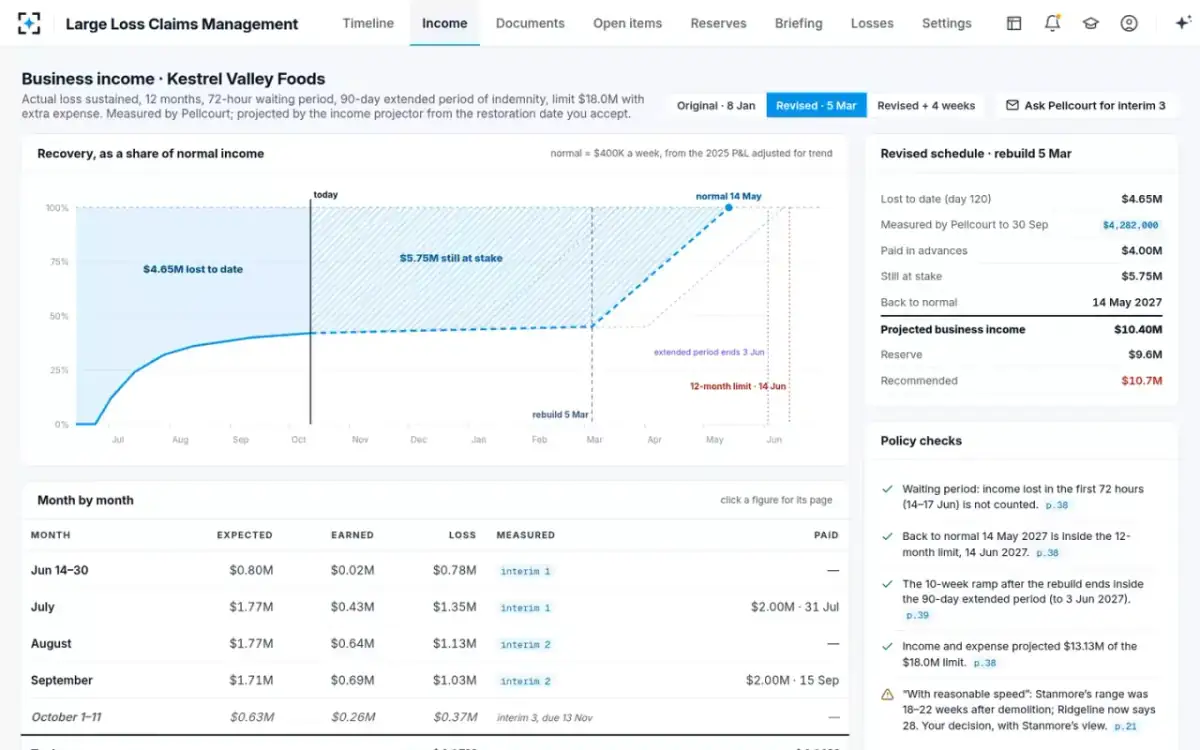
The same separation shows up in the arithmetic of any calculator, which is set out in the business interruption calculator. To see the full sample loss, start from Large Loss Claims Management.
Questions people ask
Is the extended period of indemnity the same as extended business income?
In the US forms courts have quoted, yes in effect: extended business income is the coverage, and an "Extended Period of Indemnity" on the declarations sets how many days it runs. In the Louisiana case the form's 30 days were replaced by the 90 shown on the declarations.
Can a business buy a longer extended period of indemnity?
Yes. The policies in the cases above ran from a 30-day default to 90 days bought on the declarations, and from 180 days to 365 by endorsement. A longer period matters most for businesses whose customers take months to return after a reopening.
Does the period of restoration end when the business reopens?
It ends on the earlier of two dates: when the property should have been repaired with reasonable speed, or when the business resumes at a new permanent location. Reopening at the original site does not itself end it, and a slow reopening does not extend it beyond what a reasonable rebuild would take.
What happens to business income if the business never reopens?
Business income is still owed for the time a reasonable rebuild would have taken, but extended business income is not, because it starts only when operations actually resume. That was the result for the New Jersey dairy distributor whose warehouse was never rebuilt.
What is period of restoration business income?
It is the business income the policy pays during the period of restoration: the net income the business would have earned plus its continuing normal operating expenses, less what it still earns, from the end of the waiting period until the property should have been restored. Extra expense runs over the same period, starting immediately.