A large loss property adjuster is the insurer's senior adjuster on a commercial property claim too big or complex for an ordinary desk: a plant fire, a storm-damaged hotel, a warehouse roof collapse. Carriers title the role general adjuster, large loss adjuster or major and complex loss adjuster. The work is less about estimating damage than about holding the whole loss together: appointing the engineer, the cause-and-origin investigator and the forensic accountant, agreeing scope with the contractor, paying advances, setting and moving reserves, and keeping the dates and amounts in everyone's documents consistent while the claim runs for a year or more.
Botminds' Large Loss Claims Management is built for that person. It places every report, letter, invoice and proof of loss on a lane of one timeline per loss, and six agents read each document as it arrives, so the adjuster is no longer the only place the whole picture exists. This guide follows a fictional sample adjuster, Renata Okafor, on one loss: a frozen-food plant fire in Greeley, Colorado on 14 June 2026, seen on day 120. The people and companies are invented and every figure about the loss is sample data, not a customer result.
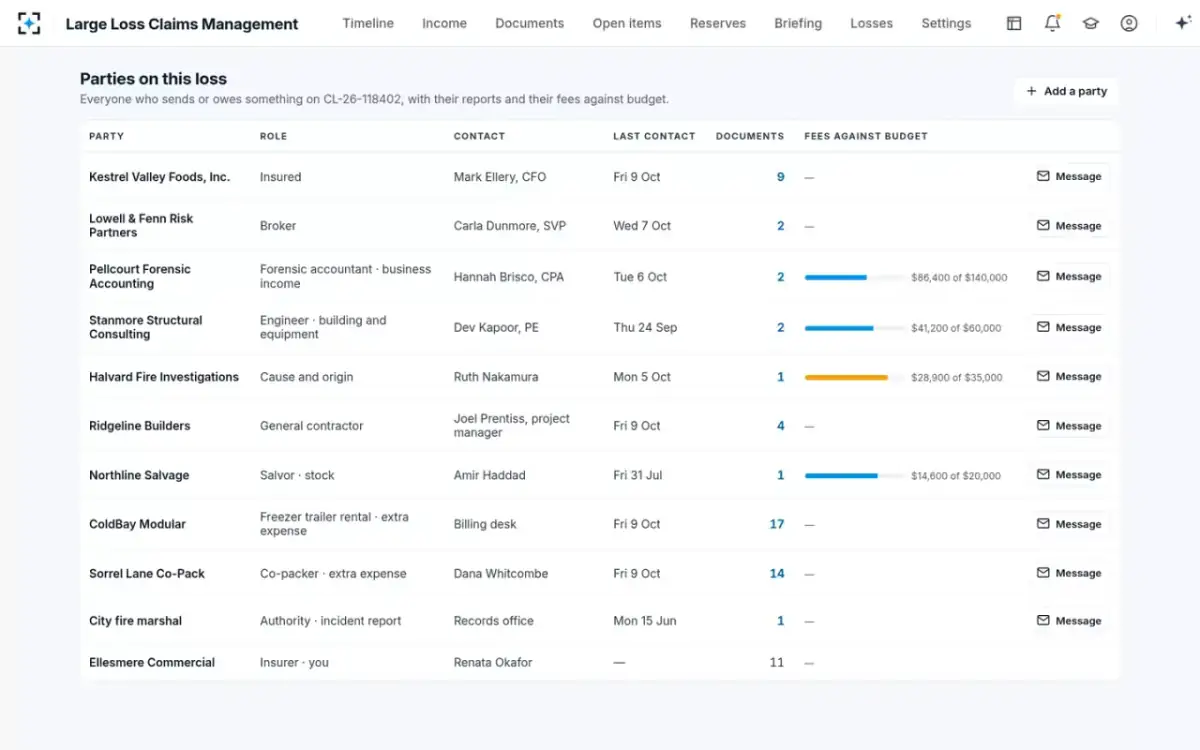
Ten parties on one fire loss, and what each sends the large loss adjuster
| Party | Documents in 120 days | What they send | What their documents move |
|---|---|---|---|
| Kestrel Valley Foods (the insured, through its CFO) | 9 | Sworn proofs of loss, P&Ls and sales ledgers | The stock claim and the income measure |
| Lowell & Fenn Risk Partners (broker) | 2 | Requests on the insured’s behalf, such as extending the co-packer | Extra expense decisions and their dates |
| Pellcourt Forensic Accounting | 2 | Interim reports measuring lost income to date | Business income paid and reserved |
| Stanmore Structural Consulting (engineer) | 2 | Engineering report: scope and a rebuild estimate of 18–22 weeks after demolition | The building scope, and what “reasonable speed” means |
| Halvard Fire Investigations (cause and origin) | 1 | Cause and origin report | Coverage, and a possible recovery from a third party |
| Ridgeline Builders (general contractor) | 4 | Agreed scope and estimate, schedules, draw requests | The building reserve and the rebuild date |
| Northline Salvage | 1 | Stock quarantine and salvage bids | What the stock claim nets after salvage |
| ColdBay Modular (freezer trailers) | 17 | Weekly rental invoices | Extra expense paid to date |
| Sorrel Lane Co-Pack | 14 | Co-packing invoices and quotes | Extra expense, and income the insured keeps earning |
| City fire marshal | 1 | Incident report | Date, time and origin of the fire |
What does a large loss adjuster do?
A large loss adjuster investigates, values and settles a commercial property claim across every coverage part, and coordinates the outside experts who establish the facts. Federal labour data describes claims adjusters generally as people who may "consult with other workers, such as accountants, architects, construction workers, engineers", and notes that as adjusters gain experience "they are assigned larger, more complex claims." On a large loss, that consultation is the job. The adjuster does not rebuild the income figure; the forensic accountant does. The adjuster does not price the steel; the contractor and engineer do. The adjuster decides what to accept, when, and what it means for payment and reserves.
The weekly reality on one open loss is a stream of documents that each change something. A revised construction schedule moves the rebuild date. A forensic accountant's interim report measures lost income to the end of the month. A co-packer quote extends an extra expense. An invoice from a freezer-trailer vendor arrives every week. Each has to be read, filed against the right coverage part, checked against the reserve, and answered or chased. On the sample loss, ten outside parties sent 53 documents in 120 days, and the carrier's own letters and payments added 11 more.
One large loss at day 120, by the numbers the adjuster carries
64
documents on the loss in 120 days
from 10 parties and the carrier
$29.6M
reserved across four coverage parts
$15.37M paid
13
open items owed by someone
two of them late
6
open large losses on the same adjuster’s desk
Who sends what on a large commercial loss
Every party on a large loss produces paper that moves a figure somewhere else, which is why the table above has a fourth column. The engineer's estimate of how long the rebuild should take is not just a building document; it is the main input to how much lost income the policy pays, because business income is paid for the time the property should take to be rebuilt. The contractor's schedule is not just a construction document; when it slips, the income projection and the reserve move with it.
Experts' fees run alongside. On the sample loss, the forensic accountant had billed $86,400 of a $140,000 budget by day 120, the engineer $41,200 of $60,000, the cause-and-origin firm $28,900 of $35,000 and the salvor $14,600 of $20,000. Watching those budgets is part of the job, and a reason why the parties list is a working tool rather than a contact sheet.
Everyone who sends or owes something, with their documents and fees against budget
What is a general adjuster? Two meanings of the title
In commercial insurance, general adjuster is a carrier's or an adjusting firm's title for its most senior property adjusters, the people who take large and complex losses; it is a job title, not a licence. In the federal flood program the same words mean something narrower: FEMA's own General Adjusters review other adjusters' flood claims. The NFIP Claims Manual says "The General Adjuster re-inspection program is designed to maintain quality claims processing within the NFIP", and lists five kinds of re-inspection, from special assists to random quality checks.
The two meanings share an idea: the general adjuster is the person trusted with the claims where getting it wrong is most expensive. A searcher who meets the title in a flood file is looking at a federal reviewer; one who meets it on a commercial fire is looking at the carrier's lead adjuster. Industry bodies also award designations to senior property adjusters; the licences that states require are a separate matter, set out below.
Does a large loss adjuster need a license?
Usually yes, but the licence depends on who employs the adjuster, not on the size of the claim. States license adjusters by type. Florida, for example, defines a company employee adjuster as an all-lines licensee on an insurer's own staff (§626.856), with separate definitions for independent adjusters working through adjusting firms and for public adjusters who work for the policyholder. No state has a separate "large loss" licence; the large loss unit is the carrier's own organisation.
On a big commercial claim the adjuster often meets a public adjuster on the other side. Florida caps what a public adjuster may charge: no more than "Ten percent of the amount of insurance claim payments or settlements" on claims made in the year after a declared emergency, and twenty percent on claims not tied to one, with lower caps where the insurer pays the policy limit for a coverage part quickly. A large loss adjuster should expect the insured's side to be professionally represented, and to argue the period of restoration and the income baseline as hard as the carrier does.
The real job: keeping dates and amounts consistent
The most expensive mistakes on a large loss are inconsistencies between the carrier's own documents, and the court record has examples. In a California case, the insurer paid business income for a restoration period of eight and a half months; the contractor's project manager testified that the repairs could have been done in five months, taking seven only because of rain. But one of the insurer's own adjusters had written to the insured that "[Travelers] estimate[s] the period of restoration to be twelve months", apparently based on its own cost consultant's figures. The court held that the letter alone raised a genuine dispute and refused summary judgment on the income claim.
In a Louisiana case after Hurricane Isaac, a restaurant had bought a 90-day extended period of indemnity, shown on one of its declaration pages. The appraisal umpire said the policy he had seen "included extended coverage for a maximum of 30 days" and that additional coverage "may have been purchased for which we have not been provided the policy." The court found those statements "inconsistent with the policy", and upheld the award only because the umpire had in the end adopted the insurer's own 84-day estimate, which happened to fit inside the 90 days. One page of the policy, missed, became a ground for challenging the award in federal court.
“I know where this loss is. It’s just that the only copy is in my head.”
Renata Okafor, the fictional sample general adjuster
Neither mistake required bad judgment. Each needed only one document on the file that disagreed with another, unnoticed. A large loss adjuster on six open losses is the reconciliation engine for every date and every dollar across hundreds of documents, and the only copy of that reconciliation is usually in email and memory.
Where a large loss adjuster's week goes
On Botminds' own estimate, most of an adjuster's hours on one open large loss go to reading and filing, re-working the income projection and reserves, chasing open items and briefing leadership, not to deciding. The estimate below is ours, made for the sample loss; it is not a measurement from any carrier.
Hours a week on one open large loss: Botminds' estimate, by hand and with the solution
| Task | By hand | With the solution |
|---|---|---|
| Reading and filing new reports, letters and invoices | 2 h | 0.5 h |
| Re-working the income projection and reserves | 1.5 h | 0.5 h |
| Chasing open items and drafting status letters | 1.5 h | 0.5 h |
| Writing the leadership briefing | 1 h | 0.5 h |
| Answering “where are we?” from broker and leadership | 1 h | 0.5 h |
| Total for one loss | 7 h | 2.5 h |
The arithmetic of a desk explains why reserves move late. Six open losses at seven hours each is a full working week before any site visit, negotiation or coverage analysis. Something has to give, and what usually gives is re-projecting the income and the reserve when a document moves the date. It waits for the forensic accountant's next interim or the quarterly reserve review.
Authority: what the large loss adjuster decides, and what goes up
A large loss adjuster decides coverage questions, accepts dates, pays within a payment authority and changes reserves within a reserve authority; above those limits, a director approves. The sample carrier's rules show the shape: Renata may pay up to $2.5 million and may change a reserve by up to $1.0 million on her own; above that, the Director of Major and Complex Loss approves. Restoration dates are hers to accept. Coverage positions, such as whether code-required sprinklers fall under the ordinance or law coverage, are hers to take, with the policy wording and the experts' views beside her.
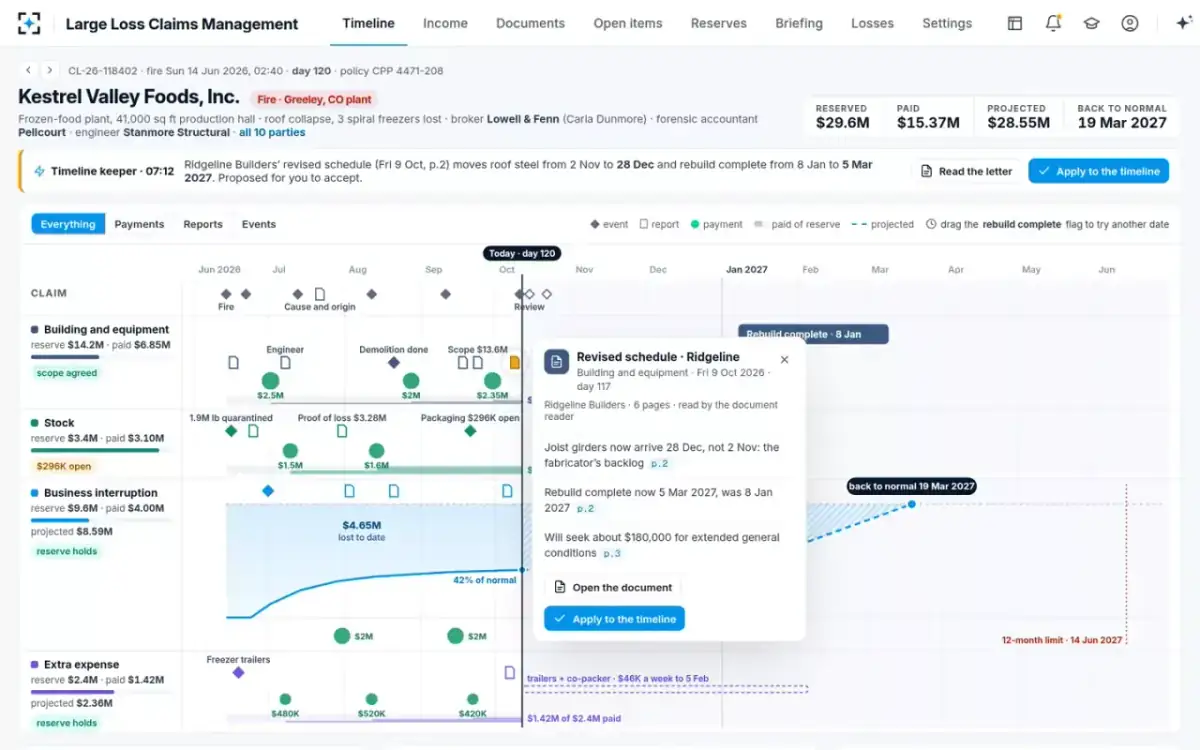
Those limits matter for speed as much as for control. When a contractor's schedule moved the sample plant's rebuild eight weeks, the reserve needed $1.5 million more: over Renata's authority. The director, Victor Allard, approved it at 09:20 the same morning, because the recommendation reached him with the schedule, the projection and four cited reasons. The adjuster's own reserve history matters later, too. In a Michigan case, the insurer's adjuster testified that he had recommended early on that a reserve of the policy limit be set for lost income "because the repairs likely would take up to seven months", pending financial data; the insured then tried to use that reserve as proof of its loss.
A document on its lane: what the agents read from it, with the page
What changes for the large loss adjuster with Large Loss Claims Management
The adjuster keeps every decision and loses most of the clerical reconciliation. In the solution, a document reader takes the dates, amounts and statements from every report with their page; a timeline keeper notices when a document moves a milestone and proposes the move; an income projector re-projects lost income; a reserve adviser compares projections with reserves; an open items tracker drafts chasers and 30-day status letters; and a briefing writer drafts the leadership page. None of them sends anything, pays anything or changes a reserve. How those limits are drawn is set out in what agents may and may not do on a complex claim.
Four people on one large loss, before and after
Today
Six open losses held in email and memory; re-projects when there is time.
With agents
Every document, payment and reserve on one timeline per loss; accepts dates and pays.
Still theirs: Coverage, payments, the restoration date
Today
Sees each loss at the quarterly reserve review.
With agents
Gets a reserve change with its cited reasons the morning the schedule slips.
Still theirs: Approval above the adjuster’s authority
Today
Measures to a restoration date that may already be stale.
With agents
The measured loss sits beside the projection, cited to the interim report.
Still theirs: The measured loss
Today
Asks “where are we?” and waits for a call back.
With agents
Each request is an open item with an owner and a date.
Still theirs: The insured’s case
The difference is not speed for its own sake. It is that the contractor's delay, the forensic accountant's ramp-back assumption and the reserve are reconciled on the day the document arrives, with the page that proves each change. Where large losses come from and why they stay open is covered in what is a large loss claim, and the date at the centre of most disputes in when the period of restoration ends. The whole loss, screen by screen, is on the Large Loss Claims Management page.
Questions people ask
What is a complex claims specialist?
A complex claims specialist is a carrier's adjuster for claims that need expert investigation or long handling, such as large commercial property, business interruption or disputed causation. The title overlaps with general adjuster and large loss adjuster; the common thread is senior authority and outside experts.
How many claims does a large loss adjuster handle?
Far fewer than a field or desk adjuster, because each claim runs for months. No public figure exists for caseloads. In the fictional sample unit, one general adjuster carries six open losses inside a unit holding 14 with $212.4 million reserved.
What is the difference between a large loss adjuster and a public adjuster?
The large loss adjuster works for the insurer, or for an adjusting firm the insurer hires, and decides what the policy pays. A public adjuster is hired by the policyholder to prepare and negotiate its claim, for a fee that some states cap; Florida's cap is 10% of claim payments in the year after a declared emergency and 20% otherwise.
Does a large loss adjuster work with forensic accountants?
Yes, on almost every claim with lost income. The insurer appoints a forensic accountant to measure the business income and extra expense loss from the insured's books, and the adjuster decides what to pay on that measure. On the fictional sample loss, the accountant's interim reports measured $4,282,000 of lost income to 30 September.
How much do claims adjusters earn, and is the job growing?
The Bureau of Labor Statistics puts the 2025 median pay for claims adjusters, appraisers, examiners and investigators at $78,020 a year, and projects a 6% decline in employment between 2025 and 2035. It does not publish separate figures for large loss adjusters.