A large loss checklist is the list of documents, data and decisions a carrier's large loss team needs in the first weeks of a major commercial property loss: the policy with every declaration page and endorsement, the insured's financial records for the business income claim, the experts appointed and their first reports, the contractor's scope and schedule, a sworn proof of loss requested for each coverage part, a reserve with its reasons, and notices to leadership and the reinsurer. The point of a checklist on a large loss is not completeness for its own sake; it is that every later figure, from the restoration date to the reserve, rests on one of these documents, and the ones missing in week four are the ones argued over in month fourteen.
The same list answers a buyer's question. Botminds' Large Loss Claims Management goes live on a carrier's own inputs, its policy forms, reserving guidelines, authority levels and a sample of past losses, and then runs each new loss from the documents below. This guide sets out the first-30-days list, the records a business interruption claim needs, the notices that go up the line, and what a team brings to go live. Examples come from the solution's fictional sample loss, a frozen-food plant fire in Colorado on 14 June 2026; its people, companies and figures are invented, not a customer's result.
The first 30 days of a large loss: a checklist
- The full policy, including every declaration page and endorsement
Limits by coverage part, waiting period, time limit, extended period of indemnity bought, ordinance or law limits. A Louisiana appraisal umpire missed a 90-day extension on one declaration page.
- The cause and origin investigator appointed
Coverage and any recovery from a third party start here; preserve the evidence for a joint examination.
- The engineer appointed, with a rebuild estimate in weeks
The estimate is the first evidence of what “reasonable speed” means for the period of restoration.
- The forensic accountant appointed, with a records request
Several years of financial statements, monthly sales, payroll, the general ledger.
- A sworn proof of loss requested for each coverage part
Commercial forms run the 60 days from the insurer’s request; a late request is a late clock.
- The contractor’s scope, estimate and schedule
The schedule’s substantial completion date feeds the income projection.
- Stock quarantined, inventoried and bid for salvage
Stock is usually the first part that can be proved and paid.
- Advances on undisputed amounts, each tied to its coverage part
Business income advances keep the insured operating while the loss is measured.
- A reserve by coverage part, with a reason for each figure
The reasons are what a director, a reinsurer or a court will ask for.
- Reinsurer notified if the loss can reach the retention
On the sample loss, eight days after the fire.
- A written status to the insured, and a date for the next one
The sample carrier writes every 30 days until every coverage part is decided.
- Open items listed with an owner and a due date
Who owes what: the insured, the broker, each expert, the carrier.
The checklist in use: the sample loss's first ten weeks
A checklist earns its keep when the dates are filled in. On the sample loss, the items arrived in the order below, and the gaps between them are the honest measure of a large loss's opening weeks: the reinsurer knew within eight days, the engineer's report took three and a half weeks, and the forensic accountant's first measure of lost income arrived ten weeks after the fire. Every projection made before 21 August was an estimate without a measured month behind it.
The sample loss's first ten weeks, item by item
| Day | Date | What arrived | Checklist item |
|---|---|---|---|
| 0 | Sun 14 Jun | Fire at 02:40; the fire marshal’s incident report | Notice |
| 8 | Mon 22 Jun | Reinsurer notified under the per-risk treaty | Reinsurer notice |
| 24 | Wed 8 Jul | Engineering report: scope and an 18–22 week rebuild after demolition | Engineer |
| 38 | Wed 22 Jul | Cause and origin report | Cause and origin |
| 41 | Sat 25 Jul | Stock quarantine and salvage bids | Stock |
| 47 | Fri 31 Jul | Sworn proof of loss for stock, $3.28M; first $2M business income advance | Proof of loss; advances |
| 50 | Mon 3 Aug | Sworn proof of loss for business income requested | Proof of loss |
| 68 | Fri 21 Aug | Demolition complete; forensic accountant’s first interim report | Contractor; forensic accountant |
What documents are needed for a commercial fire claim?
A commercial fire claim needs documents from the insured, the experts, the contractor and the carrier, and each decides a different part of the claim. The table lists what the sample loss collected in its first 120 days. By day 120 it held 64 documents from 10 parties and the carrier; the first 30 days produced the ones every later figure depends on.
The documents behind a commercial fire claim, and what each decides
| Document | From | What it decides |
|---|---|---|
| Policy, declarations and endorsements | Carrier and broker | Limits, waiting period, time limit, extended period, ordinance or law |
| Incident report | Fire marshal or police | Date, time and origin of the loss |
| Cause and origin report | Investigator | Coverage; recovery from a third party |
| Engineering report | Structural engineer | Scope; a reasonable rebuild time |
| Scope, estimate and schedule | Contractor | Building reserve; the restoration date |
| Stock inventory and salvage bids | Insured and salvor | The stock claim, net of salvage |
| Financial statements, ledgers, payroll | Insured | The business income baseline |
| Interim reports | Forensic accountant | Business income measured to date |
| Sworn proofs of loss, one per part | Insured | The amount claimed; the payment clocks |
| Extra expense invoices | Vendors | Extra expense paid |
The insured's duties after a loss, as the policy states them
The checklist on the insured's side is written into the policy. The commercial form quoted by a federal court in New Jersey lists eight duties in the event of loss, from notifying the police if a law may have been broken and giving prompt notice, to letting the insurer inspect the property and "examine your books and records", sending a signed, sworn proof of loss within 60 days of the insurer's request, and cooperating in the investigation. The last duty matters most for business income: "If you intend to continue your business, you must resume all or part of your “operations” as quickly as possible."
That duty is why a large loss checklist includes the extra expense decisions early. Renting freezer trailers and contracting an outside co-packer, as the sample plant did within weeks, costs money under extra expense but reduces the business income loss, and the policy expects it. A carrier that agrees those arrangements in the first 30 days, in writing and with a review date, avoids arguing later about whether the insured resumed "as quickly as possible". What each sworn proof must contain is covered in the sworn statement in proof of loss.
What records does a business interruption claim need?
The business's own financial history, in enough detail to rebuild a normal month, plus evidence of what it has earned and spent since the loss. The standard form tells the adjuster to base the loss on the business's net income before the damage and its likely net income without it, and on other sources including the business's bills, invoices, deeds, liens and contracts. A Michigan court listed what one insured had surrendered: "signed corporate tax returns; detailed general ledgers, trial balances, and journal entries with explanations; bank statements, check registers and bank reconciliations; paid bills", and payroll records.
That insured still lost its income claim, because nobody turned the records into a calculation. A checklist should therefore name both the records and the analysis: who will measure the loss, from which months, by when. On the sample loss, the forensic accountant's first interim report arrived on 21 August, ten weeks after the fire, and every later projection rested on it.
Records to request for a business interruption claim
- Three years of profit and loss statements and tax returns
The baseline: what the business was doing before the loss.
- Monthly sales and production records
Seasonality, and the trend the accountant may apply.
- General ledger, trial balances, journal entries
Which expenses continue and which stop.
- Payroll records
Payroll is a continuing expense the forms include.
- Bank statements and paid bills since the loss
What the business actually earned and spent while damaged.
- Contracts with customers and suppliers
Lost contracts, penalties, outside production arrangements.
- Invoices for every extra expense
Temporary premises, rented equipment, outside production.
Requests to avoid: information not reasonably required
A checklist can also go too far. California's claims regulation requires every insurer to "conduct and diligently pursue a thorough, fair and objective investigation" and forbids it to "persist in seeking information not reasonably required for or material to the resolution of a claim dispute." On a large loss, the line is drawn by the coverage parts in play: three years of ledgers are material to a business income claim and not to a building claim with no income at stake. A request list tied to coverage parts, with the reason for each item, is easier to defend than a generic one.
Large loss report and large loss notice: what goes up the line
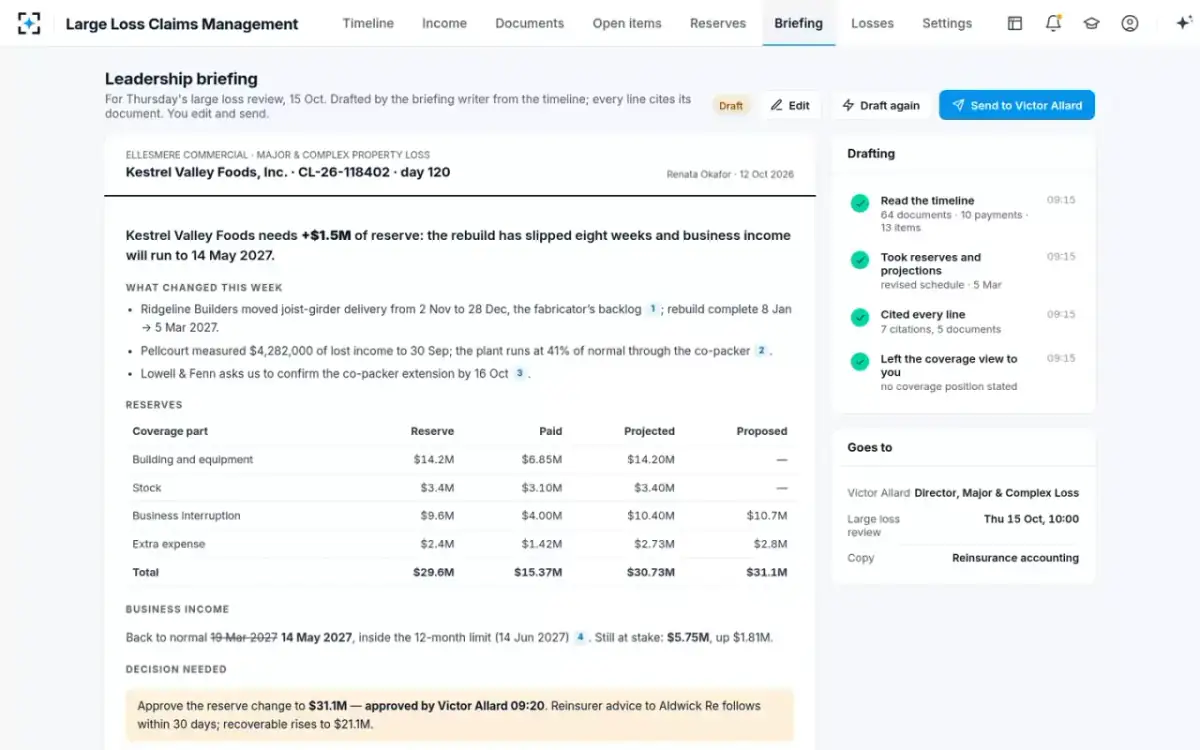
A large loss report is the internal briefing on a loss for claims leadership, usually at a regular large loss review; a large loss notice is the first alert that a loss has crossed the carrier's threshold. Both should state the loss in a sentence, what changed since the last report, the reserves by coverage part, the business income position and the decision needed. Regulators collect their own versions after catastrophes: Florida, for example, requires insurers to report claims and losses on dates it sets under its catastrophe reporting rules (Florida OIR).
A one-page large loss report for Thursday's review, every line cited
What to send the reinsurer on a large loss
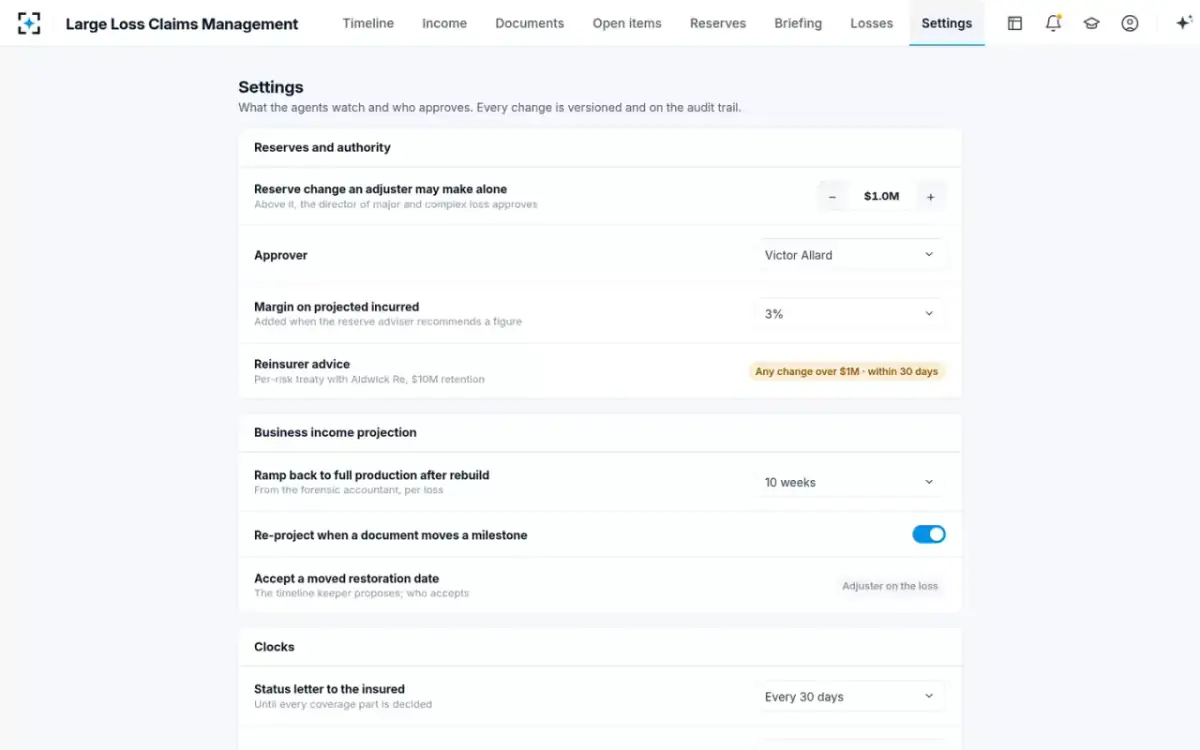
What the reinsurer needs is set by the treaty, not by regulation, so the treaty is the first document on this part of the checklist. The sample carrier's per-risk treaty has a $10 million retention, and its rule is to advise the reinsurer of any change over $1 million on a loss above it, within 30 days. On the sample loss the reinsurer was notified on 22 June, eight days after the fire. When the reserve rose by $1.5 million on 12 October, the recoverable moved from $19.6 million to $21.1 million, and the advice was drafted the same day for reinsurance accounting to send.
The sample loss and its reinsurer
$10M
per-risk treaty retention
8days
from the fire to the reinsurer’s notice
$21.1M
recoverable after the October change
from $19.6M
30days
to advise any change over $1M, under the carrier’s rule
What a team brings to go live with Large Loss Claims Management
Going live needs less than buyers usually expect, because the solution runs on the documents a large loss already produces. The carrier supplies four things: its policy forms, so the policy checks can cite the right pages; its reserving guidelines, including any margin it adds to projections; its authority levels and approvers; and a sample of past large losses, on which the solution is tested before it touches a live one. The rest are settings the carrier chooses: the large loss threshold, the ramp-back assumption the forensic accountant supplies per loss, whether a moved milestone triggers re-projection, and the clocks for status letters and decisions.
One list, two uses: a new loss and a go-live
On a new large loss: This loss’s declarations, forms and endorsements
To go live with the solution: Your policy forms, so every check can cite its page
On a new large loss: A reserve by coverage part, with reasons
To go live with the solution: Your reserving guidelines and any margin you apply
On a new large loss: Who decides dates, payments and reserves on this loss
To go live with the solution: Your authority levels and named approvers
On a new large loss: The insured’s financial records
To go live with the solution: A sample of your past large losses, to test on
On a new large loss: Status letters and proof of loss dates for this loss
To go live with the solution: Your rules for each, as settings
The carrier's rules, set once and versioned
Where the solution does not fit is just as clear. It does not replace the forensic accountant, the engineer or the adjuster's coverage judgment, and it sends nothing on its own. A team that wants to see whether it fits should start with a handful of closed large losses it knows well and ask where the restoration date moved, when the reserve followed, and what the briefings said at the time. What the agents may do on those losses is set out in complex claims management solutions, and the role they support in the large loss property adjuster. The full sample loss is on the Large Loss Claims Management page.
Questions people ask
What is a large loss report?
An internal report on a large loss for claims leadership, usually prepared for a regular large loss review. It states the loss, what changed, the reserves by coverage part, the business income position and the decision needed; the sample report runs to one page with seven citations to five documents.
What is a large loss notice?
The first alert that a claim has crossed the carrier's large loss threshold, sent to the large loss unit and leadership, and to the reinsurer where the treaty requires it. On the fictional sample loss the reinsurer was notified eight days after the fire.
How many documents does a large loss generate?
No published figure exists. The fictional sample loss had 64 documents from 10 parties and the carrier after 120 days, including 17 from the freezer-trailer vendor and 14 from the co-packer.
What should a business gather first after a large loss?
Its policy, every page; photographs and records of the damage and of what it spends protecting the property; three years of financial statements and monthly sales; payroll records; and contracts with key customers and suppliers. The policy also expects it to resume operations, fully or partly, as quickly as possible.
Who sends status letters on a large loss?
The adjuster on the loss, under the state's rules and the carrier's own. California requires written notice every 30 days while a decision is pending; the sample carrier applies a 30-day letter on every loss, drafted by the solution and sent only by the adjuster.