A sworn statement in proof of loss is a document in which the policyholder states, under oath, the facts of a loss and the amount it claims: when and how the loss happened, who has an interest in the property, what each item was worth and what was lost, what other insurance applies, and what is now being claimed. Property policies require it as a condition of payment. New York's standard fire policy asks for it within sixty days after the loss, and the commercial forms quoted in federal court opinions require it within 60 days after the insurer asks for it. Once it arrives, the insurer's own clocks start: to accept or deny, to explain what more it needs, and to pay.
On a large commercial loss the sworn proof is rarely one document. There is usually a proof for the building, one for the stock, and one or several for business income as the loss accrues, each starting its own clock. Botminds' Large Loss Claims Management tracks every proof as an open item with an owner, a date and the document that asked for it. This guide follows the proofs on the solution's fictional sample loss, a frozen-food plant fire in Colorado, and sets out what courts and statutes say about the rest. The people, companies and figures on the sample loss are invented sample data, not a customer's result.
Three sworn proof of loss clocks, counted from different events
- Loss to proof due60 days
- Proof to payment due60 days
- Request to proof due60 days
- Proof and agreement to payment30 days
- Request to due date60 days
- Late10 d
What is a sworn statement in proof of loss?
It is the policyholder's formal claim: a statement of the loss and the amount, signed and sworn, that the policy makes a condition of payment. New York's statute, which sets out the standard fire policy, requires the insured to render "a proof of loss, signed and sworn to by the insured," stating the insured's knowledge and belief as to a list of facts. The commercial forms quoted in federal opinions phrase the duty as one triggered by the insurer: "Send us a signed, sworn proof of loss containing the information we request to investigate the claim. You must do this within 60 days after our request. We will supply you with the necessary forms."
The oath is the point. A sworn proof puts the insured's account on the record, and the amounts in it become the claim the insurer has to accept, reject or answer. It is separate from an examination under oath, which the same standard policy also lets the insurer require, and from the insurer's own inspection of the books and records. On a large loss it is often the first document in which the business itself states a number for lost income.
What a sworn proof of loss must state
The standard fire policy's list is the template most property proofs follow, though commercial forms let the insurer ask for what it needs. New York's version asks the insured to state:
The contents of a sworn proof of loss, from New York's standard fire policy
- The time and origin of the loss
The policy’s words: “the time and origin of the loss”.
- Every interest in the property
“the interest of the insured and of all others in the property”, which on a commercial loss means lenders, landlords and joint payees.
- Value and loss, item by item
“the actual cash value of each item thereof and the amount of loss thereto”.
- Encumbrances
“all encumbrances thereon”: mortgages and liens.
- Other insurance
“all other contracts of insurance, whether valid or not, covering any of said property”.
- Changes since the policy began
Any change in title, use, occupation, location, possession or exposure of the property since the policy was issued.
- Occupancy at the time of loss
Who occupied each building, for what purpose, and whether it stood on leased ground.
A business income proof adds what the standard fire policy never contemplated: monthly income and expense figures and the records behind them. The commercial forms anticipate this by letting the insurer specify the information it needs, and the insured's evidence lives or dies by what goes in. In an Ohio case, the court held a restaurant's income claim failed because the sworn proof contained only a lease and a purchase agreement; the policy required the insured to detail its losses in a "sworn proof of loss" within 60 days of the insurer's request, and evidence produced later in litigation did not cure it.
When is a sworn proof of loss due?
Usually within 60 days, but counted from different events depending on the policy. New York's standard fire policy counts from the loss: the insured must render the proof "within sixty days after the loss, unless such time is extended in writing by this Company". The commercial forms quoted in federal opinions count from the insurer's request, so on a large loss the insurer controls when each clock starts. Some states set their own rules for residential losses after a declared emergency; California's, which pushes the proof of loss for contents after a total loss to at least 100 days, is set out in the Eliminate the List Act.
Extensions are common and should be in writing. In a Michigan case, the insurer requested a proof of loss on 4 April 2013; the insured asked for more time, the insurer agreed, and the insured filed a sworn "interim" proof on 18 June (Bowlers' Alley). On a large loss, interim proofs for business income are a normal way to get paid on the months already measured while the rest of the loss accrues.
Proof of loss or proof of claim: California's distinction
California's claims regulation runs its clocks from "proof of claim", a wider idea than the sworn form. It defines proof of claim as any evidence or documentation the insurer holds, sent by the claimant or gathered in its own investigation, that shows the claim and reasonably supports the size of the loss (10 CCR 2695.2(s); the definition's effect on a denial is set out in California denial letter requirements). Its 40-day period to accept or deny, in whole or in part, runs from that.
The difference matters on a long commercial claim. Under a policy condition, a carrier can wait for the sworn form; under California's regulation, a forensic accountant's interim report already in the file may be proof of claim for the months it measures. A carrier handling a California large loss cannot treat a missing sworn proof as stopping every clock. The sample carrier's own rule, 40 days to accept or deny after a proof of loss, applies on every loss whatever the state, a setting the carrier chose.
On a large loss, one proof per coverage part
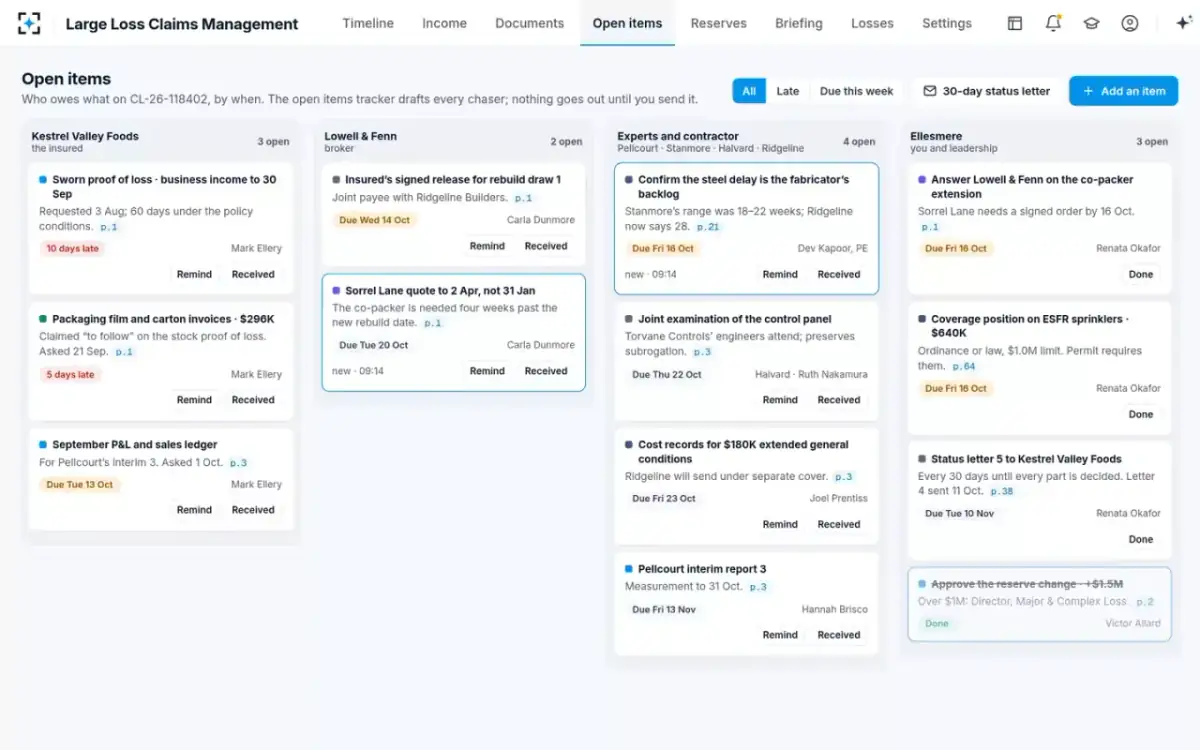
Each coverage part on a large loss is usually proved separately, at its own pace. On the sample plant, the stock was proved first: a sworn proof of loss for $3.28 million arrived on 31 July, seven weeks after the fire, once the quarantined stock had been inventoried and bid for salvage. The building is being proved through the agreed scope and the contractor's draws. Business income is proved in pieces: the carrier requested a sworn proof for losses to 30 September on 3 August, and on day 120 it was ten days past the policy's 60 days.
The sample loss's proofs of loss, part by part, on day 120
| Coverage part | Proof | Status on 12 Oct | What it unlocks |
|---|---|---|---|
| Stock | Sworn proof for $3.28M, received 31 Jul | $3.10M paid of a $3.4M reserve; $296K of packaging invoices “to follow”, 5 days late | Final stock payment |
| Business income to 30 Sep | Requested 3 Aug; 60 days under the policy conditions | 10 days late; the September P&L also due | Payment on the measured months beyond the $4.00M advanced |
| Building and equipment | Agreed scope and estimate; draw requests | Draw 1 paid; the insured’s signed release due 14 Oct | Rebuild draws to the contractor and insured |
| Extra expense | Vendor invoices as incurred | Paid in instalments; co-packer extension pending | Continued trailers and co-packing |
Can an insurer reject a proof of loss?
Yes. An insurer can reject a sworn proof that is unsupported, incomplete or inconsistent with the evidence, and should say why in writing. Some states set a deadline for that answer. In the Michigan case the court quoted the state's insurance code, which requires an insurer to "specify in writing the materials that constitute a satisfactory proof of loss not later than 30 days after receipt of a claim unless the claim is settled within the 30 days." The insurer there rejected a $2.6 million interim proof on 17 July 2013, less than thirty days after receiving it, with a detailed letter covering nine categories of items, and the court held that was enough to avoid waiving its objections.
A proof built on a disputed term can be rejected even when the amounts are agreed. In a Maryland case the insured sent a proof of loss based on an appraisal award that included a 15-month period of restoration; the insurer "challenged the Award and rejected the proof of loss", because it accepted only 12 months, and the dispute went to court.
What a weak sworn proof of loss costs
The cost of an error in a sworn proof is mostly time, and on a large loss time is money for both sides: unpaid income for the insured, an open reserve and litigation expense for the insurer. The court record puts figures on it.
Three proofs of loss that ended in court
$33,632
extra income an Ohio restaurant sought beyond the $14,900 paid
lost: the evidence was not in its sworn proof
$2.6M
Michigan bowling centre’s interim proof, rejected in under 30 days
suit filed 6 Sep 2013; ruling May 2015
$200,000
lost income claimed in that proof with no calculation behind it
dismissed
7years
from a Maryland fire to a 2022 ruling, after a proof built on a disputed period was rejected
Each case failed at the same seam: the proof and the file did not match. The Ohio restaurant's argument about its likely income was never in its sworn proof. The bowling centre's income line was a round number its own accountant had not calculated. The Maryland proof carried a period of restoration the parties had never agreed. For an insurer the lesson runs the other way too: a request that does not say what a satisfactory proof must contain, or a rejection that does not say what is missing, leaves the carrier arguing waiver instead of the merits.
A proof that pays and a proof that stalls
Stalls: Round figures or policy limits
Pays: Each amount traced to the general ledger, an invoice or a report
Stalls: A total with no months behind it
Pays: Monthly figures matching the accountant’s measure
Stalls: An end date nobody has agreed
Pays: The period the parties have accepted, or the measured months only
Stalls: A form with no list of what is needed
Pays: A written list of the materials that make it satisfactory
Stalls: Silence, then a late rejection
Pays: A written answer within the state’s deadline, item by item
Deadline to respond to a sworn proof of loss
The insurer's deadline depends on the policy and the state, and several apply at once. The commercial forms quoted in federal opinions say the insurer "will pay for covered loss within 30 days after we receive the sworn proof of loss" if the insured has complied with the policy and the amount is agreed or an appraisal award has been made. New York's standard fire policy makes the loss payable sixty days after proof of loss. California requires acceptance or denial within 40 days of proof of claim and, once a claim is accepted, payment "immediately, but in no event more than thirty (30) calendar days later". Michigan, as quoted in the case above, requires the insurer to specify the materials it needs within 30 days.
A large loss multiplies those clocks by the number of proofs. On the sample loss, the stock proof's clock has run and the business income proof's has not started, because the proof has not arrived. The clock the insurer controls is the request: a proof requested late starts late. How the proofs fit into the wider sequence of a commercial claim is in the commercial insurance claims process.
Tracking every sworn proof on a large loss with the solution
The solution treats each proof as an open item: who owes it, when it was requested, which document asked for it and when it is due. Its open items tracker drafts the reminder and the 30-day status letter; nothing goes to the insured, the broker or the experts until the adjuster sends it. When a proof arrives, the document reader takes its amounts with their pages and places it on its lane, so the stock proof sits on the stock lane and the income proof beside the forensic accountant's measure.
Open items by who owes them: the sworn proof of loss for business income, ten days late
The forensic accountant's role in supporting and testing a business income proof is covered in forensic accounting in insurance claims, and what a team needs in hand in the first weeks of a loss in the large loss checklist. The full sample loss is on the Large Loss Claims Management page.
Questions people ask
Is a sworn proof of loss the same as an examination under oath?
No. The sworn proof is a written statement the insured signs; an examination under oath is questioning by the insurer's representative, transcribed and signed. New York's standard fire policy provides for both, requiring the insured to "submit to examinations under oath by any person named by this Company" in addition to rendering the proof.
Does the insurer have to provide the proof of loss form?
Under the commercial forms quoted in federal opinions, yes: "We will supply you with the necessary forms." The form usually asks for the policy details, the date and cause of loss, the amount claimed under each coverage part and any other insurance.
Can the deadline for a sworn proof of loss be extended?
Yes, and the extension should be in writing. New York's standard policy allows the sixty days to be extended in writing by the insurer, and in the Michigan bowling centre case the insurer granted the extension the insured asked for before it filed its interim proof.
Can there be more than one proof of loss on a claim?
Yes, and on large losses there usually are: one per coverage part, and interim proofs for business income as the months are measured. Each starts its own payment clock, which is why a claim-level "proof received" date hides more than it shows.
What does a sworn statement in proof of loss sample look like?
Forms vary, and many follow the standard fire policy's list: the policy number and period, the date, time and cause of the loss, the insured's interest and anyone else's, the value of the property and the amount of loss, deductions, other insurance and the net amount claimed, followed by the insured's signature and an oath. A business income proof attaches the monthly calculation and the records behind it.