The period of restoration ends on the earlier of two dates: the date when the property at the insured premises should be repaired, rebuilt or replaced with reasonable speed and similar quality, or the date when the business resumes at a new permanent location. It does not end when the contractor actually finishes, and it does not end when sales return to normal. Because the first date is a judgment about what a reasonable rebuild would take, it moves every time a contractor's schedule, an engineer's estimate or a permit moves, and each move changes how much lost income the policy pays and how much the insurer must reserve.
Botminds' Large Loss Claims Management is built around that moving date. When a document changes the rebuild schedule, the solution proposes the new date with the page that moved it; the adjuster decides whether to accept it, and the income projection and the reserves follow the same morning. This guide follows one such move on the solution's fictional sample loss: a steel delivery on a frozen-food plant rebuild in Greeley, Colorado, slipping eight weeks. The companies, people and figures are invented sample data, not a customer's result.
One steel delay, followed from the contractor's letter to the income line
- Demolition to steel on site10 wks
- Roof3 wks
- Freezers4 wks
- Finish3 wks
- Ramp to full production10 wks
- Demolition to steel on site, fabricator backlog18 wks
- Roof3 wks
- Freezers4 wks
- Finish3 wks
- Ramp to full production10 wks
The definition: should be, not was
The period of restoration ends on a hypothetical date, not an actual one, and courts have said so in terms. A federal court in New York, deciding a claim by a company whose offices were destroyed in the World Trade Center, concluded that "the ‘period of restoration’ ends when the property necessary to resume operations should have been repaired, rebuilt or replaced with reasonable speed and similar quality, and not when operations have been actually resumed, whether to their pre-loss levels or otherwise." That 2005 decision, Lava Trading, is quoted in a Connecticut opinion from the same year that applied the same standard to another tenant of the towers.
So the end date is an argument about reasonableness, usually built from two documents: an engineer's or a cost consultant's estimate of a reasonable schedule, and the contractor's actual schedule. When they agree, the date is easy. When the contractor runs late, the question is whether the delay is part of what a reasonable rebuild of similar quality would take, or a slowness the policy does not pay for. Any lost income after the date stops being business income under the policy; it may still be covered for a fixed number of days as extended business income, which is explained in period of indemnity vs period of restoration.
Does a contractor delay extend business income?
Only if a reasonable rebuild would have run into the same delay; the policy pays for the time the work should take, not for every day it actually takes. That is why delay evidence cuts both ways. In a California case, the contractor's own project manager testified that the repairs could have been finished in five months and that "seven months were necessary only because of rain delays." The insurer had paid for eight and a half months. But its own adjuster had written that the insurer estimated the period of restoration at twelve months, and the court held that a fact-finder could find the period longer than what had been paid.
In a New York case, the argument ran the other way in time. The insurer blamed the insured's continued loss of income on "planning, permitting, financing, and COVID-related delays", and the insured answered that those delays "are irrelevant as they only occurred after the 12-month period of restoration time frame already elapsed." The insured's answer treated the period as a fixed twelve months; the fight was over what fell inside it.
On the sample loss, the engineer had estimated the rebuild at 18 to 22 weeks after demolition, assuming steel lead times of no more than ten weeks. The contractor's revised schedule now says 28 weeks, and blames the fabricator's production backlog. The solution flags that difference beside the projection with both pages, and opens an item for the engineer to confirm whether the backlog is real and unavoidable. Accepting the new date for reserving is not a coverage concession; it is the adjuster deciding what to plan for while the reasonable-speed question is answered.
What the eight-week slip changed on the sample loss
8weeks
rebuild complete moves from 8 Jan to 5 Mar 2027
+$1.81M
more business income still at stake
$3.94M → $5.75M
+$1.5M
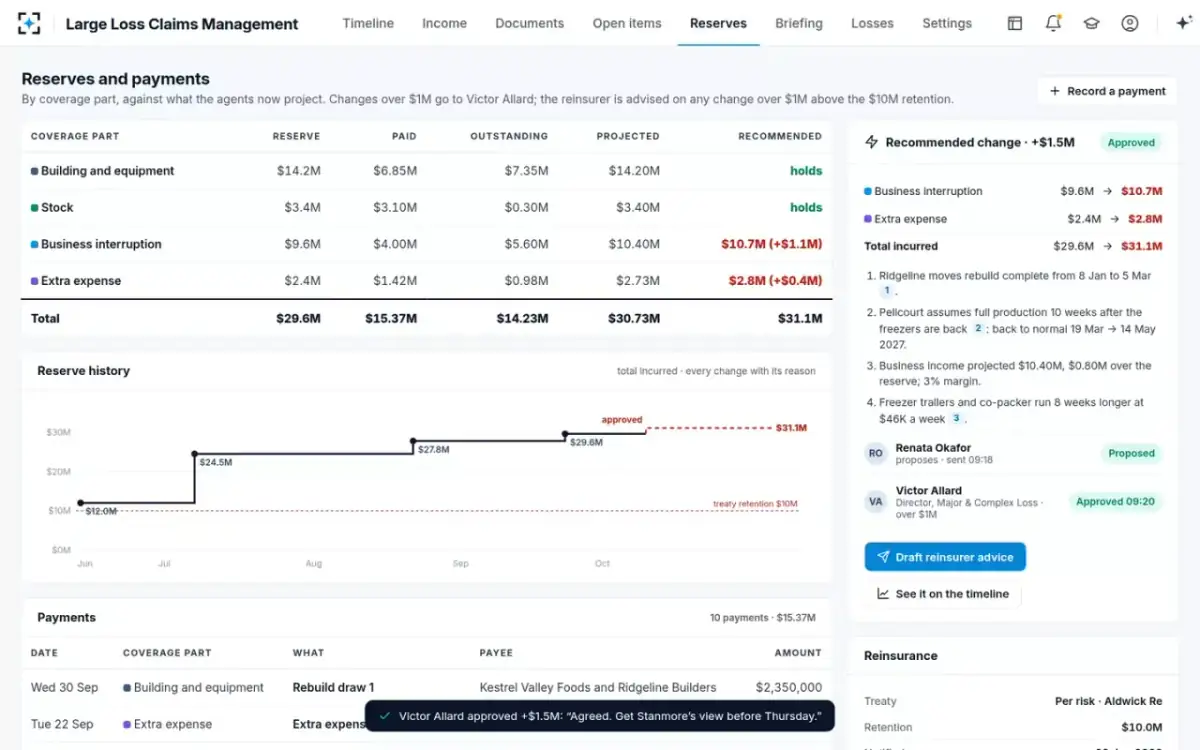
reserve change recommended and approved
business income +$1.1M, extra expense +$0.4M
28weeks
from demolition to completion in the contractor’s revision
the engineer estimated 18–22
What happens to business income when the rebuild is delayed?
Every week the restoration date moves out adds roughly a week of the business's lost income to the claim, less whatever it still earns during that week, and the extra expense of keeping going runs on too. On the sample plant, normal income is $400,000 a week from its 2025 accounts adjusted for trend, and production continues in part through an outside co-packer. The eight-week slip added $1.81 million of income still at stake, about $226,000 a week (our arithmetic), and kept the freezer trailers and co-packer eight weeks longer at $46,000 a week.
The money moves in three places at once. The income projection moves: back to normal goes from 19 March to 14 May 2027, because the forensic accountant assumes full production ten weeks after the freezers are back. The reserve moves: business income projected at $10.40 million against a $9.6 million reserve, and extra expense at $2.73 million against $2.4 million. And the policy checks move: the new date has to stay inside the 12-month limit and the 90-day extended period, which it does on the sample policy with three weeks to spare.
Cost inflation adds to the pressure. The producer price index for goods used in commercial and healthcare structures rose 9.1% in the twelve months to September 2026 (BLS data via FRED; our arithmetic), so a delayed rebuild can also cost more to finish, which the building lane has to absorb separately.
What if the business never rebuilds?
The period of restoration still ends when the property should have been rebuilt, even if it never is. A New Jersey court applied that rule to a dairy distributor whose subcontracted warehouse burned down and was never rebuilt: "Even in the case where the business does cease altogether, the calculation of business income loss must be based on what the Policy says it will: the date when the repairs or rebuilding should have reasonably been completed."
The case also shows how far apart three parties' dates can be. The insurer had set the period at 23 months, its estimate of a reasonable rebuild. A public adjuster's report for the insured calculated 35 months to replace the warehouse with a similar facility. The insured argued for 48 months plus a 24-month renewal, the remaining term of its distribution contract. The court rejected the contract theory as irrelevant to the period, and left the actual length for later proof.
Three parties, three restoration periods on one warehouse fire
| Who | Period of restoration | Basis |
|---|---|---|
| Insurer | 23 months | Reasonable time to rebuild a comparable facility |
| Public adjuster for the insured | 35 months | Time to replace the warehouse with a similar facility |
| Insured, in court | 48 months plus 24 | The rest of its distribution contract, with a renewal |
Who decides the period of restoration?
The insurer's adjuster decides what date the insurer will pay to, on the evidence of its experts, and the insured can dispute it through appraisal of the amount or in court. Inside a carrier, that makes the restoration date an adjuster's decision with consequences for three other people: the forensic accountant, who measures to it; the reserving director, who reserves to it; and the reinsurer, whose share depends on it. In the solution that split is enforced. The timeline keeper may only propose a moved date, with the document that moved it; the adjuster accepts it and can undo it; the income projector never sets the period or the amount payable.
Between the parties, a policy's appraisal clause may or may not reach the date, depending on what the parties referred to the appraisers and on the court. In a Maryland case the parties disputed whether the restoration period after a February 2015 restaurant fire was 12 months or 15, and the insured was still litigating it in 2022 (Rod & Reel). The cases on appraisal are compared in the guide to both periods.
Increased period of restoration: codes, permits and the ordinance exclusion
Ordinary permitting time is argued as part of what a reasonable rebuild takes; extra time caused by enforcing a building or environmental law is excluded from the standard period of restoration unless the policy adds it back. The form quoted in the Maryland case excludes any increased period required to comply with a law regulating construction, use or repair, or requiring pollutants to be cleaned up. Whether a policy adds that time back depends on its own coverage parts and endorsements, so the declarations decide.
The sample loss has exactly this question pending. The new building permit requires an early-suppression sprinkler system that the old hall did not have, at about $640,000, under a policy with a $1.0 million ordinance or law limit. Whether the extra installation time extends the period of restoration is a coverage position the solution leaves to the adjuster, with the policy wording and the engineer's view beside it; the agents state no position.
The steel delay, followed through one morning
The contractor's letter arrived on Friday 9 October. At 07:12 on Monday, the solution's document reader had taken three facts from it, each with its page: joist girders now arriving 28 December rather than 2 November because of the fabricator's backlog; rebuild complete now 5 March rather than 8 January; and a claim of about $180,000 for extended general conditions to come. The timeline keeper proposed moving the rebuild milestone.
The contractor's letter, read with its page and placed on the building lane
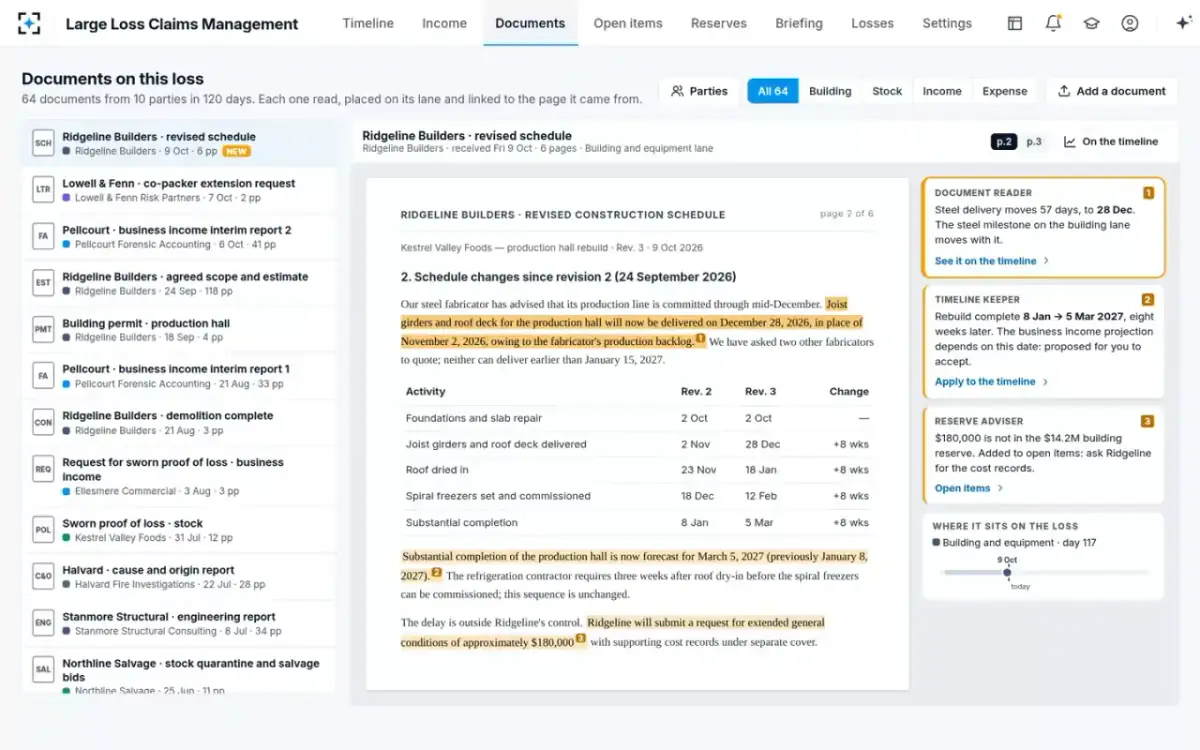
From the letter to an approved reserve: who did what
Agent
Document readerReads the six-page schedule; takes the steel date, the completion date and the $180K claim with their pages.
Never: Infers a figure that is not on a page
Agent
Timeline keeperProposes moving rebuild complete from 8 Jan to 5 Mar 2027.
Never: Applies the move itself
A person decides
General adjuster, 09:14Accepts the new date for the projection; can undo it.
Agent
Income projectorMoves back to normal to 14 May; income at stake $3.94M → $5.75M; checks the 12-month and 90-day limits.
Never: Sets the period of restoration or the amount payable
Agent
Reserve adviserRecommends +$1.5M with four cited reasons.
Never: Changes a reserve
A person decides
Director, 09:20Approves the change, which is over the adjuster’s $1M authority.
The change approved: reserve history against the treaty retention
A checklist for every moved restoration date
Whatever tools a team uses, each move of the restoration date should leave the same trail. The questions below are the ones the court cases on this page turned on, and the ones a reinsurer or a regulator's examiner will ask.
When a document moves the rebuild date
- Which document moved it, and which page?
A schedule revision, an engineer’s letter, a permit. The California insurer’s own twelve-month letter put its eight-and-a-half-month payment in dispute.
- Is the new date still reasonable speed?
Ask the engineer to test the contractor’s reason, as the sample loss does with the steel backlog.
- Is any of the extra time code-driven?
Ordinance or law time is excluded from the standard period and may sit under a separate limit.
- Does the new date stay inside the policy’s time limits?
The coverage’s own months, and the extended period after reopening.
- What does it do to income, extra expense and the reserve?
Re-project all three the same day, with the reasons stated.
- Who has to know?
The forensic accountant, the director if authority is exceeded, the reinsurer above the retention, and the insured in the next status letter.
The arithmetic that sits under the projection, and what a spreadsheet can and cannot check, is in the business interruption calculator; how a forensic accountant tests it is in forensic accounting in insurance claims. The full sample loss is on the Large Loss Claims Management page.
Questions people ask
Is the period of restoration the time it actually took to rebuild?
No. It is the time the rebuild should have taken with reasonable speed and similar quality, which can be shorter or longer than what happened. A federal court in New York held it ends when the property should have been restored, "and not when operations have been actually resumed".
Does weather delay extend the period of restoration?
It can, if a reasonable rebuild would have met the same weather; it is a question of fact. In the California case, the contractor said five months was achievable and seven were needed only because of rain, while the insurer's own letter estimated twelve; the court left the length to a fact-finder.
Can the period of restoration be longer than the policy term?
Yes. The standard form says the expiration date of the policy will not cut short the period of restoration, so a loss late in the policy year is paid for its full reasonable restoration. A time limit written into the coverage, such as 12 months of actual loss sustained, still applies.
What is an extended period of restoration?
Most people searching for it mean the extended period of indemnity, also called extended business income: extra days after the property is actually restored and the business reopens, while sales recover. It is a separate period with its own trigger and its own number of days: from 30 to 365 in the policies quoted in the cases cited in these guides.
Who pays for a contractor's extended site costs when the rebuild runs late?
That is a building claim, not business income, and it depends on the policy and on why the delay happened. On the fictional sample loss, the contractor's $180,000 claim for extended general conditions is not in the building reserve and sits as an open item until the contractor sends its cost records.