The commercial insurance claims process runs through the same steps as any property claim: notice, investigation, coverage, scope and estimate, proof of loss, measurement, payment and, if the parties disagree, appraisal or litigation. What makes a commercial property claim different is that on a serious loss those steps run in parallel on four lanes: the building and equipment, the stock and business property, the business's lost income, and the extra expenses it incurs to keep operating. Each lane has its own limit, its own experts and its own proof, and the lanes depend on one another, so the claim is finished only when the slowest lane is.
Botminds' Large Loss Claims Management draws a large loss exactly that way: one timeline per loss, one lane per coverage part, with every report, payment and reserve on its lane. To show the process concretely, this guide follows the solution's fictional sample loss, a fire that destroyed the production hall of a frozen-food plant in Greeley, Colorado at 02:40 on Sunday 14 June 2026. Names and figures are invented sample data, not a customer's result.
One commercial fire, four lanes: the building sets the pace for income
- Scope and demolition10 wks
- Rebuild, on the revised schedule28 wks
- Salvage and proof7 wks
- Paid; $296K open10 wks
- Lost to date, measured17 wks
- Projected to rebuild complete21 wks
- Ramp back to full production10 wks
- Freezer trailers and co-packer, to 2 Apr 202742 wks
What are the steps of a commercial property claim?
A commercial property claim moves through ten recognisable steps, from notice to final release, though on a large loss several are open at once. The table below lists them in the order they usually begin, with the document that typically closes each. The policy conditions set much of the sequence: in the business income forms quoted in federal court opinions, the insured must "Send us a signed, sworn proof of loss containing the information we request to investigate the claim" within 60 days after the insurer asks for it, and the insurer pays within 30 days after receiving the sworn proof once the amount is agreed or an appraisal award has been made.
The commercial insurance claims process in ten steps, and the paper that closes each
| Step | What happens | Closed by |
|---|---|---|
| 1. Notice and first response | Loss reported; site secured; emergency mitigation; experts appointed | Acknowledgment and an expert roster |
| 2. Cause and origin | Investigator establishes how and where the loss began | Cause and origin report |
| 3. Coverage | Adjuster reads the policy against the facts; any reservation is stated | Coverage position, part by part |
| 4. Scope and estimate | Engineer and contractor agree what must be repaired or rebuilt | Agreed scope and estimate |
| 5. Stock and contents | Inventory, quarantine, salvage bids | Sworn proof of loss for stock |
| 6. Advances | Undisputed amounts paid early, often part by part | Payment with the coverage it is made under |
| 7. Business income measured | Forensic accountant measures lost income month by month | Interim reports, then a final measure |
| 8. Rebuild and draws | Contractor works to a schedule; draws paid, often jointly | Substantial completion |
| 9. Disputes | Appraisal of the amount, or litigation over coverage | Appraisal award or judgment |
| 10. Close | Final proofs, releases, last payments, recovery from third parties | Final release and closing report |
Three features distinguish the commercial version. Proofs of loss come per coverage part and often in stages, so step 5 for the stock can be finished while step 7 for lost income has months to run. Advances are routine, because a business cannot wait a year for its money: on the sample loss, $15.37 million had been paid by day 120, including two $2 million business income advances. And step 9 is common enough to plan for: the business income forms quoted in the court cases on this page let either side demand appraisal when "we and you disagree on the amount of Net Income and operating expense or the amount of loss".
Four lanes, one claim: building, stock, business income, extra expense
A commercial package policy pays a large loss under separate coverage parts, and the claims process treats each as its own lane with its own reserve. The building lane is paid on the agreed scope and the contractor's draws. The stock lane is paid on inventory, salvage and a sworn proof. The business income lane pays the net income the business would have earned plus its continuing expenses, measured for the period the property should take to be rebuilt. The extra expense lane pays the costs of keeping going, such as rented freezer trailers and an outside co-packer on the sample loss, at $46,000 a week by October.
The lanes are not independent, and that is the point of drawing them together. The building lane's end date is the business income lane's main input. The extra expense lane both costs money and reduces the business income loss, because production kept running through the co-packer earns income that would otherwise be lost. A federal appeals court made the second link explicit in a hurricane case: when a partially reopened business earned enough to cover its continuing expenses, "all charges and expenses have, by definition, been covered by income", and the $12,308,522 the jury had awarded for them was vacated.
The sample loss on day 120, lane by lane
$14.2M
building and equipment reserve
$6.85M paid; scope agreed at $13.6M
$3.4M
stock reserve
$3.10M paid; $296K of packaging still open
$9.6M
business income reserve
$4.00M paid in advances
$2.4M
extra expense reserve
$1.42M paid
Who are the experts on a commercial fire claim?
A commercial fire claim normally needs a cause-and-origin investigator, a structural engineer, a forensic accountant and, where stock is damaged, a salvor; the contractor and the insured's broker or public adjuster are the other regular parties. The speed at which carriers assemble them is visible in court records. In a Louisiana case after Hurricane Isaac struck in late August 2012, the insurer had by 3 September "retained multiple experts to adjust the claim, including an independent field adjuster, a structural engineering group, and a certified public accountant."
Each expert's report changes a different lane. The cause-and-origin report decides coverage and any recovery from a third party: on the sample loss, a joint examination of a control panel was set for 22 October because it might support a claim against its maker. The engineer's report sets the scope and, through its rebuild estimate, the reasonable length of the rebuild. The forensic accountant's interim reports measure the income loss to date. The large loss adjuster who coordinates them is the subject of the large loss property adjuster.
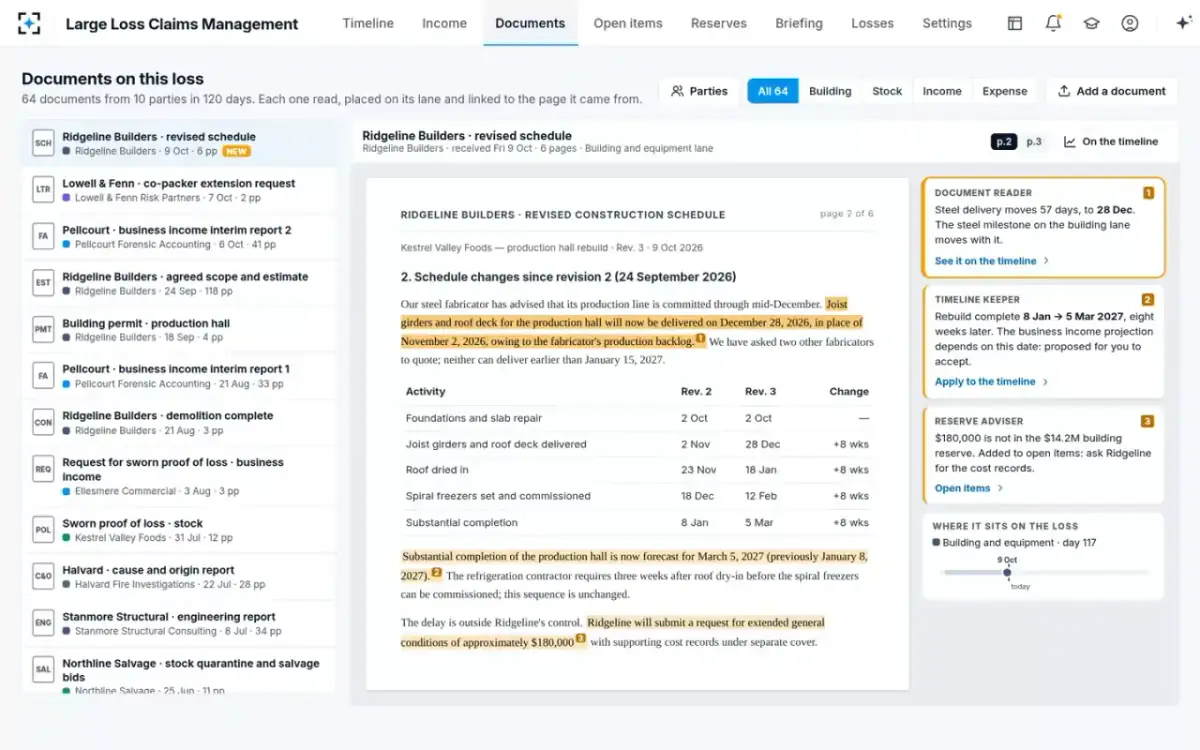
64 documents from 10 parties, each placed on its lane and opened at its page
How long does a commercial property claim take?
A straightforward commercial claim can close in weeks, but a large one with business income usually runs for a year or more, because lost income is measured until the property should be rebuilt and the business back to normal. No national data measures commercial claim duration. Florida's regulator publishes the closest proxy: after Hurricane Milton, 47.5% of commercial property claims were closed fourteen months after landfall, against 94.0% of homeowners claims (Florida OIR, data as of 9 December 2025).
On the sample loss, the arithmetic is visible in the lanes. The rebuild runs to week 38 on the revised schedule; the forensic accountant's ten-week ramp back to full production takes business income to week 48; the policy's 12-month limit on lost income ends at week 52. Every lane but stock is still open on day 120, and two of them depend on a steel delivery. Why the timing of these large claims is so different from a homeowners desk is set out in what is a large loss claim.
Why the slowest lane decides when the claim closes
The building lane usually decides, because business income and extra expense both run until the property should be restored, and extra expense often runs until normal operations return. When the sample plant's contractor reported on 9 October that steel joists would arrive on 28 December rather than 2 November, its substantial completion moved from 8 January to 5 March 2027. Nothing about the stock changed. But the business income lane's back-to-normal date moved from 19 March to 14 May 2027, the income still at stake rose from $3.94 million to $5.75 million, and the freezer trailers and co-packer were needed eight weeks longer.
What one steel delay changed on each lane of the sample loss
Before the revised schedule: Rebuild complete 8 Jan 2027; reserve $14.2M holds
After the adjuster accepted it: Rebuild complete 5 Mar 2027; reserve holds; the contractor’s $180K for extended general conditions becomes an open item
Before the revised schedule: Reserve $3.4M; $296K of packaging open
After the adjuster accepted it: Unchanged
Before the revised schedule: Back to normal 19 Mar 2027; $3.94M still at stake
After the adjuster accepted it: Back to normal 14 May 2027; $5.75M at stake; reserve $9.6M → $10.7M
Before the revised schedule: Trailers and co-packer to 5 Feb
After the adjuster accepted it: To 2 Apr; reserve $2.4M → $2.8M
This is the process point most claims systems miss. They record each lane's transactions, but the dependency between the building date and the income lane lives in the adjuster's head and the forensic accountant's next report. The way that dependency works in the policy wording is explained in period of indemnity vs period of restoration.
What clocks apply to a commercial property claim?
The state's claims-handling rules apply to commercial claims as they do to homeowners claims, but some of the hardest deadlines are written for residential and small commercial property. Florida's 60-day pay-or-deny rule, for example, reaches commercial structures only up to 10,000 square feet, and excludes nonresidential commercial policies covering property in more than one state (§627.70131(7)). The policy's own clocks then carry more weight: the sworn proof within 60 days of a request, and payment within 30 days of the proof once the amount is agreed.
California's regulation shows the kind of clock that does reach a long commercial claim. An insurer that needs more time to decide must write to the claimant, and then write again every 30 calendar days until it decides or legal action is served. Where the decision waits on a future event, such as a rebuild, the letter must explain that and estimate when the decision can be made. On a large loss, that estimate is the restoration date, so the status letter and the timeline have to agree. The sample carrier applies a 30-day letter as its own rule on every loss, whatever the state.
Proof of loss statements arrive lane by lane
On a large commercial loss the insured usually files more than one sworn proof of loss: one per coverage part, and sometimes interim proofs for business income as the loss accrues. On the sample loss, the stock proof for $3.28 million arrived on 31 July. The business income proof to 30 September had been requested on 3 August and was, by the policy's 60-day condition, ten days late on day 120. A process that tracks one "proof of loss received" date per claim loses that detail, and with it the clocks that each proof starts. What a sworn proof contains and what it triggers is covered in the sworn statement in proof of loss.
Running the commercial insurance claims process on one timeline
The solution runs the process as the lanes above, with six agents keeping them current and the adjuster deciding. A document reader takes each report's dates and amounts with their page and places it on its lane; a timeline keeper proposes moving a milestone when a document moves it; an income projector re-projects business income; a reserve adviser recommends reserve changes with reasons; an open items tracker keeps who owes what, by when, and drafts the 30-day letter; a briefing writer drafts the leadership page. The adjuster accepts dates and pays; the director approves reserve changes above the adjuster's authority.
The loss timeline: a lane per coverage part, from the fire to day 120
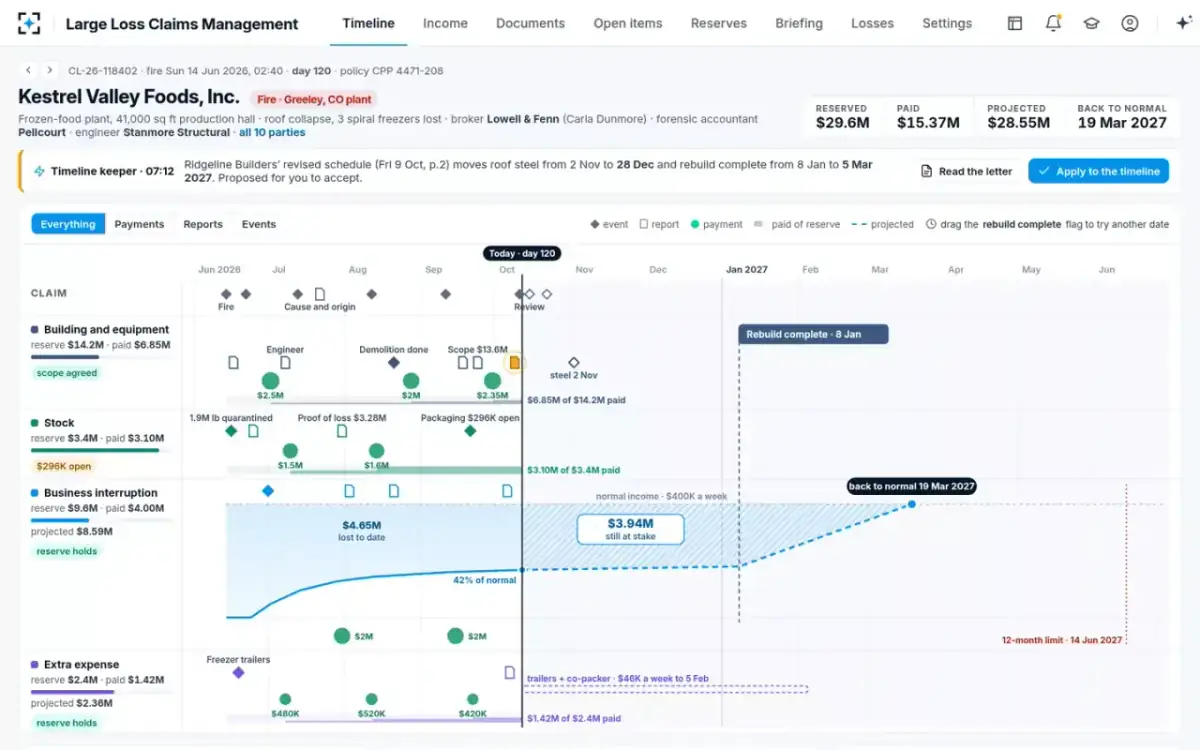
For a broker or risk manager on the insured's side, the same picture answers the question that otherwise takes a phone call: which lane is waiting on whom. To see the full loss, screen by screen, start from Large Loss Claims Management.
Questions people ask
What is the first step after a commercial property loss?
Give prompt notice, then protect the property: the commercial forms quoted in federal opinions require the insured to "Take all reasonable steps to protect the Covered Property from further damage" and to keep a record of what that costs. The insurer will then appoint an adjuster and, on a serious loss, experts such as a cause-and-origin investigator and an engineer within days.
Is a commercial property claim different from a business interruption claim?
They are usually two parts of the same claim under one commercial policy: the property part pays to repair or replace what was damaged, the business income part pays lost net income and continuing expenses while it is restored. The business income amount depends on the property part's rebuild date, which is why they are handled together.
Does an insurer pay a commercial claim before it is finished?
Commonly yes, through advances on undisputed amounts for each coverage part. On the fictional sample loss, $15.37 million of $29.6 million reserved had been paid by day 120, including $4 million of business income advances, while the rebuild was months from complete.
What happens if the insurer and the business disagree on the amount?
The business income forms quoted in the federal cases on this page let either side demand appraisal of the amount: each picks an appraiser, the two pick an umpire, and a decision agreed by any two is binding. Appraisal settles the amount, not coverage; the same forms add, "If there is an appraisal, we will still retain our right to deny the claim."
Does a commercial claim need a sworn proof of loss?
Usually, when the insurer asks for one. In the business income forms quoted by federal courts, the insured must send a signed, sworn proof of loss within 60 days after the insurer's request, and the insurer pays within 30 days after receiving it once the amount is agreed or an appraisal award is made.