Forensic accounting in insurance claims is the measurement of a business's lost income and extra expense from its own records after an insured loss. On a commercial property claim with business interruption, the insurer usually retains a forensic accountant, and the insured often hires its own: each rebuilds what the business would have earned had the damage not happened, subtracts what it did earn, tests which expenses really continued, and reports the loss month by month, often in interim reports while the claim is open. Their figure is trustworthy when four things hold: every number traces to a page of the business's records, the baseline is the business's own history, the restoration date it runs to has a document behind it, and the policy's limits are applied.
Botminds' Large Loss Claims Management is built to keep those four true on a large commercial loss as new documents arrive, without taking the measurement away from the accountant: the measured loss stays hers, and the agents' projection sits beside it for the insurer's reserving. This guide works through the four tests on the solution's fictional sample loss, a frozen-food plant fire in Colorado measured by a fictional firm, Pellcourt Forensic Accounting. The people, companies and figures are invented sample data, not a customer's result.
Four tests of a business interruption figure, and how to run each
- Every figure traces to a page
Each month’s expected, earned and loss figure points to a general ledger entry, a P&L, an invoice or an interim report. Test: open three at random.
- The baseline is the business’s own history
Expected income comes from the months before the loss, with any trend stated. Test: is a post-loss boom or a lost contract leaking in?
- The restoration date has its document
The months measured run to a date someone accepted, from a schedule or an engineer. Test: which document, which version?
- The policy’s limits are applied
Waiting period, time limit, extended period, dollar limit, from the declarations as well as the form. Test: each with its page.
What does a forensic accountant do on a business interruption claim?
A forensic accountant measures the business income loss the policy describes, using the records the policy lets the insurer see. The standard form quoted by a federal court in Ohio says the loss "will be determined based on" the business's net income before the damage, its likely net income had no damage occurred, the operating expenses needed to resume with the same quality of service, and other relevant sources including "Your financial records and accounting procedures". The insured's duties give the access: it must, as often as reasonably required, "permit us to inspect the property proving the loss or damage and examine your books and records", and let the insurer copy them.
The work is part reconstruction, part judgment. The accountant rebuilds a normal month from past results, adjusts it for trend and seasonality, measures actual results since the loss, and separates expenses that continued from those that stopped. On a large loss it also measures extra expense and tests the interaction between the two: outside production costs money and earns income. Federal labour data lists accountants among the specialists adjusters "may consult with", and on serious claims carriers bring them in early. In a Louisiana case after Hurricane Isaac, the insurer had a certified public accountant on the claim within about a week of landfall (Island Concepts).
The sample loss's forensic accounting on day 120
$4.28M
lost income measured to 30 September
$4,282,000, in two interim reports
2
interim reports so far
the third due 13 November
$86,400
of a $140,000 fee budget used
10weeks
ramp to full production after the rebuild
the accountant’s assumption
Test one: every figure traces to a page
An income figure that cannot be traced to the business's records will not survive a dispute, however reasonable it looks. The court record is blunt about this. In a Michigan case, a bowling centre claimed $200,000 of lost business income, which it described as the policy limit times two. Its owner had never calculated a loss, and the court noted that its own accountant admitted he "never performed any analysis or calculation to determine the amount of plaintiff’s lost income". The income claim was dismissed. The insurer's accountant, by contrast, had worked from the financial statements and found the business declining.
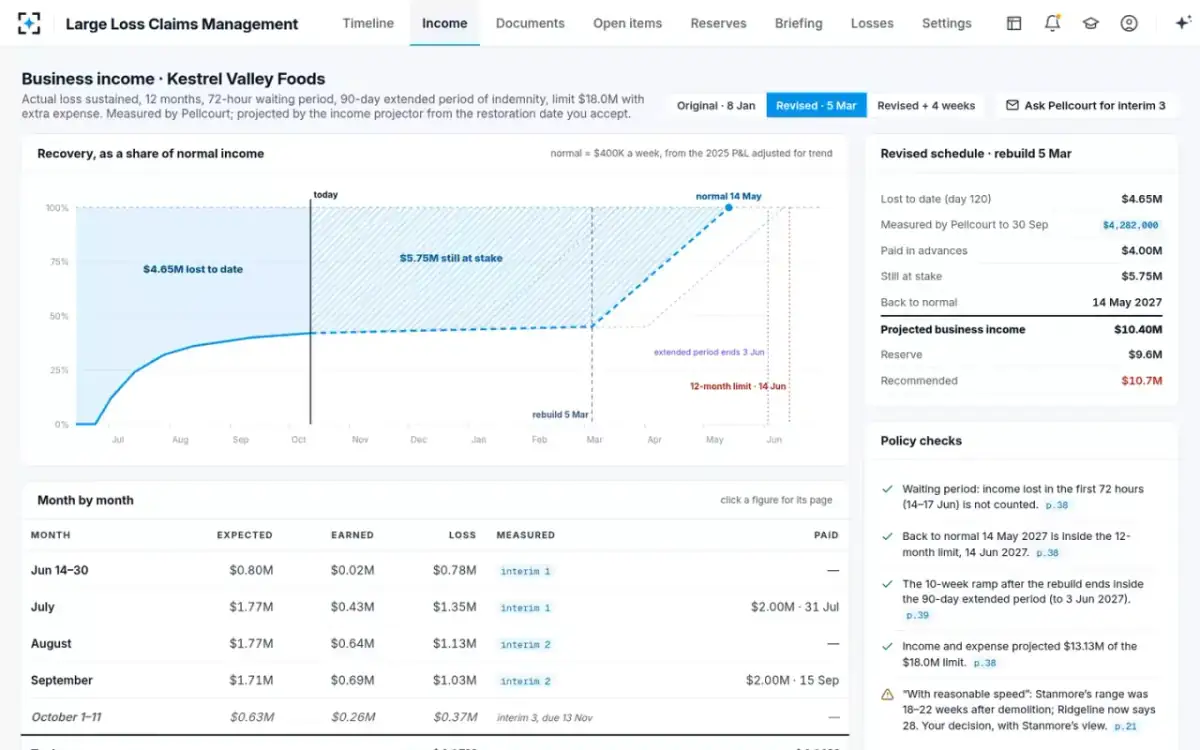
On the sample loss every monthly figure carries its source: June and July are measured in the first interim report, August and September in the second, and October is a projection until the third arrives. Clicking a figure opens the page it came from. That is test one passing, and it is the test most spreadsheet-based measures fail, not because the numbers are wrong but because nobody can show where they came from after six months of revisions.
The measured loss and the projection, side by side, each figure linked to its report
Test two: the baseline is the business's own history
Expected income should come from what the business was doing before the loss, adjusted only for trends the records support. The courts have rejected baselines built from anything else. When a Mississippi casino argued that its booming post-Katrina revenue showed what it would have earned, putting its business interruption loss near $80 million against the insurer's $6.5 million, the Fifth Circuit held that only historical sales should be considered and that "sales figures after reopening should not be taken into account".
The same discipline applies to the insured's evidence during the claim. In the Ohio case, a restaurant argued its expected income should reflect the months when its former manager ran it, and produced a spreadsheet of past income in litigation. The court held the claim failed because nothing beyond a lease and a purchase agreement had been given to the insurer in the sworn proof of loss: the insured had a "contractual duty, in the event of loss, to provide Defendant with information related to its lost income, within 60 days after Defendant requested it". A baseline argument that is not in the claim file is not in the claim.
Baseline choices, and how each fared in the cases on this page
| Baseline offered | Case | Outcome |
|---|---|---|
| Post-disaster revenue after reopening | Mississippi casino, Hurricane Katrina (5th Cir. 2010) | Rejected: only historical sales count |
| Income under a former manager, shown only in litigation | Ohio restaurant fire (N.D. Ohio 2021) | Rejected: not submitted in the sworn proof of loss |
| “Policy limit times two”, with no calculation | Michigan bowling centre (E.D. Mich. 2015) | Dismissed: no analysis supported it |
| 2025 P&L adjusted for trend | Fictional sample plant | Measured by the forensic accountant; the trend shown as an input |
Test three: the restoration date has its document
An income measure runs to a restoration date, and the forensic accountant does not set that date; the adjuster accepts it from the evidence. When the date moves and the measure does not, the figure is wrong by every week in between. On the sample loss, the contractor's revised schedule moved rebuild complete from 8 January to 5 March 2027. Because the accountant's ten-week ramp starts from that date, back to normal moved from 19 March to 14 May, and the income still at stake from $3.94 million to $5.75 million, all on the morning the adjuster accepted the new date.
“My number is only as good as the restoration date you give me.”
Hannah Brisco, CPA, the fictional sample forensic accountant
The test is simple to state: for any income projection, name the document and version that fixed its end date, and who accepted it. Where the answer is "the schedule we had in June", the projection is stale. How the date is argued, and what moves it, is in when the period of restoration ends.
Test four: the policy's limits are applied
A correct measurement can still overstate what the policy owes if the policy's limits are not applied to it, and the limits sit in more than one place. The waiting period removes the first hours; the coverage may have its own time limit; extended business income after reopening runs only for the days bought; and the dollar limit may be shared with extra expense. On the sample loss each check cites its page: the 72 hours from 14 to 17 June are not counted, back to normal falls inside the 12-month limit, the ten-week ramp ends inside the 90-day extended period, and $13.13 million projected sits inside the $18.0 million limit. How those periods fit together is set out in the business interruption calculator.
Who pays for the forensic accountant?
The insurer pays for the accountant it retains as a claims expense; the insured pays for its own unless the policy covers the cost of preparing the claim, and some do, within limits. The Michigan bowling centre's policy, as the court described it, paid "necessary expenses that [the insured] incur[s] to prepare claim information", such as taking inventories, making appraisals and preparing a statement of loss, but excluded expenses incurred to prove that a loss is covered.
The line between the two decided the bowling centre's $10,000 claim for "accounting services for business interruption" and legal services. The court dismissed it: legal work spent on a coverage dispute was excluded, and the accounting claim was unsubstantiated because the accountant had done no business interruption analysis. A policyholder whose accountant prepares the income claim exhibits is on stronger ground than one whose accountant argues coverage.
Two accountants on one claim: what each is for
Retained by the insurer: The insurer, as a cost of adjusting the claim
Retained by the insured: The insured, unless the policy pays claim preparation costs
Retained by the insurer: The insured’s books, which the policy lets the insurer examine
Retained by the insured: The same books, with the business’s own knowledge of them
Retained by the insurer: Interim and final measures of the loss for the adjuster
Retained by the insured: The income exhibits supporting the sworn proof of loss
Retained by the insurer: Appraisal of the amount, if either side demands it
Retained by the insured: The same appraisal; coverage questions go elsewhere
The professional standard a forensic accountant works to
A certified public accountant doing forensic work in a dispute follows the AICPA's Statement on Standards for Forensic Services No. 1, effective for engagements accepted from 1 January 2020. It covers litigation and investigations, and defines litigation broadly: the term "is not limited to formal litigation but is inclusive of disputes and all forms of alternative dispute resolution", which reaches an appraisal of a disputed business income loss. Routine measurement for an adjuster with no dispute may fall under the profession's consulting standards instead.
Two of its rules matter most on an insurance claim. The member must "Obtain sufficient relevant data to afford a reasonable basis for conclusions or recommendations", which is test one in professional language. And a member performing forensic services "should not subordinate his or her opinion to that of any other party", the client included. An insurer's accountant who measures to a restoration date the evidence does not support is not doing the insurer a favour.
The projection beside the measure: where the agents fit
The solution never replaces the forensic accountant's measure; it keeps a separate, labelled projection beside it for reserving, and keeps the four tests passing as documents arrive. Its income projector takes the accountant's measured loss to date, the profit and loss statements and the accepted restoration schedule, projects the recovery and the income still at stake, and checks the waiting period, the time limit and the extended period of indemnity, each with its page. It never sets the period of restoration or the amount payable.
The interim report and the contractor's schedule, each read with its page
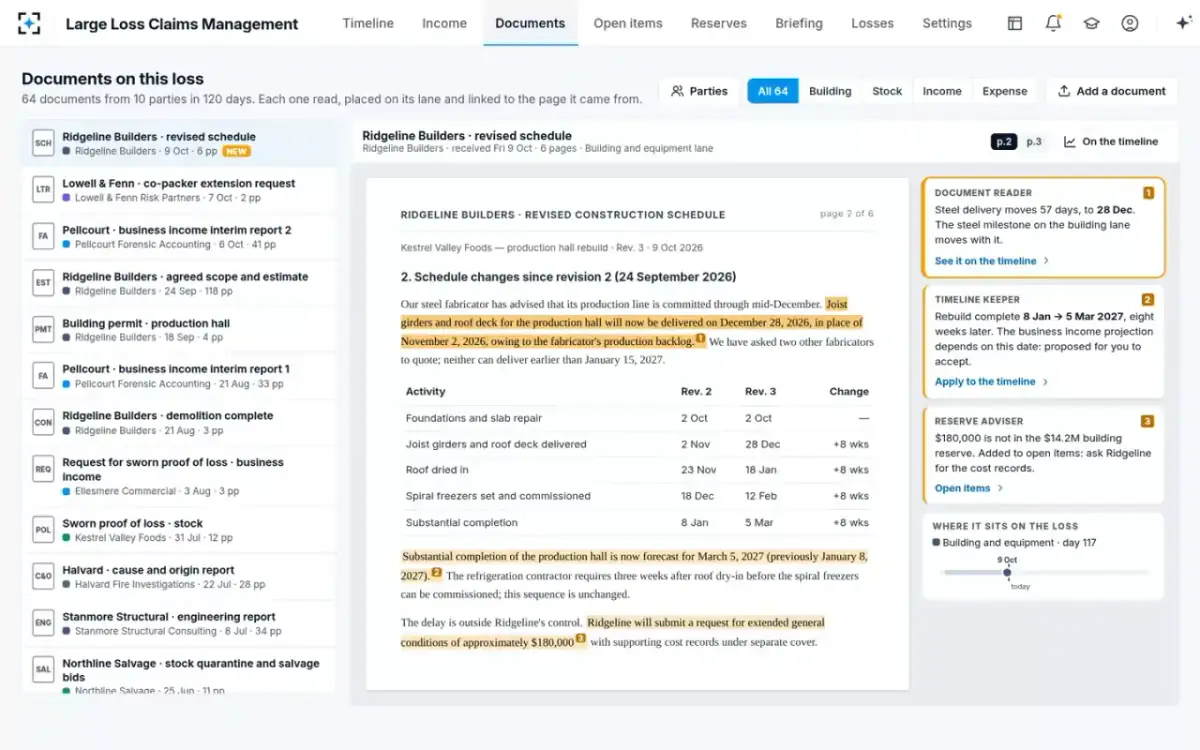
When the third interim report arrives, the document reader takes its measured months with their pages, the projection re-bases on them, and any difference between the agents' view and the accountant's measure is shown, not hidden. That separation is the design: the accountant owns the measure, the adjuster owns the date and the payment, and the agents keep the arithmetic between them current. What the agents may and may not do is set out in complex claims management solutions, and the whole sample loss is on the Large Loss Claims Management page.
Questions people ask
What is a forensic accountant in insurance?
An accountant, usually a CPA, who measures an insured loss from a business's financial records, most often business interruption and extra expense on a commercial property claim. Insurers retain them to measure the loss; policyholders retain them to prepare and support the claim; either may testify if the amount is disputed.
Can the insurer examine a business's books after a loss?
Yes, under the policy conditions. Commercial forms require the insured to let the insurer examine its books and records and copy them, and New York's standard fire policy requires the insured to "produce for examination all books of account, bills, invoices and other vouchers" as often as reasonably required.
What evidence supports a business interruption claim?
Several years of financial statements and tax returns, monthly sales, general ledgers, bank statements, payroll records and the invoices for every extra expense. The Michigan bowling centre had surrendered most of these, but lost its income claim because no one analysed them into a calculation.
Is a business interruption estimate the same as the measured loss?
No. The measured loss covers months that have happened, from the business's actual results; an estimate or projection covers months still to come and depends on the restoration date. On the fictional sample loss, $4,282,000 is measured to 30 September and the rest of the $10.40 million projected is an estimate.
Does a forensic accountant decide whether a claim is covered?
No. Coverage is the insurer's decision, and in a dispute a court's. The accountant measures the amount on the basis the adjuster supplies, including the restoration date, and the AICPA standard bars a member from opining on the ultimate question of fraud, which is for the trier of fact.