Complex claims management solutions are software for the claims a carrier's major and complex loss unit handles: large commercial property losses with business interruption, many outside experts and a year or more of documents. A useful one keeps every coverage part, document, payment and reserve on one current picture, and does the reading, filing, re-projecting and drafting that otherwise falls on a senior adjuster. The best way to evaluate one is not to ask how much it automates but where it stops. On a large loss, four decisions carry legal and financial weight and belong to named people: the restoration date, the amount payable, any coverage position, and any reserve change above the adjuster's authority.
Botminds' Large Loss Claims Management is one such solution. Six agents read each document as it arrives and keep a loss's lanes current; each has written limits, and the adjuster and the director make the decisions. This guide sets out those limits and the reasons behind them, using the solution's fictional sample loss, a frozen-food plant fire in Colorado on 14 June 2026, and court records of real commercial claims. The sample's people, companies and figures are invented, not a customer's result.
Six agents on a large loss: what each does, and the line it never crosses
| Agent | Does | Never |
|---|---|---|
| Document reader | Reads every report, letter, invoice, proof of loss and P&L; takes dates, amounts and statements with their page; places each on its lane. | Infers a figure that is not on a page. |
| Timeline keeper | Keeps milestones and dependencies on each lane; notices when a document moves one and proposes the move. | Moves a milestone without the document that moved it, or applies a new restoration date. |
| Income projector | Projects recovery and income still at stake from the P&Ls, the accountant’s measure and the schedule; checks waiting period, time limit and extended period. | Sets the period of restoration or the amount payable; projects for anything but reserving. |
| Reserve adviser | Compares projections with reserves by coverage part; recommends increases or releases with cited reasons. | Changes a reserve or makes a payment. |
| Open items tracker | Keeps who owes what by when; drafts chasers and 30-day status letters. | Writes to the insured, broker or experts without the adjuster. |
| Briefing writer | Drafts the leadership briefing and the reinsurer advice, every line cited. | States a coverage position, or sends anything. |
What is complex claims management?
Complex claims management is the handling of claims whose amount depends on expert evidence and future events rather than a standard estimate: large commercial fires and storms, business interruption, losses with disputed cause or scope. In property insurance the work sits with a carrier's large loss or major and complex loss unit, under general adjusters with high authority, and its output is less a single payment than a sequence of decisions over months. What the unit needs from software follows from that: one place where every document, figure and decision on a loss is current and cited, so that people can decide faster and defend what they decided.
Florida's regulator gives a sense of the scale of what stays open. Fourteen months after Hurricane Milton, 47.5% of commercial property claims reported in Florida were closed, against 94.0% of homeowners claims (Florida OIR, data as of 9 December 2025). Why those claims stay open is the subject of what is a large loss claim; this guide is about what software should and should not do with them.
Can software move a restoration date?
It should propose one, with the document that moved it, and never apply it. The restoration date is the most valuable assumption on a business income claim and the most litigated: the period of restoration ends when the property "should be" rebuilt with reasonable speed, which courts treat as a judgment about reasonableness, not a construction fact. A New York court held it ends when the property "should have been repaired, rebuilt or replaced with reasonable speed and similar quality, and not when operations have been actually resumed". Someone has to own that judgment, and it has to be someone who can be asked why.
The court record shows what happens when a carrier's own documents disagree about the date. In a California case the insurer paid for eight and a half months, while one of its adjusters had written that it estimated the period at twelve; that letter alone was enough for the court to refuse summary judgment (Michel Family Trust). A system that silently moved the date whenever a new schedule arrived would create exactly that kind of record. In the solution, the timeline keeper proposes the move with the page that justifies it; the adjuster accepts it, and can undo it; and the acceptance is what moves the income projection.
Who signs off when a large loss reserve moves?
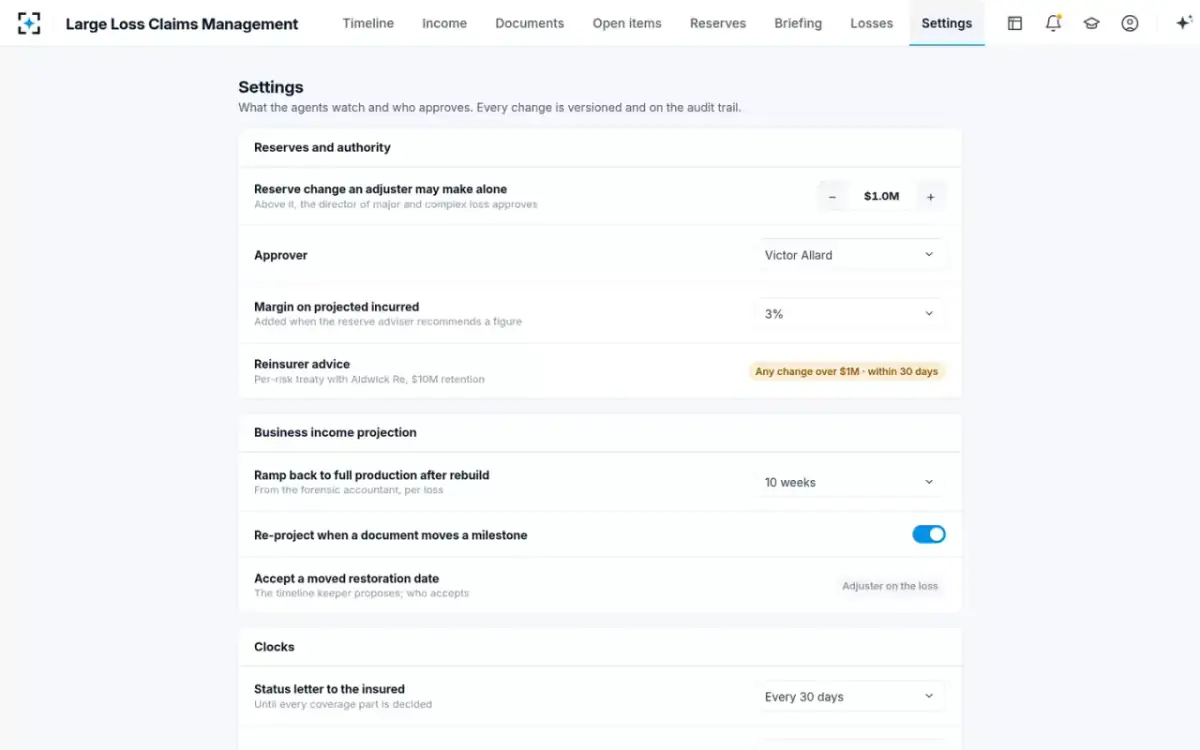
The adjuster within a written authority, and a named director above it; software can recommend, with reasons, but should not change a reserve. On the sample carrier's rules an adjuster may change a reserve by up to $1.0 million alone, and the Director of Major and Complex Loss approves anything larger. Reserves matter beyond the carrier: Florida's regulator, for example, collects catastrophe losses as estimated incurred losses that "include indemnity case reserves and payments to date".
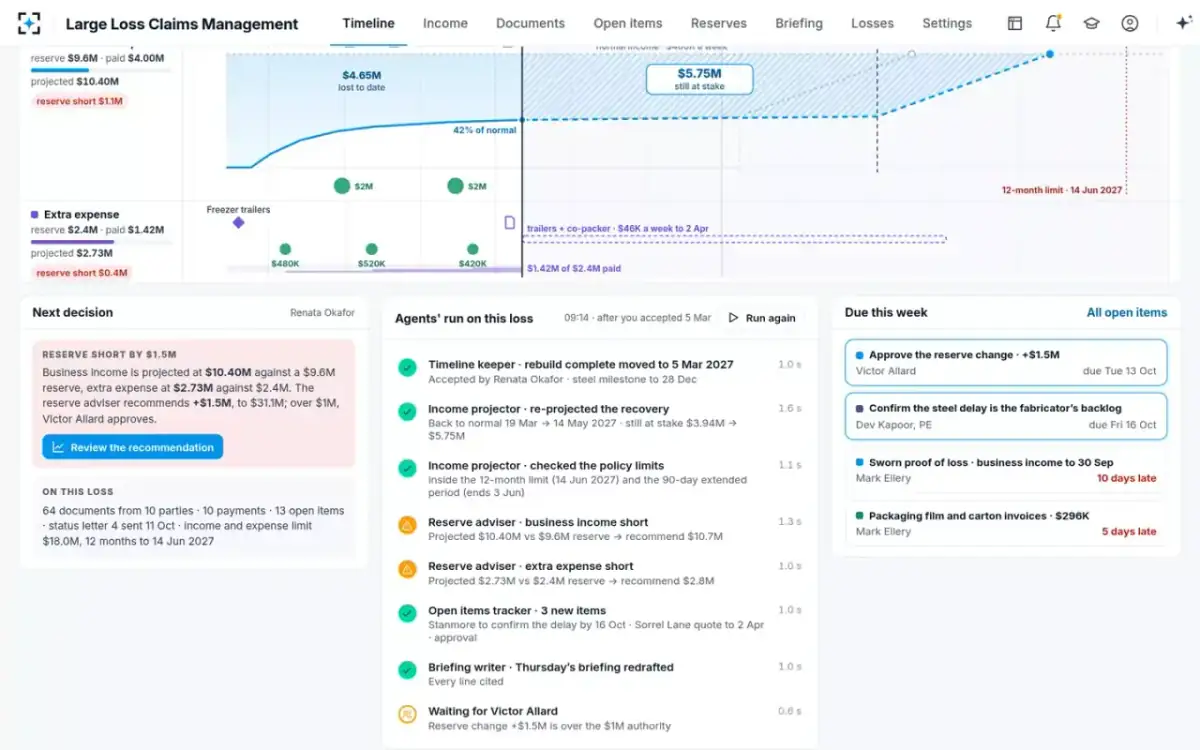
Reserves also become evidence. In a Michigan case the insured argued that the insurer's early decision to reserve its policy limit for lost income proved the loss; the adjuster explained he had recommended the reserve "because the repairs likely would take up to seven months" and would revisit it once financial data arrived. A reserve history with a reason for every change, cited to the document behind it, is the defence against that argument. On the sample loss, the reserve adviser recommended +$1.5 million with four numbered reasons, each linked to its document, and the director approved it at 09:20.
The agents' run after the adjuster accepted a new rebuild date: each step, and the one that waits for a person
Can AI project business interruption?
Yes, for reserving, if every input is traced and the projection is kept apart from the measured loss. The arithmetic is not the hard part: expected income less income earned, month by month, to the restoration date. The hard parts are the inputs, and they are where courts have drawn lines. A projection that set its baseline from a post-disaster boom would contradict the Fifth Circuit's rule that a business interruption loss "will be based on historical sales figures". One that ran to an unaccepted date would contradict the carrier's own adjuster.
The solution's income projector therefore projects from what people have supplied: the profit and loss statements, the forensic accountant's measured loss and ramp assumption, and the schedule the adjuster accepted. It checks the waiting period, the time limit and the extended period of indemnity with their pages. It labels its result as the agents' view, for reserving; the measured loss belongs to the forensic accountant and the amount payable to the adjuster. How the four inputs are tested is set out in forensic accounting in insurance claims.
One morning on the sample loss, from the contractor's letter to an approved reserve
07:12
the contractor’s revised schedule read and the date move proposed
09:14
the adjuster accepts the new rebuild date
+$1.5M
reserve change recommended with four cited reasons
09:20
the director approves, over the $1M authority
What a same-day re-projection is worth
A reserve that moves only at quarterly review moves late, and late reserve changes surprise the director, the reinsurer and the finance team. The alternative is to re-project when the evidence changes. On the sample loss the evidence changed on a Friday; by Monday morning the reserve, the income projection, the open items and the leadership briefing all reflected it, and the reinsurer advice was ready to draft because the loss was above the treaty's $10 million retention.
The same steel delay, handled two ways
Re-projected at the quarterly review: Still 8 Jan in the reserve file until the review
Re-projected the morning it was read: 5 Mar, accepted at 09:14 with the schedule’s page
Re-projected at the quarterly review: $9.6M against a $10.40M projection, unseen
Re-projected the morning it was read: $10.7M recommended with its reasons
Re-projected at the quarterly review: Learns of a larger step-up at the review
Re-projected the morning it was read: Approves +$1.5M at 09:20 the same morning
Re-projected at the quarterly review: Advised after the quarter
Re-projected the morning it was read: Advice drafted the same day for reinsurance accounting to send
Re-projected at the quarterly review: Status letter repeats the old date
Re-projected the morning it was read: Next status letter carries the new date and why
Why each limit maps to a person who answers for it
The limits are not caution for its own sake; each one follows a decision to the person who must explain it later, to an insured, an appraisal panel, a reinsurer or a court. A large loss produces a long written record, and every decision on it is eventually read by someone adverse. The question for any software is whether its record shows a named person making each of those decisions on stated evidence.
Six decisions on a large loss, who answers for each, and where it has been tested
| Decision | Who answers for it | Where it gets tested |
|---|---|---|
| The restoration date | The adjuster, on the experts’ evidence | A carrier’s own twelve-month letter against its eight-and-a-half-month payment (N.D. Cal. 2011) |
| The amount payable | The adjuster; an appraisal panel if either side demands one | An award stating a 15-month period the parties had kept out of appraisal (D. Md. 2018) |
| The measured loss | The forensic accountant | An insured’s accountant who had done no analysis (E.D. Mich. 2015) |
| A reserve above authority | The director | An early limits reserve offered by the insured as proof of its loss (E.D. Mich. 2015) |
| A coverage position | The adjuster, with counsel where needed | Appraisal settles amounts; the forms keep the insurer’s right to deny |
| What goes to the insured | The adjuster | State rules on written status and explanations, such as California’s 30-day letters |
Read down the middle column and the agents' limits write themselves: nothing in it is a job for software, and everything around it is. That is also why the solution records which agent did what, who accepted, who approved and under which version of the settings. A carrier asked in month fourteen why a reserve moved in month four can answer with the document, the page and the name.
Questions to ask any complex claims software vendor
Buyers should ask to see the limits, not just the features, and to see them on their own losses. The questions below come from the decisions on this page and the court records behind them.
Ten questions for a complex claims management solution
- Can it show the page behind every figure?
Dates, amounts and statements, each linked to the document and page it came from.
- Who moves the restoration date?
It should propose with the document; a named adjuster should accept, with undo.
- Can it change a reserve or make a payment?
It should not. It should recommend, with reasons, within your authority rules.
- Does it separate the measured loss from its projection?
The forensic accountant’s figure and the reserving view must not be blended.
- Does it check the policy’s own limits?
Waiting period, time limit, extended period, dollar limits, from the declarations as well as the form.
- Does it take coverage positions?
It should leave them to the adjuster, with the wording and the experts’ views beside them.
- Does anything go out without a person?
Chasers, status letters and briefings should be drafts until someone sends them.
- Are its rules your settings?
Authority, approver, margin, ramp-back, clocks: visible, changeable and versioned.
- Is every step and decision on the record?
Which agent did what, who accepted, who approved, under which version of the rules.
- Will it run on a sample of your own past losses before you buy?
Your policy forms, your experts’ reports, your reserve history.
The carrier's rules as settings: authority, approver, margin, ramp and clocks
Where Large Loss Claims Management fits, and where it does not
The solution fits a carrier's large commercial property losses: one timeline per loss, a lane per coverage part, and six agents keeping it current from the documents the loss already runs on, which are the policy and schedule of values, the experts' reports, the proofs of loss, the contractor's estimates and schedules, the correspondence, and the payments and reserves to date. It is designed for the adjuster who carries the loss and the director who approves its reserves.
It does not decide anything the policy or the authority rules give to a person. It does not take coverage positions; on the sample loss, whether a code-required sprinkler upgrade falls under the ordinance or law coverage is left to the adjuster. It does not measure the loss in place of the forensic accountant, and it does not write to the insured, the broker or the experts on its own. Teams that want software to settle claims without a person in the loop should look elsewhere; this solution is built on the opposite premise. The disputes it is designed to prevent are set out in when the period of restoration ends, and the inputs a team needs to go live in the large loss checklist. The full sample loss is on the Large Loss Claims Management page.
Questions people ask
What is large loss claims management software?
Software for the commercial property losses a major and complex loss unit handles: building, stock, business interruption and extra expense, with every expert, document, payment and reserve in one place. Large Loss Claims Management draws each coverage part as a lane on one timeline, and its agents read each document as it arrives.
What is a large loss manager?
A large loss manager, or director of major and complex loss, runs the unit that handles a carrier's biggest property claims and approves reserve changes and payments above the adjusters' authority. On the fictional sample carrier, that director approves any reserve change over $1 million.
Does the software take a coverage position?
No. Coverage questions, such as the period of restoration or ordinance or law on a sprinkler upgrade, are left to the adjuster with the policy wording and the experts' views beside them. The briefing writer is barred from stating one.
Does it write to the insured, the broker or the experts?
It drafts. The open items tracker drafts each reminder and 30-day status letter and the briefing writer drafts the leadership page, but nothing goes out until the adjuster sends it; the reinsurer advice is sent by reinsurance accounting.
How does a carrier go live with it?
It is built from the carrier's own policy forms, reserving guidelines, authority levels and a sample of past losses, and goes live once its checks on those losses pass. Botminds walks a team through it on its own losses first.