Reserve strengthening in insurance is an increase in the reserves an insurer holds for claims from earlier accident years, booked because the old estimate now looks too low. It is charged against the current period's earnings and reduces surplus, even though the claims belong to the past. Insurers strengthen reserves when losses develop worse than expected, when courts, inflation or claims practice change the cost of open claims, or when a review finds that earlier selections were optimistic. The charge itself does not depend on when the problem is found; what a late quarter adds is surprise, a wider range and an explanation rebuilt under deadline. Botminds' Loss Development Monitoring compares every segment's development with expectations each week so that the movement behind a strengthening is seen, and explained, in the month it starts.
The regulatory and industry figures below come from the NAIC, the Actuarial Standards Board and an SEC enforcement release. The worked example is a sample casualty book in the solution, with fictional companies and claims.
How reserve strengthening shows up in the numbers regulators read
+$7.3B
adverse prior-year development on other liability, occurrence, in 2025 ($7,278 million), the largest of any line
20%
one-year reserve development to surplus at which the NAIC’s IRIS ratio 11 is unusual
2,647
property and casualty companies in the NAIC’s 2025 IRIS ratio results
81.5%
industry loss and LAE reserves to surplus at year-end 2025
What is reserve strengthening in insurance?
Reserve strengthening is a decision to raise the carried reserve for prior accident years, and the NAIC's own early-warning ratios treat it as one of the things a jump in prior-year development can mean. On IRIS ratio 11, one-year reserve development to surplus, the NAIC manual notes that "Significant increases in this ratio might also be indicative of reserve strengthening, while significant decreases might be indicative of current reserve understatements" (NAIC IRIS Ratios Manual). On ratio 12, two-year development, it lists "Strengthening of deficient loss and LAE reserves held at the end of the second prior year-end" first among the causes of an adverse result.
The mechanics are simple. An insurer that held $100 million for an accident year and now estimates $110 million adds $10 million to the reserve; the $10 million runs through incurred losses in the current calendar year, raising the calendar-year loss ratio and lowering pre-tax income and, after tax, surplus. Analysts and rating agencies see it in Schedule P as adverse development on prior years. A strengthening of the same size spread over four quarters and one announced at year-end cost the same; they do not read the same.
Why do insurers strengthen reserves?
Insurers strengthen reserves because emergence has outrun the assumptions: claims are reported later, settle higher or are litigated more than the selected patterns and expected loss ratios allowed. ASOP No. 43 names the sources the actuary must weigh: "Claim obligations are influenced by external conditions, such as potential economic changes, regulatory actions, judicial decisions, or political or social forces" (ASOP No. 43, section 3.6.6). Internal causes count too: a change in how claims staff set case reserves, a new claim system or a change in reinsurance can all leave history that no longer predicts the future.
The 2025 data shows where the pressure sits. The NAIC reports that prior-year reserve releases across the industry produced a one-year redundancy of $20.0 billion, yet other liability on an occurrence basis developed adversely by $7,278 million, commercial auto liability by $1,837 million and commercial multiple peril by $688 million (NAIC, 2025 Full Year Results). A favorable industry total sat on top of strengthening in the commercial liability lines, the same pattern a company's own total can hide. How to read those figures, and your own, is set out in prior year reserve development in 2025.
Reserve strengthening vs adverse development: what is the difference?
Adverse development is what the data shows: losses on prior years emerging above what the last estimate expected. Reserve strengthening is what management books in response, and it can be larger or smaller than the emergence so far. An insurer that sees $5 million of adverse emergence on an accident year may strengthen by $5 million, or by $10 million if it concludes the pattern itself has changed, or by nothing if it judges the movement random. The NAIC's ratio 12 commentary shows the overlap: strengthening is a cause of adverse ratio results, alongside write-offs of uncollectible reinsurance, commutations and changes in tabular discount.
The distinction matters because each answers a different question. Development answers what happened; strengthening answers what the insurer now believes. A reserving actuary who sees development early can separate the two: the emergence in the month, the claims that caused it, and a range for what it implies for the ultimate. The claim desk's side of adverse development, the case reserve step-ups that cause much of it, is covered in adverse reserve development, traced to the file.
How does reserve strengthening affect earnings and surplus?
Dollar for dollar against current pre-tax income, and through income against surplus, which is why regulators measure prior-year development against surplus rather than against reserves. The NAIC's IRIS ratio 11 treats one-year development of 20% or more of prior-year surplus as unusual, ratio 12 does the same for two-year development, and ratio 13, the estimated current reserve deficiency, flags at 25% (NAIC IRIS Ratios Manual). How much strengthening it takes to reach those lines depends on reserve leverage, the ratio of reserves to surplus.
How much reserve strengthening reaches the NAIC's 20% line, depending on reserve leverage
The bars explain why the same strengthening is routine at one company and a regulatory event at another. At the industry's 2025 leverage, a reserve would have to prove a quarter short before one year's development reached a fifth of surplus. A long-tail commercial casualty writer carrying reserves of two or three times its surplus crosses the same line with a strengthening of under 10%. For those companies, finding the movement a quarter earlier is also finding it while there is still a choice about how to present it.
How do regulators react to reserve strengthening?
Regulators accept strengthening; they do not accept it as an explanation. The NAIC's Actuarial Opinion Working Group says that when IRIS ratios 11, 12 or 13 are unusual, the appointed actuary must comment in the statement of actuarial opinion, and it is direct about what the comment must contain: the Working Group "expects the Appointed Actuary to provide insight into the company-specific factors that caused the unusual value" (NAIC AOWG, 2026). Detailed documentation is expected in the actuarial report behind the opinion.
Securities regulators look at the other side, the gap between the actuarial estimate and what management books. In 2020 the SEC charged an insurer and its former chief financial officer over judgmental adjustments to loss reserves; the complaint alleged that the company failed to disclose that the adjustments departed from the actuarial estimates, that by the end of 2015 they exceeded $300 million, and that the company failed to keep sufficient support for management's best estimate (the release is read in top side entries meaning). The parties settled for a combined $10.5 million without admitting or denying the allegations (SEC Litigation Release No. 24838). A strengthening that arrives with its evidence is the opposite case: the movement, its causes and the range are on file before the number is booked.
The Working Group considers it insufficient to attribute unusual reserve development to “reserve strengthening” or “adverse development.”
NAIC Actuarial Opinion (C) Working Group, 2026 Regulatory Guidance
What a late quarter costs
A late quarter does not change the size of the strengthening; it changes what comes with it. Found on the next quarterly diagonal, an adverse accident year arrives as a total: more reported than expected, cause unknown, with days left before the numbers are drafted. The reserving team then rebuilds the story claim by claim from adjuster notes, under the deadline, and the committee is asked to book a range it has not had time to test. The company-specific explanation that regulators want is assembled after the decision rather than before it.
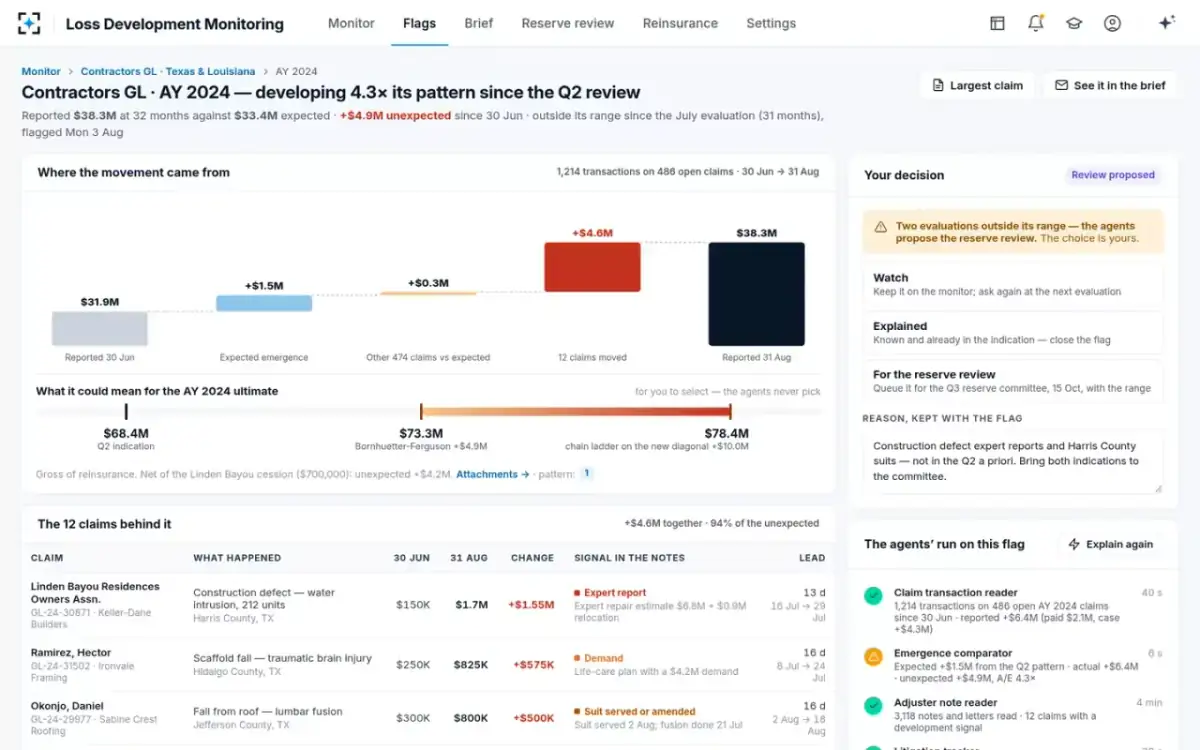
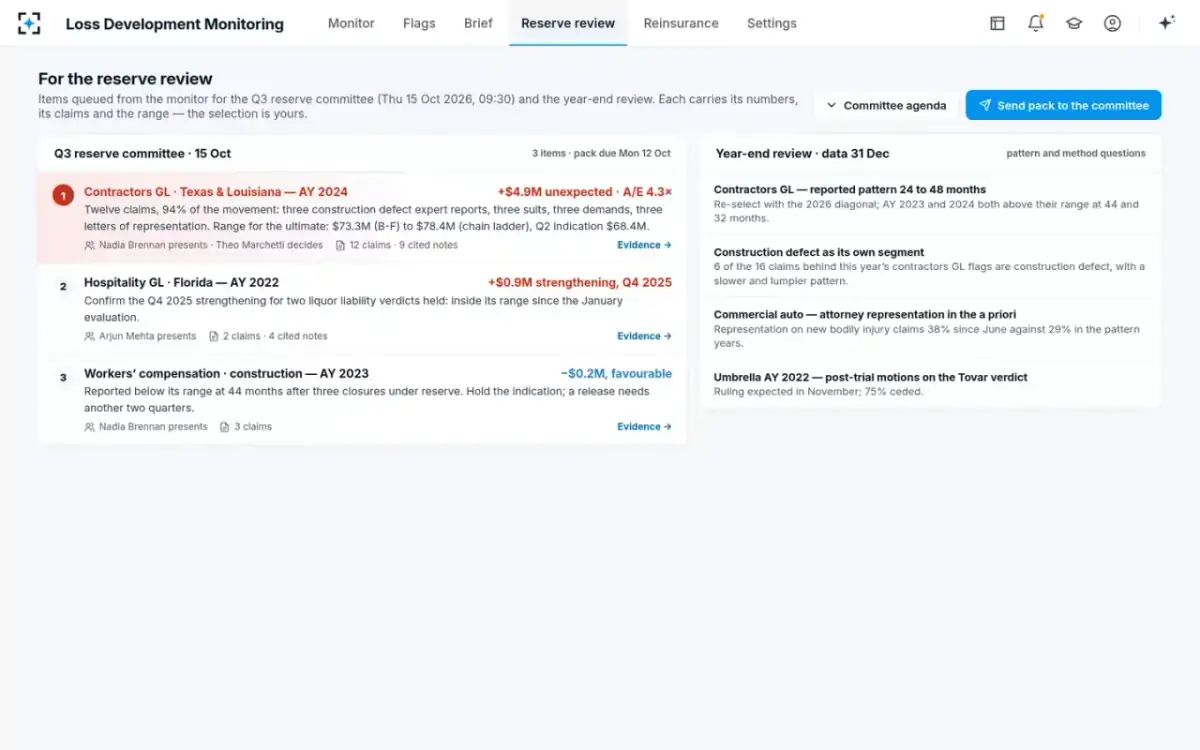
The sample casualty book shows the alternative. Contractors general liability, accident year 2024, sat on its pattern at the June evaluation the second-quarter review saw. At the July evaluation it left its expected range, reporting 50.6% of its indicated ultimate against a range of 45.3% to 50.2%, and Loss Development Monitoring flagged it on Monday 3 August. By the August evaluation it had reported $6.4 million since 30 June against $1.5 million expected: $4.9 million unexpected, 4.3 times the expected emergence. The reserving actuary marked it for the third-quarter reserve committee on 8 September, three weeks before quarter-end, with both indications.
Eight weeks of warning before quarter-end, against a break first seen on the September diagonal
- On patternto 3 Aug
- Flagged, watchedto 8 Sep
- Queued for committeeto 15 Oct
- Not comparedto 30 Sep
- Rebuild, decideto 15 Oct
Three costs follow from the second lane, and none of them is the strengthening itself. The first is the range. With one month of unexpected emergence the movement was $1.9 million; with two it was $4.9 million, and the chain ladder on the new diagonal already pointed $10.0 million above the second-quarter ultimate. A committee that sees the movement in July can wait for a second evaluation; one that sees it in October has to choose with whatever the quarter brought. The second is the explanation: the hand-built version of finding the claims and reconstructing the story takes about nine working days in Botminds' estimate for a casualty review, against about one and a half with the claims and passages already attached. The third is credibility, with the board, the auditors and the regulator who will read the actuary's comment.
What a company-specific explanation looks like
A company-specific explanation names the claims, the events and the amounts. On the sample book, $4.6 million of the $4.9 million unexpected came from twelve claims, and each claim's movement was preceded by a signal in its notes: three construction defect expert reports, three demands, three suits served or amended and three letters of representation. The remaining $0.3 million was spread across 474 other open claims. That is the kind of answer the NAIC's guidance asks for, and it exists before the committee meets.
Where the sample accident year's $4.9 million of unexpected development came from
The flag that carries its own explanation: where the movement came from and what it could mean
Can reserve strengthening be predicted?
Not exactly, but its leading indicator can be watched. A strengthening is almost always preceded by months in which an accident year reports more than its selected pattern expected. In our replay of an actual-versus-expected monitor on the CAS Schedule P research data, accident years flagged in the first year after a review later developed adversely about twice as often as those not flagged, and those flagged two years running did so about four times in five; the method and its limits are in the replay on closed years. A flag is a probability, not a forecast.
Incentives are the other predictor, and the research is mixed. Grace and Leverty's study of property-liability reserve error found stronger under-reserving among financially weak insurers, while their evidence "casts doubt on the conclusion that insurers manipulate reserves to avoid solvency monitoring" (Journal of Risk and Insurance, CAS abstract). For a chief actuary the practical lesson is about process, not motive: development compared every month, against signed patterns, with the decisions and reasons kept, leaves little room for a strengthening to be anyone's surprise.
Where Loss Development Monitoring fits, and where it does not
Loss Development Monitoring is the early part of a strengthening decision, not the decision. It compares actual with expected development for every segment and accident year at each monthly evaluation, against the last signed review's selected patterns; flags the evaluation where a curve leaves its range; attributes the unexpected to the claims that moved; and shows the effect gross, ceded and net. After two evaluations outside the range the agents propose a reserve review; the reserving actuary decides, and the chief actuary decides what the committee books. No agent changes a reserve, a pattern or an indication.
On the committee agenda with its evidence, two weeks after quarter-end
It does not set the reserve, select patterns, or replace the quarterly and year-end reviews, and it cannot see movement that has not yet reached the claim file. What it changes is when the reserving team learns, and what it knows when it does. How the committee should receive that evidence, standing questions included, is drafted in reserving committee terms of reference.
Questions people ask
What does reserve strengthening mean?
It means an insurer has raised its reserves for claims from earlier years because it now expects them to cost more. The increase is charged to current-period earnings, even though the accidents happened before.
Is reserve strengthening bad for an insurer?
It reduces earnings and surplus in the period it is booked, and repeated strengthening raises questions about the reliability of reserves. A timely, explained strengthening is far less damaging than a late one, and the NAIC's guidance expects company-specific causes, not the label alone.
What is a reserve charge?
A reserve charge is the income statement effect of strengthening: the increase in prior-year reserves booked as incurred losses in the current period. It is often announced with results, sometimes broken out by line and accident year.
What is the opposite of reserve strengthening?
A reserve release, booked when prior-year estimates prove too high. The NAIC reports a one-year redundancy of $20.0 billion for the US property and casualty industry in 2025, meaning releases outweighed strengthening overall.
Which IRIS ratios show reserve strengthening?
Ratios 11 and 12, one-year and two-year reserve development to surplus, with a usual range below 20%, and ratio 13, estimated current reserve deficiency to surplus, below 25%. The NAIC manual says significant increases in ratio 11 might indicate reserve strengthening.
How do auditors view reserve strengthening?
Auditors test whether management's booked reserve is supported and how it relates to the actuarial estimate. In its 2020 case against an insurer, the SEC alleged undisclosed adjustments that diverged from the actuarial estimates and insufficient documentation of management's best estimate; the case settled without an admission.