A top side entry, also called a topside adjustment or top-side journal, is an adjustment made to the consolidated or reported figures rather than through the sub-ledgers and transaction systems where the underlying business is recorded. It is posted "on top": in the consolidation, in the reporting package, or straight into the draft financial statements, usually at the end of the close. Many are routine and necessary, such as eliminating intercompany balances between the companies of an insurance group or reclassifying an amount to the right line. The meaning of top side entries in an audit, though, is risk: because they bypass the systems and approvals that govern ordinary journals, they are where errors and deliberate misstatements are hardest to see. In an insurer the most consequential top-side adjustments are to loss reserves, the largest liability on the balance sheet and an estimate in the first place. Three cases brought by the SEC against insurers, set out below, show what regulators look for. Botminds' Financial Close Management treats the close's version of this risk directly: an estimate booked in the quarter to save time needs a judgement memo signed by the controller and the CFO, and it is disclosed to the auditors.
The cases are summarised from the SEC's own releases, which describe allegations settled without admitting or denying them. Examples of the close come from a fictional sample insurance group, Northvale Casualty Group, in Financial Close Management.
Three SEC cases about insurers' reserves, in the regulator's numbers
$500M
in loss reserves the SEC alleged AIG added through two sham reinsurance transactions in 2000–01
$2M+
of reinsurance claims the SEC alleged Bancinsurance failed to account for properly in 2003–04
$300M+
of judgmental reserve adjustments by AmTrust’s former CFO by end-2015, as the SEC alleged
$10.5M
combined settlement paid by AmTrust and its former CFO in 2020
What are top side entries? The meaning in an insurer's close
They are entries made where the reported numbers are assembled rather than where the transactions are recorded. An insurer's ordinary journals start in a sub-ledger: premiums in the policy and billing system, paid claims and case reserves in the claims system, ceded amounts in the reinsurance system. A top side entry starts at the consolidation or the statements, and it changes the reported number without changing the sub-ledger beneath it.
That location is why the term matters. A journal that flows from a sub-ledger carries the transaction's own trail: a policy, a claim, a treaty. A top side entry carries only what its preparer writes down. If the reason, the calculation and the approval are not attached to it, nothing else in the books will explain it later. Banking has its own version of the problem, where adjustments between the general ledger and a regulatory report recur every quarter; that is covered in what a topside adjustment is in regulatory reporting. This page is about the insurer's version, where the adjustments that count most are to reserves.
What is an example of a top side entry?
The most common is a consolidation elimination; the most consequential, in an insurer, is an adjustment of booked reserves away from the actuary's indication. Between those sit reclassifications and late accruals. The table compares an ordinary journal with a top side entry on the points that decide how risky each one is.
An ordinary journal and a top side entry, side by side
Ordinary journal from a sub-ledger: A transaction system: policy, claims, reinsurance, payroll.
Top side entry at consolidation or in the statements: The consolidation, the reporting package or the draft statements.
Ordinary journal from a sub-ledger: Monthly premium written; claims paid; the quarter’s ceded recoveries by treaty.
Top side entry at consolidation or in the statements: Intercompany pooling eliminated; a reclassification between lines; reserves booked above or below the indication.
Ordinary journal from a sub-ledger: The underlying policies, claims or treaties.
Top side entry at consolidation or in the statements: Only the memo, calculation and approval attached to it.
Ordinary journal from a sub-ledger: The system’s own approvals and the journal approval.
Top side entry at consolidation or in the statements: Whatever the close process applies at the top; often fewer.
Ordinary journal from a sub-ledger: Through the period, by routine.
Top side entry at consolidation or in the statements: At the end of the period, often after the sub-ledgers lock.
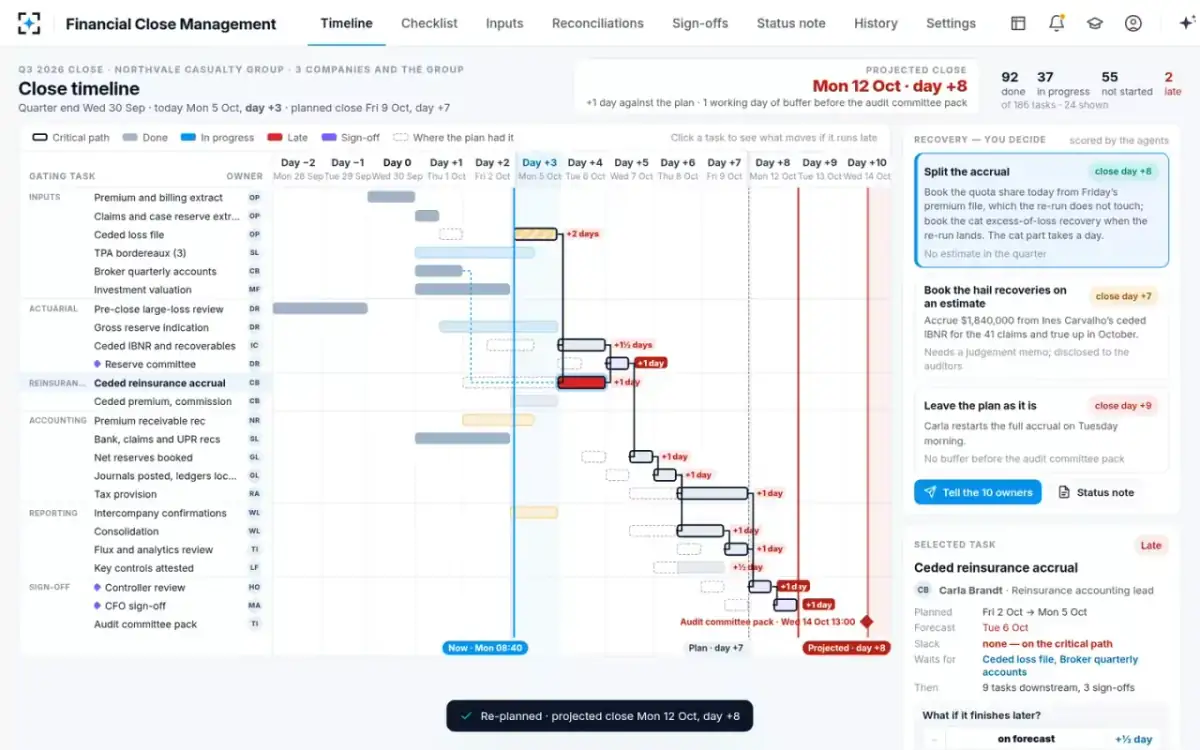
In the sample group's third-quarter close, one possible top side entry was never made. When the ceded loss file was re-run on day +3, one of three recoveries scored for the controller was to book the 41 re-coded hail claims' recoveries on the actuary's $1,840,000 ceded IBNR estimate and true it up in October. It would have kept the close on day +7. It would also have been an estimate booked to save time, and the solution flagged it accordingly: it needs a judgement memo and is disclosed to the auditors.
A recovery that would have meant booking an estimate, flagged before anyone chose it
Why are top side entries risky? What the auditing standard says
Because they are the easiest place to change a number without leaving the trail an ordinary journal leaves. The PCAOB's fraud standard for audits of public companies says that misstatements due to fraud often involve the financial reporting process, including adjustments "that are not reflected in formal journal entries, such as through consolidating adjustments, report combinations, and reclassifications". It directs the auditor to test journal entries and other adjustments, including "entries posted directly to financial statement drafts".
The same standard lists the marks auditors look for. Inappropriate entries often have characteristics such as being made to unrelated, unusual or seldom-used accounts, being made by people who do not usually make journal entries, or being "recorded at the end of the period or as post-closing entries that have little or no explanation or description", or containing round numbers. A top side reserve adjustment made by the CFO on the last day of the close, in a round amount, with a one-line description, carries several of those marks even when it is entirely proper.
A proper top side entry and an improper one can look the same in the general ledger. The difference is what is attached to it.
How do auditors test top side entries?
By understanding the close process and its controls over journals and adjustments, selecting entries with risky characteristics, and examining the support for each. The PCAOB standard asks the auditor to obtain an understanding of the financial reporting process and the controls over journal entries and other adjustments, to identify and select entries for testing, and to ask people involved in the close about unusual activity. Because fraudulent entries are often made at the end of a period, the testing ordinarily focuses there, while considering whether entries through the period also need testing.
For reserves the auditor has a second tool: hindsight. The same standard requires a retrospective review of significant accounting estimates, comparing last year's estimates with how they turned out, to look for bias in management's judgements. A pattern of top side reserve adjustments that always moved the result in the same direction will show up there, a year or more after it was booked. How the close books the actuary's number in the first place is the subject of IBNR accrual meaning.
What happened in the AmTrust reserve case?
The SEC alleged that AmTrust described its actuarial process for reserves to investors but did not disclose that its CFO adjusted the reserves away from it. According to the SEC's release, AmTrust and its former CFO "failed to disclose that Pipoly made consolidated accounting adjustments that did not properly consider the actuarial analyses and diverged from the company's actuarial estimates". The complaint also alleged that the company "failed to maintain sufficient supporting documentation for management's best estimate", and that by the end of 2015 the adjustments exceeded $300 million and affected all of the company's reporting segments.
The case is the clearest illustration of the risk in a top side reserve adjustment, and it is worth being precise about what it did not say. Management is entitled to book a reserve that differs from the actuary's indication; the carried reserve is management's best estimate, not the actuary's. The charges were about disclosure and documentation: that the adjustments, their size and the factors behind them were not disclosed, and that the support for management's estimate was insufficient. AmTrust and its former CFO settled without admitting or denying the allegations, with civil penalties of $10.3 million and $75,000, and the CFO also agreed to disgorgement.
Three SEC cases about insurers' reserves: what was booked, what was missing, how it ended
| Case | What was booked, or not | What the SEC said was missing | Outcome |
|---|---|---|---|
| AIG, 2006 | Two reinsurance transactions with Gen Re in December 2000 and March 2001, which the SEC alleged were designed to add $500 million of loss reserves. | Economic substance: the SEC called them sham transactions, designed to quell analysts’ criticism of falling reserves. | $800 million: $700 million disgorgement and a $100 million penalty, settled without admitting or denying. |
| Bancinsurance, 2009 | More than $1 million of reinsurance claims notified before the 2003 10-K, and more again before the first-quarter 10-Q, not recorded. | The claims never reached the principal financial officer or the external auditors, as the SEC alleged. | Injunctions; a $60,000 penalty for the CEO, settled without admitting or denying. |
| AmTrust, 2020 | Consolidated adjustments to reserves that diverged from the actuarial estimates, over $300 million by end-2015. | Disclosure of the adjustments and their basis; sufficient documentation of management’s best estimate. | $10.3 million and $75,000 penalties, plus disgorgement by the former CFO, settled without admitting or denying. |
The other two cases complete the picture. In AIG's case the SEC's complaint alleged that the reinsurance transactions were "designed to inflate falsely AIG’s loss reserves by $500 million in order to quell analyst criticism that AIG’s reserves had been declining"; the adjustment arrived dressed as a transaction rather than as a top side entry, which is why it was harder to see. Bancinsurance is the mirror image: not an entry that should not have been made, but entries that were never made. Its chief executive, the SEC alleged, knew of reinsurance claims before the annual report was filed and "failed to ensure that the Company's principal financial officer or its external auditors were informed of the claims". A close process has to catch both: the adjustment without support, and the known item that never reaches the books.
Who approves top side reserve adjustments?
Management does, through a defined route: the reserve committee sets the booked reserve against the actuary's indication, the CFO approves the result, and any difference between booked and indicated is explained in writing and visible to the auditors and the audit committee. In the sample group's close, the reserve committee's evidence is its minutes, with gross and net indications and booked against indicated by company and line. A reserve adjustment made later, at consolidation, should go back through the same route rather than around it.
The statutory rules add a duty that applies to every adjustment the auditor asks about. The NAIC Model Audit Rule bars any director or officer from making, or causing to be made, "a materially false or misleading statement to an accountant in connection with any audit", or from omitting a material fact needed to make what they did say not misleading. An adjustment whose basis cannot be explained to the auditor is a problem under that rule as well as under the accounting.
Are top side entries allowed?
Yes. A group cannot consolidate without eliminating intercompany balances, and a close that found a late item after the sub-ledgers locked would be worse for not booking it. Nothing in the auditing standard forbids top side entries; it treats them as a place to look. The question is never whether an entry was made at the top, but whether it is supported, approved by someone other than its preparer, disclosed where it involves a significant judgement, and explicable to someone reading it a year later.
The cases suggest a useful rule of thumb for insurers. An adjustment that moves reserves, recoverables or the timing of a loss should be treated as a judgement, not a journal, and carry the documentation a judgement needs. That is the reason the sample close's estimate route was flagged for a memo, and why the controller weighed a day of close time against it.
How should top side entries be documented?
With enough attached to each one that a reviewer, an auditor or an examiner can see what it does, why, on what basis and who approved it, without asking the preparer. The checklist below is what that means in an insurer's close.
What every top side entry in an insurer's close should carry
- The reason, in a sentence a stranger can follow
Not “per CFO” or “true-up”. What it corrects or estimates, and why it could not be booked in the sub-ledger.
- The calculation and its inputs
For a reserve adjustment, the indication it departs from, the amount, and the factors or assumptions behind it.
- A preparer and a different approver
Named, with dates. A top side entry prepared and approved by one person is the pattern auditors are told to look for.
- A judgement memo where it is an estimate
Signed by the controller and the CFO in the sample close’s rule, and disclosed to the auditors.
- The reversal or true-up plan
When the estimate will be replaced by the actual, and where the difference will go.
- A link to the close task it belongs to
So the entry shows up in the task’s history and the task cannot be done without it.
- A pattern check, every quarter
Top side reserve adjustments by direction and size over time; a one-way pattern is what a retrospective review will find.
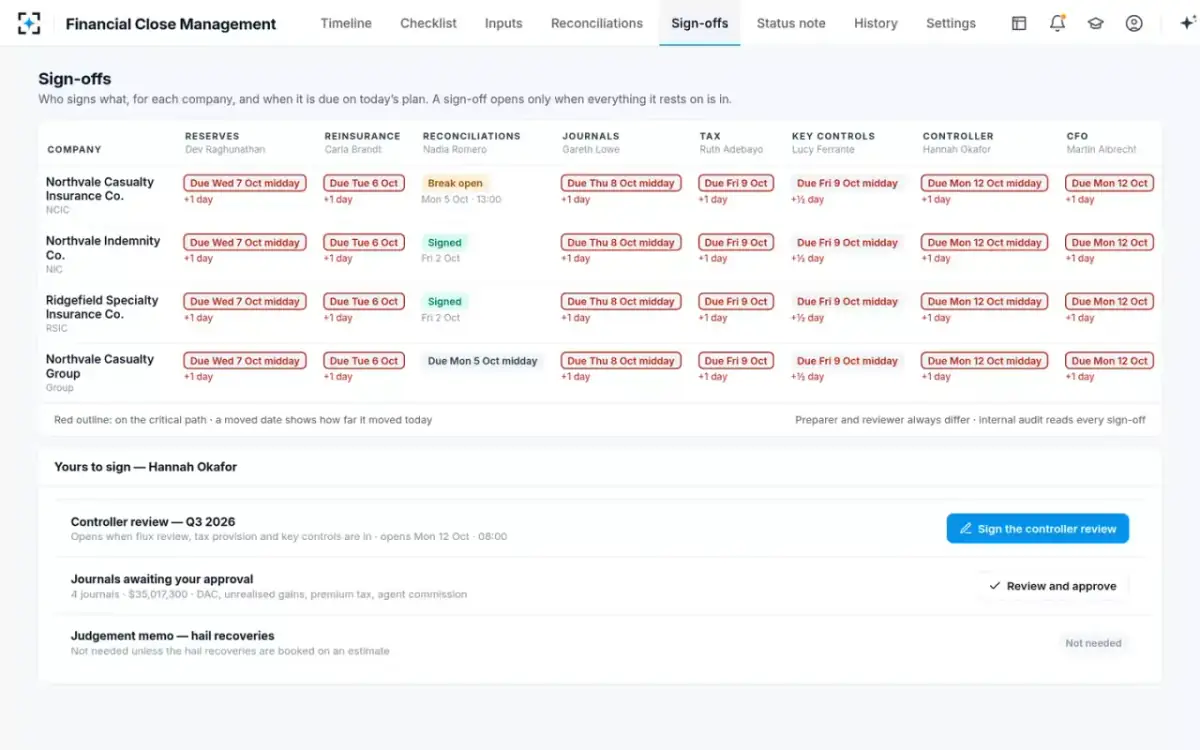
Financial Close Management covers the parts of that list that belong to the close rather than to the general ledger. It keeps the judgement memo as a sign-off of its own, opened only when an estimate is booked in the quarter; on the sample group's sign-off screen the memo for the hail recoveries reads "Not needed" because the controller chose the split. Every recovery chosen and every sign-off is on the task's history with who and when, and internal audit reads every sign-off. The solution does not post the entry itself; the journal is prepared and approved in the general ledger, under its own controls. Where those controls sit in an insurer's internal control report is covered in SOX controls for insurance companies.
Every sign-off for every company, with the judgement memo waiting only if it is needed
Questions people ask
What are top side entries?
Adjustments made to the consolidated or reported figures rather than through the sub-ledgers where transactions are recorded, often at the end of the close. Consolidation eliminations and reclassifications are common examples; in an insurer the most consequential are adjustments to loss reserves.
Why are top side entries risky?
They can change a reported number without the trail an ordinary journal carries, and they are often made late with little description. The PCAOB's fraud standard directs auditors to test adjustments including entries posted directly to the financial statement drafts, and lists late, poorly described and round-number entries among the warning signs.
What happened in the AmTrust reserve case?
In 2020 the SEC alleged that AmTrust's former CFO made consolidated reserve adjustments that diverged from the actuarial estimates, over $300 million by end-2015, without disclosure or sufficient documentation of management's best estimate. The company and the CFO settled for a combined $10.5 million without admitting or denying the allegations.
Are top side entries allowed?
Yes, and some are unavoidable, such as eliminating intercompany balances in a group. What matters is that each is supported, approved by someone other than its preparer, disclosed where it involves significant judgement and explicable to a reader later.
Who approves top side reserve adjustments?
Management, through the reserve committee and the CFO, with any difference between booked and indicated reserves explained in writing for the auditors. In Financial Close Management's sample close, an estimate booked in the quarter also needs a judgement memo signed by the controller and the CFO.