Financial close management software runs the quarter-end close as one plan: every task, input, reconciliation, journal and sign-off with its owner, its dependencies and its date, and a projected close date that moves when any of them does. For an insurer the plan has to carry a chain that general-purpose tools rarely model: claims and premium extracts, the actuary's indication, the ceded loss file and the reinsurance accrual, the reserve committee, net reserves, consolidation across statutory companies, and the sign-offs behind statutory and, for public groups, SEC filings. Choosing the software is the smaller decision. The larger one is how to bring it in without putting a close at risk, and the answer that works is to introduce it in shadow: build the calendar from last quarter, run one real close beside the existing checklist, then switch the CFO's status note to the new plan. Done that way, an insurer can be live within one quarter. Botminds' Financial Close Management is built to go in like that, and this guide sets out what to look for, what it needs and the twelve weeks week by week.
The examples come from a fictional sample insurance group, Northvale Casualty Group, in Financial Close Management. The twelve-week plan is Botminds' recommended plan, not a measured project; auditing rules quoted come from the PCAOB.
What going live in one quarter looks like
12weeks
from the first import to the CFO’s status note coming from the new plan
1close
run in shadow beside the existing checklist before anything changes
5
kinds of input it needs: calendar, arrivals, reconciliation and journal status, sign-offs, past timing
0
changes to the general ledger, reserving models or reinsurance system
What is financial close management software, and what should an insurer look for?
It is software that holds the close as a plan rather than a list, and keeps that plan true as the close runs. The distinction matters because an insurer's close fails at the joins: a ceded loss file re-run after catastrophe coding changes, a third-party administrator's bordereau that arrives late, a pooling balance one company has not confirmed. A list cannot show what those do to the date; a plan with dependencies can. An insurer evaluating the software should test it on those joins, not on the task list.
What to look for in financial close management software, and how to test it in a demo
| Look for | Why it matters in an insurer’s close | Test it by |
|---|---|---|
| Dependencies and a computed critical path | The reserve chain sets the date; a slip upstream moves every sign-off after it. | Delaying one input in the demo and watching which sign-offs move, and by how much. |
| Inputs read from outside the general ledger | Reinsurance files, bordereaux and broker accounts are where the close waits. | Asking how a re-run of a file that arrived yesterday is detected, and what happens to work that used it. |
| Done only on evidence | A tick is a statement, not proof; auditors test evidence. | Ticking a task whose journal is not posted, and seeing it refused. |
| Preparer and reviewer kept apart | Key controls need a reviewer who did not prepare the work. | Trying to review your own task. |
| People decide, and outside parties wait for them | Recoveries, estimates and messages to brokers belong to named people. | Asking what any automated part can change or send without a person. |
| History by task, and versioned rules | Internal audit and examiners read who did what, when and on what basis. | Opening a task’s history, and the version of the rules in force at last quarter-end. |
| Multi-entity sign-offs | Statutory companies sign their own reserves, reconciliations and controls. | Viewing one sign-off across every company, with what it rests on. |
Two items are worth more weight than they usually get. Reading inputs from outside the general ledger is what separates software that can see an insurer's close from software that can see only the accounting part of it. And "done only on evidence" is what makes the status believable to an auditor, a subject covered in detail in month end close checklist software. If a product cannot do those two, its critical path will be drawn from what people remember to update.
How long does it take to implement close software?
One quarter is realistic when the software is introduced in shadow and does not replace any system of record. Most of the time goes on the task list and its dependencies, not on technology. A close that runs on a spreadsheet of 150 to 200 tasks usually holds the order of the work in people's heads, and writing it down is the real implementation. The second largest piece is connecting the inputs, which is quick where a system can report arrivals and slower where a file lands in a shared folder.
The audit timetable puts a constraint on when to start. The management report on internal control that larger insurers file speaks as of 31 December, and a public group's auditor tests controls as of the same date. The PCAOB's standard notes that "Testing controls over a greater period of time provides more evidence of the effectiveness of controls than testing over a shorter period of time", and it lets an auditor rely on new controls when they "have been in effect for a sufficient period to permit the auditor to assess their design and operating effectiveness". A close tool that changes how a key control is evidenced should therefore go live in a quarter before the year-end, not in the year-end close itself. For a calendar-year insurer, a shadow third-quarter close and a live fourth is about as late as is comfortable.
Twelve weeks to live: building, connecting, replaying, shadowing, switching
Weeks 1–2
Build the calendar from last quarterImport the task list with owners, reviewers and hard dates. Draft each task’s dependencies from the order the last close actually ran in, and name the evidence that makes it done.
Controller, close lead
Weeks 3–4
Connect the inputs and the historyPoint the watcher at extracts, the reinsurance system’s files, bordereaux, broker accounts and general ledger, reconciliation and journal status. Load four or five past closes of timing by task.
Finance systems, data owners
Weeks 5–6
Replay a past quarterRun last quarter’s arrivals through the plan. The projected close and critical path should match what happened; where they do not, a dependency or an evidence rule is wrong.
Controller, internal audit observes
Weeks 7–9
Shadow closeThe quarter end falls here. Run the solution beside the existing checklist, change nothing in how the close is run, and keep a log of every slip, which tool showed it first, and every disagreement.
Whole close team
Weeks 10–11
Review and decideCompare the shadow log with the close as it ran. Set the chasing rules, the at-risk threshold and the status note times. Internal audit walks through a task’s evidence and history.
Controller, CFO, internal audit
Week 12
Switch the status noteThe CFO’s note now comes from the plan. The spreadsheet checklist is archived, and the next close runs on the solution.
Controller
What data does close software need?
Five kinds: the close calendar and task list, the arrival logs of the systems and files the close waits for, the status of reconciliations and journals, the sign-off records, and the timing of past closes. The first is a document the controller already has. The second and third come from systems the close already runs on. The last is often the hardest to find and the most useful, because it is what lets a planner forecast a task from how it has actually run rather than how it was meant to.
The inputs Financial Close Management reads, and where each one comes from
- Close calendar and task list
Tasks, owners, reviewers, hard dates such as the audit committee pack, and each task’s evidence rule. From the controller’s existing checklist.
- Arrivals from policy, billing and claims systems
The premium and billing extract, claims paid and case reserves, each with its row count and control total.
- The reinsurance system
The ceded loss file and its re-runs, which in an insurer’s close often decide the date.
- TPA bordereaux and broker or reinsurer accounts
When each was expected, when it arrived and whether it ties.
- General ledger, reconciliation and journal status
Trial balance, reconciliations with their thresholds, and journals waiting for approval or posted.
- Custodians, banks and reserving models
Positions and statements; the actuary’s indication by segment, as an arrival rather than a number to recompute.
- Prior-close timing history
The day each task finished in the last four or five closes. A spreadsheet of past dates is enough to start.
Can close software work with our existing general ledger?
It should sit beside the general ledger, not replace or post to it. Financial Close Management reads arrivals and statuses from the general ledger, sub-ledgers and the other systems the close runs on, and writes nothing back to them: it does not post journals, run reconciliations or recompute reserves. That keeps the implementation light and keeps the systems of record where they were, under their existing access and change controls.
It also changes how the auditor sees the tool. An automated check, such as one that marks a reconciliation done when the difference is under its threshold, behaves like an automated application control. The PCAOB observes that "Entirely automated application controls are generally not subject to breakdowns due to human failure", which is why auditors can carry their testing forward from year to year, provided the general controls over changes and access are effective and the control has not changed. The practical consequence for a buyer: the rules the software follows should be settings with a version history, and changing them should be a controlled act, so that an auditor can see which rules were in force at the quarter-end.
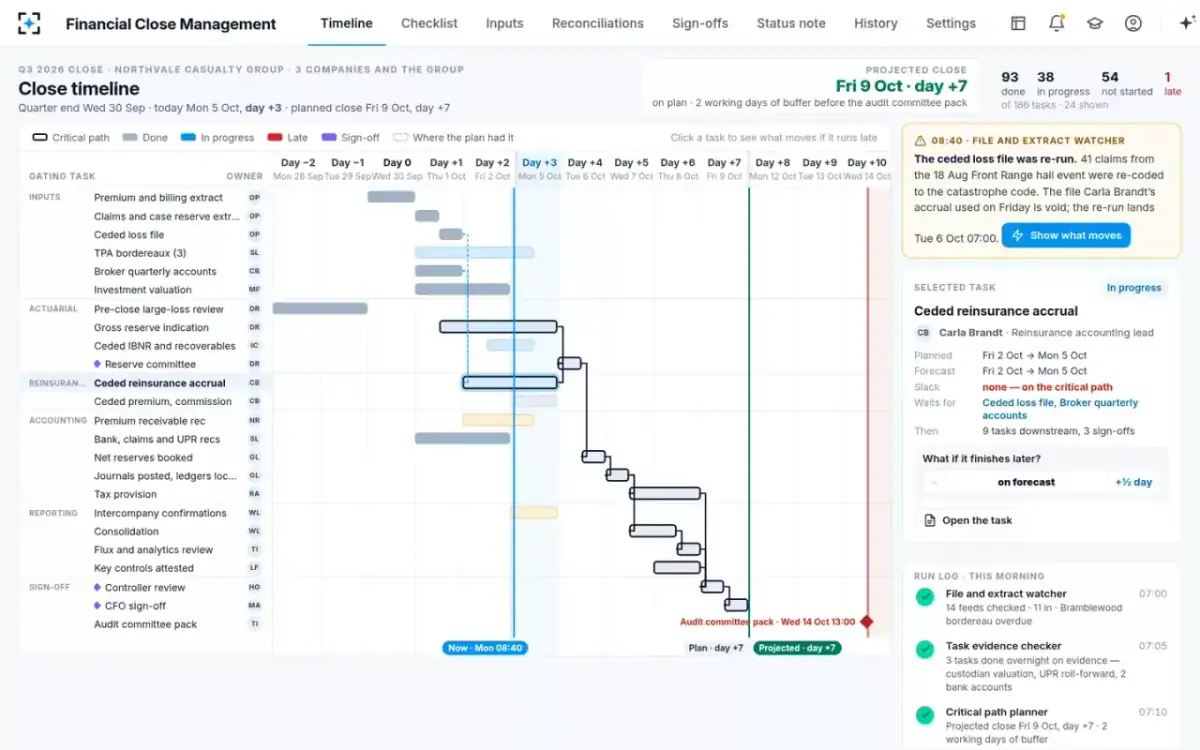
One plan: every task that holds up others, the critical path and the projected close
What is a shadow close?
A shadow close is one real quarter-end close run in the usual way, with the new software watching beside it and making no decisions. The close team works from the existing checklist; the software logs arrivals, checks evidence, keeps the critical path and drafts the status note, but nobody acts on it. Afterwards the team compares the two.
The comparison should answer four questions, each from a log kept during the close. Which slips did the software show before anyone on the team knew of them, and by how much? Where did the projected close disagree with the controller's own view, and who was right? Which tasks did the software refuse to call done that the checklist had ticked, and was the evidence really missing? And did any dependency turn out to be wrong? Each wrong dependency found in shadow is one that would otherwise have misled a live close.
The shadow close also produces the first baseline. Working days to sign-off, the day each task finished and how often each was late are the measures that tell, a few closes later, whether the software has changed anything. A baseline taken after go-live is already a different close.
How do you migrate a close checklist?
Task by task, adding three things a checklist usually lacks: what each task waits for, what evidence makes it done, and who reviews it. Start from the last close's checklist rather than a template, because it carries the tasks the team actually does. Then work through it with each owner for an hour, asking what they wait for and what they hand on. Dependencies drafted from how the last close actually ran are more accurate than ones drawn from how it was meant to run.
Expect the task count to change. Some tasks turn out to be several, such as a ceded accrual that books a quota share from one file and a catastrophe recovery from another, and splitting them is often a fast-close win in itself. Others turn out to be checks inside a larger task and are better as its evidence rule. In the sample group the result is 186 tasks, of which 24 hold up others and 162 are routine, across three statutory companies and the group.
Who owns the close calendar?
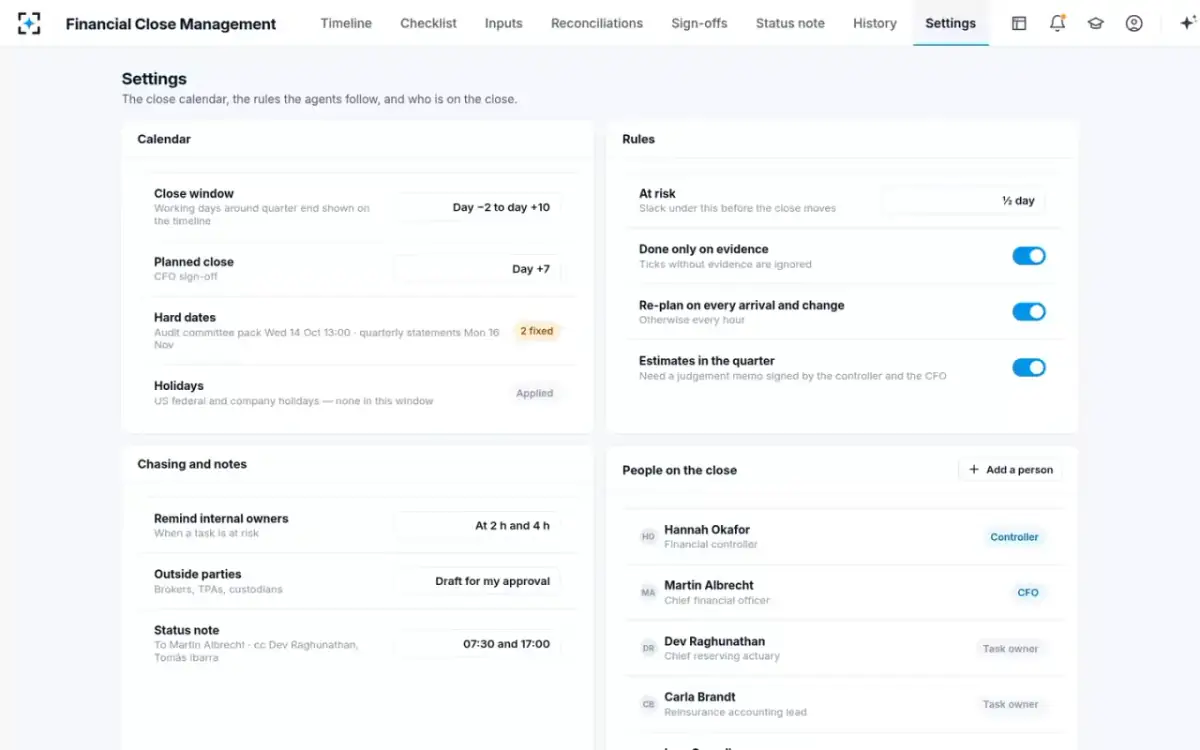
The financial controller, and only the controller changes it. The software's planner recomputes forecasts and the projected close, but the planned calendar, the hard dates, the rules for what is at risk and how owners are chased are the controller's settings. In the solution each change is saved as a new calendar version, so last quarter's close can always be read against last quarter's plan.
The controller's settings: the window, the hard dates and the rules the agents follow
Who does what in the twelve weeks
Today
Owns a spreadsheet calendar and a weekly round of status meetings.
With agents
Owns the plan, its hard dates and its rules, and reads the projected close each morning.
Still theirs: the calendar, every recovery and the controller review
Today
Fields requests for extracts and file drops during the close.
With agents
Connects each input once, so its arrival and control total are logged without a request.
Still theirs: access and change control over the systems of record
Today
Tick their tasks and answer “where is it?” by email.
With agents
Are told when an input they wait for moves, with the new time and the reason.
Still theirs: the work, its evidence, and the review of others’ work
Today
Reconstructs the close afterwards from folders and emails.
With agents
Reads each task’s evidence and history, and the rules in force, during the shadow close.
Still theirs: the independent view of whether the controls work
How do you measure success of close software?
By a handful of measures taken the same way in the shadow close and in every close after it. The first is how early a late input is seen: the day it slips rather than the day it blocks. The solution's design target is five days sooner than by hand; it is a target, to be measured on your own closes. The others are working days to the CFO's sign-off; how often each task on the critical path is late; the controller's hours spent chasing, confirming and re-planning; and how often the CFO's status note had to be corrected after it was sent.
Be wary of one measure. "Tasks completed on time" rewards ticking, and it improves whether or not the close does. A task completed on evidence, on time, against a plan that did not move, is the number that means something. In the sample group's history, working days to sign-off fell from 12 to a forecast of 8 over five quarters; the solution's contribution to any such trend can only be judged against a baseline taken before it went live.
Where Financial Close Management fits an insurer, and where it does not
It fits an insurance group whose close is long and interdependent, fed from systems outside the general ledger and from outside parties, with an actuarial and reinsurance chain on the critical path and several statutory companies to sign for. It reads what those systems already produce and adds the plan, the evidence rule and the coordination, with six agents that prepare and a controller who decides. What each agent may and may not do is set out in AI financial close software.
It does not replace the general ledger, a reconciliation tool, a consolidation system or the reserving models, and it does not produce statutory statements or schedules. A single-entity insurer whose close runs in a few days inside one ERP may find the ERP's own task list enough. And it does not make the case for itself: the shadow close does. If the shadow log shows no slip seen earlier than the team saw it, the honest conclusion is that the close does not need it yet. Management's report on internal control, where one is required, must still describe how management evaluated its controls, which is a reason to keep the evidence the software produces even if you decide against it; the NAIC Model Audit Rule sets out what that report contains.
Questions people ask
What is financial close management software?
Software that runs the period-end close as one plan: every task, input, reconciliation, journal and sign-off with its owner, dependencies and date, and a projected close that moves when any of them does. For an insurer it has to carry the reserve and reinsurance chain, which is where the close usually slips.
How long does it take to implement close software?
About one quarter when it is introduced in shadow: two weeks to build the calendar from last quarter, two to connect inputs and history, two to replay a past close, one real close in shadow and two weeks to review and switch. Go live before the year-end close, not during it, so any change to how controls are evidenced has time to operate.
What is a shadow close?
A real quarter-end close run on the existing checklist while the new software watches beside it and decides nothing. The team then compares which slips each showed first, where the projected dates disagreed, and which tasks the software would not call done. It also gives the baseline for measuring success.
Can close software work with our existing general ledger?
It should read from the general ledger and the other systems of record, not post to them. Financial Close Management reads arrivals, reconciliation and journal status and sign-offs, and writes nothing back, so the systems keep their existing access and change controls.
Who owns the close calendar?
The financial controller. The software recomputes forecasts and the projected close, but the planned dates, hard dates and rules are the controller's settings, and each change is kept as a new version.
How do you measure success of close software?
Take the same measures in the shadow close and every close after: how early a late input is seen, working days to sign-off, how often critical-path tasks are late, and the controller's coordination hours. Avoid counting tasks ticked on time, which improves whether or not the close does.