A financial close checklist is the list of every task needed to close the books at a period end: inputs received and checked, sub-ledgers closed, accounts reconciled, accruals and estimates booked, journals approved and posted, entities consolidated, statements prepared, reviewed and signed. For an insurer it also carries claims and premium extracts, administrators' bordereaux, broker and reinsurer accounts, the actuary's indication, the ceded accrual and the reserve committee, which is why an insurance group's checklist easily runs to 150 or 200 lines across several statutory companies. A CFO cannot read that list every day, and should not have to. What the CFO needs from it is three answers: what is late, what it delays, and who is fixing it, with the projected close date and anything that needs a decision. Botminds' Financial Close Management produces exactly that view. Its close status writer drafts a note from the plan as it stands, at times the controller sets, with the projected close, what moved, what is done, what to watch and what needs a decision, each statement cited to its task or file, and the controller sends it.
The examples come from a fictional sample insurance group, Northvale Casualty Group, whose CFO, Martin Albrecht, receives the note at 07:30 and 17:00 during the close. The rules quoted come from the Sarbanes-Oxley Act and the NAIC Model Audit Rule.
The checklist the controller runs, and the note the CFO reads
186
tasks on the sample group’s quarter-close checklist
3
questions the CFO needs answered: what is late, what it delays, who is fixing it
2a day
status notes during the close, at 07:30 and 17:00
1
date the CFO cares about most: the projected close against the plan
What is on a financial close checklist for an insurer?
Seven groups of tasks, in roughly the order the close runs them. The table lists them for a property and casualty group, with what each group means for the CFO. The full list a controller keeps, with the evidence that makes each task done, is set out in month end close checklist software.
An insurer's financial close checklist, in seven groups, and what each means to the CFO
| Group | Typical tasks | What the CFO needs to know |
|---|---|---|
| Inputs | Premium and billing extract; claims paid and case reserves; ceded loss file; TPA bordereaux; broker and reinsurer accounts; custodian positions; bank statements | Which are late or re-run, and whether any feeds the reserve chain |
| Actuarial | Pre-close large-loss review; gross indication; ceded IBNR and recoverables; reserve committee | When the committee meets, and anything that will move booked against indicated |
| Reinsurance | Ceded reinsurance accrual by treaty; ceded premium and commission | Whether the ceded view is final, and any estimate proposed to save time |
| Accounting | Premium receivable, claims payable, bank and UPR reconciliations; net reserves booked; journals approved and posted; sub-ledgers locked | Breaks over threshold, and journals waiting for approval |
| Reporting | Intercompany and pooling confirmations; consolidation; flux and analytics review | Which company has not confirmed, and the variances that need explaining |
| Tax and controls | Tax provision; key controls attested by preparer and reviewer | Any control not evidenced in time for sign-off |
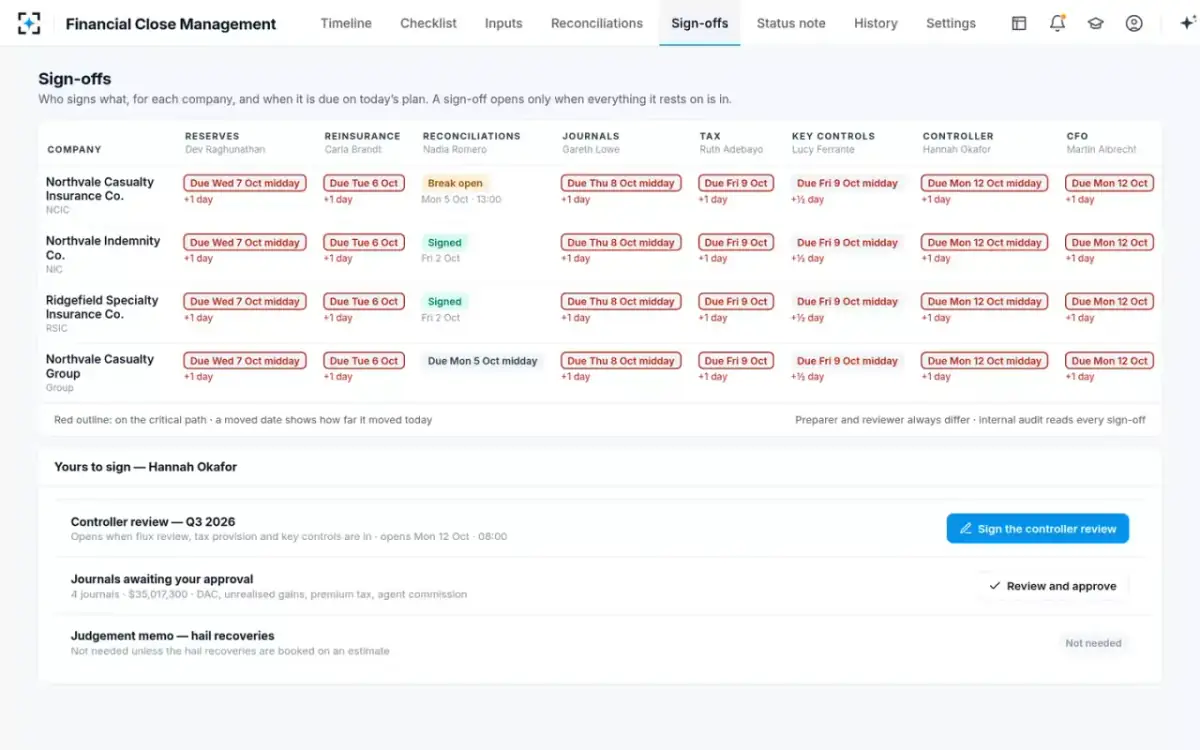
| Sign-off | Each company’s sign-offs; controller review; CFO sign-off; audit committee pack | The projected sign-off date against the plan and the buffer before the hard date |
What should a CFO see during the close?
The projected close against the plan, the few things that could move it, and anything only the CFO can decide. Not the percentage of tasks done. The reason is partly practical and partly legal. Under the Sarbanes-Oxley Act, the officers who certify a public company's periodic reports must certify that they have designed internal controls that bring material information to them from others in the company, above all while the reports are being prepared (15 U.S.C. § 7241; how the certification cascades down an organisation is in the sub-certification process). The close is that period. A CFO who learns on day +6 that the reserve chain slipped on day +3 has a control that did not work.
Statutory reporting puts the same weight on the CFO. Under the NAIC Model Audit Rule, management's report on internal control over financial reporting, required from insurers with $500 million or more of premium, must include the "Signatures of the chief executive officer and the chief financial officer". A CFO who signs that report is attesting, among other things, to how the close is run. The status note is where they see it running.
Half the checklist is done, and that tells the CFO almost nothing
The chart makes the point. On the morning the sample group's ceded loss file was re-run, half the checklist was done and only two tasks were late, about one percent. Measured by percentage complete, the close looked on track. In fact one of the two late tasks, the ceded reinsurance accrual, sat on the critical path, and the projected sign-off had moved from Friday to the following Tuesday, with no buffer left before the audit committee pack. The CFO's checklist is not the list with ticks; it is the list of tasks that can move the date.
A close that is 49% done can be two days late. The CFO's question is never how much is finished, but what is left on the chain.
What is an at-risk close task?
A task that is not yet late but whose slack has fallen below a set threshold, so that any further delay will move something that depends on it. In the sample group the threshold is half a day, a setting the controller chooses from half a day, one day or two hours. Three statuses need keeping apart, because each calls for a different response. A late task has passed its planned finish. An at-risk task is still within its plan but nearly out of slack. A task waiting on an input cannot start until something it depends on arrives, and the person to chase is the one who owes the input, not the task's owner.
On the sample close's morning, twelve tasks were at risk and eleven were waiting on an input. Among the at-risk tasks were the premium receivable reconciliation, with a break of $412,380 against a $250,000 threshold, and the intercompany confirmations, because one company had not confirmed its pooling balance. Neither was late; both could become the reason the close was.
How do you report close status? What goes in a close status note
In a short note with five parts, each a sentence or two, each pointing to the task or file behind it: the projected close, what moved, what is done, what to watch, and what needs the reader. The note is drafted from the plan, not from what people remember, and nothing in it states a date the plan has not computed. In the solution the close status writer drafts it, the controller reads and edits it, and it goes only when she sends it.
The CFO's status note on day +3, redrafted from the new plan
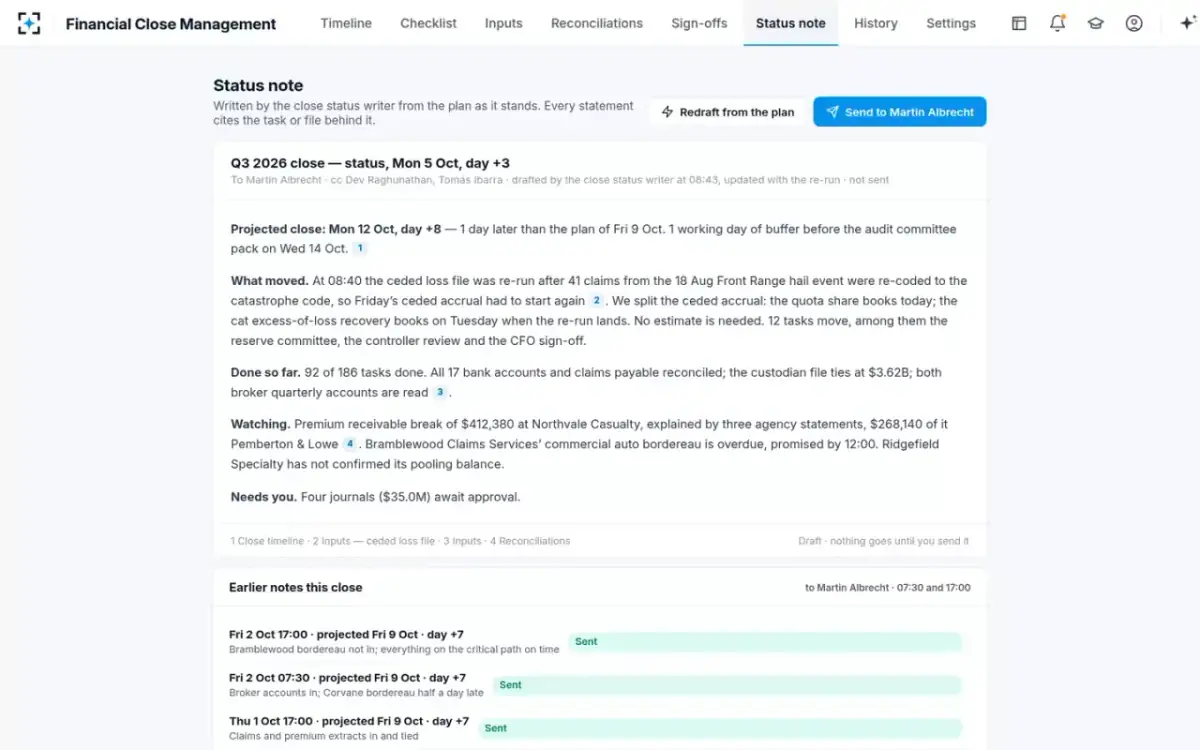
The five parts of a close status note, with the sample note's answer to each
| Part | What it answers | In the sample note |
|---|---|---|
| Projected close | When will we sign, against the plan, and how much buffer is left? | Mon 12 Oct, day +8: one day later than plan, one working day of buffer |
| What moved | What changed since the last note, why, and what was done about it? | Ceded loss file re-run; accrual split; no estimate needed; 12 tasks move |
| Done so far | What can the CFO stop worrying about? | 92 of 186 done; 17 bank accounts and claims payable reconciled; custodian ties |
| Watching | What could move the date or the numbers next? | $412,380 receivable break; an overdue bordereau; an unconfirmed pooling balance |
| Needs you | What only the reader can decide or approve? | Four journals, $35.0M, awaiting approval |
How often should close status be reported?
Twice a day during the close is a common rhythm, and the sample group's is 07:30 and 17:00: once before the day's work so the CFO knows what to expect, once at the end so the CFO knows what happened. The solution offers 07:30 and 17:00, 17:00 only, or 07:30 only, as the controller's setting. Between notes, a change in the projected close is the event that matters. When the ceded file was re-run at 08:40 on day +3, the note was redrafted from the new plan that morning rather than waiting for 17:00.
Frequency is less important than consistency. A note that always has the same five parts, in the same order, lets the CFO read it in a minute and notice what is different. A note that changes shape with whoever wrote it that day has to be read in full each time, and is skimmed after the first week.
What close items matter most to a CFO?
Those that can move the close date, change the reported numbers, or put the company's name on something. In practice that is a short list: tasks on the critical path, especially the reserve committee and anything feeding it; reconciliation breaks over threshold; any estimate proposed for the quarter to save time; inputs owed by outside parties that are late; and the hard dates, such as the audit committee pack and the statutory filing. Items that matter less are those with slack, however many there are.
The estimate deserves a line of its own. In the sample close, one recovery the controller was offered would have booked the hail recoveries on the actuary's ceded IBNR estimate to keep the close on day +7, with a judgement memo signed by the controller and the CFO and a disclosure to the auditors. A CFO should see such a proposal before it is chosen, not after, because it is the CFO's signature it needs. The cases that show why are in top side entries meaning.
The CFO's financial close checklist, in the order to read it
- Projected close against plan, and the buffer before the hard date
If the buffer is under a day, ask what the recovery options are and who chooses.
- What moved since the last note, and why
Each change should name the task or file that caused it, not just the new date.
- The reserve committee’s date, and anything that feeds it
The committee is the middle of the chain: it moves everything after it.
- Breaks over threshold
Amount, threshold, days open, and the items that explain it.
- Estimates proposed for the quarter
Any recovery that books an estimate needs your signature on a memo and a disclosure to the auditors.
- Inputs owed by outside parties
Who is late, what it holds up, and whether a note has gone. Nothing goes to them without the controller.
- What needs you
Approvals and decisions only you can make, with their due time.
How do you escalate a late close task?
By a ladder that starts with the owner and ends with a decision, not with a meeting. In the sample group's settings, an internal owner whose task is at risk is reminded at two hours and four hours, and no person is chased more than twice a day. If the task still slips and it sits on the critical path, the adviser lists what moves and scores ways to win the time back; the controller chooses one, and the owners who move are told. The CFO hears in the next note, or at once if the projected close moves past a hard date.
Two rules keep the ladder from doing harm. Outside parties, such as brokers, administrators and custodians, are contacted only by the controller, from a drafted note she approves. And no recovery skips a key control: winning back a day by having the preparer review their own work is not on the list. The sample close's own escalation shows the ladder working in two minutes rather than two days; the day-by-day picture is in the month end close timeline.
Who signs what, for every company, and how far it moved today
Questions people ask
What is on a financial close checklist?
Every task needed to close the books: inputs received and checked, reconciliations, accruals and estimates, journals approved and posted, consolidation, review and sign-off. An insurer's adds claims, premium and ceded files, bordereaux, broker and reinsurer accounts, the actuary's indication and the reserve committee.
What should a CFO see during the close?
The projected close against the plan, what moved and why, what could move it next, and what needs a decision. Not the percentage of tasks done: in the sample close, 49% done and only two tasks late still meant a two-day slip, because one of them, the ceded accrual, sat on the critical path.
What is an at-risk close task?
A task within its plan but with slack below a set threshold, half a day in the sample group's settings, so that any further delay moves the tasks after it. It is different from a late task, which has passed its planned finish, and from one waiting on an input, where the person to chase is whoever owes the input.
How often should close status be reported?
Twice a day is a common rhythm; the sample group's notes go at 07:30 and 17:00. A change in the projected close should trigger a redraft at once, as it did in the sample close when a ceded file was re-run at 08:40 and the note was redrafted that morning.
What goes in a close status note?
Five parts: the projected close with its buffer, what moved, what is done, what to watch, and what needs the reader. Each statement should point to the task or file behind it, and no date should appear that the plan has not computed.