A month end close timeline is the close calendar drawn day by day: what happens in the days before the period end, what happens on each working day after it, and which tasks wait for which. In a typical company the work runs from cut-offs and pre-close reviews, through sub-ledger closing, reconciliations and accruals, to consolidation, review and sign-off. An insurer's quarter close follows the same arc, with one difference that decides its length: the largest numbers are estimates that pass through the actuary. Claims and premium extracts feed the actuary's indication, the ceded loss file feeds the reinsurance accrual, the reserve committee waits for the net view, net reserves wait for the committee, consolidation waits for the journals, and the CFO waits for everything. That chain is the critical path, and a late claims file or a re-run ceded file at its head moves the CFO's sign-off by days. Botminds' Financial Close Management draws the timeline with that chain on it, recomputes it on every arrival, and shows what moves the moment something slips.
The timeline on this page is a fictional sample insurance group's third-quarter 2026 close, Northvale Casualty Group, as planned and run in Financial Close Management. No regulator or research body publishes a standard close timeline for insurers; read the sample as an illustration of the shape, and your own close history as the benchmark.
One insurer's quarter close timeline, in four numbers
day +7
planned CFO sign-off: seven working days after quarter-end
24of 186
tasks hold up others; the other 162 run beside them
day +4
the reserve committee in the plan, the middle of the chain
+2days
one re-run ceded loss file moved the sign-off, before recovery
What is a typical month end close timeline?
A typical timeline has five stretches: pre-close work in the last days of the period, inputs and sub-ledger closes in the first days after it, estimates and accruals next, then journals, consolidation and reporting, and finally the reviews and sign-offs. How many working days each takes depends on the company; there is no published standard, and the honest benchmark is your own last four or five closes.
Auditors describe the same stretches in their own terms. The PCAOB's standard for audits of internal control lists the period-end financial reporting process as including "Procedures used to initiate, authorize, record, and process journal entries in the general ledger" and the procedures used to record recurring and nonrecurring adjustments and to prepare the annual and quarterly statements and disclosures. A close timeline is that process laid out against the calendar, with an owner and a date on each step.
An insurer's quarter close timeline, day by day, with the critical path through the actuary
What is day plus one in a close calendar?
Day +1 is the first working day after the period end; day 0 is the last day of the period; day −1 and day −2 are the working days before it. In the sample quarter, day 0 is Wednesday 30 September, day +1 is Thursday 1 October, day +3 is Monday 5 October and day +7 is Friday 9 October, because weekends and holidays are skipped. Counting in working days keeps a timeline comparable from quarter to quarter, whichever weekday the quarter ends on.
The convention has a trap. Filing deadlines are counted in calendar days: a statutory quarterly statement is due 45 calendar days after quarter-end. A close calendar in working days and a filing calendar in calendar days have to be reconciled once, at the start of the year, and the hard dates entered into the plan. The statutory dates are set out in NAIC quarterly statement due dates.
What is on the critical path of an insurance close?
The reserve chain, in most insurers: the data that feeds the actuary, the indication, the ceded view, the reserve committee, net reserves, the journals and sub-ledger lock, consolidation and tax, the reviews, and the sign-offs. In the sample group's plan the chain runs from the ceded loss file into the ceded reinsurance accrual on day +2 and +3, the reserve committee on day +4, net reserves the same day, journals and the sub-ledger lock on day +5, consolidation and the tax provision on day +6, and the flux review, controller review and CFO sign-off on day +7. Every one of those has no slack.
The actuary is in the middle of it for a reason the profession's own standard makes explicit. The actuarial standard on unpaid claim estimates asks the actuary to consider changing conditions likely to be insufficiently reflected in the data, and gives as examples changes in the reinsurance programme and in how the claims staff work (ASOP No. 43, section 3.6.7; the claims side is in claims reserving best practices). The actuary cannot sign a net indication until the ceded view is settled, and cannot settle it while the ceded loss file is still changing. The close waits for the actuary, and the actuary waits for the files.
Most of an insurer's close tasks have slack; a few set the date
The sample close’s 186 tasks
- Hold up other tasks · 13%
- Routine, with slack · 87%
Which close tasks can run in parallel?
Anything that does not wait for the reserve chain: bank and cash reconciliations, investment valuation and custodian positions, premium receivable and unearned premium, most of the third-party administrators' bordereaux, intercompany confirmations, and the preparation of the tax provision and the statements. In the sample plan these fill the first days after quarter-end, beside the actuarial work, and most of them finish before the reserve committee meets.
Parallel tasks still matter in two ways. They can join the critical path if they slip far enough: a premium receivable break that is still open when the journals lock, or an intercompany pooling balance that one company has not confirmed when consolidation starts. And they compete for the same people at the end. In the sample close, Ridgefield Specialty had not confirmed its pooling balance on the morning of day +3, which made the intercompany confirmations at risk two days before consolidation needed them.
When does the reserve committee meet in the close, and how many days after quarter-end?
After the gross indication and the ceded view are in, and before net reserves are booked: in the sample plan, on day +4. How many days after quarter-end that falls depends on how much of the actuarial analysis is done before quarter-end and rolled forward, how late the claims and ceded data arrive, and how many companies and lines the committee covers. How the booked number then becomes a journal is the subject of IBNR accrual meaning.
The plan and the history often disagree. In the sample group's last five closes, the reserve committee was planned for day +4 each time and met on day +5, day +6½, day +4½, day +4 and day +5½, late in three. In each of those three the ceded accrual was late too.
The reserve committee against a plan of day +4, five closes
How does a late claims file affect the close?
It moves every task after it on the chain by however long it is late, unless the slack in between absorbs it, and on the critical path there is no slack. The sample close shows the mechanics. At 08:40 on day +3 the reinsurance system re-ran the ceded loss file after 41 claims from an August hail event were re-coded to the catastrophe code. The file the ceded accrual had used on Friday was void; the re-run would land at 07:00 the next day; the accrual takes two days.
What moves when the ceded loss file is re-run: every bar slides along its links
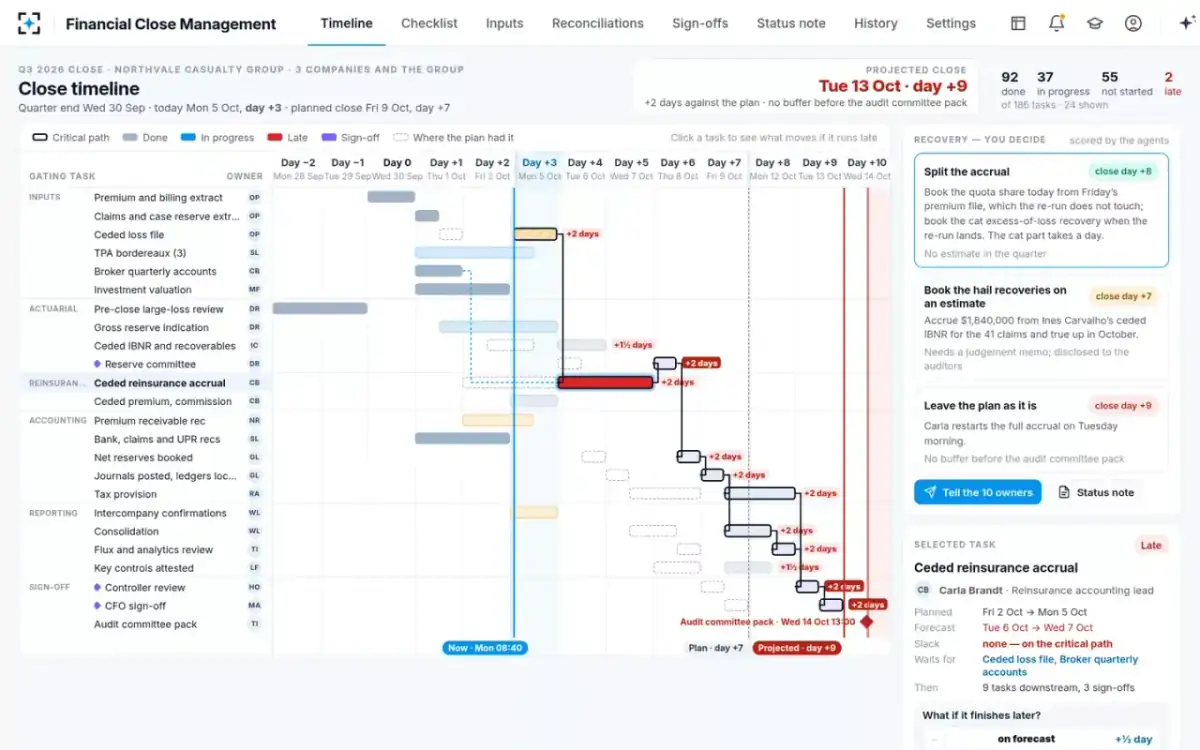
Without any action the CFO sign-off moved two working days, from Friday 9 October to Tuesday 13 October, and the two days of buffer before the audit committee pack on Wednesday 14 October were gone. Twelve tasks moved, three of them sign-offs. The controller split the accrual, booking the quota share that day from Friday's premium file and the catastrophe treaty's recovery when the re-run landed, and the timeline re-planned to Monday 12 October, day +8. The table shows where the chain landed after the split.
The critical path after the split: planned against forecast, task by task
| Task | Owner | Planned | After the split |
|---|---|---|---|
| Ceded reinsurance accrual | Reinsurance accounting lead | Mon 5 Oct | Tue 6 Oct · +1 day |
| Ceded IBNR and recoverables | Actuary, ceded reserves | Mon 5 Oct | Tue 6 Oct · +1½ days |
| Reserve committee | Chief reserving actuary | Tue 6 Oct | Wed 7 Oct · +1 day |
| Net reserves booked | Senior accountant | Tue 6 Oct | Wed 7 Oct · +1 day |
| Journals posted, sub-ledgers locked | Senior accountant | Wed 7 Oct | Thu 8 Oct · +1 day |
| Consolidation and eliminations | Consolidation lead | Thu 8 Oct | Fri 9 Oct · +1 day |
| Tax provision | Tax | Thu 8 Oct | Fri 9 Oct · +1 day |
| Controller review and CFO sign-off | Controller, then CFO | Fri 9 Oct | Mon 12 Oct · +1 day |
The same mechanics apply to a late claims extract or a late bordereau. Where the late input feeds the gross indication, the slip enters the chain one step earlier and moves the committee directly. Where it feeds only a parallel task, such as one administrator's bordereau feeding a reconciliation with slack, it may move nothing at all. Knowing which is which, the morning it happens, is most of the value of drawing the timeline. What that is worth in money is worked through in fast close accounting for insurers.
How the year-end timeline differs from a quarter
The year-end close runs the same chain with more on it and less room after it. The sample group's year-end close for 2025 took 13 working days to the CFO's sign-off, against 10 to 12 in the quarters around it, and its reserve committee met on day +6½, the latest of the five. Three things lengthen it. The actuary's year-end review is the one that supports the appointed actuary's opinion, filed with the annual statement by 1 March, so it is deeper and is documented for regulators. The year-end audit runs alongside it, so open items draw questions before they are booked. And more of the year's estimates are trued up at once.
Two practical consequences follow for the timeline. First, plan the year-end separately rather than stretching the quarterly template: its pre-close work starts earlier, often with an analysis on data to a cut-off in November and a roll-forward to 31 December. Second, protect the days after sign-off, because the annual statement, its schedules and the opinion all have to be finished before 1 March, and every day the close takes comes out of them. A year-end close that slips by two days does not move 1 March; it compresses the statement work behind it.
The same history gives the way to build your own timeline. Take the day each task finished in your last four or five closes, set each task's planned day from that history rather than from the template, and mark the chain of tasks that, close after close, finished last. That chain is your critical path, and it is far shorter than the full task list suggests: in the sample, only 24 of 186 tasks hold up others at all, and fewer still sit on the longest chain.
Who decides when the close is complete?
The financial controller signs the controller review and the CFO signs the close; the timeline only says when each can happen. In the sample group the controller's review opens only when the flux review, the tax provision and the key controls it rests on are in, and the CFO's sign-off follows it. Each company's reserves, reinsurance, reconciliations, journals, tax and key controls are signed by their own owners first. The close is complete when the last of those is signed, not when the last task is ticked.
The timeline does change who knows what, and when. In the sample close, ten owners whose tasks moved received a note naming the task, its new time and the reason, drafted by the solution and sent by the controller. The CFO's status note was redrafted from the new plan the same morning. The person who decides was the same; the day she found out was not.
Questions people ask
What is a typical month end close timeline?
Pre-close work in the last days of the period, then inputs and sub-ledger closes, estimates and accruals, journals and consolidation, and reviews and sign-offs. In the fictional sample insurer the quarter close is planned to day +7; no regulator or research body publishes a standard, so your own close history is the benchmark.
What is on the critical path of an insurance close?
Usually the reserve chain: claims and ceded data, the actuary's indication, the ceded accrual, the reserve committee, net reserves, journals and the sub-ledger lock, consolidation and tax, and the final reviews and sign-offs. Tasks on it have no slack, so any slip moves the close date.
What is day plus one in a close calendar?
The first working day after the period end. Day 0 is the period end itself, and days −1 and −2 are the working days before it. Close calendars count in working days, while filing deadlines count calendar days.
How does a late claims file affect the close?
If it feeds the critical path, it moves every task after it by however long it is late. In the sample close, a ceded loss file re-run on day +3 moved twelve tasks and the CFO sign-off by two working days until the controller split the accrual and won one day back.
Which close tasks can run in parallel?
Those that do not wait for the reserve chain: bank and investment reconciliations, premium receivable and unearned premium, most bordereaux, intercompany confirmations and preparation of tax and statements. They can still join the critical path if they slip far enough, such as an unconfirmed pooling balance when consolidation starts.