An IBNR accrual is the journal entry that brings an insurer's estimate of incurred but not reported claims into the general ledger at the period end. It accrues, as a liability and as incurred losses, the cost of claims that have happened but are not yet known to the insurer, and in the broad sense actuaries use, the further development expected on claims that are known but not yet fully reserved. The number is not an accountant's: it starts as the actuary's indication, is set by management as its best estimate, usually through a reserve committee, and is then booked as the change from last period's balance. Because the actuary's analysis is often run on data from before the quarter end and rolled forward, and because claims keep being reported after it, the IBNR accrual is also the entry most certain to be revised next period. That makes it a close task with a long chain behind it. Botminds' Financial Close Management keeps that chain on one timeline: the quarter's IBNR journal waits on the reserve committee, which waits on the indication and the ceded view, which wait on the claims extract and the ceded loss file.
Definitions below come from the Casualty Actuarial Society's study text and NAIC regulators' guidance; close examples from a fictional sample insurance group, Northvale Casualty Group, in Financial Close Management. The entries shown are illustrative.
The estimate behind the accrual, at industry scale and in one sample close
$1.03T
U.S. property and casualty loss and LAE reserves at the end of 2025
$20.0B
one-year redundancy: earlier estimates released as they proved too high
$1.84M
the sample group’s ceded IBNR estimate for 41 re-coded hail claims
day +4
when the sample group’s reserve committee is planned, before the IBNR journal posts
What is an IBNR accrual? The estimate, and what "IBNR" covers
It is the accounting side of an actuarial estimate: the amount by which booked IBNR reserves change at the period end, recorded as a liability and through incurred losses. What it contains depends on which definition of IBNR the company uses. The CAS study text on estimating unpaid claims separates case outstanding, set by claims staff on known claims, from four components actuaries call the broad definition of IBNR: development on known claims, reopened claims, claims incurred but not reported, and a "provision for claims in transit (i.e., claims reported but not recorded)".
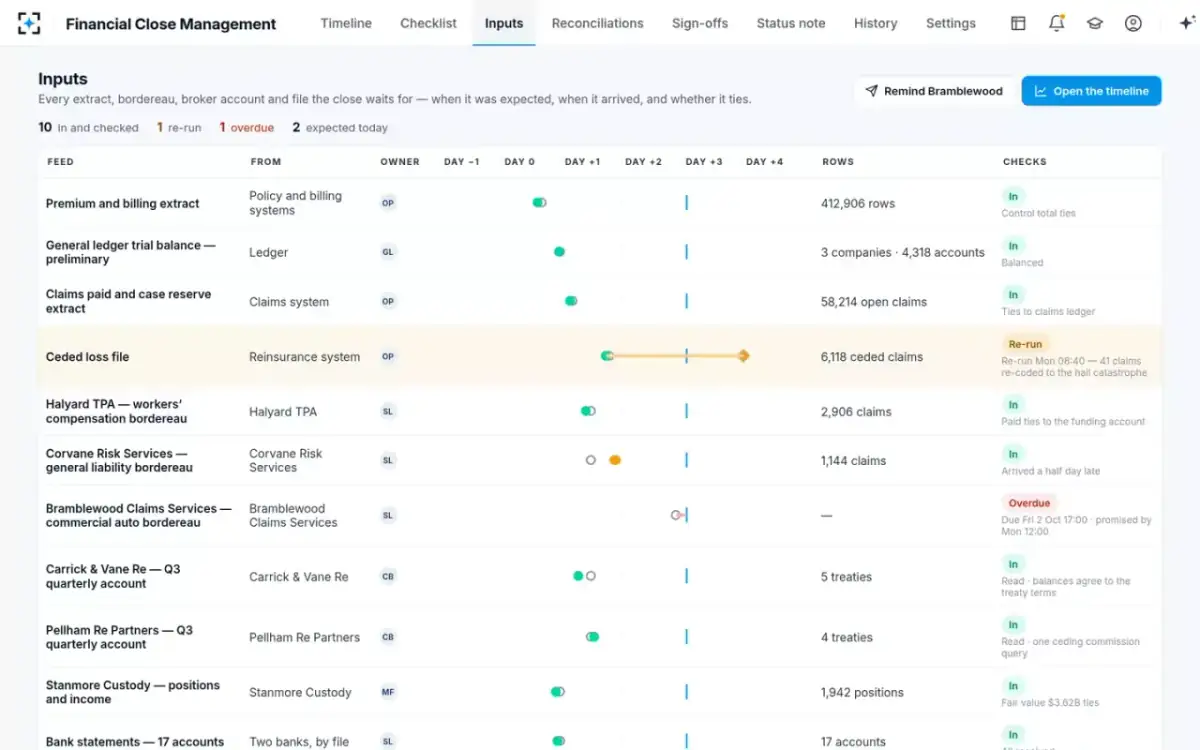
The last of those is worth a closer look in a close. Claims in transit are reported to someone, a third-party administrator or a broker, but not yet in the insurer's claims system. A bordereau that arrives late, as one administrator's did in the sample close, moves claims from "in transit" to "reported" after the actuary's data cut-off. Whether they sit in case reserves or IBNR at quarter-end depends on when the data was taken. The split between the adjuster's number and the actuary's is covered in depth in case reserves vs IBNR; this page is about how the actuary's number reaches the books.
Who provides the IBNR number for the close?
The actuary provides an indication; management decides what to book. The CAS study text draws the distinction cleanly. An unpaid claim estimate is the result of an actuarial method, and different methods give different estimates, whereas "The carried reserve for unpaid claims is the amount reported in a published statement or in an internal statement of financial condition". The IBNR accrual books the carried reserve, not the indication.
For statutory accounting, the NAIC's principle is management's best estimate: SSAP No. 55 asks management to record its best estimate of unpaid claims and claim adjustment expenses, line by line and in total, with conservatism as a concept but no required margin (the difference between statutory and GAAP reserves reads the rule). In most insurers the place where management forms that estimate is the reserve committee, which compares booked with indicated by company and line. When booked departs from indicated, the reason belongs in writing; the cases in top side entries meaning show what happens when it is not.
From the actuary's analysis to the IBNR journal, and its true-up
Before quarter-end
The actuary’s analysisTriangles and methods run on data to a cut-off date before the quarter ends, by segment.
Day +1 to +3
Roll-forward and indicationThe last weeks’ paid and reported claims, re-coded catastrophes and the ceded file added; the indication signed.
Day +4
Reserve committeeBooked against indicated, by company and line. Management’s best estimate is set here.
Day +4 to +5
The IBNR accrual postedThe change from last quarter’s booked IBNR to this quarter’s, gross and ceded, by company and line.
Next quarter
True-upThe new estimate replaces the old; the difference is development on prior periods.
How is IBNR booked in the general ledger?
Usually as the change in the balance: the new estimate of IBNR for each company and line, less what is already booked, debited to incurred losses and credited to the IBNR reserve, with loss adjustment expense alongside it and the ceded share recorded against reinsurance recoverables. An increase raises incurred losses in the quarter; a decrease releases reserves into income. The table walks one illustrative line through a quarter, with round figures chosen to show the mechanics.
One line of business, one quarter: how an IBNR accrual is worked out and booked
| Step | Gross | Ceded | Net |
|---|---|---|---|
| IBNR booked at the end of last quarter | $40.0M | $8.0M | $32.0M |
| Management’s best estimate this quarter, after the committee | $43.5M | $9.1M | $34.4M |
| The accrual: change in IBNR | +$3.5M | +$1.1M | +$2.4M |
| Entry | Dr incurred losses; Cr IBNR reserve | Dr reinsurance recoverable; Cr ceded losses incurred | $2.4M more net incurred losses |
| Next quarter, if the estimate for these accident periods falls to $33.0M net | $1.4M favorable development |
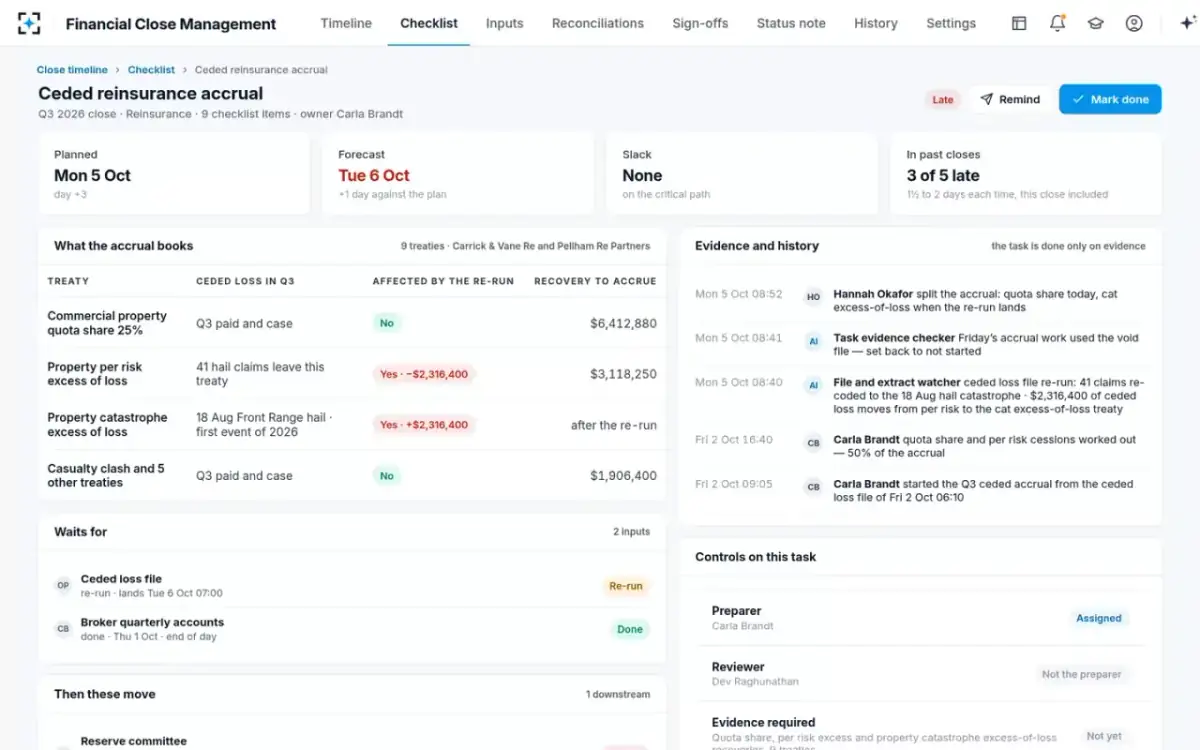
Two details make the accrual harder than the table suggests. It is booked by legal entity and by line, so a group with three statutory companies posts three sets, plus any pooling between them. And its ceded side depends on the reinsurance programme: which treaty a claim falls under can change after the quarter-end, as it did when the sample group's ceded loss file was re-run and 41 hail claims moved from the per risk treaty to the catastrophe treaty. The gross losses did not change; the ceded IBNR and the recoverables had to be split again by treaty.
When is IBNR booked in the close?
Late in the chain: after the claims and premium extracts, the actuary's indication, the ceded view and the reserve committee, and before the journals lock and consolidation starts. In the sample group's plan the gross reserve indication finishes on day +3, the reserve committee meets on day +4, net reserves are booked the same day, and journals post and sub-ledgers lock on day +5. The quarter's IBNR journal for loss and loss adjustment expense sits in the queue of journals awaiting approval, marked as waiting for the reserve committee; the ceded recoverables accrual waits for the ceded accrual.
That position is why the IBNR accrual so often decides the close date. Anything that moves the indication or the ceded view moves the committee, and the committee moves everything after it. In the sample close, the ceded loss file re-run on day +3 set the ceded IBNR work back to not started and pushed the committee from Tuesday to Wednesday morning. The month end close timeline draws the whole chain.
The ceded accrual behind the ceded IBNR, by treaty
What is a roll-forward in reserving?
A roll-forward is an analysis run on data up to a cut-off before the period end and then brought forward to the period end with the claims activity in between. It is how much reserve work gets done in time for a close. NAIC regulators accept it for the annual opinion: their working group "recognizes that most of the analysis supporting an SAO may be done with data received prior to year-end and rolled forward to year-end". They also say what they expect to see: why the actuary changed the selected ultimates, and how the changes reached the final estimates, because a bare summary of final selections does not count as support (NAIC AOWG, 2026; the support auditors ask for is in the PBC request list for a reserve audit).
For the close, the roll-forward is a timing tool with a known weakness. It lets the indication be ready within days of the quarter end rather than weeks, but anything that changes between the cut-off and the booking has to be caught and carried through: late-reported claims, a large loss reported in the last week, a re-coded catastrophe, a late bordereau. Each of those is an input arrival the close can see. A close plan that logs them against the indication shows the actuary what to roll forward, and shows the controller when the roll-forward will move the committee.
A quarter's IBNR on a roll-forward: where the data comes from, and when
- Analysis on data to the cut-offweeks before quarter-end
- Roll-forwardto quarter-end
- Indication signedday +1 to +3
- Inputs and extractsthrough quarter-end
- Committee, journalday +4 to +5
Why does the IBNR accrual change after quarter-end?
Because the information it estimates keeps arriving. Claims incurred in the quarter are reported in the weeks after it; administrators' bordereaux and brokers' accounts bring claims that were in transit; catastrophe events are coded and re-coded; reinsurance files are re-run. Each changes either the gross estimate or how it is ceded. The accrual booked on day +5 is the best estimate on day +5, and the next quarter's estimate will replace it.
The IBNR accrual is booked once and corrected forever: each quarter's estimate is next quarter's development.
That revision is visible at industry level. In 2025, U.S. property and casualty insurers held $1.03 trillion of loss and loss adjustment expense reserves, and the NAIC reports that "There was a one-year redundancy of $20.0 billion": estimates booked a year earlier proved higher than needed. The Federal Insurance Office's 2026 report describes 2025's favorable development as the largest of the past ten years (FIO, 2026; the line-by-line picture is in prior year reserve development in 2025). Favorable at the total can hide adverse lines underneath; the NAIC report attributes earlier years' shrinking releases to adverse development in commercial liability.
Auditors use the same hindsight on purpose. The PCAOB's fraud standard requires a retrospective review of significant estimates, "by comparing the prior year's estimates to actual results", to see whether management's judgements show a possible bias. A run of IBNR accruals that are always released, or always strengthened, is the pattern that review looks for.
How is the IBNR accrual trued up?
By replacing the estimate rather than reversing it line by line. Next quarter the actuary re-estimates ultimate losses for every open accident period, management sets a new best estimate, and the accrual books the change. The part of that change that relates to earlier periods is development: favorable if the old estimate was too high, adverse if too low. It runs through incurred losses in the quarter it is recognised.
The true-up is also where an estimate booked to save time comes back. In the sample close the controller was offered a way to keep the close on day +7: book the 41 hail claims' recoveries on the actuary's $1,840,000 ceded IBNR estimate and true it up in October. The true-up would have been mechanical, but the estimate in the quarter needed a judgement memo signed by the controller and the CFO and a disclosure to the auditors. She split the accrual instead and took day +8, with the recoveries booked from the re-run file. Either choice is defensible; the point is that it was a choice, made by a named person, with its price stated.
Every input the indication depends on, with when it arrived and whether it ties
What is the difference between IBNR and case reserves in accounting?
Case reserves are set claim by claim by claims staff on reported claims; IBNR is set in total by the actuary, by segment, for everything else. In the books both are part of the liability for unpaid losses, and both move incurred losses. The accounting difference is where they come from: case reserves flow from the claims system, transaction by transaction, while the IBNR accrual is a period-end estimate posted as a journal. That makes the IBNR journal one of the largest entries in an insurer's close that does not come from a sub-ledger, and one an auditor will look at closely.
Questions people ask
What is an IBNR accrual?
The period-end entry that books the estimate of claims incurred but not yet reported, and in the broad definition the further development on known claims, as a liability and through incurred losses. It is usually booked as the change from last period's IBNR balance, by company and line.
Who provides the IBNR number for the close?
The actuary provides an indication; management sets the amount booked as its best estimate, usually through a reserve committee. Under statutory accounting the liability is based on management's best estimate, and any difference from the indication should be explained in writing.
What is a roll-forward in reserving?
An analysis run on data to a cut-off before the period end, then brought forward with the activity in between. NAIC regulators accept it for the annual opinion but expect the actuary to document why the selections changed and how the changes reached the final estimate.
How is the IBNR accrual trued up?
Next period's estimate replaces it. The part of the change that relates to earlier periods is development, favorable or adverse, and it runs through incurred losses in the period it is recognised. In 2025 the NAIC reports a one-year redundancy of $20.0 billion across the industry.
Why does the IBNR accrual change after quarter-end?
Claims keep being reported, bordereaux and broker accounts bring in claims that were in transit, and catastrophe coding and reinsurance files change. Each moves the gross estimate or its ceded share, so the next estimate differs from the one booked.