The difference between stat and GAAP reserves depends on the business. For property and casualty claims, both bases start from the same best estimate of unpaid losses, so the differences are mainly how reinsurance is shown, whether and how reserves are discounted, and what management books against the actuary's range. For life and annuity contracts the bases measure differently: statutory reserves follow state valuation law and the NAIC Valuation Manual, now largely principle-based with prescribed floors, while US GAAP, since the FASB's long-duration targeted improvements, updates cash-flow assumptions at least annually, discounts at a current single-A rate and carries guarantees at fair value. Botminds' Statutory, GAAP & IFRS 17 Reconciliation explains those differences every quarter as steps of the walk from statutory surplus to GAAP equity, each with its rule and the journal that books it.
The life figures on this page come from a fictional sample life and annuity insurer as its third quarter of 2026 runs through the solution; the rules are quoted from NAIC working-group documents, NAIC guidance and SEC regulations.
What is the difference between statutory and GAAP reserves?
Statutory reserves are measured to show regulators whether the insurer can pay; GAAP reserves are measured to show investors what the business earned. The NAIC puts the purpose in terms of solvency: statutory accounting exists to show regulators whether the insurer can meet its obligations, which is why it centres on the balance sheet (NAIC, Statutory Accounting Principles; quoted in statutory accounting principles). When the industry agreed in 2019 that the FASB's new long-duration rules should not apply to statutory reserves, it wrote of "the objectives of statutory accounting that stress the ability to pay claims in the future by intentionally establishing conservative reserves" (NAIC SAPWG, August 2019 hearing; interested parties' comments).
The table sets out each source of difference, which business it affects, and why it exists. The rest of the page takes the rows in turn.
Where stat and GAAP reserves differ, and why
| Source of difference | Statutory | US GAAP | Why they differ |
|---|---|---|---|
| Unpaid claims (P&C, and claims on life and health contracts) | Management's best estimate under SSAP No. 55, with the concept of conservatism | The liability for unpaid claims, reported as management's best estimate of loss reserves | Usually little; differences come from presentation and discounting |
| Reinsurance presentation | Liabilities shown net of reinsurance on the balance sheet | A separate "Reinsurance recoverable" asset caption for SEC filers | Different offset rules; equity is unaffected for ordinary reinsurance |
| Discounting of P&C reserves | Limited, and gross and net figures appear in different documents | Set by the company's GAAP accounting policy and disclosed | A legitimate difference even within statutory reporting |
| Life policy reserves | Valuation Manual: higher of prescribed formula reserves and modelled reserves under principle-based reserving | Liability for future policy benefits with assumptions reviewed at least annually and no provision for adverse deviation | Prescribed conservatism against current best estimates |
| Discount rate on life reserves | Prescribed by the valuation law and Valuation Manual | Updated each reporting date to an upper-medium-grade yield; the change goes through other comprehensive income | Statutory rates move slowly; GAAP rates move with the market |
| Guarantees on annuities | Inside the statutory reserve for the contract | Market risk benefits measured at fair value | Fair value moves with markets and own credit; statutory reserves do not |
Are statutory reserves higher than GAAP reserves?
For long-duration life business they usually are, and for short-duration claims they are usually close. The reason for the life gap is the measurement model, not a single assumption. Statutory policy reserves under SSAP No. 51 "shall be established as required in Appendix A-820, Minimum Life and Annuity Reserves and Appendix A-822, Asset Adequacy Analysis Requirements or the Valuation Manual", in the NAIC staff's summary (NAIC SAPWG, 2019), and those minimums carry prescribed margins that GAAP removed.
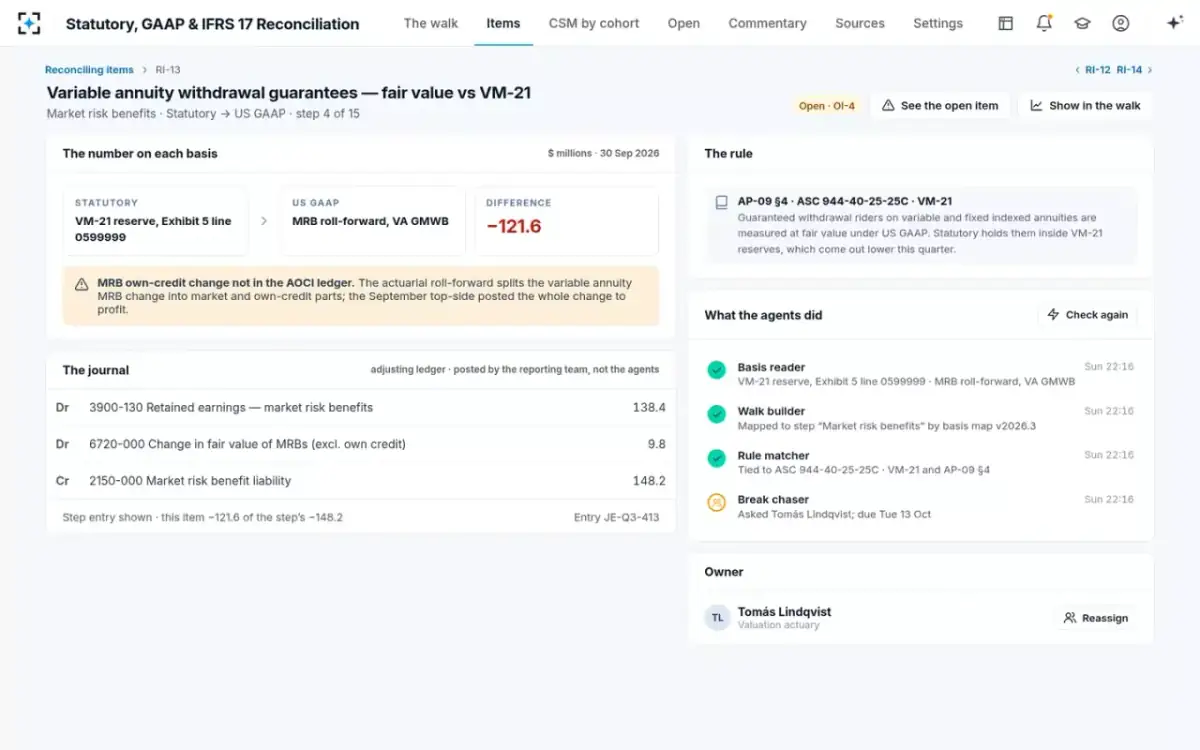
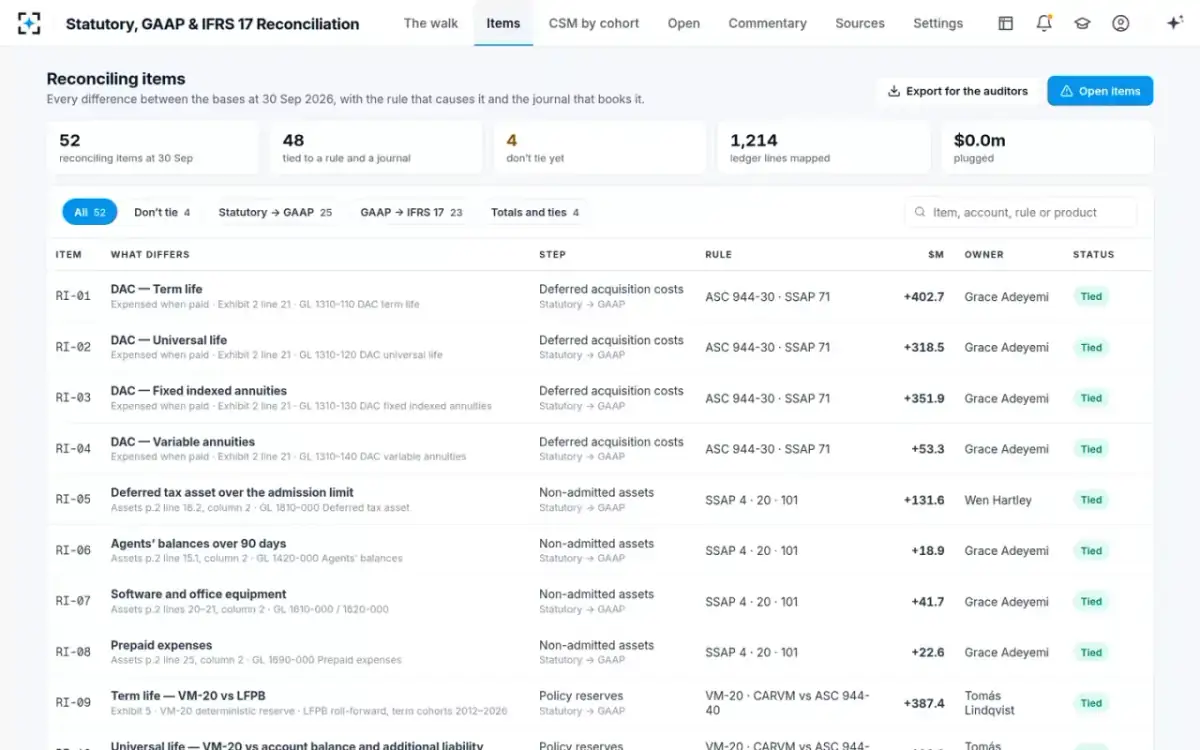
In the sample quarter, policy reserves were the third-largest step from statutory surplus to GAAP equity: GAAP held $612.9 million less. The largest single item inside the step was term life, where the statutory reserve under VM-20 exceeded the GAAP liability for future policy benefits by $387.4 million. Not every item runs the same way, though. Variable annuity withdrawal guarantees went the other direction: carried at fair value under GAAP, they were $121.6 million higher than inside the statutory reserve.
The sample insurer's reserve-related steps from statutory surplus to GAAP equity
What is management's best estimate under SSAP 55?
SSAP No. 55 requires management to record its own best estimate of unpaid claims and claim adjustment expenses, with conservatism as a concept but without a required margin. The NAIC staff's summary of paragraph 12 puts the duty on management, line by line and in total (NAIC SAPWG, 2019; how the claim department's case reserves and the actuaries' IBNR meet in that estimate is in case reserves vs IBNR).
This guidance identifies that management shall follow the concept of conservatism when determining estimates, but there is not a specific requirement to include a provision for adverse deviation in claims.
NAIC staff, summarising SSAP No. 55 (agenda item 2019-06)
Because both bases book management's best estimate, the gap between stat and GAAP claim reserves at a P&C insurer is usually small. The larger risk is that management's estimate drifts from the actuary's without explanation, which is a disclosure problem on either basis. In 2020 the SEC charged an insurer and its former CFO, alleging that the CFO's consolidated accounting adjustments departed from the actuarial estimates without properly considering them, that this was not disclosed, and that the company kept too little support for management's best estimate (SEC Litigation Release No. 24838; settled without admitting or denying the allegations; the case is read in top side entries meaning).
How is discounting treated in statutory reserves?
Statutory property and casualty reserves are generally undiscounted, and where a company does discount, the gross and net figures can appear in different statutory documents. The NAIC's actuarial opinion working group gives this as its example of a difference that is not an error: "One situation in which a legitimate difference might arise is in the case of non-tabular discounting", where the reserves in the opinion's Exhibit A "come from Schedule P, Part 1, which is gross of non-tabular discounting, while the Actuarial Report and the AOS might present the direct and assumed loss reserves on a net of discounting basis" (NAIC, 2026 Regulatory Guidance).
Life reserves are discounted on both bases, and there the difference between bases is the rate. Under the FASB's long-duration rules, as the NAIC staff summarise them, "The ASU requires entities to update the discount rate assumption at each reporting date", the rate reflects an upper-medium-grade fixed-income yield, and "Change in the discount rate shall be recognized through other comprehensive income" (NAIC SAPWG, 2019). The sample insurer's discount-rate step added $421.7 million to GAAP equity, all of it in accumulated other comprehensive income, while statutory reserves did not move with the market.
How LDTI changed the difference for life insurers
The FASB's long-duration targeted improvements widened the gap between bases by moving GAAP towards current estimates while statutory stayed with prescribed ones. In the NAIC staff's summary of ASU 2018-12: "The ASU requires entities to review, and if there is a change, update the assumptions used to measure cash flows at least annually"; "The ASU requires all market risk benefits associated with deposit (or account balance contracts) to be measured at fair value"; and assumptions for the liability for future policy benefits "shall not include a provision for the risk of adverse deviation" (NAIC SAPWG, agenda item 2019-06).
The NAIC did not follow. Its working group rejected ASU 2018-12 for statutory accounting, and in 2023 its staff described the later amendment as updating "transition guidance for ASU 2018-12, which had previously been rejected for statutory accounting" (NAIC SAPWG, March 2023). The same document summarises the dates: "ASU 2018-12, as amended by 2022-05, is effective for public entities for fiscal years beginning after December 15, 2022", and for nonpublic entities for fiscal years beginning after December 15, 2024. Since then, every quarter of a public life writer's GAAP reserves has rested on assumptions statutory reserves do not use.
Stat vs GAAP reserves: property and casualty against life and annuity
Property and casualty: Management's best estimate of unpaid losses and loss adjustment expense.
Life and annuity: Different models: Valuation Manual minimums on statutory; current-assumption liability for future policy benefits on GAAP.
Property and casualty: Reinsurance presentation, discounting, and how far management's booked figure sits from the actuary's.
Life and annuity: Assumptions, margins, discount rates and the fair value of guarantees.
Property and casualty: Usually modest for ordinary reinsurance and undiscounted reserves.
Life and annuity: Often hundreds of millions for a mid-sized writer; the sample insurer's reserve steps net to +$886.4 million.
Property and casualty: Mostly with claims development.
Life and annuity: With assumption studies every year and with interest rates every quarter.
Do P&C reserves differ much between stat and GAAP?
Usually not in amount, though the balance sheets look different. A GAAP balance sheet filed with the SEC shows reinsurance as an asset: Regulation S-X lists "Reinsurance recoverable" among the asset captions for insurers (17 CFR 210.7-03), while the statutory statement shows loss reserves net. Ordinary reinsurance therefore changes the presentation without changing equity. Retroactive reinsurance, ceded reserve credit and the statutory provision for reinsurance can change equity; those are covered on the reinsurance side, in the Schedule F penalty for reinsurance.
The more consequential P&C difference is often not between bases but between management and the actuary, which shows up identically on both. Explaining a reserve difference between bases is therefore only half the job; the other half is being able to show, on either basis, why the booked figure is where it is.
One reserve difference, opened to its numbers, rule and journal
How a reserve difference is explained each quarter
A reserve difference between bases is explained by its movement, not its level: the level was explained last quarter, and the question each quarter is what changed it. For a life writer the movement usually has three sources. New business adds to both bases in different amounts; an assumption study changes the GAAP liability at once and the statutory reserve only where the Valuation Manual's prescribed elements allow; and a change in market interest rates moves the GAAP discount rate, through other comprehensive income, while the statutory rate stays put.
The evidence for each source is the actuary's roll-forward on each basis, read side by side. In the sample quarter, the walk caught one place where the bases had drifted apart for a reason that was not economic: a ceded reserve credit on one coinsurance treaty was $3.4 million away from the GAAP reinsurance recoverable after the known basis difference, because the GAAP recoverable still used the previous year's lapse assumption while the direct reserves used the new one. The owner confirmed it and re-ran the recoverable. A walk that only compared totals would have shown a small difference in a large number and moved on.
That is why each reserve item carries an owner, almost always the valuation actuary, and why the explanation of a reserve movement should name the assumption memo or rate change behind it. The reconciliation then answers the question an examiner or auditor will ask: not whether the two reserves differ, which they always will, but whether the difference this quarter is the one the models and the assumptions say it should be.
Why do statutory and GAAP equity differ?
Reserves are only part of the answer. For the sample insurer, reserve-related steps added a net $886.4 million going from statutory surplus to GAAP equity, but deferred acquisition costs added $1,126.4 million, nonadmitted assets $214.8 million, and lower bond values under GAAP took away $1,037.5 million. Statutory capital and surplus of $1,842.6 million became GAAP equity of $2,962.2 million. The full bridge, line by line, is in stat to GAAP adjustments, and the asset side that statutory accounting removes is in nonadmitted assets.
Each difference also has to survive the audit. Reconciliation across reporting regimes is an old regulatory habit: when Texas adopted the NAIC's manual it required the notes to audited statutory statements to reconcile them to the annual statement filed with the department and to describe each difference in writing (Texas Department of Insurance, 2000; the NAIC's own version of the rule is quoted in fast close accounting for insurers). A written description of the nature of each difference is a good standard for the walk between bases too.
Reserve items in the list of reconciling items, each with its rule and owner
Questions people ask
Why are statutory reserves more conservative than GAAP reserves?
Because statutory accounting is built for solvency: the NAIC describes conservatism as a cautious approach that helps "protect policyholders by reducing the risk that an insurer's financial position is overstated". For life business that shows up in prescribed minimum reserves; GAAP after LDTI removed the provision for adverse deviation from the liability for future policy benefits.
What is SSAP 55?
SSAP No. 55, Unpaid Claims, Losses and Loss Adjustment Expenses, is the NAIC statement that governs statutory liabilities for unpaid claims on property and casualty, life and health contracts. It requires management to book its best estimate for each line and in total, following the concept of conservatism without a specific required margin for adverse deviation.
Did the NAIC adopt LDTI for statutory accounting?
No. The NAIC's Statutory Accounting Principles Working Group rejected ASU 2018-12 for statutory accounting, and in 2023 its staff recommended rejecting the transition amendment, ASU 2022-05, on the same basis. Statutory life reserves continue to follow the Valuation Manual.
What is principle-based reserving?
It is the statutory method for many life products since the Valuation Manual became operative on 1 January 2017. Under it, in the NAIC's words, insurers hold "the higher of (a) reserves using prescribed factors or (b) reserves which consider a wide range of future economic conditions" using their own credible experience.
When did LDTI take effect?
As the NAIC staff summarised the FASB's amended dates, for public entities in fiscal years beginning after 15 December 2022, and for other entities in fiscal years beginning after 15 December 2024, with their interim periods from fiscal years beginning after 15 December 2025. For calendar-year public life writers that meant 2023 statements.