IFRS 17 software is any system an insurer uses to measure, report or explain its insurance contracts under IFRS 17, and the choice that matters is which of those three jobs a product does. A measurement engine projects cash flows and computes the fulfilment cash flows, risk adjustment and contractual service margin for each group of contracts; a reporting suite turns those results into journals, the balance sheet and the disclosure tables; an explanation layer reads both and says why the numbers moved, in words an audit committee can repeat. An insurer that has reported under IFRS 17 since 2023 already owns at least the first. Botminds' Statutory, GAAP & IFRS 17 Reconciliation is the third: it sits beside the engine and the general ledger, reads the IFRS 17 results with the statutory and US GAAP figures, and builds and explains the walk between them.
The IASB was frank about the price of the first two layers. Its effects analysis concluded that "applying IFRS 17 for the first time will result in significant costs for some companies, but overall the benefits of IFRS 17 will outweigh the costs" (IASB, IFRS 17 Effects Analysis). This guide is about the cost that remains after they are bought. Sample figures come from a fictional life and annuity insurer as its third quarter of 2026 runs through the solution; cost figures are Botminds' estimates, with the method stated.
What does IFRS 17 software cost over three years?
No regulator or standard-setter publishes what IFRS 17 software costs, and this guide does not rely on surveys by firms that sell implementation work. What can be estimated honestly is the recurring effort each option leaves, because the IASB described where that effort sits. Measured in working days from the last basis landing to an explained result, the three options differ by a factor of almost five over twelve quarters.
Working days from the last results landing to an explained quarter, over three years
The bars measure elapsed days, not people or money, because elapsed days are what a group timetable feels. A team that takes 4.75 working days to explain a quarter that its parent wants on the tenth working day has almost no slack if any basis lands late. The cost in salaries depends on the size of the team; the cost in risk depends on how often the explanation is still being written when the pack is due.
How much does IFRS 17 implementation cost, according to the IASB?
The IASB gave no figure, because it expected the cost to vary unusually widely, but it named where the money goes. "The likely implementation costs of IFRS 17 that the Board has identified for companies will be in: (a) project design and implementation; (b) systems set-up; (c) process changes; and (d) education and communication" (IASB, Effects Analysis). The project summary was blunter: "Companies will incur significant operational costs applying the requirements in IFRS 17, including for the development of systems" (IASB, Project Summary).
What the IASB expected IFRS 17 to cost, and which layer of software carries it
| Cost the IASB identified | What it said | Layer that carries it |
|---|---|---|
| Systems set-up | Systems to "analyse data with sufficient granularity to identify and maintain consistent groups of contracts" and "track information about inception dates and the coverage period of those groups" | Measurement engine and data |
| Updating estimates every period | IFRS 17 "requires a company to update its assumptions about cash flows, discount rates and risk at each reporting date" | Measurement engine and actuarial process |
| Ongoing system and control costs | "expected to be higher for many companies compared with those incurred when applying IFRS 4" | All layers |
| Disclosures, once systems exist | The main ongoing cost: analysing the information those systems produce (quoted in full below) | Explanation |
| Groups of contracts and subsidiaries | "Higher costs will be incurred by companies that have a large number of groups of contracts, that do not use integrated systems on an ongoing basis and that need to collect information about insurance contracts from their subsidiaries" | Reporting and explanation |
The IASB also said cost would depend on three things: "the extent to which the requirements in IFRS 17 differ from the approaches currently applied by the company", "the number and type of insurance contracts the company has" and "the existing systems used by the company for other purposes, such as regulatory reporting." For a US insurer in an IFRS group, the third point cuts both ways. Its statutory and US GAAP systems are mature, but none of them measures a contractual service margin, so the IFRS 17 engine sits beside them rather than on top of them, and the three must be reconciled every quarter.
The costs that stay after go-live
Go-live removes the project cost and leaves the run cost, and the IASB expected the run cost to be dominated by analysis. Its ongoing-cost section listed updating assumptions at each reporting date, maintaining data from previous periods, adjusting the contractual service margin and providing disclosures, then added the line that matters most for software choice:
Once a company has set up systems to provide the disclosures required by IFRS 17, the Board expects the main ongoing cost to arise from the analysis of information provided by those systems.
IASB, IFRS 17 Effects Analysis (2017)
That analysis has become a regulatory issue in its own right. When ESMA and national enforcers reviewed 16 European insurers' first IFRS 17 statements, they found that disclosures on accounting policies, judgements and estimates "were often not entity-specific or, in limited cases, missing" (ESMA, From black box to open book?). Engines and suites produce the tables; neither writes the entity-specific explanation that enforcers asked for.
Build, buy or run alongside: three options compared
The three options are not exclusive; most insurers will own an engine whatever they choose. The real decision is where the explanation is produced: in spreadsheets around the engine, inside a reporting suite's commentary module, or in a separate layer that reads every basis.
Three ways to equip an IFRS 17 quarter, and what each leaves for people
| Extend the engine, explain in spreadsheets | Buy a reporting suite | Add an explanation layer alongside | |
|---|---|---|---|
| What it automates | Measurement; some movement-analysis output | Measurement output to journals, balance sheet and disclosure tables | Reading every basis, tying, mapping to the walk, drafting explanations, chasing breaks |
| What stays manual | Tying, mapping, the walk to statutory and GAAP, every explanation | The explanation, and the walk to statutory and GAAP unless the suite holds them | Judgements, approvals, adjusting entries |
| Who it suits | A single-basis insurer with few groups of contracts | A group consolidating many IFRS 17 entities | A subsidiary or group explaining IFRS 17 beside statutory and US GAAP |
| Implementation | Lowest, but the spreadsheets become a control risk | Largest: data model, chart of accounts, controls | Reads what you already produce; testable on a closed quarter |
| Main risk | Key-person dependency; copied-forward explanations | A long project that still leaves the narrative to people | Only as good as the engine output and policy papers it reads |
The honest limits of the third option belong in the table. An explanation layer does not measure a single contract, so it cannot replace an engine; it does not post entries, so it cannot replace a general ledger or subledger; and it can only explain what the engine and the policy papers support. What it removes is the quarter's manual reading, mapping and drafting, and the risk that last quarter's explanation is still in this quarter's commentary.
The explanation layer's view: three bases, one walk, every step tied
What should IFRS 17 software explain?
It should explain every line the standard requires the insurer to show separately, in the insurer's own terms. Paragraph 104 lists the movements in the reconciliation of the contractual service margin; paragraph 117 requires disclosure of the significant judgements, and changes in them, made in applying the standard (quoted in IFRS 17 automation); paragraph 109 asks when the remaining margin will be earned (IFRS 17). Software that produces those tables without the reasons behind them leaves the hardest part of each quarter to people.
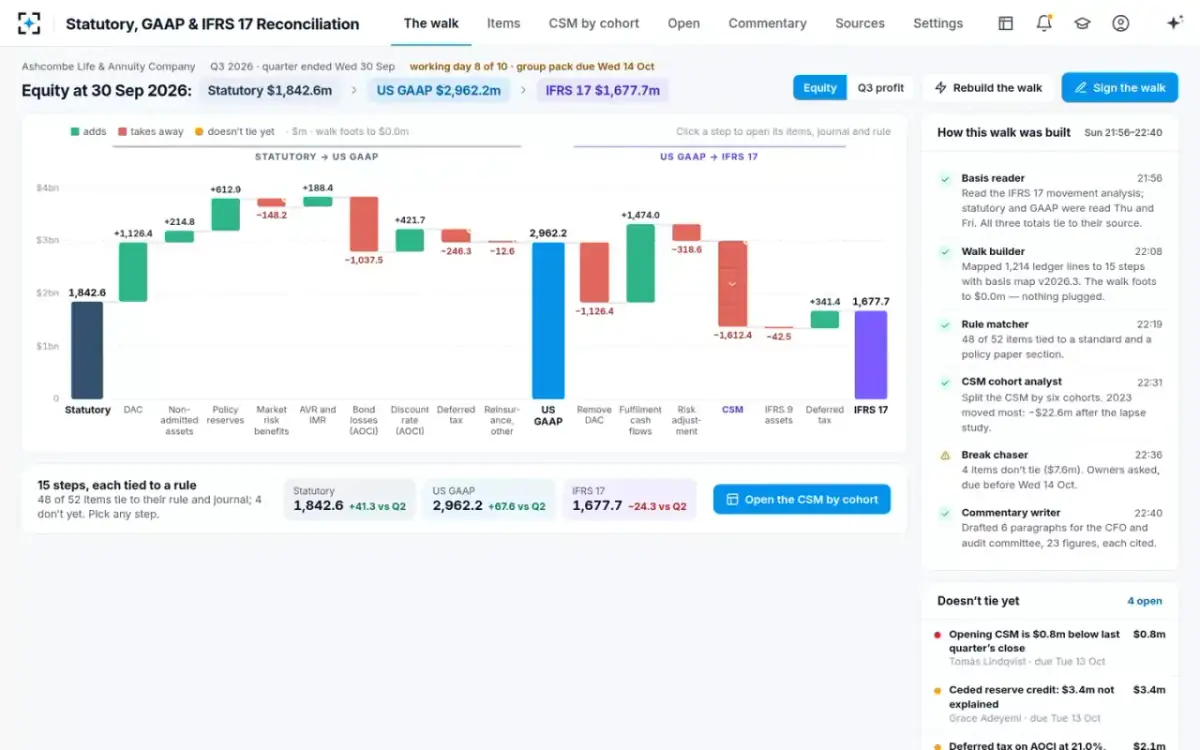
For a US subsidiary there is a fourth requirement no standard writes down: explaining IFRS 17 against the other bases the company reports. A CFO who sees US GAAP equity of $2,962.2 million and IFRS 17 equity of $1,677.7 million will ask why, and the answer runs through six steps: the deferred acquisition costs removed, the GAAP reserves replaced with fulfilment cash flows, the risk adjustment and the margin added as liabilities, the effect of IFRS 9 on assets, and deferred tax. Stat to GAAP adjustments, line by line walks the same insurer from statutory surplus to GAAP equity first.
Can IFRS 17 be done in Excel?
The measurement can be prototyped in a spreadsheet but rarely run in one at scale, because the standard's grouping and annual-cohort requirements multiply the number of groups each year. The IASB expected insurers to need systems that "track information about inception dates and the coverage period of those groups of contracts", and every annual cohort adds a group that must be tracked for the life of its contracts.
The explanation, by contrast, is still done in Excel at many insurers, and that is where the control risk concentrates: a bridge copied forward from last quarter, a plug that makes the walk foot, a commentary sentence nobody re-checked. Moving it out of spreadsheets is less about speed than about being able to show, for each sentence, the row it came from.
Every source landed, every total tied, before any explanation is written
How to compare IFRS 17 software proposals on equal terms
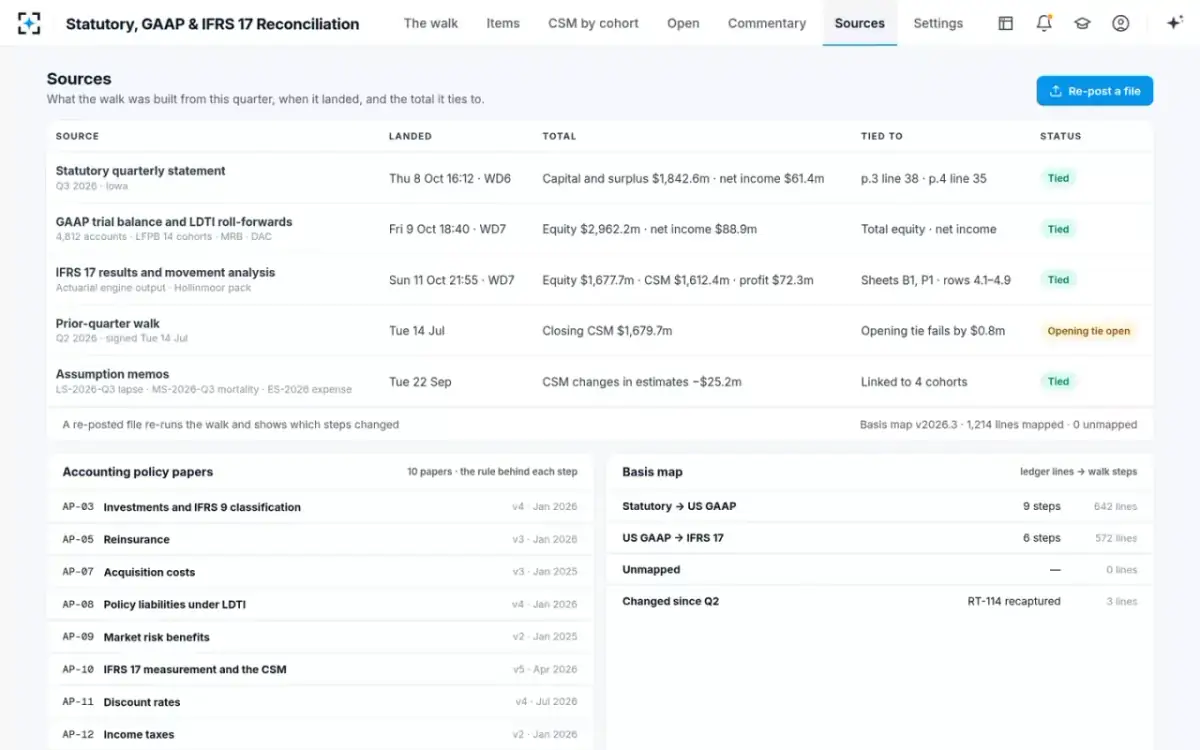
Proposals for IFRS 17 software are hard to compare because each prices a different scope. Put them on one footing before comparing totals: the same legal entities, the same bases, the same quarter, and the same definition of done. For an explanation layer, done means an explained walk with every item tied to its rule and nothing plugged; for a suite, it means journals and disclosure tables; for an engine, measured groups. A low price for the wrong definition of done is not a saving.
Then compare three numbers for each option. The first is set-up effort, in your team's days as well as the vendor's, because the IASB's cost areas, project design, systems set-up, process changes and education, all consume internal time. The second is the recurring effort each quarter, measured as in the chart at the top of this page, from the last results landing to an explained quarter. The third is the controls cost: who must review what the software produces, and how an auditor will test it. Software that saves preparation time but needs every output re-performed has moved the cost, not removed it.
Finally, ask what each option does when something changes. A new annual cohort arrives every year; assumptions change every year; accounting policies change less often but more expensively. The IASB expected higher costs for "companies that have a large number of groups of contracts", and that number only grows. The right comparison is the eleventh year, not the first.
Where an explanation layer fits in IFRS 17 software, and where it does not
Statutory, GAAP & IFRS 17 Reconciliation fits an insurer whose numbers are right but whose explanation is slow: typically a life and annuity writer reporting statutory, US GAAP with long-duration improvements, and IFRS 17 for a parent. It does not fit an insurer still choosing how to measure under IFRS 17, which needs an engine and an accounting policy first, or one whose problem is data quality inside the engine, which an explanation layer will expose but not fix.
Its agents read the three bases, the accounting policy papers and last quarter's walk; they draft the walk, the cohort notes and the commentary; they never post a journal entry, change an assumption or accept a difference on a zero-tolerance tie. Materiality, the cohort grain, the ties and the signers are settings for each entity. The way to judge it is on a quarter you have already closed, which is the subject of IFRS 17 implementation support: test it on last quarter first.
Questions to put to any IFRS 17 software vendor
- Which of the three jobs does it do: measure, report or explain?
A product that does all three should show each separately, with its own controls.
- What does it need from us, and in what form?
An explanation layer should read your engine output, trial balance and statutory statement as they are.
- How does it handle a new annual cohort every year?
Paragraph 22 adds a group a year; ask how the eleventh year looks, not the first.
- Can every figure in its narrative be traced to a source row?
Enforcers asked for entity-specific explanations; auditors will ask where each came from.
- What can it never do?
Post, re-measure, plug, accept a difference: limits should be built in, not configured off.
- Will you run it on our last closed quarter before we sign?
Count the items it explains without help and the breaks it finds that you did not.
Questions people ask
How much does IFRS 17 software cost?
No regulator or standard-setter publishes software prices, and the IASB declined to estimate implementation cost because it expected it to vary so much by company. It identified the cost areas instead: project design and implementation, systems set-up, process changes, and education and communication. Compare options on the recurring effort they leave as well as on licence and project cost.
How long does an IFRS 17 software project take?
The standard itself allowed years: issued in May 2017, it was deferred in 2020 to periods beginning on or after 1 January 2023, a deferral the IASB said was "intended to allow time for an orderly adoption". An explanation layer that reads existing output is a different scale of project, and can be tested on one closed quarter in about two weeks.
Do we need new software for IFRS 17?
For measurement, almost always: statutory and US GAAP systems do not compute a contractual service margin or track annual cohorts. For reporting and explanation, it depends on how many entities and bases you report, and on whether the people explaining each quarter are spending their time on judgement or on tying and mapping.
What is the difference between an IFRS 17 engine and a reporting tool?
The engine measures: it projects cash flows and produces fulfilment cash flows, risk adjustment and margin per group. The reporting tool presents: it turns those results into journals, statements and disclosure tables. Neither, by itself, explains why the results moved or how they compare with statutory and US GAAP figures.
What are the ongoing costs of IFRS 17?
The IASB expected ongoing costs to come from updating assumptions at each reporting date, running actuarial models, maintaining data from previous periods and, once systems exist, analysing their output. It expected those costs to be higher for many companies than under IFRS 4, and highest for groups with many groups of contracts and subsidiaries.