IFRS 17 automation, done well, automates the work around the numbers rather than the numbers themselves. The measurement of each group of contracts, its fulfilment cash flows, risk adjustment and contractual service margin, already runs in an actuarial engine; what most insurers still do by hand is read that output, tie it to the general ledger and to the other reporting bases, explain each movement and chase what does not reconcile. Botminds' Statutory, GAAP & IFRS 17 Reconciliation puts agents on exactly that part: they read the IFRS 17 results beside the statutory and US GAAP figures, build the walk between them, draft a plain-words note for each cohort's margin and ask owners about breaks, while the valuation actuary, the head of financial reporting and the CFO keep every judgement and signature.
The examples come from a fictional sample life and annuity insurer as its third quarter of 2026 runs through the solution. The requirements quoted are from IFRS 17 as published by the IFRS Foundation, from European enforcers' review of first-year IFRS 17 reports, and from the US actuarial profession's standards.
An entity shall disclose the significant judgements and changes in judgements made in applying IFRS 17.
IFRS 17, paragraph 117
What can be automated in IFRS 17 reporting?
Almost everything that is reading, matching and drafting can be automated; almost nothing that is choosing can. The IASB expected exactly this split before the standard took effect: once the systems are built, it said, the main ongoing cost would be analysing what they produce (IASB, Effects Analysis). An insurer that bought an engine and a disclosure tool has automated the calculation and the table. It has not automated the analysis, and the analysis is where the quarter's days go.
That analysis has a fixed shape, because IFRS 17 prescribes it. Paragraph 104 requires the reconciliation of the contractual service margin to show separately "changes in estimates that adjust the contractual service margin", "the effects of contracts initially recognised in the period" and "the amount of the contractual service margin recognised in profit or loss to reflect the transfer of services" (IFRS 17, paragraph 104). Every one of those lines needs a reason a reader can follow, and the reason usually lives in a document the engine never sees: a lapse study, a mortality memo, a treaty amendment.
What IFRS 17 makes you reconcile, every reporting period
IFRS 17 builds the reconciliation into the standard, which is why so much of the work is tying rather than calculating. Paragraph 98 requires an insurer to "disclose reconciliations that show how the net carrying amounts of contracts within the scope of IFRS 17 changed during the period because of cash flows and income and expenses recognised in the statement(s) of financial performance", with separate reconciliations for insurance contracts issued and reinsurance contracts held.
For contracts measured under the general model, paragraphs 100 and 101 then ask for two sets of opening-to-closing reconciliations: one by remaining coverage, loss component and incurred claims, and one by component of the measurement, namely the estimates of the present value of future cash flows, the risk adjustment for non-financial risk and the contractual service margin. Paragraph 109 adds a forward view, requiring the insurer to disclose "when it expects to recognise the contractual service margin remaining at the end of the reporting period in profit or loss quantitatively, in appropriate time bands" (IFRS 17).
Each of those tables has an opening balance that must equal last period's closing one, a closing balance that must equal the balance sheet, and movements that must agree with the income statement. For a US subsidiary of an IFRS group, the same quarter also has a statutory statement and a US GAAP trial balance that describe the same contracts differently. The tie-outs multiply; the judgements do not. That asymmetry is what makes the work automatable.
The IFRS 17 quarter as a chain of tasks
Split into its tasks, an IFRS 17 quarter divides into three kinds of work: work an agent can do completely and show, work an agent can prepare but a named person must decide, and work that should stay out of any automation because it is a judgement the standard asks the entity to make and disclose.
An IFRS 17 quarter, task by task: agent, person, never
| Task | Agents do | A named person decides | Never automated |
|---|---|---|---|
| Read the engine output and movement analysis | Read every sheet and row; tie the totals to the source and to the trial balance | Nothing, unless a total fails to tie | Adjusting a total so that it ties |
| Tie to statutory and US GAAP | Map each line to a step of the walk between bases; check the walk foots with no plug | Which policy paper governs a new kind of item | Plugging an unexplained difference |
| Reconcile the contractual service margin by cohort | Split opening, new business, interest, changes in estimates and release per annual cohort; compare release with plan | Whether a change relates to future or current service when the classification is unclear | Reclassifying a change to move it out of profit or loss |
| Explain changes in estimates | Link each change to its assumption memo or study; draft a plain-words note | The valuation actuary approves each note | Changing an assumption |
| Chase breaks | List every failed tie and every item above materiality; find the likely cause; ask the owner with the numbers | The owner explains or corrects; a correcting entry is posted by the reporting team | Accepting a difference on a zero-tolerance tie; posting an entry |
| Draft commentary and disclosure narrative | Draft management and audit-committee commentary with every figure linked to its source | The CFO approves; disclosure judgements stay with the reporting lead | Sending anything outside the reporting team |
The columns are deliberately unequal. Reading and tying are complete agent tasks because there is a right answer and the agent can show its working: a total either equals its source line or it does not. Explaining is shared because the explanation must be true and must also be the actuary's. The judgement column is narrow but untouchable, and the standard itself names it in paragraph 117, quoted at the top of this page: a judgement can only be disclosed as the entity's if a person in the entity made it.
Can AI explain IFRS 17 movements?
AI can draft an accurate explanation of an IFRS 17 movement if it has three things: the movement analysis, the assumption evidence behind it, and a rule that no sentence may carry a figure it cannot link. Without the evidence it produces fluent boilerplate, which is exactly what European enforcers found too much of in first-year reports. ESMA's review of 16 insurers' 2023 statements noted "the low level of entity-specific details in some areas" and found that judgements were "often boilerplate and/or repeated the requirements of the standard" (ESMA, From black box to open book?).
In the sample quarter, the 2023 annual cohort's margin fell by $22.6 million. The engine shows the number; the drafted note says why: fixed indexed annuities sold that year were being surrendered faster once their surrender charge fell below 5%, the third-quarter lapse study raised the lapse assumption from 6.0% to 7.8% a year, and because the change relates to future coverage it comes out of the margin rather than this quarter's profit. The note also explains the less obvious consequence: with fewer contracts expected to stay, a bigger share of what is left is earned now, so the cohort released $11.3 million against $9.4 million planned.
The margin opened by cohort, with a drafted note waiting for the actuary
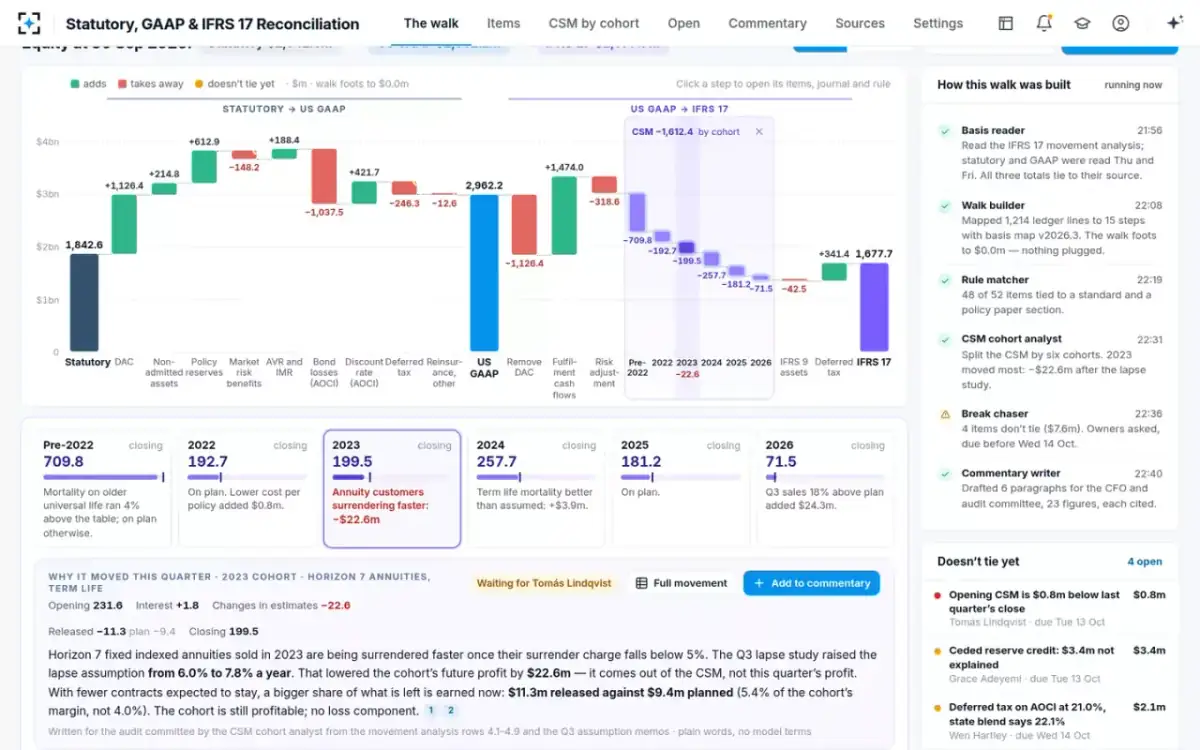
The IASB's 2020 amendments were made partly to make financial performance easier to explain (IASB, June 2020). Agents do not change what is hard to explain; they change who writes the first draft and how quickly the evidence is gathered. The IFRS 17 analysis of change works through the sentences for each step of the movement.
What stays with the actuary under IFRS 17
The assumptions, the classification of each change, and the approval of every explanation stay with the actuary. IFRS 17 decides the accounting by the nature of the change: a change in fulfilment cash flows that relates to future service adjusts the contractual service margin under paragraph B96, while the effect of the time value of money and financial risk does not, under paragraph B97. Deciding which a given change is can be a matter of judgement, and ESMA found that for contracts without direct participation features "no entity-specific disclosure of inputs, assumptions and estimation techniques were provided to explain how issuers distinguished changes in estimates of future cash flows arising from the exercise of discretion from other changes in estimates."
The US actuarial profession treats an AI drafting tool as a model in its own right. The Academy's professionalism committee wrote that generative AI is a model to which ASOP No. 56 applies, and that the actuary stays responsible for the decision whether and how to rely on an AI tool (American Academy of Actuaries, 2024; non-binding guidance). ASOP No. 56 itself requires the actuary to check that a model's output fairly represents what it models (ASOP No. 56; the validation tests are set out in AI in actuarial reserving). In Europe, EIOPA's opinion makes the same point for the function: "The actuarial function is responsible for the controls on AI systems that fall under its responsibilities" (EIOPA, 2025).
Maker and checker: every draft has a named approver
The safe pattern is the one finance already uses for journals: the preparer is never the approver. In the solution, each agent prepares one kind of output and a named person approves it, and the limits are written into what the agent is allowed to do rather than into a review step that a busy quarter could skip.
From engine output to approved commentary, with the limits on each step
Agent
Basis readerReads the IFRS 17 results, movement analysis, statutory statement and GAAP trial balance; ties each total to its source line.
Never: adjusts a total that does not tie
Agent
Walk builderMaps every line to one step of the walk and checks it foots from statutory to GAAP to IFRS 17.
Never: plugs an unexplained amount
Agent
CSM cohort analystSplits the margin movement by annual cohort, compares release with plan and drafts a note linked to the assumption memo.
Never: changes an assumption
A person decides
Valuation actuary approves each cohort noteConfirms the cause and the classification of each change in estimates.
Agent
Break chaserLists failed ties and items above materiality, finds the likely cause and asks the owner with the numbers.
Never: accepts a difference or posts a correcting entry
Agent
Commentary writerDrafts commentary for the CFO and audit committee with every figure linked to its step.
Never: sends the commentary
A person decides
Head of financial reporting signs; CFO approves the commentaryThe signature states what it means, and open items are listed on the signed walk.
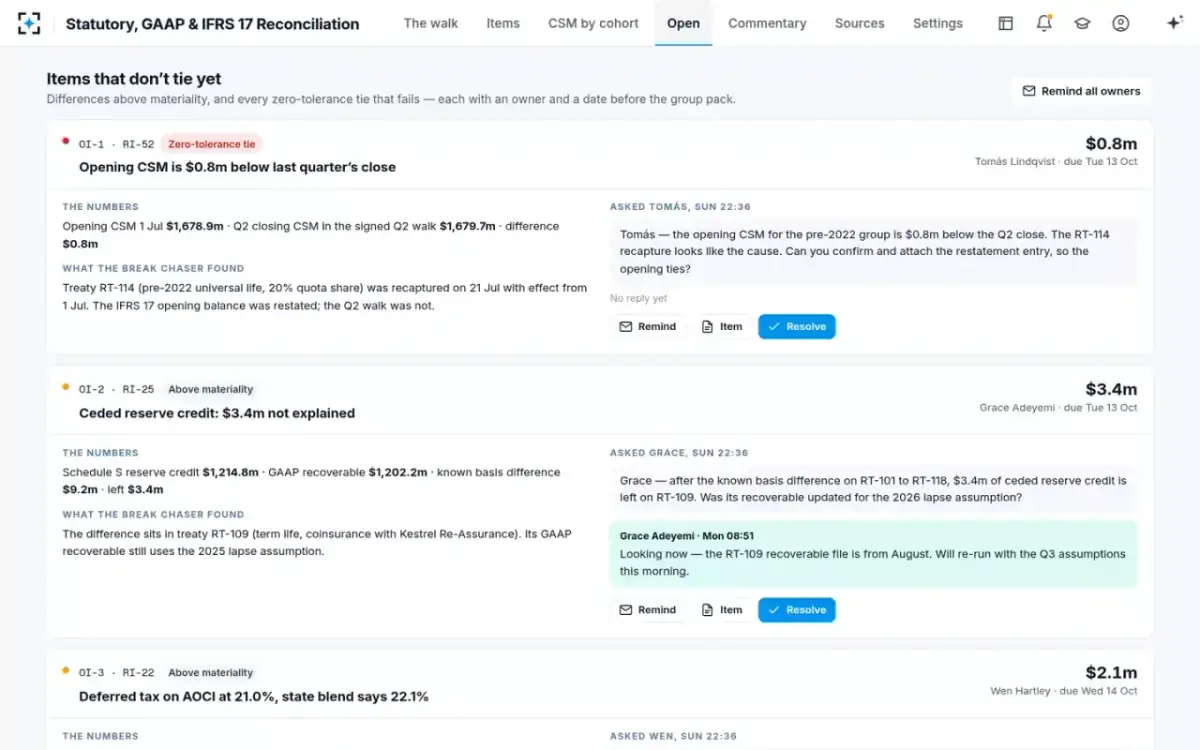
What doesn't tie, each with an owner, a cause and a question already sent
Where the time goes in an automated IFRS 17 quarter
Automation moves the IFRS 17 quarter from preparing to reviewing. No regulator or standard-setter publishes how long insurers take to explain their IFRS 17 results, so the split below is Botminds' estimate for a mid-sized life and annuity writer, built from the six steps between the last basis landing and an explained walk.
Where the explaining time goes: by spreadsheet and with agents
By spreadsheet · about 4.75 days
- Tying totals and mapping lines · 37%
- Matching items to rules · 16%
- Explaining the margin by cohort · 16%
- Chasing breaks · 16%
- Writing commentary · 15%
With agents · about 1 day
- Tying totals and mapping lines · 20%
- Matching items to rules · 10%
- Explaining the margin by cohort · 25%
- Chasing breaks · 25%
- Writing commentary · 20%
The shape changes as well as the size. By spreadsheet, more than a third of the time is mechanical: tying and mapping. With agents, half of what remains is the margin and the breaks, which is where the valuation actuary and the owners of open items spend their time reviewing and answering. That is the right place for people to be.
The controls an auditor will ask about
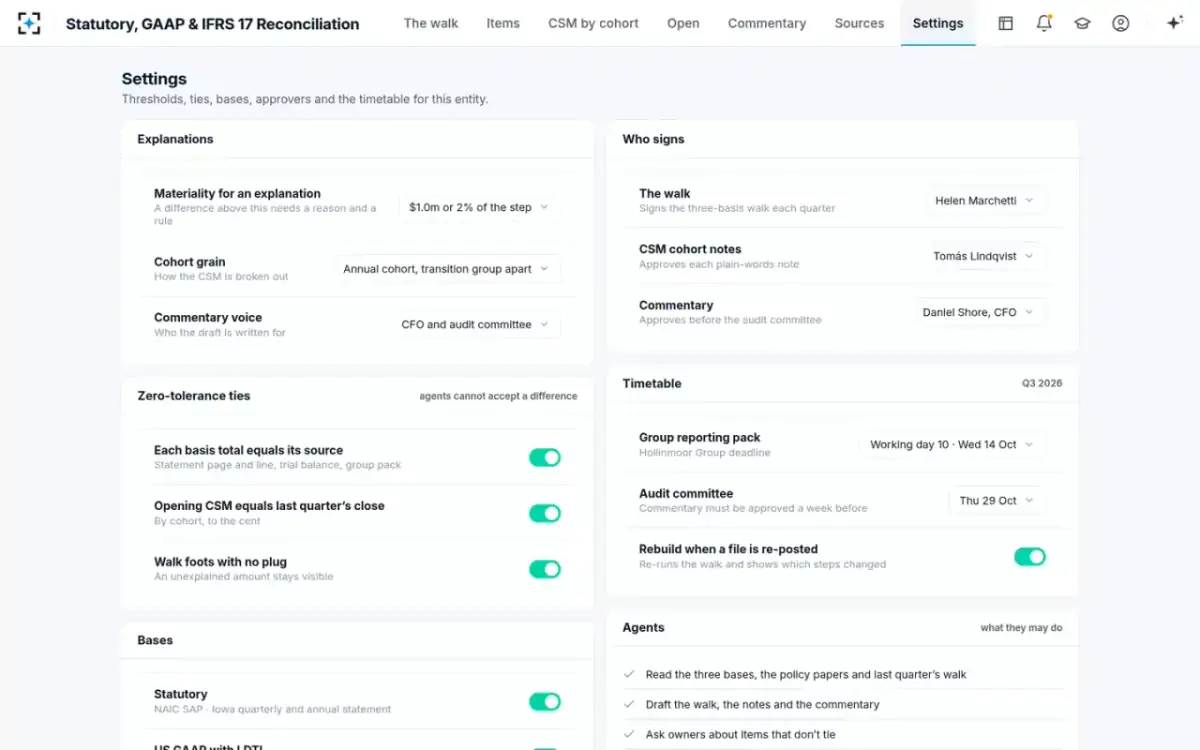
An auditor reviewing automated IFRS 17 reporting will ask three questions: can the automation change a number, can it hide a difference, and can you show what it did. The answers should be no, no and yes, and they should be settings rather than promises. In the solution, the agents are read-only on every source; three ties are zero-tolerance by default (each basis total equals its source, the opening margin equals last quarter's close by cohort, the walk foots with no plug); and each agent step, owner reply and approval is kept with who did it and when.
Thresholds, zero-tolerance ties and who signs are settings for each entity
What to ask before you buy IFRS 17 automation
Most products sold as IFRS 17 automation are measurement engines, disclosure generators or data pipelines; few explain. Before buying, ask questions that separate the categories, and be clear about which problem you have. Statutory, GAAP & IFRS 17 Reconciliation does not measure contracts or replace your engine: it reads the engine's output. It fits an insurer whose numbers are right but whose explanation, across bases and cohorts, takes days. IFRS 17 software: engine, suite or an explanation layer compares the three options on cost.
Questions that separate IFRS 17 automation that explains from automation that calculates
- Does it read our engine's output as it is, or does it need its own data model?
An explanation layer should sit on the results you already sign, not ask you to re-run them.
- Can it show, for every figure in a draft, the row it came from?
A sentence without a source is a sentence an auditor will have to re-perform.
- What can it never do?
Post entries, change assumptions, accept a difference on a zero-tolerance tie: these should be hard limits, not permissions an administrator can grant.
- Does it tie IFRS 17 to statutory and US GAAP, or only to itself?
For a US subsidiary the hardest questions are between bases: why IFRS 17 equity is lower than GAAP equity.
- Who approves each explanation, and is the approval kept?
Paragraph 117 makes judgements disclosable; the approver of each judgement should be on file.
- Can we test it on a quarter we have already closed?
The honest test is last quarter: count the items it explained without help.
That pilot is the subject of IFRS 17 implementation support: test it on last quarter first. It is the fastest way to find out whether a product explains your quarter or only describes its own features.
Questions people ask
What is IFRS 17 automation?
It is software that removes manual steps from IFRS 17 reporting. The term covers three different things: actuarial engines that measure groups of contracts, tools that build the disclosure tables, and agents that read the results and explain them. The IASB expected building the first two to be the main implementation cost before the standard took effect on 1 January 2023; the third addresses the analysis it expected to remain afterwards.
Which IFRS 17 tasks are the hardest to automate?
The judgements: whether a change in estimates relates to future service, how coverage units are set, how transition was applied. ESMA found that only 38% of the 16 insurers it reviewed explained how coverage periods were determined, and that judgement disclosures were often boilerplate. Those calls should stay with people; automation can gather the evidence for them.
How long does IFRS 17 reporting take each quarter?
No regulator or standard-setter publishes a benchmark. Botminds estimates about 4.75 working days for a mid-sized life and annuity writer to get from the last basis landing to an explained three-basis walk by spreadsheet, and the solution's design target is one day; measure your own quarter before comparing.
Who signs IFRS 17 disclosures?
The financial statements are approved by the entity's board under the reporting rules that apply to it; inside the company, the reporting lead owns the disclosures and the valuation actuary owns the measurements behind them. In the solution, the head of financial reporting signs the walk, the valuation actuary approves each cohort note and the CFO approves the commentary.
Does AI used in IFRS 17 reporting need to be governed?
Yes. US actuaries treat a generative AI tool as a model under ASOP No. 56, which requires validating its output, and EIOPA makes the actuarial function responsible for controls on AI in its area. For US insurers, state regulators' AI guidance also applies; AI Governance & Model Inventory covers the NAIC's model bulletin.