Nonadmitted assets are assets that an insurer owns and carries in its books but that statutory accounting does not allow it to count when measuring its financial condition, because they could not readily be used to pay policyholders' claims. Office furniture, prepaid expenses, advances to officers, premiums long overdue and the part of a deferred tax asset above a statutory limit are typical. They are deducted from surplus on the statutory balance sheet, and they are the clearest single expression of statutory accounting's purpose: a regulator counts only what could pay claims. US GAAP has no such concept, so every nonadmitted asset is added back on the way from statutory surplus to GAAP equity. Botminds' Statutory, GAAP & IFRS 17 Reconciliation explains that step every quarter, item by item, from the statutory statement and the general ledger accounts behind it.
The sample figures on this page come from a fictional life and annuity insurer as its third quarter of 2026 runs through the solution; the rules are quoted from the NAIC and from Florida, New York and Texas law.
What are nonadmitted assets?
The NAIC defines them as "assets having economic value other than those which can be used to fulfill policyholder obligations, or those assets which are unavailable due to encumbrances or other third party interests and should not be recognized on the balance sheet" (NAIC glossary). Admitted assets, by contrast, are "insurer assets which can be valued and included on the balance sheet to determine financial viability of the company".
The distinction comes from the second of statutory accounting's three concepts. Under recognition, in the NAIC's words, "Only assets that are available to pay policyholder obligations should be included. Assets that cannot readily be used to pay current or future claims are excluded from the balance sheet and instead reduce surplus" (NAIC, Statutory Accounting Principles). The asset is not written off: it still exists, it is still owned, and it is shown on the statutory assets page with its nonadmitted amount deducted. Statutory accounting principles, in plain words covers the three concepts together.
One sample insurer's nonadmitted step: most of it is deferred tax
Why are some assets nonadmitted?
They are nonadmitted because statutory surplus is meant to measure what stands between policyholders and loss, and some assets would not help. Furniture cannot be sold for anything like its book value in a liquidation; a prepaid expense is a service already bought, not cash; a premium a year overdue may never be collected; a deferred tax asset is worth something only if the insurer earns taxable profits in future. The NAIC's glossary entry for the capital and surplus requirement makes the link: the requirement is "generally measured as a company's admitted assets minus its liabilities, determined on a statutory accounting basis" (NAIC glossary).
This method tends to be more conservative than the Generally Accepted Accounting Principles used by most businesses.
NAIC glossary, Statutory Accounting
What are examples of nonadmitted assets?
State insurance codes list them, and the lists are remarkably alike. Florida's statute opens: "In addition to assets impliedly excluded by the provisions of s. 625.012, the following expressly shall not be allowed as assets in any determination of the financial condition of an insurer" (Fla. Stat. § 625.031). New York's section on assets not admitted covers the same ground in its own words (N.Y. Ins. Law § 1302).
Common nonadmitted assets, the rule that excludes them, and what GAAP does
| Asset | Statutory rule (examples) | Why it is excluded | Under US GAAP |
|---|---|---|---|
| Prepaid expenses | Florida: "Prepaid and deferred expenses". New York: prepaid or deferred charges for expenses, and commissions paid | A service already paid for cannot pay a claim | Asset until consumed |
| Furniture, fixtures and equipment | Florida: "Furniture, fixtures, furnishings, safes, vehicles, libraries, stationery, literature, and supplies". New York: tangible personal property, fixtures and printed matter | Little value in a liquidation | Asset, depreciated |
| Data processing systems over a cap | Florida admits them only up to 3 percent of capital and surplus, amortized over at most 3 years | Value depends on the business continuing | Asset, depreciated or amortized |
| Advances to officers and staff | Florida and New York: advances other than policy loans, on personal security | Unsecured, and to insiders | Receivable, subject to allowance |
| Intangibles | Florida: "Trade names, patents, agreements not to compete, and other like intangible assets"; New York: trade names and agency plants | No value apart from the business | Recognised where GAAP criteria are met |
| Overdue premiums and agents' balances | Florida admits premiums in course of collection "not more than 3 months past due" | Collection doubtful | Receivable, subject to allowance |
| Deductible recoverables over 90 days | SSAP No. 65: those "greater than ninety days old shall be nonadmitted" | Collection doubtful | Receivable, subject to allowance |
| Deferred tax over the admission limit | SSAP No. 101: the realization criteria for deferred tax assets | Value depends on future taxable profit | Recognised, with a valuation allowance if needed |
Some items become nonadmitted because of how they arise rather than what they are. When an insurer prepays a third-party administrator for claims, the NAIC's 2019 materials describe guidance under which such prepayments "do not reduce the reporting entity's liabilities for unpaid claims/ losses or claims/ loss adjusting expenses, but are recognized as nonadmitted prepaid expenses" (NAIC SAPWG, August 2019). Paying early does not shrink the claim liability, and the payment cannot be counted as an asset either.
When is premium receivable nonadmitted?
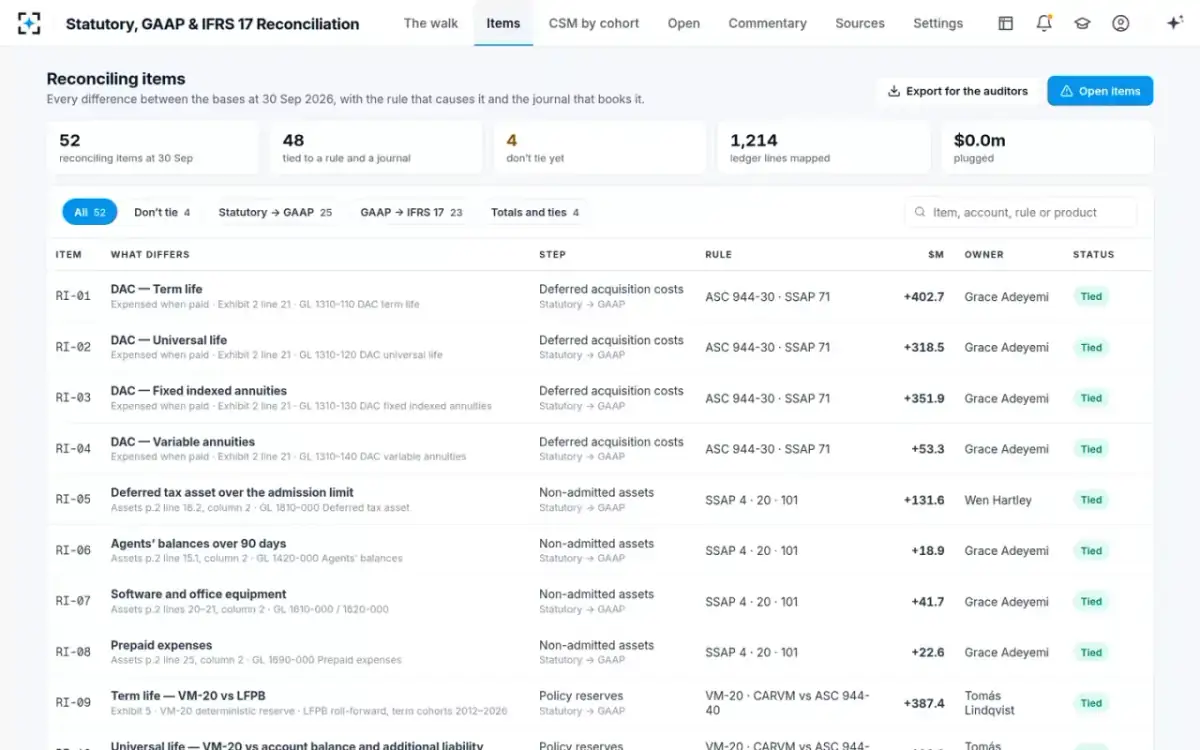
Premium receivable becomes nonadmitted once it is too long overdue. Florida's code admits "Premiums in the course of collection, other than for life insurance, not more than 3 months past due, less commissions payable thereon" (Fla. Stat. § 625.012(5)(a)), and the NAIC's rules apply a similar ninety-day test to uncollected premiums and agents' balances. The sample insurer's step included $18.9 million of agents' balances more than 90 days overdue.
For a property and casualty insurer, overdue premium is often the nonadmitted item that moves most from quarter to quarter, and its timing is a collections question as much as an accounting one. How the ninety-day rule works, and what it costs in surplus, is covered in non-admitted premium receivable.
How do nonadmitted assets affect surplus?
Nonadmitted assets reduce statutory surplus dollar for dollar: the asset stays on the books, but its nonadmitted amount is deducted from the assets that count. New York's statute puts the mechanics in law: nonadmitted assets and "all other assets of doubtful value or character" shall "be reported, to the extent of the value disallowed, as deductions from the gross assets of such insurer" (N.Y. Ins. Law § 1302(b)). Because the deduction runs through surplus rather than income, an increase in nonadmitted assets lowers surplus without touching statutory net income.
That makes the quarter-to-quarter change in nonadmitted assets a line to watch. A rise in overdue agents' balances, or a deferred tax asset that outgrows the admission limit as surplus falls, can reduce surplus in a quarter when operating results look normal. For an analyst reading an insurer's statement, the nonadmitted column is where the gap between economic value and claims-paying value is shown.
The nonadmitted step in the walk from statutory surplus to GAAP equity

Are nonadmitted assets on the GAAP balance sheet?
Yes. GAAP has no admission test, so assets that statutory accounting nonadmits generally appear on the GAAP balance sheet, measured under GAAP's own rules: equipment depreciated, receivables net of an allowance for credit losses, deferred tax assets reduced by a valuation allowance only where GAAP's realization test requires it. That is why the nonadmitted line is added back in every stat to GAAP walk, and why it is usually one of the first lines after acquisition costs. Stat to GAAP adjustments, line by line shows where it sits among the others.
The deferred tax line shows the two bases' logic most clearly. Statutory accounting adopts the FASB's income-tax standard "with modifications for state income taxes", "the realization criteria for deferred tax assets, and the recording of the impact of changes in deferred tax balances" under SSAP No. 101 (NAIC SAPWG, March 2023), and the excess over the admitted amount is nonadmitted. In the sample quarter that excess, $131.6 million, was the largest nonadmitted item, and the whole of it came back under GAAP.
Each nonadmitted item tied to its statutory line and its account
How a cap turns part of an asset into a nonadmitted one
Some assets are not wholly in or out: a cap admits part and nonadmits the rest, and the cap is usually a percentage of surplus. Florida's code admits data processing systems costing at least $25,000, amortized over no more than three years, but "The aggregate amount admitted under this subsection shall be limited to 3 percent of the insurer's capital and surplus, adjusted to exclude any electronic data processing equipment and operating software, net deferred tax assets, and net positive goodwill, as reported on the insurer's most recently filed annual statement" (Fla. Stat. § 625.012(11)).
The arithmetic is simple but easy to get wrong, because the base is adjusted surplus, not reported surplus. Take an illustrative insurer with $500 million of capital and surplus in its last annual statement, of which $40 million is net deferred tax assets and $10 million is data processing equipment. Adjusted surplus is $450 million, so the cap is $13.5 million; if its systems are carried at $25 million, $11.5 million is nonadmitted. The cap also moves with surplus: a weak year that lowers surplus lowers the cap, and more of the same asset becomes nonadmitted without anything happening to the asset itself.
Deferred tax works the same way in principle under SSAP No. 101, which is why the deferred tax line is often the largest and the most volatile nonadmitted item. In a walk between bases, both parts of a capped asset need explaining: the admitted part, which is in statutory surplus, and the nonadmitted part, which returns under GAAP. In the sample insurer's walk the two appear in different steps, the nonadmitted excess in the nonadmitted step and the rest in the deferred tax step.
Do states treat nonadmitted assets the same way?
Mostly, but not entirely, because admission is set by each state's law within the NAIC's framework. The NAIC's manual "does not override state laws", and a state's prescribed practices apply to every insurer domiciled there (NAIC). When Texas adopted the NAIC manual in 2000, it said so directly: "If an item is not admitted as an asset by the Insurance Code or by rule, it is still not admitted even if the Manual indicates otherwise" (Texas Department of Insurance, 2000).
Office equipment and systems in two states' rules
Florida (current statute): Expressly not allowed as assets.
Texas (2000 adoption rule): Furniture and office equipment "may be admitted as an asset as permitted by Texas Insurance Code" where the code allowed it.
Florida (current statute): Admitted up to 3 percent of capital and surplus, amortized over at most 3 calendar years.
Texas (2000 adoption rule): Electronic machines and operating systems software "may be an admitted asset" as the code permitted.
Florida (current statute): State statute governs admission.
Texas (2000 adoption rule): "Texas law and regulations prevail."
Can nonadmitted assets become admitted?
Yes, when the reason for nonadmitting them goes away. An overdue premium that is collected stops being a nonadmitted receivable; a deferred tax asset can become admissible when the conditions of the statutory admission test change; equipment within a state's cap is admitted again once the cap allows. A regulator can also permit an asset: Florida admits "Other assets, not inconsistent with the provisions of this section, deemed by the office to be available for the payment of losses and claims, at values to be determined by it" (Fla. Stat. § 625.012(17)).
What does not happen is a change of mind about the same asset in the same condition. Because admission follows rules and state law rather than management's view of value, the explanation of a nonadmitted balance should always name the rule, and the explanation of a change should name the event. In the solution each nonadmitted item carries both, so the quarter's change in the step can be explained item by item.
Questions people ask
What is the difference between admitted and nonadmitted assets?
Admitted assets count toward statutory surplus; nonadmitted assets do not. The NAIC defines admitted assets as those "which can be valued and included on the balance sheet to determine financial viability of the company", and nonadmitted assets as those other than ones that can be used to fulfil policyholder obligations, or that are encumbered.
Is a nonadmitted asset the same as a nonadmitted insurer?
No. A nonadmitted insurer, in the NAIC's glossary, is an "insurance company not licensed to do business within a given state", such as a surplus lines carrier. A nonadmitted asset is an accounting term for an asset that does not count in statutory surplus; the two share only the word.
Are nonadmitted assets written off?
No. The asset stays in the insurer's books and on the statutory assets page, with the nonadmitted amount shown and deducted from the assets that count. If it later becomes admissible, or is collected, the deduction reverses through surplus.
Where are nonadmitted assets reported?
On the statutory assets page, where each line shows the asset, the nonadmitted portion and the net admitted amount, with the nonadmitted amounts deducted in arriving at admitted assets. The sample insurer's four items are read from column 2 of that page, line by line.
Why is a deferred tax asset partly nonadmitted?
Because SSAP No. 101 limits how much of a net deferred tax asset can count toward surplus, through its realization criteria and admission test. Only the admitted portion counts; the rest is nonadmitted, and in the sample it was the largest nonadmitted item at $131.6 million.