A non-admitted premium receivable is premium an insurer is owed but may not count as an asset on its statutory balance sheet, most often because it is more than 90 days due. Under the NAIC's statutory accounting (SSAP No. 6), uncollected premium over ninety days due is nonadmitted to the extent no related unearned premium offsets it, a receivable from an agent over ninety days due is nonadmitted in full, and an installment over ninety days due takes every later installment already booked on the policy with it. The amount is charged straight to surplus, and collecting it the week after quarter-end does not restore it. That makes the 90-day rule a reconciliation problem as much as a collections problem: cash that has arrived but sits unapplied, or an agency statement nobody has matched, ages exactly like premium nobody paid. Botminds' Premium & Claims Reconciliation finds those balances at every close and drafts the entries that apply them.
The examples come from a fictional sample insurer, Larkspur Mutual Insurance Group, at its third-quarter 2026 close in the solution, plus clearly marked illustrations of our own. The rules come from the NAIC's statutory accounting papers and interpretations and from state examination reports, linked where they appear.
The same overdue premium, three ways: how much the 90-day rule takes
Direct-billed annual policy, $12,000, 120 days due, $8,000 still unearned
- Admitted: covered by unearned premium · 67%
- Nonadmitted · 33%
Same policy, billed through an agent
- Nonadmitted in full, regardless of unearned premium · 100%
Monthly installments, $40,000 in course of collection, first one over 90 days
- Nonadmitted in full: the overdue installment and every later one booked · 100%
What is a non-admitted premium receivable?
A non-admitted premium receivable is a premium balance that statutory accounting removes from admitted assets, so it does not support the insurer's surplus or its capital ratios, even though it remains on the books and may well be collected. Statutory accounting exists to show what is available to pay policyholders, and it treats an overdue receivable as unavailable.
The NAIC set out the reasoning when it codified the rule. Issue Paper No. 10, the paper behind SSAP No. 6's treatment of uncollected premium, explains that a receivable should reflect "only amounts that are available to meet both current and future policyholder obligations when the obligations are due" (NAIC Issue Paper No. 10, 1998).
"Under the conservatism concept of statutory accounting, uncollected premiums over ninety days due, even if they are determined to be collectible, should be nonadmitted and charged to surplus."
NAIC Statutory Issue Paper No. 10, Uncollected Premium Balances (1998)
Nonadmission is separate from impairment. A receivable that is probably uncollectible is written off against operations whatever its age; a receivable that is merely over 90 days due is nonadmitted even if the policyholder pays next week. The first is a judgment about collection; the second is a calendar.
What is the 90-day rule for premium receivables?
The 90-day rule says uncollected premium, amounts due from agents and brokers, and installment premiums become nonadmitted assets once they are more than ninety days due. It is written in SSAP No. 6, paragraph 9, and its three parts treat the three kinds of receivable differently, which is why the Split above shows three different answers for the same overdue policy.
For direct-billed premium the nonadmission applies only to the part of the overdue balance that no related unearned premium covers, because the unearned premium reserve on the same policy would fall away if it were cancelled for nonpayment. For agents' balances it applies regardless of any offsetting unearned premium. For installments, Florida's insurance regulator quoted the rule when it examined a property insurer's 2008 quarterly statement: "if an installment premium is over ninety days due, the amount over ninety days due plus all future installments that have been recorded on that policy shall be nonadmitted." The insurer had nonadmitted only the overdue piece, and the examiners found nonadmitted premiums understated by $57,242 (Florida OIR, Royal Palm Insurance Company, 2008).
The rule is not the only statute in play. Some states write their own admitted-asset limits into the insurance code, and the domiciliary state's law governs where it differs from the NAIC manual. The guide to uncollected premiums and agents' balances shows where each part lands on the annual statement.
When does the 90-day clock start?
The clock starts on the policy's effective date for original and deposit premium, on the endorsement's effective date for endorsement premium, and on the contractual due date for each installment. It does not start on the billing date or on the date the agent's contract says the agent must remit. Issue Paper No. 10 is explicit that the due date for original premium "is governed by the effective date of the underlying insurance contract and not the agent/reporting entity contractual relationship."
That one sentence is where most aging reports go wrong. New York's examiners found an insurer that "used the contractual due date to calculate when premium is overdue for original and endorsement premium instead of the effective date," and that "nonadmitted uncollected premium balances which are over three months instead of over ninety days" (New York Insurance Department, Utica National Assurance Company, 2010). Three calendar months can be 92 days; the rule says ninety.
Take an illustration. A commercial policy is written through an agency effective 1 July, and the agency agreement gives the agency 45 days after month-end to remit, so the agency's payment is due 15 August. On 30 September the premium has not arrived. Measured from the agency's due date it is 46 days late. Measured as the rule requires, from 1 July, it is 91 days due, and at the third-quarter close it is nonadmitted in full.
Does unapplied cash count as collected premium?
Not until it is applied. Cash that arrives without a policy number, or from an agency sweep that nobody has matched to its statement, usually sits in a suspense or unapplied cash account while the policies it pays for stay open in billing and keep aging. On the statement date the receivable is still there, still over or under ninety days, and the cash that would have cleared it is a separate balance. Whether the two can be netted is a matter for the statutory offsetting rules, not for the reconciliation; the safe course is to apply the cash before the quarter closes.
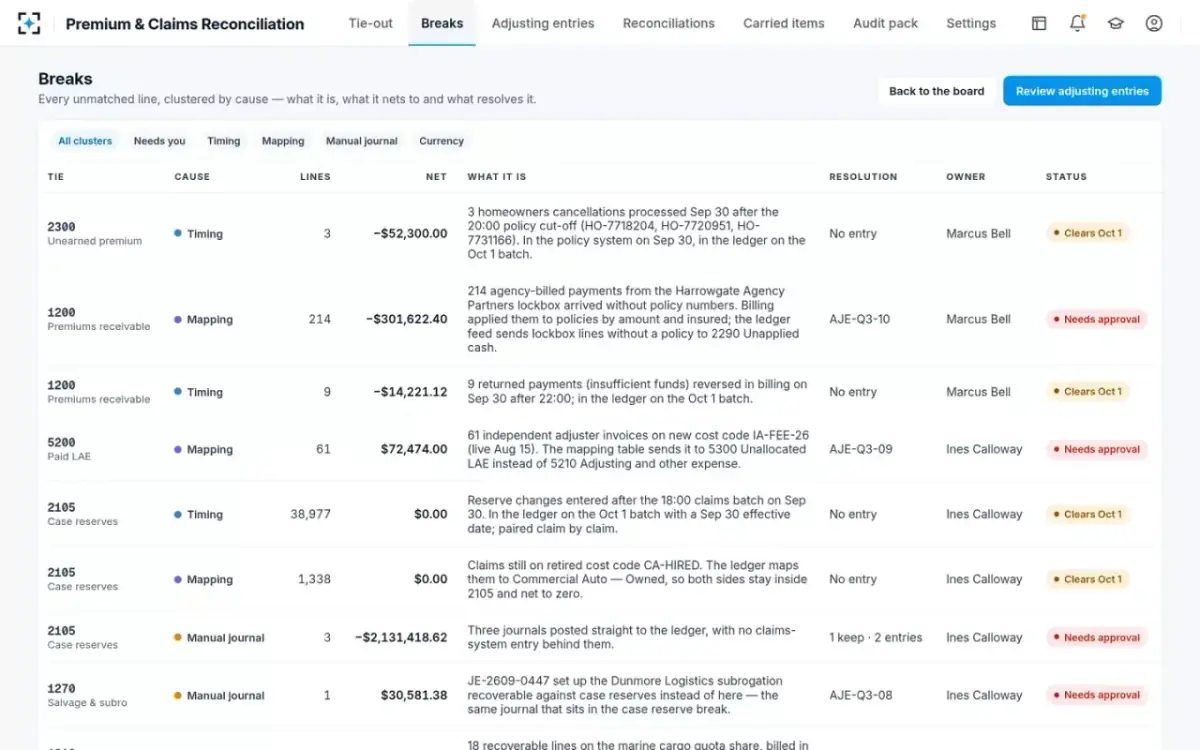
At the sample insurer this was the largest premium break of the quarter. On September 30, 214 agency-billed payments from one agency's lockbox arrived without policy numbers. Billing applied them to policies by amount and insured, but the general ledger feed sent them to unapplied cash, so premiums receivable was out by −$301,622.40 between the two systems. A second, older item was the agency's July sweep, $18,440.00, unapplied for 72 days.
Every break, with what it is and what resolves it
The NAIC also closed the obvious workaround. Issue Paper No. 6 says that amounts due from agents which are paid before the statement date and handed back after it should be treated as a "wash" transaction: the receivable is re-established and aged "using the original due date of the receivable." Short-term financing that exists to avoid the rule is treated the same way (NAIC Issue Paper No. 6, 1998).
How does nonadmitted premium affect surplus? A worked example
Nonadmitted premium reduces surplus dollar for dollar on the statutory statement, because the asset is removed while the related liabilities stay. And because collecting the money after the statement date does not reverse the nonadmission for that date, the cost of a stale balance is paid at the close, not when the cash arrives.
What the same $301,622.40 of unapplied agency cash can cost in surplus
The arithmetic is simple; the timing is not. The sample insurer's premium accountant had the cash in hand on September 30. Had it sat unmatched until the policies passed 90 days, the whole amount, being agency-billed, would have come off surplus at quarter-end, and collecting it in October would have restored it only for the next statement.
How much surplus rests on agents' balances: NAIC's 2025 IRIS ratio
2,647
property and casualty companies in NAIC’s 2025 IRIS ratio results
8%
median agents’ balances to surplus, excluding zero and default values
40%
level at which NAIC treats the ratio as unusual
Has the NAIC ever extended the 90-day rule?
Yes, a handful of times, each for a named catastrophe and only for a limited period. The NAIC's Statutory Accounting Principles Working Group has granted 60-day extensions for regionally significant catastrophes and a longer one for COVID-19, and each was temporary and optional (NAIC INT 20-02).
Every NAIC extension of the 90-day rule listed in INT 20-02
| Interpretation | Event | What it allowed |
|---|---|---|
| INT 05-04 | Hurricanes Katrina, Rita and Wilma | A 60-day extension |
| INT 13-01 | Hurricane / Superstorm Sandy | A 60-day extension |
| INT 17-01 | Hurricanes Harvey, Irma and Maria | A 60-day extension |
| INT 18-04 | Hurricanes Florence and Michael | A 60-day extension |
| INT 20-02 | COVID-19 | A one-time optional extension for the first and second quarter 2020 statements, later extended to the third quarter; it expired before the year-end 2020 statements |
The COVID interpretation describes itself as "a one-time optional extension of the ninety-day rule for uncollected premium balances, bills receivable for premiums and amounts due from agents and policyholders." The pattern matters for planning: extensions follow disasters, they are short, and none has changed how the clock is measured. An insurer cannot count on one to rescue a receivable that went stale because of unapplied cash.
How to age premium receivables so the statement is right
Age premium receivables policy by policy, from the due date the rule prescribes, after applying all cash received, with agents' balances and direct-billed balances kept apart. An aging that starts from invoice dates, nets cash at the agency level, or treats a quarter as three months will produce a nonadmitted figure that an examiner can recompute differently.
- Apply the cash first. Clear unapplied and suspense cash to policies before running the aging, or the aging overstates what is overdue.
- Use the prescribed due date. Effective date for original premium and endorsements; contractual due date for each installment.
- Count days, not months. Over ninety days due is over ninety days.
- Split the billing routes. Agency-billed balances are nonadmitted regardless of unearned premium; direct-billed only to the extent unearned premium does not cover them.
- Pull in later installments. When one installment passes ninety days, every later installment already booked on that policy follows it.
- Reconcile the aging to the general ledger. The aged total must equal the receivable account, or the nonadmitted figure rests on a different number from the balance sheet.
The last step is the reconciliation, and it is the one most often skipped. The guide to the general ledger reconciliation process shows what happens when the subsidiary detail and the filed statement are not tied.
What the over-90 balance costs, and the days that drive it
The over-90 balance costs whatever surplus it removes at each statement date, and the days that drive it are mostly inside the insurer's own close. No public source measures how long insurers take to apply cash or clear agency exceptions, so the planning question is internal: how many of the ninety days are spent before anyone looks at a balance?
Count them for one agency-billed policy. If agency statements arrive a few weeks after month-end, exceptions are worked in the following close, and unmatched cash waits for the quarter-end push, a policy can be sixty or seventy days into its ninety before a person first sees it. The sample insurer's settings put a hard line under that: every carried reconciling item is aged at each close, and anything over 60 days escalates to its owner and the controller, which leaves thirty days to act before the statutory line.
Carried items aged by band, and the receivables past 90 days
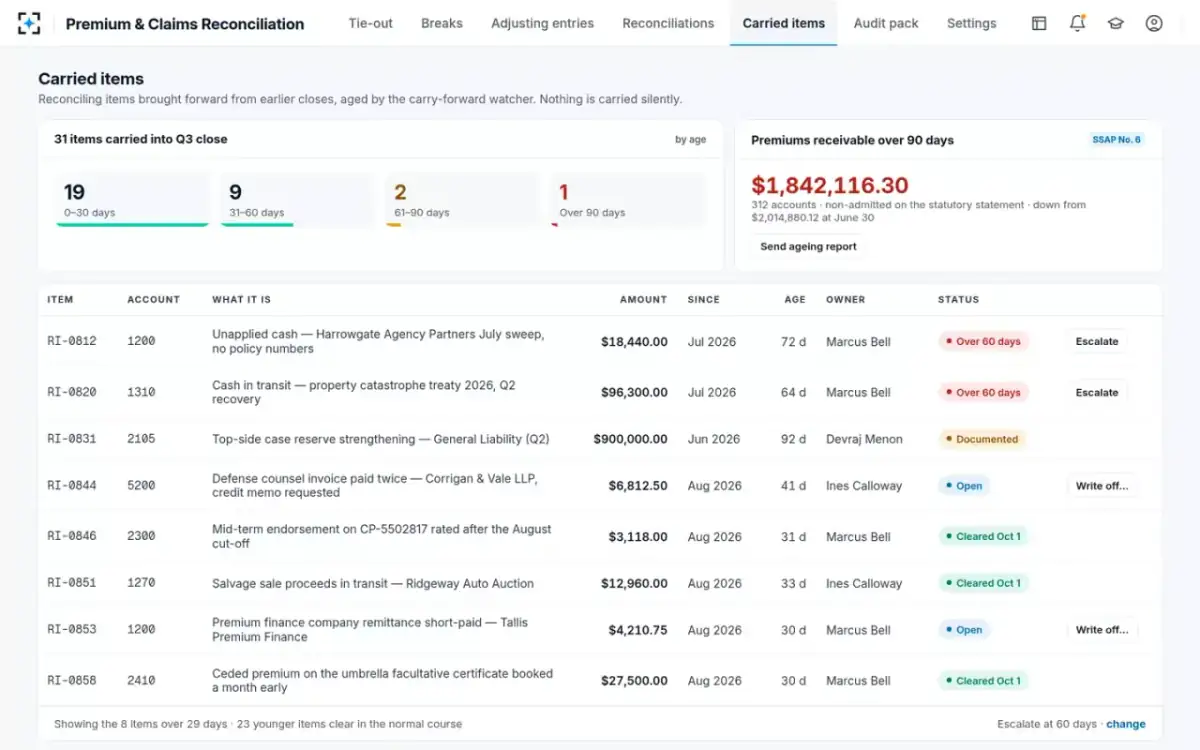
At the sample insurer, premiums receivable more than 90 days past due stood at $1,842,116.30 across 312 accounts at September 30, down from $2,014,880.12 at June 30. The solution reports that balance for the statutory statement; how much of it is nonadmitted depends on the billing route and unearned premium of each policy, by the rules above. To see the aging, the escalation and the drafted entries in one close, start from Premium & Claims Reconciliation.
Questions people ask
What is SSAP 6?
SSAP No. 6 is the NAIC statement of statutory accounting principles for uncollected premium balances, bills receivable for premiums, and amounts due from agents and brokers. It sets the 90-day nonadmission rule, the due-date rules and the write-off of uncollectible balances. It sits in the NAIC's Accounting Practices and Procedures Manual, which states adopt with their own prescribed or permitted variations.
Does collecting the premium after quarter-end reverse the nonadmission?
No, not for that statement. The NAIC's issue papers say amounts nonadmitted at the statement date and collected afterwards should not be used to adjust the nonadmitted asset; the recovery is recognised in the period the cash is received. Collection helps the next statement, not the one being closed.
Is a nonadmitted receivable written off?
No. Nonadmission removes it from admitted assets and surplus but leaves it on the books and in collection. A write-off is a separate step taken when collection is probably not going to happen, and it runs through operations rather than directly through surplus.
Do audit premiums and retrospective premiums follow the same clock?
Their due dates come from the policy or contract. Under Issue Paper No. 10, if the policy does not say when an audit premium is due, any uncollected audit premium, whether billed or only accrued, is nonadmitted. Earned but unbilled premium has its own treatment under the premium standard.
How does the 90-day rule show up in IRIS ratios?
IRIS ratio 10 compares agents' balances in course of collection with policyholders' surplus, and the NAIC treats 40% or more as unusual. In the 2025 results the median was 8% once zero and default values are excluded. A rising ratio is a prompt to look at aging and cash application before an analyst does.